PHR Practice Questions & Answers,
100% Accurate, rated A+
80/20 rule - ✔✔-80 percent of problems are caused by 20 percent causes. Pareto chart.
LMRDA (Labor Management Reporting and Disclosure Act) - ✔✔-Taft Hartley
...
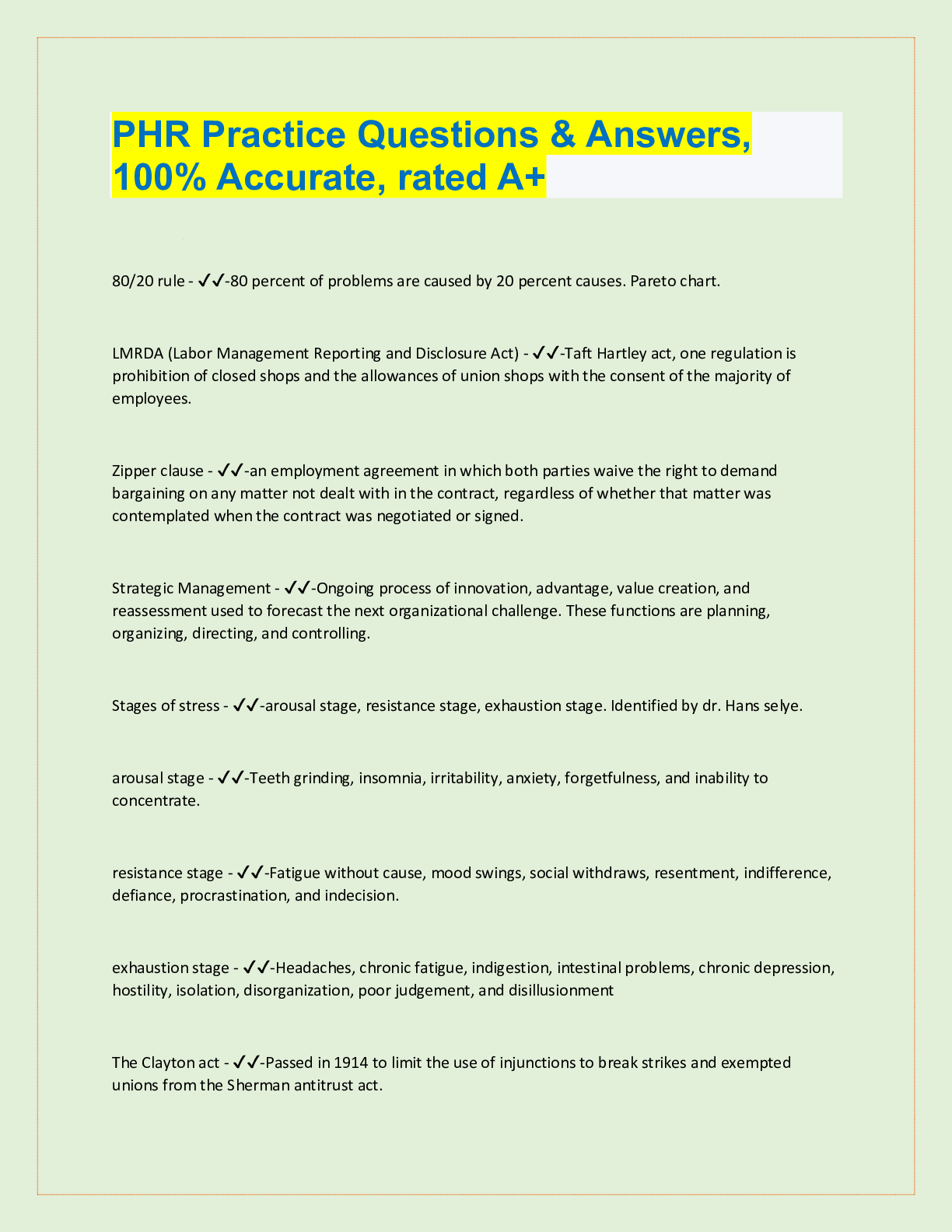
PHR Practice Questions & Answers,
100% Accurate, rated A+
80/20 rule - ✔✔-80 percent of problems are caused by 20 percent causes. Pareto chart.
LMRDA (Labor Management Reporting and Disclosure Act) - ✔✔-Taft Hartley act, one regulation is
prohibition of closed shops and the allowances of union shops with the consent of the majority of
employees.
Zipper clause - ✔✔-an employment agreement in which both parties waive the right to demand
bargaining on any matter not dealt with in the contract, regardless of whether that matter was
contemplated when the contract was negotiated or signed.
Strategic Management - ✔✔-Ongoing process of innovation, advantage, value creation, and
reassessment used to forecast the next organizational challenge. These functions are planning,
organizing, directing, and controlling.
Stages of stress - ✔✔-arousal stage, resistance stage, exhaustion stage. Identified by dr. Hans selye.
arousal stage - ✔✔-Teeth grinding, insomnia, irritability, anxiety, forgetfulness, and inability to
concentrate.
resistance stage - ✔✔-Fatigue without cause, mood swings, social withdraws, resentment, indifference,
defiance, procrastination, and indecision.
exhaustion stage - ✔✔-Headaches, chronic fatigue, indigestion, intestinal problems, chronic depression,
hostility, isolation, disorganization, poor judgement, and disillusionment
The Clayton act - ✔✔-Passed in 1914 to limit the use of injunctions to break strikes and exempted
unions from the Sherman antitrust act.
Sherman Antitrust Act - ✔✔-an 1890 law that banned the formation of trusts and monopolies in the
United States.
HR audit - ✔✔-is a comprehensive method (or means) to review current human resources policies,
procedures, documentation and systems to identify needs for improvement and enhancement of the HR
function as well as to assess compliance with ever-changing rules and regulations.
What is the most important consideration in workforce planning and employment? - ✔✔-The legal and
regulatory environment
Title VII of the Civil Rights Act of 1964 was amended three times to clarify and expand its coverage. -
✔✔-Equal Employment Opportunity Act of 1972, Pregnancy Discrimination Act of 1978 and Americans
with Disabilities Act of 1990
The process of attempting to retain the knowledge of workers is known as what? - ✔✔-Knowledge
management
ADDIE model - ✔✔-Analysis
Design
Development
Implementation
Evaluation
Which of the following is the correct sequence of instructional design? - ✔✔-(ADDIE) Analysis, design,
development, implementation, evaluation. The ADDIE model is used to describe the process of
instructional design. It focuses on first identifying the gap between desired and actual behavior,
designing and developing programs to bridge that gap, implementing the training program, and then
evaluating the effectiveness of the training.
pay equity - ✔✔-defined by what the employee brings to the job (inputs) and what they receive as
rewards (outcomes). Degree of secrecy, how wages are set, and the process for determining value are
all elements of organizational justice.
yellow dog contract - ✔✔-an agreement some companies forced workers to take that forbade them
from joining a union. This was a method used to limit the power of unions, thus hampering their
development. Outlawed in 1932 by the Norris-LaGuardia Act.
Petermann v. International Brotherhood of Teamsters - ✔✔-
Workers' compensation, unemployment, and medical benefits are all calculated using which of the
following modifiers? - ✔✔-The loss experience, or experience modifier is used to modify or recalculate
the rate of insurance an employer must pay. An employer's insurance premium is based on the amount
of use, similar to car insurance. The more claims an employer has, the more expensive it is to purchase
the insurance.
Older Worker Benefits Protection Act (OWBPA) - ✔✔-amended the Age Discrimination in Employment
Act.
Which of the following acts was an amendment to the Employee Retirement Income Security Act
(ERISA)? - ✔✔-There have been a number of amendments to ERISA, typically expanding the protection
for health benefit plan participants and beneficiaries. These amendments include the Consolidated
Omnibus Budget Reconciliation Act (COBRA), the Health Insurance Portability and Accountability Act
(HIPAA), and the Mental Health Parity Act (MHPA).
learning organization - ✔✔-Peter Senge pioneered the concept. It incorporates the concept of lifelong
learning using five disciplines: systems thinking, personal mastery, mental models, building a shared
vision, and team learning.
Cliff Vesting - ✔✔-Requires participants to complete a specific number of years of service with an
employer before they get any vested benefits, after which they are 100% vested.
Alternative Dispute Resolution (ADR) - ✔✔-The resolution of disputes in ways other than those involved
in the traditional judicial process. Negotiation, mediation, and arbitration are forms of ADR. Without
litigation.
Foreign Corrupt Practices Act (1977) - ✔✔-a law that makes it a crime for U.S. corporations to bribe an
official of a foreign government or political party to obtain or retain business
Burlington Industries, Inc. v. Ellerth - ✔✔-Employers are liable if supervisors create a hostile work
environment for employees.
Vicarious Liability - ✔✔-Legal doctrine under which a party can be held liable for the wrongful actions of
another party.
Respondeat Superior - ✔✔-"Let the master answer" an employer is vicariously liable for the behavior of
an employee working within his or her scope of emplo
[Show More]


, 6e Ibraiz Tarique, Dennis Briscoe, Randall Schuler.png)
.png)

.png)
.png)