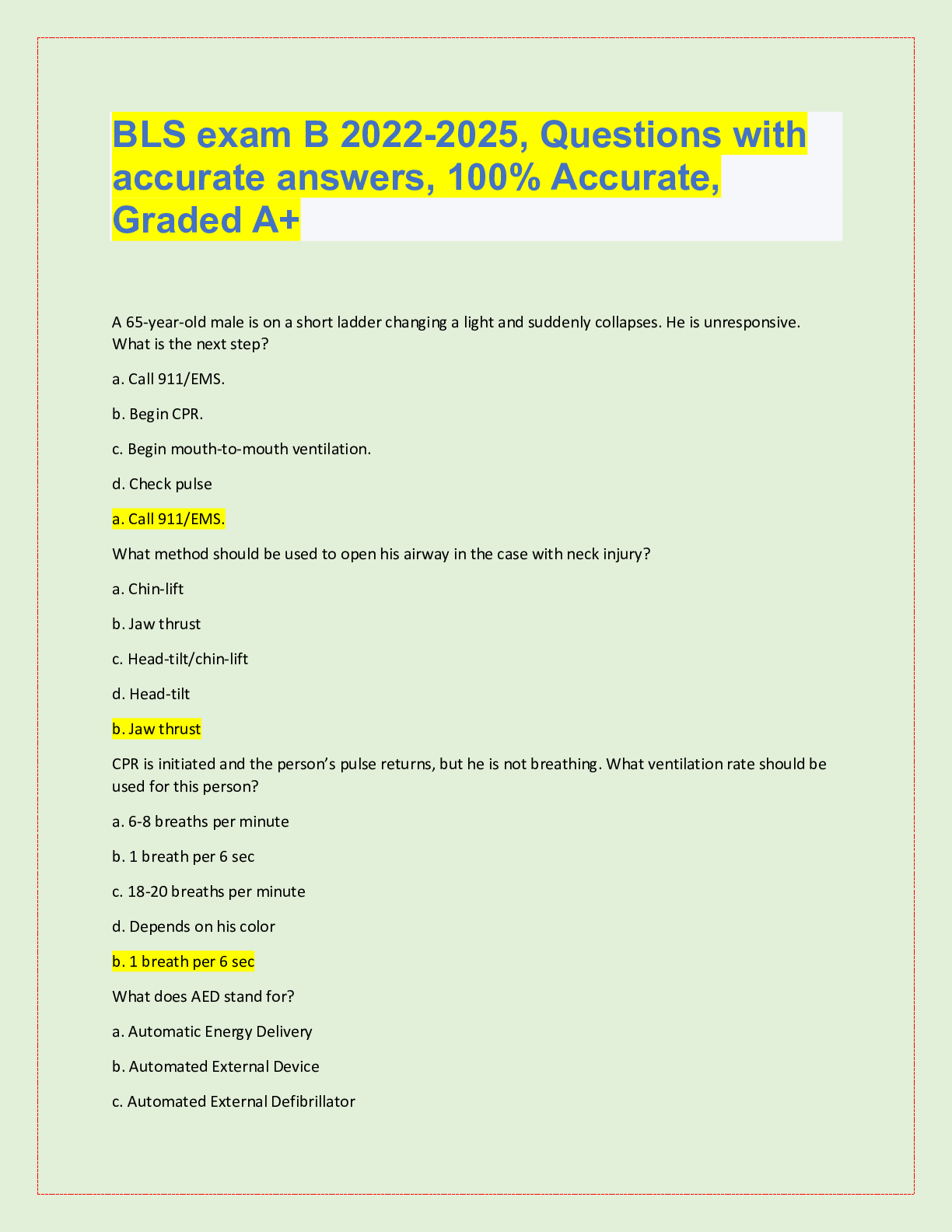
SHRM-CP Practice Test Questions &
Answers. 100% Accurate, Graded A+
A small start-up software company realizes that the technology skillsets of newly hired programmers are
more advanced than the existing programmers
...
SHRM-CP Practice Test Questions &
Answers. 100% Accurate, Graded A+
A small start-up software company realizes that the technology skillsets of newly hired programmers are
more advanced than the existing programmers' skillsets. Recognizing the constant business need for
these evolving, state-of-the-art skillsets, which is the best workforce development strategy to
implement?
A. Partner with a local community college to offer programmers the opportunity to update their
skillsets.
B. Offer new hires shorter-term contracts to allow for a continual hiring of programmers with the most
up-to-date skills.
C. Design a rigorous in-house training program to get longer-tenured programmers up to speed with the
newer programmers.
D. Perform a job redesign for the existing employees that will not require new, updated skills. - ✔✔-B.
Offer new hires short-term contracts to allow for a continual hiring of programers with the most up-to�date skills.
Rationale: If the skillsets of employees who have been with the company for several years become
inferior to those of new hires, planning for churn by offering smaller contracts is a better strategy.
Repeatedly training an entire staff with new skills that they may or may not grasp will not be cost�effective to the organization, and there may not be enough work at the company to support a job
redesign.
Which hands-on training method best allows an onboarding manufacturing employee to practice his job
in a risk-free setting?*
A. Apprenticeship
B. Simulation
C. Team Training
D. Role Play - ✔✔-B. Simulation
Rationale: Simulations can be used to teach production and process skills in a risk-free environment. A
role play is best used to assess and train interpersonal skills. Apprenticeship is a type of on-the-job
training where the trainee will still be exposed to risk. Team training is used to improve the effectiveness
of group interactions.
An HR manager has been asked to design a training program for the company. Which HR metric should
be considered first in designing the program?*
A. Average tenure of employees
B. Percentage of employees with a career plan
C. Total costs for training
D. Performance quality of one-year employees - ✔✔-C. Total costs for training
Rationale: Total cost for training is the only metric that is specific to all training programs, so it must be
considered in the initial stages of all program development. Response options A, B, and C are factors
that may or may not be considered for some training programs.
A valued employee arrives 15 minutes late for work without explanation. Using the company's positive
approach to discipline, which action should be taken to course-correct the employee's tardiness?*
A. Final warning
B. Written reprimand
C. Verbal caution
D. Counseling - ✔✔-D. Counseling
Rationale: Positive approach to discipline builds on the theory that violations are actions that usually can
be corrected constructively without penalty. Counseling is the first step that does not implement a
penalty. The other options are all examples of penalties.
An HR director believes it is important that managers take more responsibility for performance
appraisals. Which responsibility should the HR director assign specifically to the managers?*
A. Track timely receipt of appraisals
B. Identify development areas
C. Design appraisal system
D. Train staff to use performance system - ✔✔-B. Identify development areas
Rationale: "Identify development areas" is best determined by managers because they know more of
the job specifics. The other options are responsibilities that HR would typically handle.
Which is a significant benefit of recruiting from internal sources?
A. Minimizes inflated expectations about the job
B. Innovation increases with each infusion of new talent
C. Provides a continuous pool of applicants
D. Employees will all be of the existing mindset - ✔✔-A. Minimizes inflated expectations about the job
Rationale: Internal applicants who apply for positions will have a better understanding of what the job
entails because they are more knowledgeable about the company and how it operates. Innovation is not
guaranteed from new talent. Employees with the same mindset can be hesitant to suggest change.
Internal recruiting may not always provide a continuous pool of applicants if current employees are not
interested in applying.
The CEO asked the HR director to support this new staffing need of moving the operation to
headquarters by supplying 70 new jobs. Which is the best action for HR to take first to begin supporting
this initiative?*
A. Identify a recruiting firm to attract talent to fill the new positions.
B. Survey employees to gauge interest in relocating to company headquarters.
C. Review job descriptions and total rewards structure to align them with staffing goals.
D. Identify employees unwilling to relocated so they can convey historical knowledge to new hires. -
✔✔-C. Review job descriptions and total rewards to align them with staffing goals.
Situational judgment test (SJTs) require you, as an examinee, to think about what is occurring in the
scenario and decide which response option identifies the most effective course of action. Other
response options may be something you could do to respond in the situation, but SJTs require thinking
and acting based on the best of the available options. Do not base your answer on your organization's
approach to handling the situation, but rather, answer based on what you know should be done
according to best practice. Panels of SHRM-certified subject matter experts rate the effectiveness of
each response option,
[Show More]


, 6e Ibraiz Tarique, Dennis Briscoe, Randall Schuler.png)
.png)

.png)
.png)