SHRM-CP - PRACTICE EXAM Questions
& Answers, 100% Accurate, rated A+
1) A specialized field which works on engineering the work environment is: A. industrial existentialism.
B. ergonomics. C. environmentalism. D. en
...
SHRM-CP - PRACTICE EXAM Questions
& Answers, 100% Accurate, rated A+
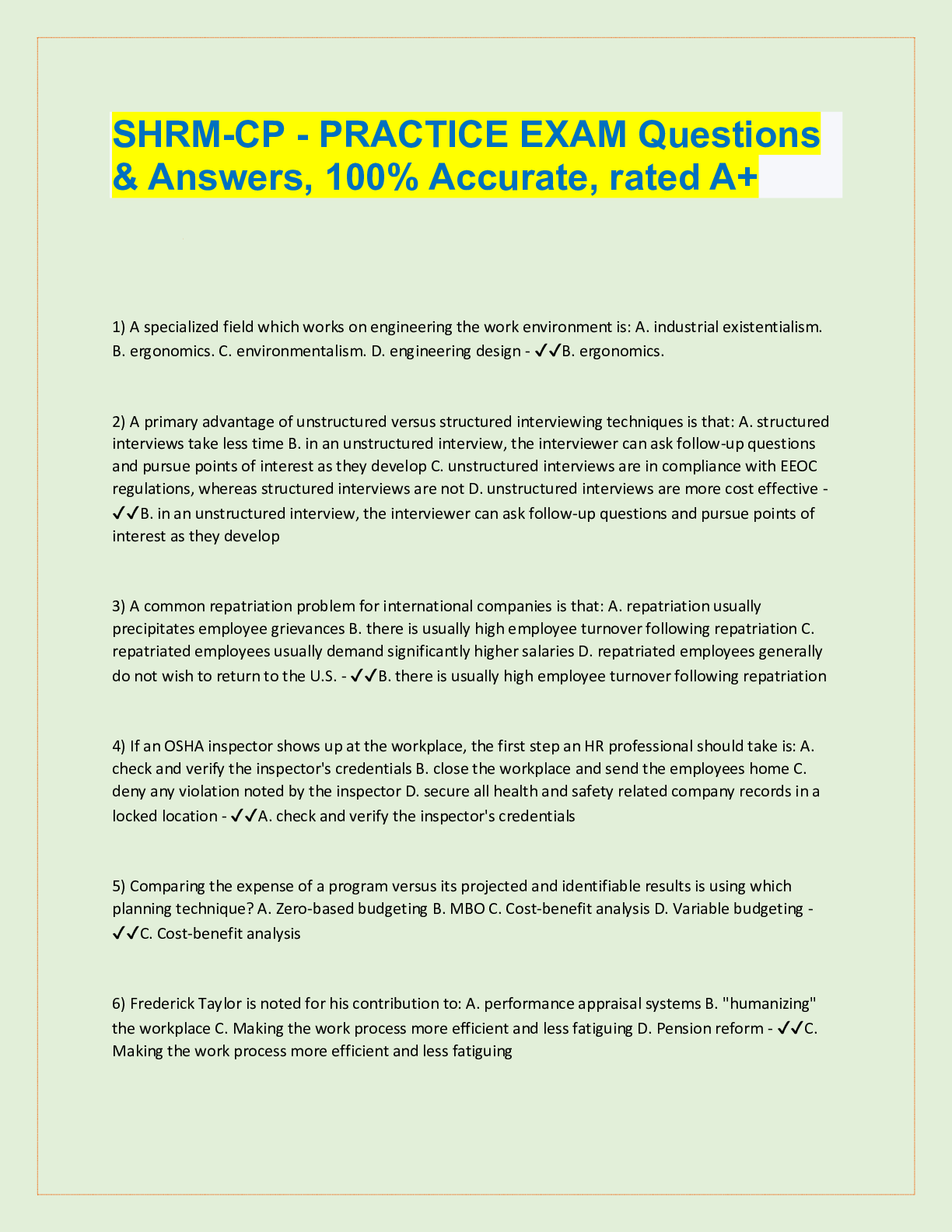
1) A specialized field which works on engineering the work environment is: A. industrial existentialism.
B. ergonomics. C. environmentalism. D. engineering design - ✔✔B. ergonomics.
2) A primary advantage of unstructured versus structured interviewing techniques is that: A. structured
interviews take less time B. in an unstructured interview, the interviewer can ask follow-up questions
and pursue points of interest as they develop C. unstructured interviews are in compliance with EEOC
regulations, whereas structured interviews are not D. unstructured interviews are more cost effective -
✔✔B. in an unstructured interview, the interviewer can ask follow-up questions and pursue points of
interest as they develop
3) A common repatriation problem for international companies is that: A. repatriation usually
precipitates employee grievances B. there is usually high employee turnover following repatriation C.
repatriated employees usually demand significantly higher salaries D. repatriated employees generally
do not wish to return to the U.S. - ✔✔B. there is usually high employee turnover following repatriation
4) If an OSHA inspector shows up at the workplace, the first step an HR professional should take is: A.
check and verify the inspector's credentials B. close the workplace and send the employees home C.
deny any violation noted by the inspector D. secure all health and safety related company records in a
locked location - ✔✔A. check and verify the inspector's credentials
5) Comparing the expense of a program versus its projected and identifiable results is using which
planning technique? A. Zero-based budgeting B. MBO C. Cost-benefit analysis D. Variable budgeting -
✔✔C. Cost-benefit analysis
6) Frederick Taylor is noted for his contribution to: A. performance appraisal systems B. "humanizing"
the workplace C. Making the work process more efficient and less fatiguing D. Pension reform - ✔✔C.
Making the work process more efficient and less fatiguing
7) An HR professional is investigating reasons for job turnover among company employees moving from
one job or department to another. Which data collection method would provide the information
without interdepartmental conflicts? A. Surveys to all employees who have changed positions within the
last year. B. Group interviews with employees and previous supervisors to discuss reasons for job
changes. C. Search through performance appraisal files and personnel records to learn reasons for job
turnover within the company. D. Questionnaires distributed only to employees who have changed
positions - ✔✔C. Search through performance appraisal files and personnel records to learn reasons for
job turnover within the company.
8) Of the following, the weakest tool for predicting an applicant's job performance is the: A. application
form B. proficiency test C. interview D. prior work reference - ✔✔C. interview
9) Keeping a record of all employees and listing significant successes and failures of each describe which
method? A. critical incident B. MBO C. Essay form D. Field review - ✔✔A. critical incident
10) Which of the following pieces of federal legislation is considered pro management? A. Wagner Act B.
National Industrial Recovery Act C. Railway Recovery Act D. Taft-Hartley Act - ✔✔D. Taft-Hartley Act
11) The most important element in defending an organization's position in a disciplinary action is to
demonstrate that: A. the employee has been warned B. the employee knew the rules before the
infraction C. an example was needed to eliminate or reduce similar misbehavior D. progressive discipline
has been applied consistent with policy and past practice - ✔✔D. progressive discipline has been applied
consistent with policy and past practice
12) Which of the following would be considered nontaxable indirect compensation? A. Employee
discounts on employer goods or services B. Employer-paid group-term life insurance over $50,000 C.
Personal use of a company car D. Severance pay - ✔✔A. Employee discounts on employer goods or
services
13) The lowest dose level at which toxic effects of a material can be demonstrated is called: A. the
adverse impact level B. the toxicity level C. the lethal level D. the just-toxic amount - ✔✔B. the toxicity
level
14) Which type of organizational structure creates a dual chain of command? A. Line and staff B.
Functional C. Matrix D. Vertical - ✔✔C. Matrix
15) The use of an aptitude test in the selection process best predicts: A. skill level B. job knowledge C.
manual dexterity D. training performance - ✔✔D. training performance
16) A company is in the process of establishing formal compensation policies and practices. This
company is in which phase of the organizational cycle? A. Introduction B. Transition C. Growth D.
Maturity - ✔✔D. Maturity
17) The first step in the job analysis process entails: A. deciding how the organization will use the
information collected B. writing new job descriptions for all current employees C. comparing old job
descriptions with new job specifications D. replacing job descriptions with job specifications - ✔✔A.
deciding how the organization will use the information collected
18) A process that aims to improve the performance and interaction within a specific group of
employees is: A. teambuilding B. a Scanlon plan C. human factors engineering D. survey research - ✔✔A.
teambuilding
19) Which of the following is a primary advantage of a balanced scorecard? A. It separates business
strategy from day-to-day activities. B. It relates performance of business functions to the organization's
mission. C. It focuses on financial measurements and hard data results. D. It tracks progress against
goals without raising accountability issues. - ✔✔B. It relates performance of business functions to the
organization's mission.
Use the following information to answer questions 20 through 22)
A manufacturing facility purchases new equipment so that it can increase productivity. Employees are
trained on the new equipment. In anticipation of the increased productivity, the piece-rate standards for
the workers are increased. However, the operations manager has noticed that the volume and quality of
its products has actually declined.
20) What is the FIRST thing the operations manager should do?
A. Talk to employees about the situation.
B. Return to the original compensation plan.
C. Send employees to refresher training.
D. Lower the expected production volume. - ✔✔A. Talk to employees about the situation.
A manufacturing facility purchases new equipment so that it can increase productivity. Employees are
trained on the new equipment. In anticipation of the increased productivity, the piece-rate standards for
the workers are increased. However, the operations manager has noticed that the volume and quality of
its products has actually declined.
21) The manager determines that the decline is a result of both the new equipment and the
compensation policy. Because some of the employees are not yet proficient on the equipment, they
believe that the higher productivity goals are not achievable. What is the next thing the manager should
do?
A. Reinstate the original compensation plan. B. Provide a breather period before instituting the new
compensation incentives. C. Threaten to reprimand all workers who are falling below standards. D.
Provide retraining and coaching for all workers who are below standard. - ✔✔D. Provide retraining and
coaching for all workers who are below standar
[Show More]


, 6e Ibraiz Tarique, Dennis Briscoe, Randall Schuler.png)
.png)
.png)

.png)