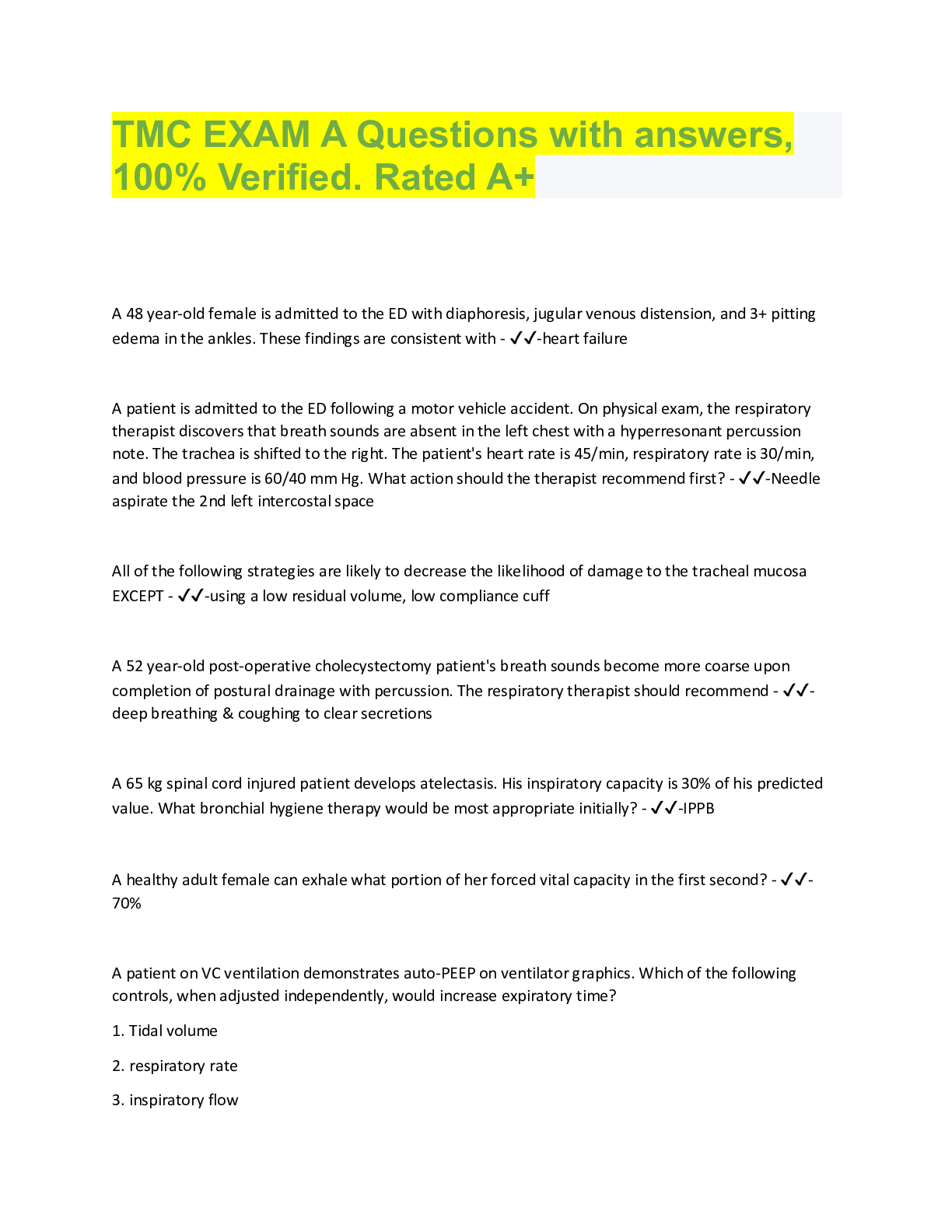
TMC EXAM A Questions with answers,
100% Verified. Rated A+
A 48 year-old female is admitted to the ED with diaphoresis, jugular venous distension, and 3+ pitting
edema in the ankles. These findings are consistent wi
...
TMC EXAM A Questions with answers,
100% Verified. Rated A+
A 48 year-old female is admitted to the ED with diaphoresis, jugular venous distension, and 3+ pitting
edema in the ankles. These findings are consistent with - ✔✔-heart failure
A patient is admitted to the ED following a motor vehicle accident. On physical exam, the respiratory
therapist discovers that breath sounds are absent in the left chest with a hyperresonant percussion
note. The trachea is shifted to the right. The patient's heart rate is 45/min, respiratory rate is 30/min,
and blood pressure is 60/40 mm Hg. What action should the therapist recommend first? - ✔✔-Needle
aspirate the 2nd left intercostal space
All of the following strategies are likely to decrease the likelihood of damage to the tracheal mucosa
EXCEPT - ✔✔-using a low residual volume, low compliance cuff
A 52 year-old post-operative cholecystectomy patient's breath sounds become more coarse upon
completion of postural drainage with percussion. The respiratory therapist should recommend - ✔✔-
deep breathing & coughing to clear secretions
A 65 kg spinal cord injured patient develops atelectasis. His inspiratory capacity is 30% of his predicted
value. What bronchial hygiene therapy would be most appropriate initially? - ✔✔-IPPB
A healthy adult female can exhale what portion of her forced vital capacity in the first second? - ✔✔-
70%
A patient on VC ventilation demonstrates auto-PEEP on ventilator graphics. Which of the following
controls, when adjusted independently, would increase expiratory time?
1. Tidal volume
2. respiratory rate
3. inspiratory flow
4. sensitivity - ✔✔-1, 2, and 3 only
Which of the following would be the most appropriate therapy for a dyspneic patient who has crepitus
with tracheal deviation to the left and absent breath sounds on the right? - ✔✔-insert a chest tube
Following cardiac surgery, a 55 year-old patient has the following ABG results: pH 7.50, PaCO2 30 torr,
PaO2 62 torr, HCO3 25 mEq/L, SaO2 92%, HB 14 g/dL, BE +2. Venous blood gas results are pH 7.39,
PvCO2 43 torr, PvO2 37 torr, and SvO2 66%. Calculate the patient's C(a-v)O2. - ✔✔-5.0 vol %
A patient on VC, SIMV with a VT of 500 mL has a PIP of 25 cm H2O, Pplat of 15 cm H2O and PEEP of 5 cm
H2O. What is the patient's static lung compliance? - ✔✔-50 mL/cm H2O
Immediately after extubation of a patient in the ICU, the respiratory therapist observes increasing
respiratory distress with intercostal retractions and marked stridor. The SpO2 on 40% oxygen is noted to
be 76%. Which of the following would be most appropriate at this time? - ✔✔-Reintubation
Which of the following patients would most likely benefit from pressure support ventilation? - ✔✔-A
patient on SIMV with a mandatory rate of 12/min and total rate of 24/min.
A patient receiving mechanical ventilation has developed a temperature of 99.9° F with purulent
secretions over the last 12 hours. The respiratory therapist has also noted a steady increase in peak
inspiratory pressure. What initial recommendation should be made to address these changes? - ✔✔-
obtain a sputum gram stain
Which of the following information may be obtained from a FVC maneuver during bedside pulmonary
function testing?
1. FEV1
2. PEFR
3. FRC
4. RV - ✔✔-1 & 2 only
The respiratory therapist provides education for a patient who is being discharged home on aerosol
therapy. The most important reason for the patient to follow the recommended cleaning procedures
using a vinegar/water solution is that this solution will - ✔✔-retard bacterial growth
A patient who complains of dyspnea is noted to have a dry, non-productive cough. On physical
examination, breath sounds are diminished on the right, tactile fremitus is decreased and there is
dullness to percussion over the right lower lobe. The respiratory therapist should suspect that the
patient is suffering from - ✔✔-pleural effusion
Which of the following suction catheters would be appropriate to use for a patient with a size 8.0 mm ID
endotracheal tube? - ✔✔-12 Fr
A patient who is receiving continuous mechanical ventilation is fighting the ventilator. His breath sounds
are markedly diminished on the left, there is dullness to percussion on the left, and the trachea is shifted
to the left. The most likely explanation for the problem is that - ✔✔-the endotracheal tube has slipped
into the right main stem bronchus.
The respiratory therapist notes a developing hematoma after an arterial blood gas was drawn from the
right radial artery. The immediate response is to - ✔✔-apply pressure to the site
A patient's breathing pattern irregularly increases and decreases and is interspersed with periods of
apnea up to 1 minute. Which of the following conditions is the most likely cause of this problem? - ✔✔-
elevated intracranial pressure
What value for the apnea-hypopnea index (AHI) is consistent with mild obstructive sleep apnea? - ✔✔-5
to 15
While monitoring a newborn utilizing a transcutaneous monitor, the respiratory therapist notices a
change in PtcO2 from 60 to 142 torr and simultaneously the PtcCO2 changes from 37 to 2 torr. What is
the most likely explanation for these changes? - ✔✔-air leak around the sensor
A patient on the general medical ward receives oxygen via 28% air entrainment mask with the
flowmeter set at 5 L/min. What is the total flow delivered to the patient? - ✔✔-55 L/min
Which of the following measurements is most indicative of congestive heart failure? - ✔✔-pulmonary
capillary wedge pressure of 30 mmHg
Sleep apnea can be defined as repeated episodes of complete cessation of airflow for - ✔✔-10 seconds
or longer
A patient in the ICU receiving mechanical ventilation underwent fiberoptic bronchoscopy during which a
tissue biopsy was collected. Immediately following the procedure, the respiratory therapist notes that
the peak inspiratory pressure on the ventilator has increased. Potential causes for this include all of the
following EXCEPT - ✔✔-hypoxemia
What size endotracheal tube would be appropriate for an adult female patient? - ✔✔-7.0 to 7.5 mm
The respiratory therapist is asked to evaluate the presence of Auto-PEEP on a patient receiving
mechanical ventilation. In order to do this, the therapist should - ✔✔-initiate an expiratory hold just
prior to the next ventilator-delivered breath.
A patient who suffered trauma in an ATV accident is being monitored in the ICU. A pulmonary artery
catheter has been placed and the following data is available:
PCWP 4 mm Hg
PAP (mean) 8 mm Hg
CVP 2 cm H2O
Cardiac Output 3L/min
The respiratory therapist should recommend - ✔✔-IV fluid challenge
What is the primary advantage of volume-controlled ventilation as compared to pressure-controlled
ventilation? - ✔✔-VC provides a constant minute ventilation
Bronchial breath sounds heard over the lung periphery indicate - ✔✔-lung consolidation
During a pre-operative evaluation, bedside spirometry results are as follows: FVC 88% of predicted, FEV1
85% of predicted, FEV1/FVC 82% of predicted and FEF25-75 81% of predicted. How should the
respiratory therapist interpret these results? - ✔✔-Normal lung function
A 55 year-old male patient is evaluated for pulmonary rehabilitation. During a cycle ergometer
cardiopulmonary stress procedure, the patient has a heart rate of 100/min and a respiratory rate of
20/min. He suddenly begins to complain of chest pain and severe shortness of breath. The respiratory
therapist should - ✔✔-terminate the procedure immediately
At 1 minute post-delivery, a newborn has blue extremities with a pink body, heart rate is 90/min,
respiratory rate is 20/min with a weak cry, cough reflex is present, and there is some flexion of the
extremities. At 5 minutes post-delivery, the infant is completely pink, heart rate is 140/min, respiratory
rate is 40/min, cough reflex is present, and the baby is active with a strong cry. What APGAR scores
should be assigned? - ✔✔-6 & 10
The respiratory therapist is asked to administer 2.5 mg of albuterol to a patient via small volume
nebulizer. The medication is available in a 0.5% solution. What volume of albuterol should be
administered? - ✔✔-0.50 mL
After consulting on management of a patient with pneumonia and atelectasis, the pulmonologist
documents a need to change the patient's treatment regimen in the Progress Notes. The respiratory
therapist should - ✔✔-check the medical record for new physician orders
A 60 kg (132 lb) patient is mechanically ventilated at the following settings: VC, A/C; VT 500 mL,
respiratory rate 12/min, FIO2 1.00 and 10 cm H2O PEEP. The patient's peak airway pressure is 60 cm
H2O and his SpO2 is 85%. A current chest x-ray shows diffuse bilateral infiltrates. Which of the following
is the most appropriate action in order to reduce peak airway pressure? - ✔✔-change to airway pressure
release ventilation
In order to verify the accuracy of a lab-based spirometer device, the respiratory therapist should utilize a
- ✔✔-3.0 L syringe
While performing diagnostic chest percussion, the respiratory therapist notes decreased resonance to
percussion. Which of the following are potential causes of this finding?
1. Pneumothorax
2. Pleural effusion
3. Pneumonia
4. Atelectasis - ✔✔-2, 3, and 4 only
Following thoracotomy, a patient on volume-control ventilation has a chest tube in the left pleural
space. While inspecting the chest drainage system, the respiratory therapist notes bubbling in the water
seal chamber during the inspiratory phase. The therapist should report this to the physician as - ✔✔-a
persistent bronchopleural fistula
A 19-year-old patient is brought to the Emergency Department after taking a handful of pills. The
patient is obtunded but is making regular, sonorous respiratory efforts. Auscultation reveals coarse
rhonchi bilaterally. Which of the following should be done FIRST to assess this patient? - ✔✔-obtain an
ABG
A 60 year-old male is admitted to the ED with chest pain. The CBC and electrolytes are normal. Troponin
level is 0.4 ng/mL. The physician should report to the patient that he is suffering from - ✔✔-myocardial
infarction
A young healthy adult with complaints of intermittent wheezing is seen in the pulmonary clinic. A
pre/post bronchodilator spirometry reveals a normal study with no reversibility. Which of the following
should the respiratory therapist recommend? - ✔✔-bronchial provocation
Twenty-four hours after a patient was intubated, she develops a fever of 99.9°F, a right lower lobe
infiltrate, and her white blood cell count is 12,000 per mm3. The respiratory therapist should
recommend - ✔✔-antibiotic therapy
A tracheostomy tube has just been inserted percutaneously into a patient with a C3 fracture. How much
air should the respiratory therapist initially inject into the cuff? - ✔✔-enough to achieve a pressure of
25-35 cm H2O
All of the following conditions can be treated with hyperbaric oxygen (HBO) therapy EXCEPT - ✔✔-
pulmonary hypertension
Which of the following factors are determinants of cardiac output? - ✔✔-stroke volume and heart rate
The following ABG results are reported for a patient in the ED on room air: pH 7.20; PaCO2 24 torr; PaO2
95 torr; HCO3 10 mEq/L; SaO2 95%; BE -15 mEq/L. The respiratory therapist should recommend - ✔✔-
administering sodium bicarbonate.
The physician asks the respiratory therapist to select ventilator parameters that will deliver the lowest
peak inspiratory pressure possible. Which of the following inspiratory flow patterns will enable the
therapist to fulfill the physician's request? - ✔✔-decelerating
An intubated patient receiving 30% oxygen has a SpO2 of 80% and ETCO2 of 40 torr. After
administration of 50% oxygen for 30 minutes, the respiratory therapist notes that the SpO2 rises to 98%
and the ETCO2 remains stable at 40 torr. The major cause of hypoxemia in this patient is - ✔✔-
ventilation/perfusion mismatch
A 16 year-old patient with cystic fibrosis attends high school. Which of the following bronchial hygiene
therapies would be most appropriate for this patient? - ✔✔-Vibratory/oscillatory PEP
A patient reports that he has difficulty breathing while lying in a supine position and prefers to sleep
sitting in a chair. The respiratory therapist should record this complaint in the medical record as - ✔✔-
orthopnea
A patient receiving oxygen therapy at home calls in the middle of the night and reports that the oxygen
supply tubing will not stay attached to her transtracheal catheter. The flow rate to the transtracheal
catheter is set at 0.5 L/min. The patient has attempted to flush the catheter with saline and push a
cleaning rod through it without success. The respiratory therapist should instruct the patient to - ✔✔-
switch to a nasal cannula
A patient with copious amounts of secretions has required nasotracheal suctioning for the past 36 hours
and has now developed mild epistaxis. Which of the following should the respiratory therapist
recommend? - ✔✔-Insert a nasopharyngeal airway after bleeding has been controlled.
The most probable cause of air bronchograms and increased density on a chest x-ray is - ✔✔-pneumonia
Following abdominal surgery, a 70 year-old patient receives mechanical ventilation in the ICU at the
following settings: VC, A/C; VT 550 mL, respiratory rate 14/min, FIO2 0.50 and 10 cm H2O PEEP. Bedside
monitoring results demonstrate that the PvO2 is 35 torr and the SpO2 is 90%. The patient is alert and
oriented with stable vital signs. Which of the following should the respiratory therapist recommend? -
✔✔-increase the FiO2
The primary source of infection in the health care setting is - ✔✔-poor handwashing techniques of
personnel
A 36 year-old patient is admitted to the ED with a temperature of 38.5° C and suspected pneumonia.
The patient has no history of pulmonary disease. Auscultation reveal medium crackles throughout both
lungs. Which of the following should be recommended for management of this patient? - ✔✔-regular
coughing and deep breathing
The respiratory therapist obtains a blood gas sample from the patient's radial artery and applies
pressure to the site for 10 minutes. After removing any excess air from the syringe, the next step for
proper handling of the blood sample is - ✔✔-placing the syringe in an ice bath
Which of the following findings is LEAST compatible with hyperlucency as seen on a chest x-ray? - ✔✔-
increased fremitus
A spontaneous breathing trial is initiated on an intubated, awake, and alert 70 kg (154 lb) patient. After
40 minutes on an FIO2 of 0.30, ABG results are as follows: pH 7.39, PaCO2 44 torr, PaO2 85 torr, and
HCO3- 24 mEq/L. The patient's vital signs remained stable throughout the trial. Which of the following is
the most appropriate recommendation? - ✔✔-extubate the patient
After assisting with bronchoalveolar lavage and lung biopsy on a mechanically ventilated patient, the
respiratory therapist notes the activation of a high pressure alarm. Peak inspiratory pressure has
increased from 32 cm H2O before the procedure to 45 cm H2O after the procedure. Possible causes for
the increased pressure include
1. bronchospasm.
2. pneumothorax.
3. pulmonary hemorrhage. - ✔✔-1, 2 and 3
A 52 year-old post-operative patient's chest radiograph demonstrates infiltrates in the posterior basal
segments of the lower lobes. Which of the following is the appropriate postural drainage position? -
✔✔-Head down, patient prone with a pillow under hips
A 72 year-old female post stem cell transplant patient in the ICU complains of difficulty breathing and is
noted to have diffuse fluffy infiltrates on chest X-ray. The B-type Natriuretic Peptide (BNP) test result
demonstrates 700 pg/mL. What is the patient's possible condition? - ✔✔-moderate heart failure
Following blunt chest trauma, a 35-year-old male is orally intubated and continuous mechanical
ventilation is initiated. Physical assessment of the neck and chest reveal a midline trachea and significant
reduction in thoracic expansion of the left chest. There are diminished breath sounds in the left lung
compared to the right lung. These findings most likely indicate which of the following? - ✔✔-
Endobronchial intubation
The respiratory therapist performs the quality control procedures for the blood gas analyzer in the NICU
and notices a single data point that is 3 standard deviations from the mean value for the pH electrode.
The therapist should - ✔✔-perform another control run
A patient receiving pressure-controlled ventilation has acute hypoventilation with an ETCO2 of 70 torr.
His vital signs include: heart rate 90/min, respiratory rate 18/min, SpO2 94%. Which of the following
change(s) will address the situation?
1. Increase the pressure limit
2. Increase the sensitivity
3. Increase the mandatory rate
4. Decrease the inspiratory time - ✔✔-1 and 3 only
A 60 year-old male has just been extubated following coronary artery bypass grafting. His chest X-ray
demonstrates platelike infiltrates with scattered densities and he is noted to have decreased chest
expansion with an increased respiratory rate. Which of the following treatments should be
recommended for this patient? - ✔✔-lung expansion therapy
A 42 year-old trauma patient in the ED has been intubated with a 6.5 mm oral endotracheal tube
equipped with a high-residual-volume, low-pressure cuff. The respiratory therapist notes that a cuff
pressure of 42 cm H2O is necessary to achieve a minimal occluding volume. This would indicate that the
- ✔✔-tube is not of the appropriate size
A patient receives oxygen via nasal cannula at 2 L/min and has the following ABG results: pH 7.37,
PaCO2 42 torr, PaO2 80 torr, HCO3 38 mEq/L. The most likely explanation for these results is that - ✔✔-
the numbers were not reported correctly
The respiratory therapist completes oxygen rounds and checking oxygen saturations on a number of
patients. What solution would be most appropriate for disinfecting the surface of the pulse oximeter
between patients? - ✔✔-Ethyl alchoho
[Show More]


.png)





![Preview of [FOR ELDY] Telehealth for Mental Health Services Post Pandemic](https://browseimages.nyc3.digitaloceanspaces.com/paper-images/2026/04/19/efrRqveL2026-04-19-12-0969e3f3031469a.png)