TMC Exam C. Questions with accurate
answers, 100% Verified. Rated A+
a. manual dexterity - ✔✔-The respiratory therapist should evaluate which of the following to develop a
teaching plan for a patient who will be usi
...
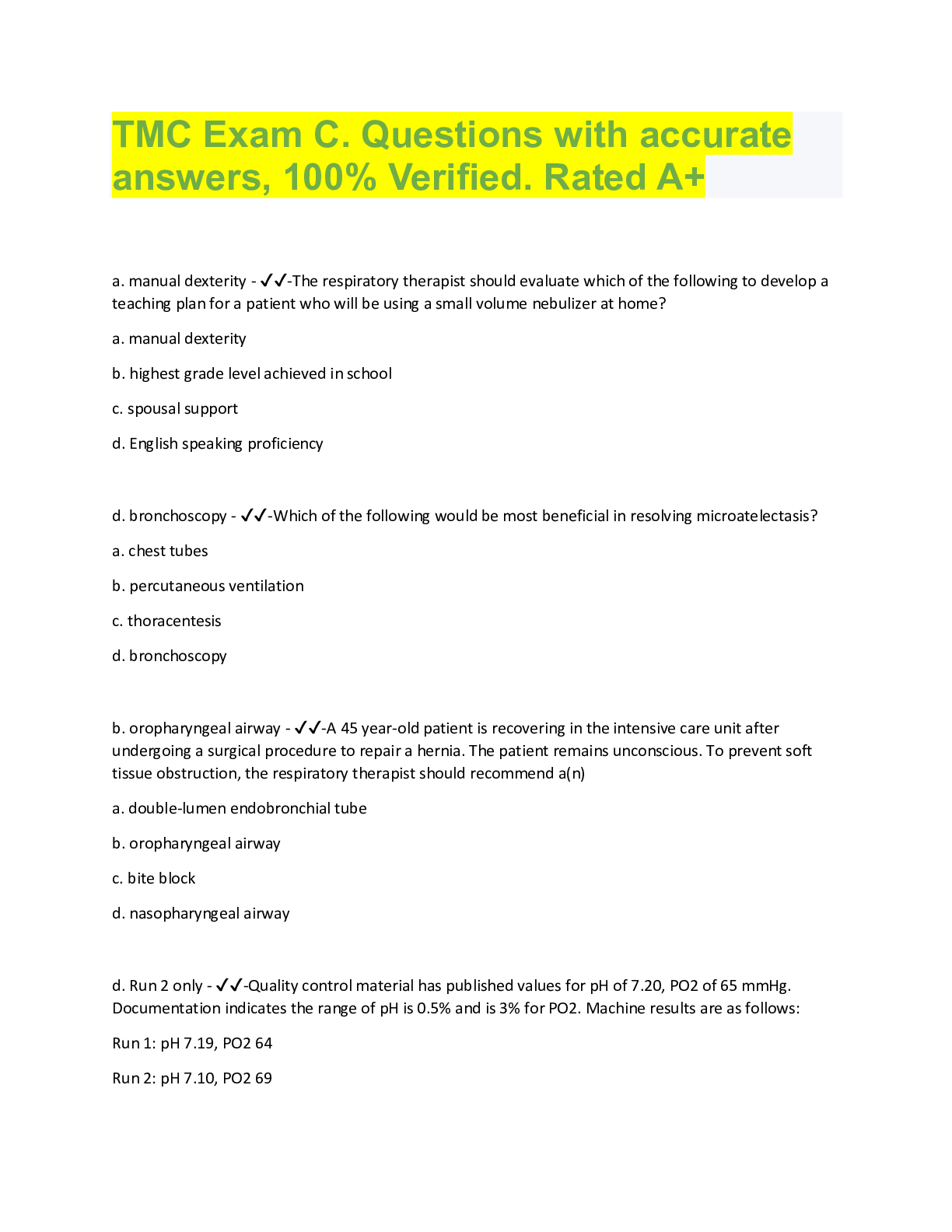
TMC Exam C. Questions with accurate
answers, 100% Verified. Rated A+
a. manual dexterity - ✔✔-The respiratory therapist should evaluate which of the following to develop a
teaching plan for a patient who will be using a small volume nebulizer at home?
a. manual dexterity
b. highest grade level achieved in school
c. spousal support
d. English speaking proficiency
d. bronchoscopy - ✔✔-Which of the following would be most beneficial in resolving microatelectasis?
a. chest tubes
b. percutaneous ventilation
c. thoracentesis
d. bronchoscopy
b. oropharyngeal airway - ✔✔-A 45 year-old patient is recovering in the intensive care unit after
undergoing a surgical procedure to repair a hernia. The patient remains unconscious. To prevent soft
tissue obstruction, the respiratory therapist should recommend a(n)
a. double-lumen endobronchial tube
b. oropharyngeal airway
c. bite block
d. nasopharyngeal airway
d. Run 2 only - ✔✔-Quality control material has published values for pH of 7.20, PO2 of 65 mmHg.
Documentation indicates the range of pH is 0.5% and is 3% for PO2. Machine results are as follows:
Run 1: pH 7.19, PO2 64
Run 2: pH 7.10, PO2 69
Run 3: pH 7.21, PO2 65
Which quality control run(s) indicate the machine is out of control?
a. Run 1 and 2
b. Run 2 and 3
c. Run 3 only
d. Run 2 only
a. ABG and alveolar oxygen tension - ✔✔-A respiratory therapist is considering a patient's readiness to
wean from mechanical ventilation. To determine the A-aDO2, the therapist will need which of the
following?
a. ABG and alveolar oxygen tension
b. VD/VT and PAO2
c. CaO2 and PAO2
d. VD/VT and ABG
c. heliox therapy - ✔✔-A patient with increased airway resistance from a fixed upper airway obstruction
would benefit most from which of the following?
a. bronchodilator therapy
b. epinephrine
c. heliox therapy
d. aerosolized atropine
d. inspiratory muscle strength - ✔✔-Evaluating MIP (maximum inspiratory pressure) is most useful in
evaluating which of the following?
a. presence of a restrictive pulmonary defect
b. effectiveness of cough
c. presence of obstructive pulmonary defect
d. inspiratory muscle strength
b. excess water in the tubing - ✔✔-An air-entrainment jet nebulizer is set at 50%. The respiratory
therapist analyzes the oxygen coming from the end of the tubing and finds it is 60%. Which of the
following most likely explains this finding?
a. poorly calibrate analyzer
b. excess water in the tubing
c. low flow through the jet orifice
d. leak in the tubing
a. examine the ventilator circuit for proper connections - ✔✔-During a preoperational test of the
ventilator with a test lung, the respiratory therapist notes a return tidal volume of 600 cc. Ventilator
settings are:
Mode: Assist/control
FiO2: 0.50
Mandatory rate: 10
VT: 750 mL
What action should the therapist take?
a. examine the ventilator circuit for proper connections
b. obtain a larger test lung
c. increase the set tidal volume to 900 mL
d. obtain a smaller test lung
d. change the fuel cell - ✔✔-During the preoperational test of the ventilator, the respiratory therapist
notices the galvanic analyzer on the ventilator is reading erroneously low. Which of the following can
the respiratory therapist do to correct the problem?
a. replace the analyzer batteries
b. replace the electrolyte solution in the analyzer
c. tag the ventilator as non-functional and avoid placing it in service
d. change the fuel cell
b. poor hand washing among staff - ✔✔-Which of the following is most likely to increase nosocomial
infection in a hospital?
a. use of an HME for 48 hours
b. poor hand washing among staff
c. frequent disconnection in the ventilator circuit
d. use of alcohol-based hand cleaners
b. disconnected thermistor line - ✔✔-While monitoring a patient receiving mechanical ventilation, the
respiratory therapist notices the low-pressure and low exhaled volume alarms are sounding. Which of
the following could be the cause?
a. kinked endotracheal tube
b. disconnected thermistor line
c. excess water in the inspiratory limb of the circuit
d. herniated endotracheal tube cuff
a. a fracture in the plastic wye - ✔✔-A patient receiving positive pressure ventilation has a low-pressure
alarm sounding. Which of the following could be the cause?
a. a fracture in the plastic wye
b. herniated cuff
c. excess secretions in the airway
d. kinked ET tube
a. provide manual ventilation - ✔✔-The high pressure alarm is sounding on a patient receiving volume
controlled ventilation. The respiratory therapist should FIRST
a. provide manual ventilation
b. suction the patient
c. observe the alarm panel to determine source
d. cancel the alarm
d. Anectine (succinylcholine chloride) - ✔✔-Which of the following medications is shown to have
sufficient affect when facial muscle twitching is observed?
a. Halcion
b. Curare (d-turbo curare)
c. Romazicon
d. Anectine (succinylcholine chloride)
d. respirometer - ✔✔-A respiratory therapist is preparing to measure SVC on a patient in the emergency
department. Which of the following equipment is required?
a. Collins water-seal spirometer
b. Geissler tube
c. Wheatstone bridge
d. respirometer
b. pressure manometer - ✔✔-A respiratory therapist is asked to determine a patient's inspiratory
muscle strength. Which of the following equipment is required for this evaluation?
a. Fleisch pneumotrachometer
b. pressure manometer
c. respirometer
d. peak flow meter
b. peak flow meter - ✔✔-A respiratory therapist is ordered to do a bedside assessment of the
effectiveness of a bronchodilator on a patient with an acute asthmatic episode. Which of the following
equipment will be needed to perform this evaluation?
a. maximum inspiratory pressure manometer
b. peak flow meter
c. Collins water-seal spirometer
d. respirometer
a. 25/8 mmHg - ✔✔-Which of the following pressures is most consistent with a normal pulmonary artery
pressure (PAP)?
a. 25/8 mmHg
b. 12/8 mmHg
c. 120/80 mmHg
d. 25/4 mmHg
d. change to an 80%/20% heliox mixture - ✔✔-A patient receiving heliox therapy at 70%/30% mixture by
non-rebreathing mask has the following arterial blood gas results:
pH 7.35 / PaCO2 45 / PaO2 110 / HCO3 24 / BE 0
Which of the following actions is appropriate?
a. change to a heliox mixture of 60%/40%
b. discontinue heliox therapy
c. switch to a partial rebreathing mask
d. change to an 80%/20% heliox mixture
c. use an air-entrainment mask set at 28% - ✔✔-A COPD patient complains of shortness of breath while
exercising with a 2 L/min nasal cannula. During exercise, SPO2 is noted to fall to 84%. Which of the
following would be most helpful to the patient during exercise?
a. decrease flow to 1 L/min nasal cannula
b. avoid exercising
c. use an air-entrainment mask set at 28%
d. use a non-rebreathing mask
a. place the patient on a non-rebreathing mask - ✔✔-A patient in the emergency room is receiving
oxygen by nasal cannula at 3 L/min. Blood gases reveal the following:
pH 7.53 / PaCO2 30 / PaO2 51 / HCO3 23 / BE -1
The respiratory therapist should immediately
a. place the patient on a non-rebreathing mask
b. decrease flow to 1 L/min
c. increase flow to 5 L/min
d. place the patient on a Venturi mask at 40%
d. increase PEEP to 22 cmH2O - ✔✔-An 80-kg (176-lb) female patient is receiving mechanical ventilation
on the following settings:
Mode: assist/control
Mandatory rate: 14/min
Total rate: 14/min
VT: 550 mL
FiO2: 0.60
PEEP: 20 cmH2O
ABG:
pH 7.38 / PaCO2 42 / PaO2 62 / HCO3 26 / BE +2
The respiratory therapist should
a. increase the FIO2 to 0.7
b. order a chest radiograph
c. increase FiO2 to 1.0
d. increase PEEP to 22 cmH2O
b. increase flow to 15 L/min - ✔✔-A patient is showing signs of respiratory distress with a respiratory
rate to 30/min and a spontaneous tidal volume of 800 mL. The patient is receiving oxygen at 60% by
large volume nebulizer with the flow set at 10 L/min. The respiratory therapist should suggest to
a. increase FiO2 to 1.0 and the flow to 15 L/min
b. increase flow to 15 L/min
c. sedate the patient
d. decrease the FiO2 to 0.50
d. decrease inspiratory time - ✔✔-The physician orders a change in I:E ratio from 1:2 to 1:4 for a COPD
patient receiving volume-cycled mechanical ventilation. Which of the following accommodates the
physician's request if the mandatory rate is not changed?
a. increase the inspiratory time
b. decrease the inspiratory flow rate
c. decrease expiratory time
d. decrease inspiratory time
a. autoPEEP - ✔✔-For a patient receiving volume-controlled ventilation in the assist/control mode, the
starting of the inhalation cycle before the expiratory flow rate returns to zero would result in which of
the following?
a. autoPEEP
b. atelectasis
c. alveolar collapse
d. decreased FRC
c. epinephrine - ✔✔-While assisting a physician during a bronchoscopy procedure, the therapist notices
bright red blood in the specimen tube. The therapist should prepare which of the following NEXT?
a. Heparin
b. atropine
c. epinephrine
d. cold normal saline
d. Bodai adapter - ✔✔-A respiratory therapist is asked to assist a physician with a bronchoscopy
procedure on a patient who is ventilator dependent and requires high levels of PEEP. Which of the
following equipment should be used?
a. closed in-line suction catheter
b. manual PEEP valve
c. Magill forceps
d. Bodai adapter
b. reduce future treatment dosage to 0.25 mL - ✔✔-A patient receiving 0.5 mL Albuterol by small
volume nebulizer complains of tingling fingers, nervousness, and heart palpitations. The therapist should
a. decrease dosage to 0.15 mL
b. reduce future treatment dosage to 0.25 mL
c. have the patient pause at the top of each breath
d. instruct the patient in performing shallow inspirations
a. cancerous mass in the lung - ✔✔-For which of the following is the respiratory therapist observing if
obtaining a series of oblique chest radiographs?
a. cancerous mass in the lung
b. pneumonia
c. pneumothorax
d. pleural effusion
d. mass in the left lobe - ✔✔-A spiral CT scan would be most helpful in evaluating which of the
following?
a. atelectasis
b. asbestosis
c. pneumonia
d. mass in the left lobe
b. decrease tidal volume - ✔✔-A 65-kg (143-lb) patient with pneumonia is receiving mechanical
ventilator support by a Servo adult ventilator on the following settings with corresponding arterial blood
gas values:
Mode: assist/control
Mandatory rate: 10/min
VT: 700 mL
FiO2: 0.50
pH 7.48 / PaCO2 33 / PaO2 98 / HCO3 24 / BE 0
Which of the following actions is most appropriate?
a. increase tidal volume
b. decrease tidal volume
c. decrease FiO2
d. decrease mandatory rate
b. increase alveolar ventilation - ✔✔-A patient is undergoing a full cardiopulmonary arrest. The patient
is intubated and is being monitored with an infrared capnographic device. PetCO2 data is showing 3%.
Which of the following is most appropriate?
a. obtain PaCO2 by a Douglas bag
b. increase alveolar ventilation
c. recalibrate the capnomete
[Show More]