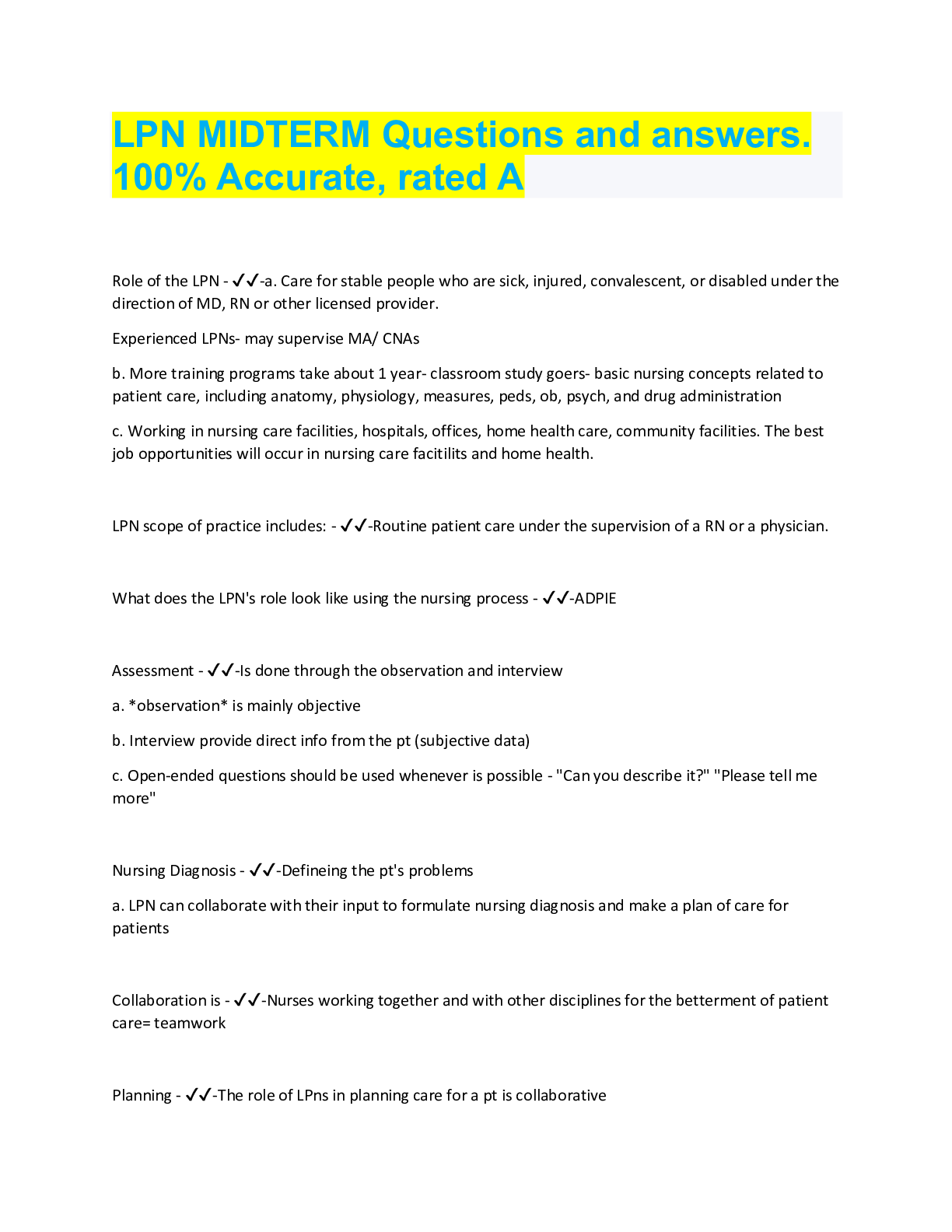
LPN MIDTERM Questions and answers.
100% Accurate, rated A
Role of the LPN - ✔✔-a. Care for stable people who are sick, injured, convalescent, or disabled under the
direction of MD, RN or other licensed provider.
E
...
LPN MIDTERM Questions and answers.
100% Accurate, rated A
Role of the LPN - ✔✔-a. Care for stable people who are sick, injured, convalescent, or disabled under the
direction of MD, RN or other licensed provider.
Experienced LPNs- may supervise MA/ CNAs
b. More training programs take about 1 year- classroom study goers- basic nursing concepts related to
patient care, including anatomy, physiology, measures, peds, ob, psych, and drug administration
c. Working in nursing care facilities, hospitals, offices, home health care, community facilities. The best
job opportunities will occur in nursing care facitilits and home health.
LPN scope of practice includes: - ✔✔-Routine patient care under the supervision of a RN or a physician.
What does the LPN's role look like using the nursing process - ✔✔-ADPIE
Assessment - ✔✔-Is done through the observation and interview
a. *observation* is mainly objective
b. Interview provide direct info from the pt (subjective data)
c. Open-ended questions should be used whenever is possible - "Can you describe it?" "Please tell me
more"
Nursing Diagnosis - ✔✔-Defineing the pt's problems
a. LPN can collaborate with their input to formulate nursing diagnosis and make a plan of care for
patients
Collaboration is - ✔✔-Nurses working together and with other disciplines for the betterment of patient
care= teamwork
Planning - ✔✔-The role of LPns in planning care for a pt is collaborative
a. LPN's can help its to establish their goals, and provide their input to the plan of care=pt centered care
Time management in patient care (4) - ✔✔-a. Planning care at the beginning of the shift
b. Prioritizing care-urgent vs. important
c. Set time limits for interventions
d. Proper delegation
Implementation - ✔✔-(interventions)
a. LPns are responsible to help its through interventions- interventions include activities related to care,
and patient teaching
Evaluation - ✔✔-This activity includes observation and documentation of outcomes.
What can the LPN do vs RN. - ✔✔-
infractions - ✔✔-A violation or infringement of a law, agreement, or set of rules.
sanctions - ✔✔-a threatened penalty for disobeying a law or rule.
"a range of sanctions aimed at deterring insider abuse"
synonyms: penalty, punishment, deterrent; More
2.
official permission or approval for an action.
"he appealed to the bishop for his sanction"
Ethics - ✔✔-Is the study of values and customs of a person or a group. It covers the use of right and
wrong in relation with the human conduct.
Nursing Ethics - ✔✔-a. Is a disciple which evaluates merits, risk and social concerns of activities in the
field of nursing.
b. This behavior is a combination of professional expectations that boarders on legal issues
c. The code of ethics for nurses provides *rules, standards and guidelines* for nurses to maintain and
promote ethical behavior in their practice
d. Nurse are expected to behave in a professional manner and to perform in the *highest level of
preparation*
Know definitions that guide ethics (beneficence etc) - ✔✔-Advocate, Autonomy, Justice, Veracity,
Beneficences, Nonmaleficence, Fidelity
Advocate - ✔✔-One who acts on behalf of another
Autonomy - ✔✔-Pt's self determination, independence and freedom- Exception: when it interferes with
another's rights or well being
Justice - ✔✔-The duty to treat all patient's fairly, and without regard to age, socioeconomic status etc. -
Exception: when it interfers with rights of others
Veracity - ✔✔-Principle of truthfulness- Exception: when it interferes with another rights or well-being
Beneficence - ✔✔-Actively "do good" for patients.- Exception: determining what is "good".
Nonmaleficence - ✔✔-Do no harm, intentionally or unintentionally.- Exception: violated in the short
term to produce a greater long-term goal.
Fidelity - ✔✔-Faithful to commitments made to self and others- Exception: conflict arises from
obligations owed to different individuals or groups. "Fidelity is the main support for the concept of
accountability,"
Ethics Committee role. - ✔✔-Are composed by health care professionals and non-medical members who
provide *consultation and advise* regarding ethical aspects of patient care. - Although you have the
rights as a nurse to refuse to assist with a procedure you believe to be morally wrong, you *do not*
have the right to refuse to provide nursing care for a patient.
Review Steps of ethical decision evaluation. (9) - ✔✔-1. Gather the facts
2. Define the ethical issues
3. Identify the affected parties (stakeholders)
4. Identify the consequences
5. Identify the obligations (principles, rights, justice)
6. Consider your character and integrity
7. Think creatively about potential actions
8. Check your gut
9. Decide on the proper ethical action and be prepared to deal with opposing arguments
Gather the facts - ✔✔-º Don't jump to conclusions without the facts
º Questions to ask: Who, what, where, when, how and why
º However, facts may be difficult to find because of the uncertainty often found around ethical issues
º Some facts are not available
º Assemble as many facts as possible before proceeding
º Clarify what *assumptions* you are making
Define the Ethical Issue's - ✔✔-º Don't jump to conclusions with first identifying the *ethical issues* in
the situation
ºDefine the ethical basis for the issue you want to focus on
º There may be *multiple* ethical issues- focus one *one* major one at a time
Identify the affected parties - ✔✔-ºIdentify all of the *stakeholders* -
who are the *primary* or direct stakeholders- Who are the *secondary* or indirect stakeholders?
º Why are they stakeholders for the issue- *Perspective-taking* - Try to see things through the eyes of
those individuals affected
Identify the relevant principles, rights, and justice issues - ✔✔-º Obligations should be thought of in
terms of principles and rights involved a. What obligations are created because of particular ethical
*principles* you might use in the situation? Examples: Do no harm, do unto others as you would have
them do unto you; Do what you have anymore in your shoes do in the given context b. What obligations
are created because of the specific *rights* of the stakeholders?- What rights are more *basic vs.
secondary* in nature? Which help protect an individual's basic autonomy? -What types of rights are
involved- *negative or positive* c.What concepts of justice (fairness) are relevant- *distributive or
procedural justice*
º Did you consider any relevant *cognitive barriers/ biases*
º Formulate the appropriate *decision or action* based solely on the above anaylusus of these
obligations
Consider your character and integrity - ✔✔-º Consider what your relevant community members would
consider to be the kind of decision that an *individual of integrity* would make in this situation.
º What *specific virtues* are relevant in the situation?
º *Disclosure rule*- what would you do if the New York times reported your action and everyone was to
read it
º Think about how your decision will be remembered when you are gone.
º Did you consider any relevant *cognitive biases/ barriers?*
º What *decision* would you come to based solely on *character* considerations?
Think creatively about potential actions - ✔✔-ºBe sure you have not been unnecessarily forced into a
corner
º You may have some choices or alternatives that have not been considered
º If you have come up with solutions "a and b" try to brainstorm and come up a "c" solution that might
satisfy *the interests of the primary parties* involved in the situation
Check your gut - ✔✔-º Even though the prior steps have argued for a highly rational process, it is always
good to *check your gut*
º*intuition* is gaining credibility as a source for good design making- knowing something is not "right" -
Particualy relevant if you have a lot of experience in the are area- *expert* decision-making
Good Samaritan Law. What is its purpose and how do nurses remain protected under the law. - ✔✔-
Protect people from prosecution who voluntarily go to the aid of others in an emergency- Nurses are
expected to render care equal to that of another provider with the *same level* of skill, training and
experience. - Laws vary by state
a. HIPPA
b. Advanced directives-self determined care - medical power of attorney
What is delegation versus what is an assignment. - ✔✔-
5 rights of delegation. - ✔✔-ºRight task
ºRight person
ºRight circumstances
ºRight communication
ºRight feedback and supervision
Right task - ✔✔-The activity falls within the delegegatee's job description or is included as part of the
established written policies and procedures of the nursing practice setting. The facility needs to ensure
the policies and procedures describe the expectations and limits of the activity and provide any
necessary competency training.
Right person - ✔✔-The licensed nurse along with the employer and the delegatee is responsible for
ensuring that the delegatee possesses the appropriate skills and knowledge to perform the activity
Right circumstances - ✔✔-The health conditions of the patient must be stable. If the patient's conditions
changes the delegatee must communicate this to the licensed nurse, and the licensed nurse must
reassess the situation and the appropriateness of the delegation.
Right communication - ✔✔-• Each delegation situation should be specific to the patient, the licensed
nurse and the delegatee
• The licensed nurse is expected to communicate specific instructions for the delegated activity to the
delegate; the delegatee as part of 2 way communication, should ask any clarifying questions. This
communication includes *any date that need to be collected, the method for collecting the data, the
time frame for reporting the results to the licensed nurse, and additional info pertinent to the
situation*• The delagetee must understand the terms of the degation and must agree to accept the
delegated activity • The licensed nurse should ensure that the delegatee understands that she or he
cannot make decisions or modifications in carrying out the active without first consulting the licensed
nurse
Right feedback and supervision - ✔✔-•The licensed nurse is responsible for monitoring the delegated
activity, following up the delegatee at the completion of the activity, and evaluating patient outcomes.
The delegatee is responsible for communicating patient information to the licensed nurse during the
delegation situation. The licensed nurse should be ready and available to intervene as necessary
• The licensed nurse should ensure appropriate docum
[Show More]