OB NCLEX Style Practice Questions &
Answers,100% Accurate, Graded A+.
latest version.
The doctor suspects that the client has an ectopic pregnancy. Which symptom is consistent with a
diagnosis of ectopic pregnancy
...
OB NCLEX Style Practice Questions &
Answers,100% Accurate, Graded A+.
latest version.
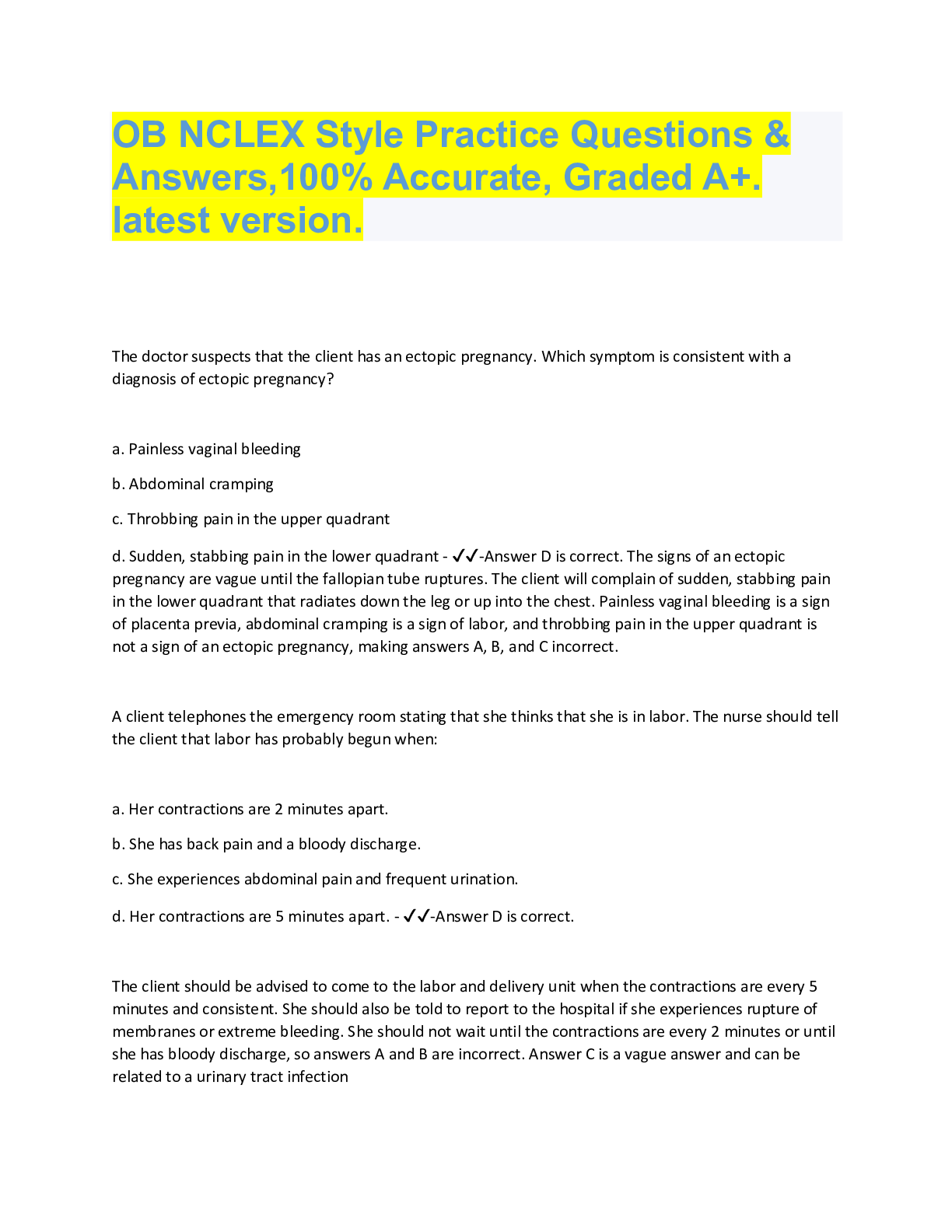
The doctor suspects that the client has an ectopic pregnancy. Which symptom is consistent with a
diagnosis of ectopic pregnancy?
a. Painless vaginal bleeding
b. Abdominal cramping
c. Throbbing pain in the upper quadrant
d. Sudden, stabbing pain in the lower quadrant - ✔✔-Answer D is correct. The signs of an ectopic
pregnancy are vague until the fallopian tube ruptures. The client will complain of sudden, stabbing pain
in the lower quadrant that radiates down the leg or up into the chest. Painless vaginal bleeding is a sign
of placenta previa, abdominal cramping is a sign of labor, and throbbing pain in the upper quadrant is
not a sign of an ectopic pregnancy, making answers A, B, and C incorrect.
A client telephones the emergency room stating that she thinks that she is in labor. The nurse should tell
the client that labor has probably begun when:
a. Her contractions are 2 minutes apart.
b. She has back pain and a bloody discharge.
c. She experiences abdominal pain and frequent urination.
d. Her contractions are 5 minutes apart. - ✔✔-Answer D is correct.
The client should be advised to come to the labor and delivery unit when the contractions are every 5
minutes and consistent. She should also be told to report to the hospital if she experiences rupture of
membranes or extreme bleeding. She should not wait until the contractions are every 2 minutes or until
she has bloody discharge, so answers A and B are incorrect. Answer C is a vague answer and can be
related to a urinary tract infection
Which of the following instructions should be included in the nurse's teaching regarding oral
contraceptives?
a. Weight gain should be reported to the physician.
b. An alternate method of birth control is needed when taking antibiotics.
c. If the client misses one or more pills, two pills should be taken per day for 1 week.
d. Changes in the menstrual flow should be reported to the physician. - ✔✔-Answer B is correct.
When the client is taking oral contraceptives and begins antibiotics, another method of birth control
should be used. Antibiotics decrease the effectiveness of oral contraceptives. Approximately 5-10
pounds of weight gain is not unusual, so answer A is incorrect. If the client misses a birth control pill, she
should be instructed to take the pill as soon as she remembers the pill. Answer C is incorrect. If she
misses two, she should take two; if she misses more than two, she should take the missed pills but use
another method of birth control for the remainder of the cycle. Answer D is incorrect because changes
in menstrual flow are expected in clients using oral contraceptives. Often these clients have lighter
menses.
A nursing instructor is conducting lecture and is reviewing the functions of the female reproductive
system. She asks Mark to describe the follicle-stimulating hormone (FSH) and the luteinizing hormone
(LH). Mark accurately responds by stating that:
a. FSH and LH are released from the anterior pituitary gland.
b. FSH and LH are secreted by the corpus luteum of the ovary
c. FSH and LH are secreted by the adrenal glands
d. FSH and LH stimulate the formation of milk during pregnancy. - ✔✔-a. FSH and LH are released from
the anterior pituitary gland.
FSH and LH, when stimulated by gonadotropin-releasing hormone from the hypothalamus, are released
from the anterior pituitary gland to stimulate follicular growth and development, growth of the graafian
follicle, and production of progesterone.
A woman who's 36 weeks pregnant comes into the labor & delivery unit with mild contracts. Which of
the following complications should the nurse watch out for when the client informs her that she has
placenta prevue?
a. sudden rupture of membranes
b. vaginal bleeding
c. emesis
d. fever - ✔✔-b. vaginal bleeding
contractions may disrupt the microvascular network in the placenta of a client with placenta prevue and
result in bleeding. If the separation of the placenta occurs at the margin of the placenta, the blood will
escape vaginally.
Sudden rupture of the membranes isn't related to placenta prevue. Fever would indicate an infectious
process, and emesis isn't related to placenta previa
A 21y.o. client has been diagnosed with hydatidiform mole. Which of the following factors is considered
a risk factor for developing hydatidiform mole?
1. age in 20s or 30s
2. high in SES
3. Primigravida
4. prior molar gestation - ✔✔-4.
previous molar gestation increases risk for developing subsequent molar gestation by 4-5 times.
Adolescents and women ages 40+ are at increased risk for molar pregs. MULTIGRAVIDAS, esp women
with prior preg loss, and women with LOWER SES are at increased risk for this problem.
A 21 y.o. has arrives to the ER with c/o cramping abdominal pain and mild vaginal bleeding. Pelvic exam
shows a left adnexal mass that's tender when palpated. Culdocentesis shows blood in the culdesac. This
client probably has which of the following conditions?
1. Abruptio placentae
2. Ecoptic pregnancy
3. Hydatidiform mole
4. Pelvic Inflammatory Disease - ✔✔-2. Ecoptic pregnancy
most ecoptic pregnancies dont appear as obvious life threatening med emergencies. THey must be
considered in any sexually active woman of childbearing age who c/o menstrual irregularity, cramping
abdominal pain, and mild vaginal bleeding.
PID, abruptio placentae and hydatidiform moles wont show blood in the cul de sac
A client, 34 weeks pregnant, arrives at the ER with SEVERE abdominal pain, uterine tenderness and an
increased uterine tone. The client denies vaginal bleeding. The external fetal monitor shows fetal
distress with severe, variable decels. The client most likely has which of the following? - ✔✔-1. Abruptio
placentae
a client w/ severe abruptio placentae will often have SEVERE abdominal pain. The uterus will have
increased tone w/ little to no return to resting tone btw/ contractions.
The fetus will start to show signs of distress, with decels in the HR or even fetal death w/ large placental
separation.
Placenta previa usually involves PAINLESS vaginal bleeding w/out UCs.
A molar preg. generally would be detected before 34 weeks gestation.
An ecoptic preg. which usually occurs in the FALLOPIAN TUBES, would rupture well before 34 weeks
gestation
Before the placenta functions, the corpus luteum is the primary source for synthesis of which of the
following hormones?
1. cortisol and thyroxine
2. estrogen and progesterone
3. LH and FSH
4. T4 and T3 - ✔✔-2. estrogen and progesterone
The CL produces progesterone and estrogen for the 1st 8-10 weeks of pregnancy until the placenta
takes over this function.
The high levels of estrogen and progesterone cause suppression of LH and FSH.
T4 and T3 are produced in the adrenal gland
Which of the following changes in resp functioning during pregnancy is considered normal?
1. increased tidal volume
2. increases expiratory volume
3. decreased inspiratory capacity
4. decreased oxygen consumption. - ✔✔-1. increased tidal volume
a pregnant client breathes deeper, which increases the tidal volume of gas moved in and out of the
respiratory tract w/ each breath.
The expiratory volume and residual volume DECREASE as the preg. progresses.
The inspiratory capacity INCREASES during preg.
The increases oxygen consumption in the preg client is 15-20% greater than in the nonpreg state
Which of the following conditions is common in pregnant clients in the 2nd trimester of preg?
1. mastitis
2. metabolic alkalosis
3. physiologic anemia
4. respiratory acidosis - ✔✔-3. physiologic anemia
Hgb and Hct values DECREASE during preg as the INCREASE in plasma volume exceeds the increase in
RBC production.
Alterations in acid-base balance during pregnancy result in a state of resp. alkalosis, compensated by
mild metabolic acidosis.
Mastitis is an infection in the breast characterized by a swollen tender breast and flu like Sx. this
condition is most freq. seen in breast feeding clients.
a 21 y.o. client, 6 weeks pregnant, is diagnosed with hyperemesis gravidum. This excessive vomiting
during pregnancy will often result in which of the following?
1. bowel perforation
2. electrolyte imbalance
3. miscarriage
4. PIH - ✔✔-2. ELECTROLYTE IMBALANCE
Excessive vomiting in clients with hyperemesis grav often causes weight loss / fluid and electrolyte, acid
base imbalance.
PIH and bowel perforation arent r/t hyper grav
the effects of hyper grav on the fetus depend on the severity of the disorder.
clients w/ severe hyper grav may have low birth weight infant, but the disorder isnt life threatening to
the fetus.
a client is being admitted to the antepartum unit for hypovolemia secondary to hyperemesis
gravidarum. WHich of the following factors predisposes a client to the development of this?
1. trophoblastic disease
2. maternal age > 35 y.o.
3. malnourished or underweight clients
4. low levels of HCG - ✔✔-1. Trophoblastic disease
is associated w/ hyperemesis grav
obesity and maternal age younger than 20 y.o. are risk factors too.
High levels of estrogen HCG have also been associated with the developme
[Show More]