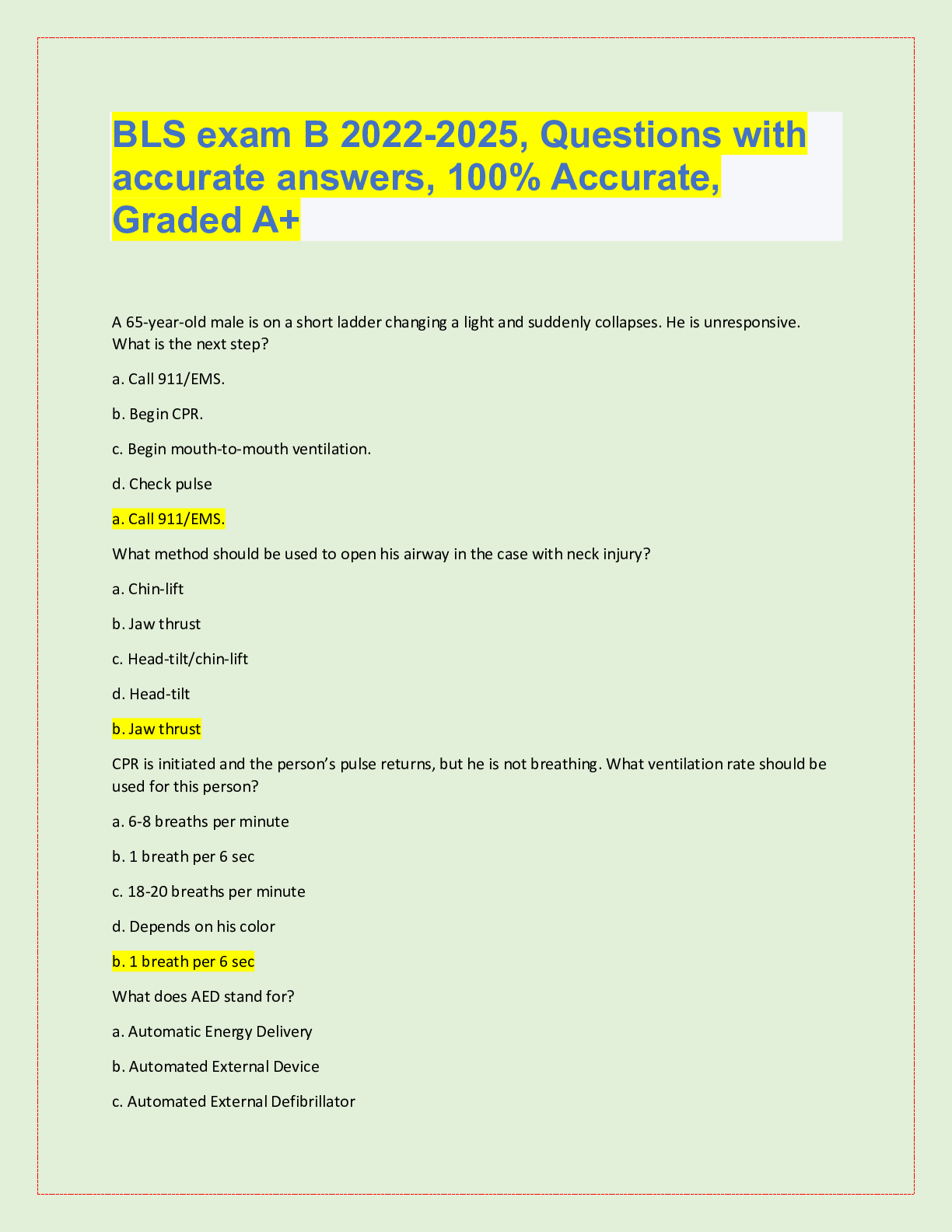
CAADC PRACTICE EXAM Questions and
answers, rated A+. latest version.
What are the Diagnostic Criteria for Panic Disorder without Agoraphobia?
All of the above
Recurrent and unexpected Panic Attacks.
Neither a subst
...
CAADC PRACTICE EXAM Questions and
answers, rated A+. latest version.
What are the Diagnostic Criteria for Panic Disorder without Agoraphobia?
All of the above
Recurrent and unexpected Panic Attacks.
Neither a substance nor a general medical condition accounts for the Panic Attacks.
No Agoraphobia present. - ✔✔-ALL OF THE ABOVE
An individual who has lost control of their drinking (alcohol) and is unable to stop or cut down despite
serious negative health consequences and the loss of valued activities or relationships, seems to be
suffering from:
Alcohol dependency
Codependent personality disorder
Alcohol abuse
Fetal alcohol syndrome - ✔✔-ALCOHOL DEPENDENCY
A commonly used instrument in psychological assessment which obtains a diagnosis by testing such
indices as anxiety, paranoia, depression, and gender issues:
Thematic Apperception Test
Luria-Nebraska Test
MMPI
Korsakoff's Psychosis Test - ✔✔-MMPI
A client has a history of depression, mood swings, and problems with his body image. He is an exercise
junkie and hits the gym at least twice a day even when he is sick. One day he asks if you can refer him to
a physician that can prescribe some pills to help him control his weight. You should suspect:
Performance anxiety
An eating disorder
Chemical dependency
A metabolic imbalance - ✔✔-AN EATING DISORDER
The diagnosis of Panic Disorder in children is controversial, with some arguing that they do not have
panic attacks because:
Children are not capable of making internal, catastrophic interpretations of physical symptoms
Their nervous systems are not fully developed
Children don't have as many fears as adults
They have much less life experience - ✔✔-Children are not capable of making internal, catastrophic
interpretations of physical symptoms
When performing a psychosocial assessment on an infant by questioning her parents, what data
gathered during the session would have the greatest significance?
Information about the mother's pregnancy, including any drug use
Information about the infant's development
Information about the infant's caregivers
Information about the infant's siblings - ✔✔-The correct answer: Information about the infant's
development
Pure brain!
The psychosocial deals specifically with the psychological and social development of the individual�therefore the best information from the parents of an infant would have to consist of developmental
information about the infant. While the other choices consist of information that would be helpful in
making the psychosocial assessment, the information provided by a developmental history from the
parents would be of the greatest value.
For a diagnosis of delusional disorder:
At least three non-bizarre delusions must have occurred for at least two weeks
One or more non-bizarre delusions must have occurred for at least a month
More than one bizarre delusion must have occurred for at least two months
One or more bizarre delusions must have occurred for at least six months - ✔✔-One or more non�bizarre delusions must have occurred for at least a month
As an addictions counselor your are legally and ethically, bound to take reasonable steps to prevent a
client's threatened suicide. These steps depend on the degree of risk and your client's willingness and
ability to follow your recommendations. When the risk is not immediate, these recommendations could
be to:
Develop a no-suicide contract
Consider hospitalization
All answers are correct
Involve the client's support systems and relieve isolation. - ✔✔-All answers are correct
Procedures or instruments such as inventories, questionnaires, checklists, structured interviews, etc.
which are the basis developing and forming a judgment regarding the specific nature extent of the
client's problems.
Testing tools
Assessment tools
Diagnostic tools
Screening tools - ✔✔-Assessment tool
Assessment tools are the procedures or instruments such as inventories, questionnaires, checklists,
structured interviews, etc. which are the basis developing and forming judgment regarding the specific
nature extent of the client's problems.
Achievement tests are different from ability tests because:
Achievement tests are less related to school subjects than are ability tests
Achievement tests are more related to school subjects than are ability tests
Ability tests access what a client already knows
Ability tests access past performance - ✔✔-Achievement tests are more related to school subjects than
are ability tests
When formulating a diagnosis in counseling, the counselor must bear in mind that
Diagnosis is a function of the value judgments of the particular counselor
it is important to obtain a consensus of not less than three of your colleagues before submitting an
official diagnosis
Diagnoses are useful primarily for insurance and billing purposes but of little or no use when it comes to
treatment
culture affects the manner in which clients' problems are defined. - ✔✔-culture affects the manner in
which clients' problems are defined.
This is a psychological assessment tool which presents a set of ambiguous stimuli to an individual:
Projective test
Intelligence test
Achievement test
Personality inventory - ✔✔-Projective test
A woman presents to your office dressed very provocatively. Her emotions seem superficial, she cries
easily and she notes that, recently, her husband has not been paying attention to her. The most likely
tentative diagnosis is:
Schizotypal Personality Disorder
Adjustment Disorder with Depressed Mood
Histrionic Personality Disorder
Borderline Personality Disorder - ✔✔-Histrionic Personality Disorder
A standard criteria for admission to an inpatient program or a residential program is:
A court order
A polysubstance dependence
3 DUI convictions within 5 years
A need for 24 hour supervision - ✔✔-A need for 24 hour supervision
The first session or first initial interview is mainly intended to:
Work with the patient to determine what his or her treatment expectations might be
Determine if the patient is appropriate and ready for treatment
Work with the patient by showing him or her that significant change can happen with the first session
Get the patient started by the creation of a formal contract - ✔✔-Work with the patient to determine
what his or her treatment expectations might be
A Korean client comes to your practice; you are unfamiliar with Korean customs and beliefs. The first
thing you should do is to:
Postpone therapy with the client until you have read up on Wicca culture
Indicate to the client that you are unfamiliar with her cultural background
Say nothing, but continue therapy
Refer the client to someone with a similar background - ✔✔-Indicate to the client that you are
unfamiliar with her cultural background
An ethical practitioner does not intentionally practice outside his/her major areas of competence, and
makes it his/her business to attempt to objectively assess where his/her deficits lie. Since all clinical
problems exist in particular contexts, however, the practitioner must attempt to distinguish general
clinical principles that transcend particular contexts and "micro-competencies" that are needed to work
effectively with particular client populations. In addition, competence must be evaluated against a
constantly changing context of existing knowledge in a particular field. The practitioner is advised to be
honest with his/her client regarding his/her lack of knowledge in a particular area.
When dealing with crisis intervention, a addictions professional should FIRST:
Do a "reality check" with the patient
Present a rational explanation to the patient
Go with the patient's feelings regarding the traumatic experience
Talk with the patient about future goals and objectives to keep him focused - ✔✔-Go with the patient's
feelings regarding the traumatic experience
Which is not a repercussion of compliance with HIPAA standards?
Eliminate redundant paperwork
Allow remote access to records
Streamline operations
Increased exposure to lawsuits - ✔✔-Increased exposure to lawsuits
A 28-year-old woman comes to your agency, indicating that she is ready to cash in her chips. She is
depressed, but also recognizes that she needs help. She really seems upset, but doesn't seem to have a
plan to commit suicide at this time. She has a support network consisting of her husband and his
parents. To protect the safety of this patient you might first:
Establish rapport and have your secretary call her husband
Try some self-disclosure with the patient, indicating that everyone feels down in the dumps from time
to time
Don't mess around. Call 911 and get her into a hospital ASAP
Since she does not have a specific plan, work with the patient on writing a no-suicide agreement - ✔✔-
Since she does not have a specific plan, work with the patient on writing a no-suicide agreement
For an intense, chronic, dual disorder the client probably will have:
Some treatment complications, to need more care, and will progress in TX more slowly
No treatment complications, to need less medical care, and will progress quickly in TX
Extensive treatment complications, to need more medical care, and will progress slowly
Few treatment complications, to need some medical care, and will progress in TX - ✔✔-Extensive
treatment complications, to need more medical care, and will progress slowly
During the course of working with a client, you discover that he cannot perform sexually. As an
addictions counselor you would: (Choose the BEST answer)
Make a referral to a Psychiatrist
Make a referral to a Mental Health Professional
Make a referral to Medical Doctor
Make a referral to a Sex Therapist - ✔✔-Make a referral to Medical Doctor
Mary is three months pregnant and wants to quit smoking. She says she currently smokes a pack of
cigarettes a day. You should refer Mary to: (Choose the BEST answer)
Her nearest pharmacy for nicotine patches or gum
A medical doctor
Social services
A psychologist - ✔✔-A medical doctor
A client of yours was not hired for a position after the employer discovered that he is a recovering
alcoholic. You feel that your client would be an excellent candidate for the job and know that he has
been sober for over a year. What should you do?
Offer your client a job working with you
Offer to help your client sue the employer for discrimination
Discuss other employment options with your client
Write the employer a letter, with the client's consent, explaining why he would be a good candidate for
the position - ✔✔-Write the employer a letter, with the client's consent, explaining why he would be a
good candidate for the position
You are an intake counselor working in a drug treatment facility. When you screen for suicide potential,
your most important concern should be lethal plan, means, and opportunity. When you identify that the
client in front of you presents these qualities you should: (Choose the BEST answer)
Contact her family in order to provide her support and taking steps to maintain her safety
Contact your supervisor, to maintain her safety
Call the police to have her Baker Acted into protective custody to maintain her safety
Begin a crisis intervention, taking steps to maintain her safety - ✔✔-Begin a crisis intervention, taking
steps to maintain her safety
During the screening appointment, the client sitting across from you begins to tell you that he has had
to put aluminum foil over his windows to block the radio transmissions, and stop the voices. As an
Addictions Counselor you should:
Terminate the interview and arrange for this client to be screened and evaluated by a mental health
counselor
Following the interview, arrange for this client to be screened and evaluated at a mental health crisis
unit
Following the interview, give this client a referral to a mental health provider
Terminate the interview and write an evaluation that indicates that this client is not appropriate for
treatment at this time - ✔✔-Following the interview, arrange for this client to be screened and
evaluated at a mental health crisis unit
Any client that manifests an indication of a serious mental health issue or problem needs to be assessed
by competent mental health providers. Being an addictions counselor does NOT qualify one to deal with
schizophrenia. Before any treatment, a client with mental health problems MUST be stabilized prior to
addictions treatment.
What is the best way to respond to a client who is dissatisfied with the way her counseling is
progressing?
discuss her concerns and make necessary changes
refer her to a new counselor
confront her resistance
terminate her counseling - ✔✔-discuss her concerns and make necessary changes
Your client has been married to a substance user for twelve years. He tells you that he had always used
sleeping pills and enjoyed an occasional cocktail, but that recently he has been using a gram of cocaine
each week. He has begun taking cash advances on their credit cards and writing bad checks. The MOST
appropriate referral for this client would be: (Choose the BEST answer) A referral to
A referral to Narcanon
A referral to Alcoholics Anonymous
A referral to Narcotics Anonymous
A referral to CoDA - ✔✔-A referral to Narcanon
This group is targeted to dealing with those involved with cocaine
One of your clients is a 40 year old chronic alcoholic male, a veteran of the USMC. He has begun
treatment after a family intervention. During group he has expressed his anger towards his employer,
and his coworkers, whom he feels is treating him unfairly. This client, when he was drinking was abusive
to his wife and children. You know that he is a hunter, and has firearms in the home. He has become
withdrawn and sullen. According to his assessment he has few hobbies or outside interests. He often
disagrees with other group members and is argumentative. Based on these observations, and in
reviewing all of these factors you are concerned that he may be: (Choose the BEST answer)
Dangerous to others in his workplace, and make a referral for an evaluation by a Mental Health
Counselor
Secretly drinking or using drugs. You would do a random drug screen
Demonstrating Post Acute Withdrawal Syndrome
In the midst of a relapse episode, and staff him with the treatment team - ✔✔-Dangerous to others in
his workplace, and make a referral for an evaluation by a Mental Health Counselor
Based on these observations, and in reviewing all of these factors you are concerned that he may be
dangerous to others in his workplace, and make a referral for an evaluation by a Mental Health
Counselor.
One of your clients witnessed a severe accident in which individuals were killed and badly injured.
During group, about a month following the accident, he discloses that he has been having vivid physical
reactions which include feelings of panic, shortness of breath, sweating, a tightness in his chest and
palpitations. As an addictions counselor you would recognize these symptoms as: (Choose the BEST
answer)
Possible evidence of a Schizoid Disorder and make a referral to a mental health professional for an
evaluation
Possible evidence of a health disorder and make a referral to a medical health professional for an
evaluation
Possible evidence of Post Traumatic Stress Disorder and make a referral to a mental health professional
for an evaluation
Possible evidence of Depression and make a referral to a mental health professional for an evaluation -
✔✔-Possible evidence of Post Traumatic Stress Disorder and make a referral to a mental health
professional for an evaluation
These symptoms, feelings of panic, shortness of breath, sweating, a tightness in his chest and
palpitations are possible evidence of Post Traumatic Stress Disorder, and would justify a referral to a
mental health professional for an evaluation.
Which of these clients most need a referral to a physician?
A 25 year old female who has relapsed using crack cocaine following a miscarriage
A 53 year old woman grieving for a longer than normal period for her deceased husband
A 47 year old man with a history of depression who suddenly exhibits bouts of rage
A 12 year old boy who has been using inhalants - ✔✔-A 47 year old man with a history of depression
who suddenly exhibits bouts of rage
The DSM-5 defines "Psychological Stressor" as:
A chemical or biological agent that aggravates a symptoms of a mental disorder.
Any emotional or physical factor that disrupts the normal physiological, cognitive, emotional, or
behavioral balance of an individual.
An early or premonitory sign or symptom of a disorder.
Any life event or life change that may be associated temporally (and perhaps causally) with the onset,
occurrence, or exacerbation of a mental disorder. - ✔✔-Any life event or life change that may be
associated temporally (and perhaps causally) with the onset, occurrence, or exacerbation of a mental
disorder.
The DSM-5 defines "Psychological Stressor" as: Any life event or life change that may be associated
temporally (and perhaps causally) with the onset, occurrence, or exacerbation of a mental disorder. For
example, the diagnosis of Conversion Disorder (Functional Neurological Symptom Disorder) requires the
examiner to specify: with psychological stressor (specify stressor) or without psychological stressor.
The DSM-5 defines "Macropsia" as:
The visual perception that objects are larger than they actually are.
The misinterpretation of a real external stimulus.
A hallucination involving sight, which may consist of formed images, such as of people, or of unformed
images, such as flashes of light.
Interpretation that things are smaller in proportion to the background landscape. - ✔✔-The visual
perception that objects are larger than they actually are.
In the DSM-5, the term "Macropsia" is defined as: The visual perception that objects are larger than they
actually are. Macropsis is different from micropsia, which the DSM-5 defines as the visual perception
that objects are smaller than they actually are. Macropsia is a diagnostic criteria under substance use
disorders, like Hallucinogen Persisting Perception Disorder.
The DSM-5 defines "Mood" as:
An exaggerated feeling of well-being, euphoria, or elation. A person experiencing mood may describe
feeling "high," "ecstatic," "on top of the world", or "up in the clouds".
An unpleasant emotion, such as sadness, anxiety, or irritability.
A pervasive and sustained emotion that colors the perception of the world.
A mental state that arises spontaneously rather than through conscious effort and is often accompanied
by physiological changes. - ✔✔-A pervasive and sustained emotion that colors the perception of the
world.
In the DSM-5, "Mood" is defined as: A pervasive and sustained emotion that colors the perception of the
world. Common examples of mood include depression, elation, anger, and anxiety. In contrast to affect,
which refers to more fluctuating changes in emotional "weather", mood refers to a pervasive and
sustained emotional "climate". Types of mood include dysphoric, elevated, euthymic, expansive, and
irritable.
The DSM-5 defines "Parasomnias" as:
Disorders involving the amount, quality, or timing of sleep.
Disorders of sleep involving abnormal behaviors or physiological events occurring during sleep or sleep�wake transitions.
Undesired daytime sleep episodes caused by excessive sleepiness.
Primary disorders of sleep or wakefulness characterized by insomnia or hypersomnia. - ✔✔-Primary
disorders of sleep or wakefulness characterized by insomnia or hypersomnia.
The DSM-5 defines "Parasomnias" as: Disorders of sleep involving abnormal behaviors or physiological
events occurring during sleep or sleep-wake transitions. Parasomnias are different from dyssomnias,
which the DSM-5 defines as primary disorders of sleep or wakefulness characterized by insomnia or
hypersomnia as the major presenting symptom. Dyssomnias are disorders of the amount, quality, or
timing of sleep.
Disorders of sleep involving abnormal behaviors or physiological events occurring during sleep or sleep�wake transitions. - ✔✔-Parasomnias
DSM-5 defines as primary disorders of sleep or wakefulness characterized by insomnia or hypersomnia
as the major presenting symptom. Disorders of the amount, quality, or timing of sleep - ✔✔-Dyssomnias
The DSM-5 defines "Auditory Hallucination" as:
A hallucination involving the perception of sound, most commonly of voice.
A sensory perception that has the compelling sense of reality of a true perception but that occurs
without external stimulation of the relevant sensory organ.
A hallucination when one may continue to speak even though no one is listening.
A misperception of a real external stimulus, such as hearing the rustling of leaves as the sound of
voices. - ✔✔-The DSM-5 defines "Auditory Hallucination" as: A hallucination involving the perception of
sound, most commonly of voice.
In general, consist of perception-like experiences with the clarity and impact of a true perception but
without the external stimulation of the relevant sensory organ. One person may recognize the false
sensory experience, whereas another may be convinced that the experience is grounded in reality. Are
further categorized as: auditory, geometric, visual, gustatory, mood-congruent, mood-incongruent,
olfactory, somatic, tactile, and visual. - ✔✔-Hallucinations
The DSM-5 defines "Olfactory Hallucination" as:
An imagined perception that people are conspiring to steal one's nose (or other sensory body part).
An imagined perception where one envisions people having multiple noses or lacking one altogether.
An imagined perception involving the sensation of electric shocks.
An imagined perception involving odor, such as burning rubber or decaying fish. - ✔✔-An imagined
perception involving odor, such as burning rubber or decaying fish.
The DSM-5 defines "Echolalia" as:
The pathological, parrot-like, and apparently senseless repetition (echoing) of a word or phrase just
spoken by another person.
A nearly continuous flow of accelerated speech with abrupt changes from topic to topic.
Repetition by imitation of the movements of another. The action is not a willed or voluntary one and
has a semiautomatic and uncontrollable quality.
Discordance between affective expression and the content of speech or ideation. - ✔✔-The
pathological, parrot-like, and apparently senseless repetition (echoing) of a word or phrase just spoken
by another person.
Echolalia falls under Criterion B - restricted, repetitive patterns of behavior, interests, or activities
required to diagnose Autism Spectrum Disorder. Echolalia is also one of the behaviors that characterizes
complex vocal tics necessary in the diagnosis of Tourette's Disorder and Persistent (Chronic) Motor or
Vocal Tic Disorder.
The DSM-5 defines "Hypervigilance" as:
An enhanced state of sensory sensitivity accompanied by an exaggerated intensity of behaviors whose
purpose is to detect threats.
A state of unresponsiveness with immobility and mutism.
An increased auditory perception.
The condition of maintaining an abnormally low awareness of environmental stimuli. - ✔✔-An
enhanced state of sensory sensitivity accompanied by an exaggerated intensity of behaviors whose
purpose is to detect threats. Also accompanied by a state of increased anxiety which can cause
exhaustion. Other symptoms include abnormally increased arousal, a high responsiveness to stimuli, and
a continual scanning of the environment for threats. In hypervigilance, there is a perpetual scanning of
the environment to search for sights, sounds, people, behaviors, smells, or anything else that is
reminiscent of threat or trauma. The individual is placed on high alert in order to be certain danger is
not near. Hypervigilance can lead to a variety of obsessive behavior patterns, as well as producing
difficulties with social interaction and relationships.
The DSM-5 defines "Expansive Mood" as:
An unpleasant mood, such as sadness, anxiety, or irritability.
Mood in the "normal" range, which implies the absence of depressed or elevated mood.
An exaggerated feeling of well-being or elation.
Lack of restraint in expressing one's feelings, frequently with an overvaluation of one's significance or
importance. - ✔✔-Lack of restraint in expressing one's feelings, frequently with an overvaluation of
one's significance or importance.
Mood is further defined as a pervasive and sustained emotion that colors the perception of the world.
Examples of mood include depression, elation, anger, and anxiety whereas types of mood include
dysphoric, elevated, euthymic, expansive, and irritable.
The DSM-5 defines "Micropsia" as:
The visual perception that objects are smaller than they actually are.
The interpretation that objects are larger than they appear to be.
A hallucination involving sight, which may consist of formed images, such as of people, or of unformed
images, such as flashes of light.
The misinterpretation of a real external stimulus. - ✔✔-The visual perception that objects are smaller
than they actually are.
Micropsia is a diagnostic criteria under substance use disorders, like Hallucinogen Persisting Perception
Disorder.
The DSM-5 defines "Tic" as:
Stereotyped or repetitive/rhythmic motor movements, use of objects, or speech.
Repetitive, seemingly driven, and nonfunctional motor behavior.
The manifestation of impaired skills requiring motor coordination.
An involuntary, sudden, rapid, recurrent, nonrhythmic motor movement or vocalization. - ✔✔-An
involuntary, sudden, rapid, recurrent, nonrhythmic motor movement or vocalization.
Tics are often associated under neurodevelopmental motor disorders that include Developmental
Coordination Disorder, Stereotypic Movement Disorder, Tourette's Disorder, Persistent (Chronic) Motor
or Vocal Tic Disorder, and Provisional Tic Disorder. The duration, presumed etiology, and clinical
presentation define the specific tic disorder that is diagnosed;
Diagnostic Criterion A states that "Both multiple motor and one or more vocal tics have been present at
some time during the illness, although not necessarily concurrently." - ✔✔-Tourette's Disorder
Criterion A states that "Single or multiple motor OR vocal tics have been present during the illness, but
NOT BOTH motor and vocal." - ✔✔-Persistent Motor or Vocal Tic Disorder
Criterion A states that there should be a "single or multiple motor and/or vocal tics." - ✔✔-Provisional
Tic Disorder
The DSM-5 defines "Irritable Mood" as:
A pervasive and sustained emotion that colors the perception of the world.
An unpleasant mood, such as anxiety, or irritability.
Mood with the absence of depressed or elevated affect.
Easily annoyed and provoked to anger. - ✔✔-Easily annoyed and provoked to anger.
The DSM-5 defines "Late Insomnia" as:
Awakening in the middle of the night followed by eventual return t
[Show More]



![Preview of Deviant Behavior, 12th Edition, By Alex Thio, Jim Taylor, Martin Schwartz [PDF] [eBook]](https://scholarfriends.com/storage/[PDF] [eBook] for Deviant Behavior, 12th Edition, By Alex Thio, Jim Taylor, Martin Schwartz.png)







![Preview of Introduction to Social Problems, 10th Edition, By Thomas J Sullivan, [PDF] [eBook]](https://scholarfriends.com/storage/[PDF] [eBook] for Introduction to Social Problems, 10th Edition, By Thomas J Sullivan,.png)


![Preview of Consumer behavior, 12th Edition, By Leon Schiffman, Joseph Wisenblit [PDF] [eBook]](https://scholarfriends.com/storage/[PDF] [eBook] for Consumer behavior, 12th Edition, By Leon Schiffman, Joseph Wisenblit.png)