CAADC Top Exam Questions with
accurate answers, 100% accurate, rated
A
1. _________is the essential first step in determining the possible causes of
addiction for the person and the most appropriate treatment modal
...
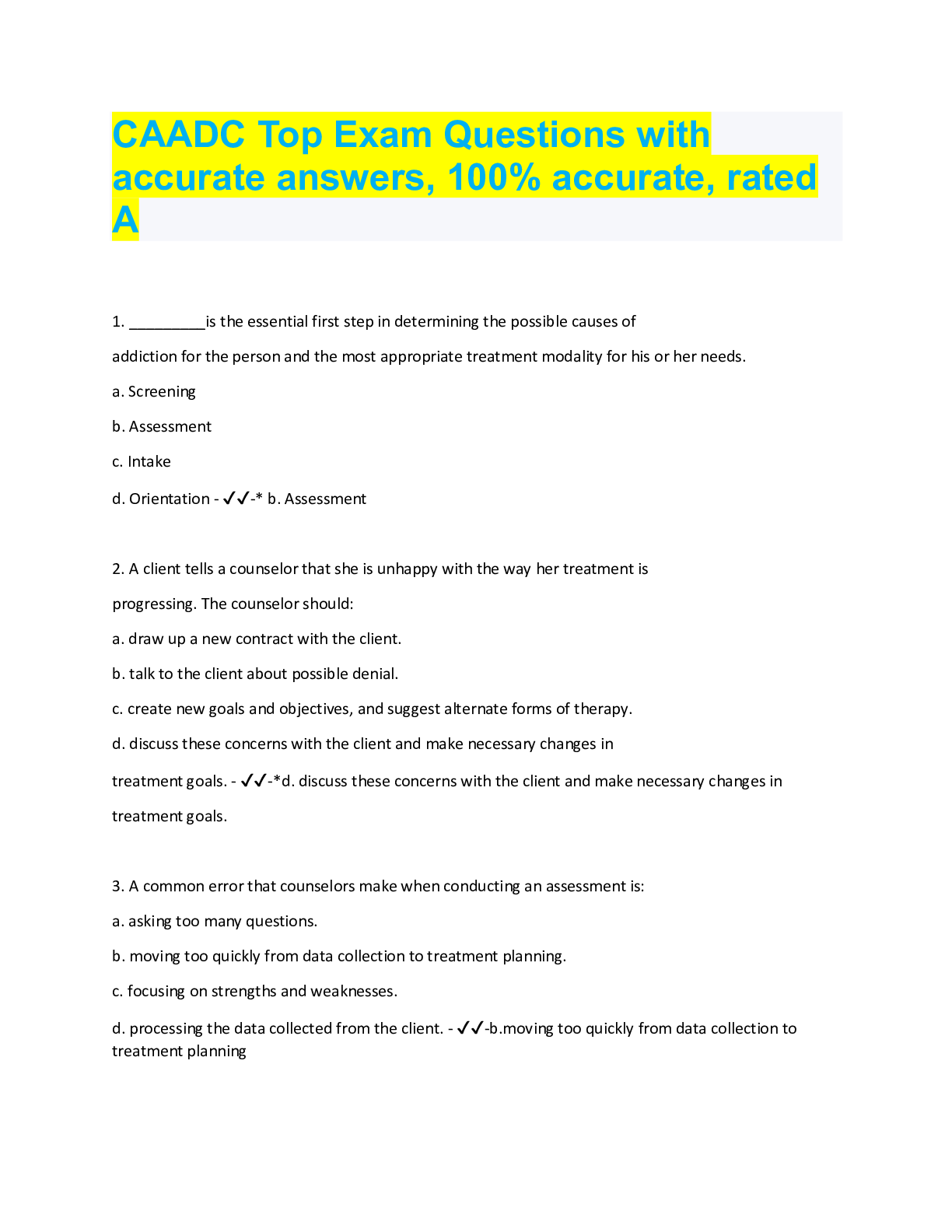
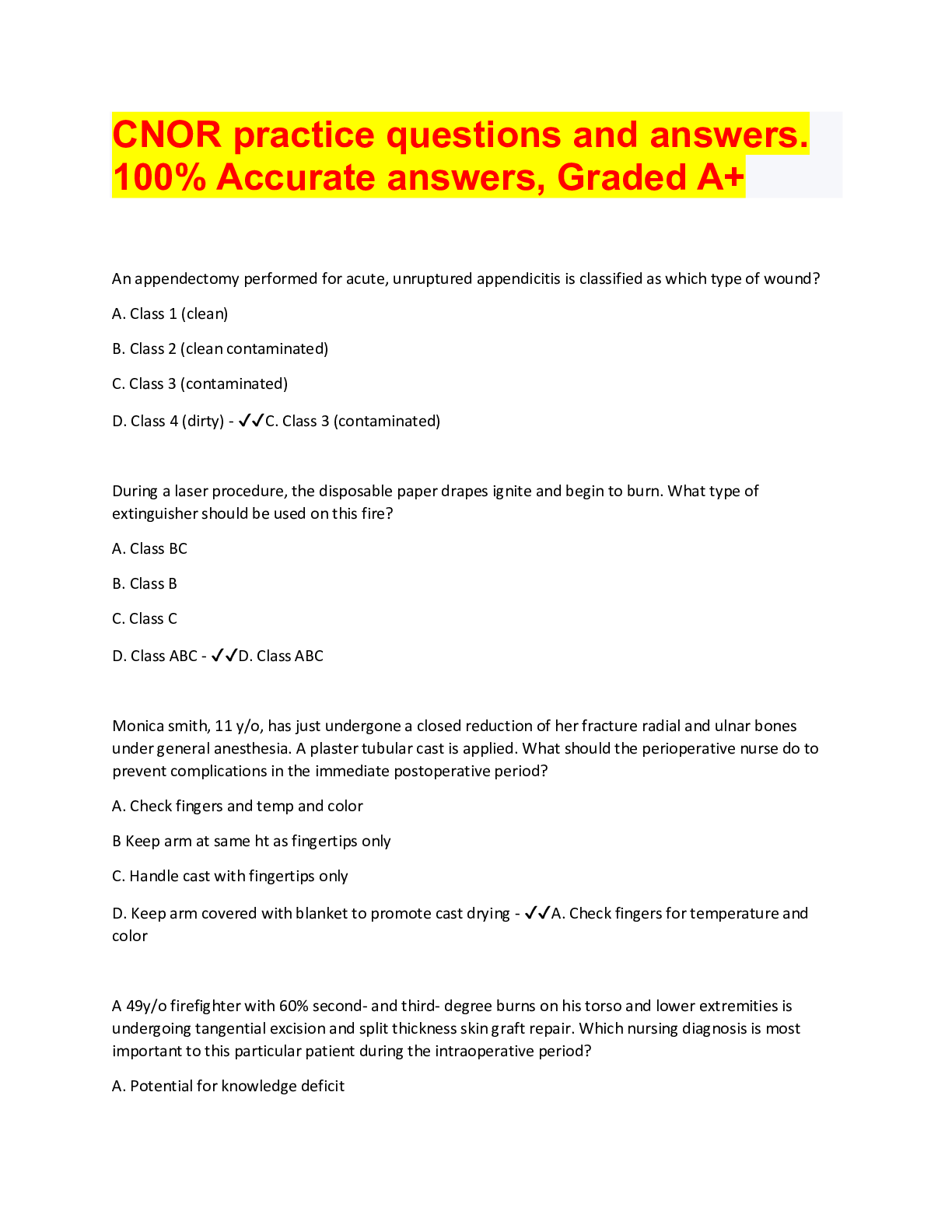
CAADC Top Exam Questions with
accurate answers, 100% accurate, rated
A
1. _________is the essential first step in determining the possible causes of
addiction for the person and the most appropriate treatment modality for his or her needs.
a. Screening
b. Assessment
c. Intake
d. Orientation - ✔✔-* b. Assessment
2. A client tells a counselor that she is unhappy with the way her treatment is
progressing. The counselor should:
a. draw up a new contract with the client.
b. talk to the client about possible denial.
c. create new goals and objectives, and suggest alternate forms of therapy.
d. discuss these concerns with the client and make necessary changes in
treatment goals. - ✔✔-*d. discuss these concerns with the client and make necessary changes in
treatment goals.
3. A common error that counselors make when conducting an assessment is:
a. asking too many questions.
b. moving too quickly from data collection to treatment planning.
c. focusing on strengths and weaknesses.
d. processing the data collected from the client. - ✔✔-b.moving too quickly from data collection to
treatment planning
4. A female client reports that she has some concerns about the relationship
between her husband and her 14-year-old daughter from a previous
marriage. She reports that her husband and daughter frequently argue,
that her daughter refuses to take direction from her stepfather, mid that her
daughter regularly complains about her stepfather's "faults" and describes
how her biological father is better. The MOST relevant professional to
whom a referral should be made is a:
a. Social worker.
b. Clinical psychologist.
c. Licensed professional counselor.
d. Marriage and family therapist. - ✔✔-d. Marriage and family therapist
5. A key factor for counselors to consider is that in a counseling relationship,
the counselor has differential power. One of the best safeguards is:
a. to be alert to and understand the power relationship.
b. to utilize the differential power to motivate the client.
c. to realize the importance of this power in client interventions.
d. to use differential power to get the client to try new behaviors. - ✔✔-a. to be alert to and understand
the power relationship.
6. A pretreatment period is frequently the result of waiting lists or client
reluctance to become fully engaged in primary treatment. What might be a
danger of this pretreatment period?
a. The pretreatment period may be when clients lose interest in treatment.
b. A client may receive enough help so as not to need the services of the
program or agency.
c. Successful pretreatment may result in a client needing services that an
agency doesn't have, thus losing the potential admission.
d. There is really no danger with pretreatment - recovery will require much
more programming than pretreatment can offer. - ✔✔-a. The pretreatment period may be when clients
lose interest in treatment.
7. According,to Marlatt's model of the relapse process, which of the following statements is NOT true?
a. Clients should be taught skills for anticipating, avoiding, and coping with
their personal high-risk situations.
b. Clients should be taught constructive responses to cope with lapses when
they do occur.
c. Clients should be helped to recognize that one or more temporary lapses
are likely to occur and are permitted.
d. Any positive expectations that clients have about drug use should be
countered with reminders about the lows that follow the highs and about
the long-term negative consequences of substance abuse. - ✔✔-c. Clients should be helped to recognize
that one or more temporary lapses
are likely to occur and are permitted.
8. According to the DSM-IV-TR, all of the following are criteria for psychoactive substance dependence
EXCEPT:
a. substance often taken in larger amounts than the person intended.
b. marked lack of initiative, interest or energy.
c. frequent intoxication when expected to fulfill major role obligations.
d. one or more unsuccessful efforts to cut down substance use. - ✔✔-b. marked lack of initiative,
interest or energy.
9. All of the following are goals of person-centered therapy EXCEPT:
a. teaching clients to formulate and carry out plans to change their behavior.
b. focusing on the person instead of the presenting problem.
c. assisting clients in enhancing their coping skills.
d. individualizing the treatment plan. - ✔✔-a. teaching clients to formulate and carry out plans to
change their behavior.
10. Bob is a case manager in an intensive inpatient treatment facility. He
recently was assigned a client, Mary, who presents not only with
alcoholism but has also been diagnosed with AIDS. To assist Mary in her
treatment and recovery needs, Bob would probably need to have
knowledge of all of the following areas EXCEPT:
a. AIDS epidemiology and transmission routes.
b. the disease's clinical progression.
c. new medication used in treatment regimens.
d. available social services for AIDS clients. - ✔✔-c. new medication used in treatment regimens.
11. Therapeutic communities differ from Synanon because:
a. these communities try to return clients to society.
b. these communities are based on individual psychotherapy rather than
group encounter.
c. these communities keep the patients busy rather than engaging in
contemplative thought.
d. these communities rely on professional psychologists rather than former
addicts or abusers. - ✔✔-a. these communities try to return clients to society.
12. During the screening process, a critical task that the counselor has is to:
a. complete a mental status exam.
b. engage the client's family in treatment.
c. develop a treatment plan.
d. establish rapport with the client. - ✔✔-d. establish rapport with the client.
13. During the assessment process, your alcohol and tranquilizer abusing
client reveals a history of self-destructiveness when frustrated and an
inability to delay impulses. The MOST appropriate assessment battery in
this case is:
a. the Beck Depression Scale , the MAST test, and the MMPI.
b. the Beck Depression Scale , the MAST test, and the Stanford-Binet.
c. the MAST test, the Strong-Campbell, and the Stanford-Binet.
d. the MMPI, the Strong-Campbell, and the Stanford-Binet. - ✔✔-a. the Beck Depression Scale , the
MAST test, and the MMPI
14. The primary purpose of the screening process is to:
a. develop a treatment plan.
b. have the client sign appropriate documents.
c. determine one's appropriateness and eligibility for admission.
d. identify the client's strengths and weaknesses. - ✔✔-c. determine one's appropriateness and
eligibility for admission.
15. Effective case management for persons in need of multiple services
requires:
a. monitoring, feedback, and evaluation of services.
b. frequent face-to-face contact with the client.
c collaboration with family members.
d. careful matching with appropriate 12-step groups. - ✔✔-a. monitoring, feedback, and evaluation of
services.
16. In determining whether a chemically dependent patient should be treated in an inpatient or
outpatient program, all of the following should be considered EXCEPT:
a. whether the patient has a history of sobriety during the last several years.
b. whether the patient's job and family are likely to give him another chance if
this treatment fails.
c. whether the patient has family support for sobriety.
d. whether the patient has a history of failed treatment on an outpatient or
inpatient basis. - ✔✔-b. whether the patient's job and family are likely to give him another chance if
this treatment fails.
17. Alcohol decreases resistance to HIV infection by:
a. compromising T-cell functions.
b. impairing frontal cortical functions.
c. increasing serotonin levels in the synaptic gap.
d. decreasing cardiopulmonary functioning. - ✔✔-a. compromising T-cell functions.
18. It is crucial for the case manager to be aware of what may inhibit
minorities' participation in the substance abuse treatment continuum.
Suppose that you are a case manager, working in an outpatient program
with a Somali client. AA is an integral part of your program, yet you are
aware of the fact that while "accepting one's powerlessness" is a central
tenet of 12-Step self-help programs, members of oppressed groups may
not accept it, given their own societal powerlessness. What would be the
best thing to do in such a case?
a. Ask the client to participate, never-the-less, and suggest he simply "do his
best" when dealing with the issue of powerlessness.
b. Let the client know that participation in AA is mandatory, and that if he
doesn't participate, he could be discharged for "noncompliance."
c. Be sensitive to such cultural differences and seek out other recovery
resources that are relevant to the individual's values.
d. Seek out another Somali who is in a local AA group and ask the he or she
sponsor your client. - ✔✔-c. Be sensitive to such cultural differences and seek out other recovery
resources that are relevant to the individual's values.
19. It is important to understand clients and their expectations for counseling.
Clients coming in for treatment carry with them both helpful and harmful
expectations. Which of the following is a harmful client expectation?
a. "This counselor is a stranger, but maybe I can learn to trust her."
b. "My counselor will direct me to do what I need to do, and everything will be
OK."
c. "My counselor will be a resource that I can use to resolve my problems."
d. "The counselor's main concern and responsibility is to help me achieve my
goals and objectives." - ✔✔-b. "My counselor will direct me to do what I need to do, and everything will
be
OK."
20. Joe is a 27-year old addict who has begun counseling, but has not yet
been able to give up using drugs. During one session, he tells his
counselor that he is beginning to feel that "it is useless to try to stop," and
that "sometimes life is not worth living." The counselor is concerned that
Joe could be suicidal. The counselor should:
a. assess Joe's potential for suicide without directly asking him about suicide
plans, but assess his high-risk factors.
b. assess Joe's potential for suicide by asking him about his intent, and
evaluating high risk factors.
c. determine if Joe has a gun or other weapon.
d. initiate involuntary hospitalization procedures. - ✔✔-b. assess Joe's potential for suicide by asking him
about his intent, and
evaluating high risk factors.
21. If the orientation process is neglected or incomplete a client may:
a. remain in denial about his/her addiction.
b. have incorrect information and unanswered questions about the program.
c. need to be referred to an outside agency.
d. need additional education about addiction. - ✔✔-b. have incorrect information and unanswered
questions about the program.
22. is one of case management's hallmark characteristics.
a. Advocacy
b. Cooperation
c. Stabilization
d. Flexibility - ✔✔-a. Advocacy
23. When language is a barrier to treatment planning, this situation can be
overcome by:
a. employing an interpreter.
jb. training the counselor in cultural sensitivity.
c. requiring the client to utilize a family member as an interpreter.
d. getting the client a language tutor. - ✔✔-a. employing an interpreter.
24. The first contact that a potential client would have with an agency would
g| likely be for the purpose of:
a. family therapy.
b. education.
c. psychosocial assessment.
d. screening. - ✔✔-d. screening.
25. The MOST SIGNIFICANT barrier to effective treatment for alcohol and
other drug abuse for single parents is lack of:
a. job skills.
b. child care services.
c. educational training.
d. primary health care. - ✔✔-b. child care services.
26. Sarah, a counselor in a drug treatment center, grew up in an alcoholic home and still has strained
relationships. Which statement BEST describes Sarah's situation?
a. Sarah can expect her unresolved conflicts to rise to the surface because of
her work in the treatment center.
b. Sarah can resolve her personal pain by working professionally with
addicted family units in a treatment center.
c. Sarah may be more comfortable with her clients because she is familiar
with their behavior. d. Sarah may have unfinished business with her parents. - ✔✔-a. Sarah can expect
her unresolved conflicts to rise to the surface because of
her work in the treatment center.
27. You are asked to see a client in the emergency room for a consultation. The nursing notes read:
pupils dilated; gooseflesh; lacrimation; muscle jerks; flu syndrome; vomiting; diarrhea; nervousness;
yawning; and severe anxiety. You conclude that the client is withdrawing from:
a. Hallucinogens.
b. CNS depressants.
c. Opioids.
d. Dextroamphetamines. - ✔✔-c. Opioids.
28. The organization founded as an alternative to programs with spiritual overtones, whose publication
is called "The Small Book," is:
a. Rational Recovery.
b. Secular Organization for Sobriety.
c. Men and Women for Sobriety.
d. Codependents Anonymous. - ✔✔-a. Rational Recovery.
29. Effective communication occurs in groups when:
a. message receivers hear "you" messages.
b. message receivers do not speak.
c. message senders use third-person pronouns.
d. message senders use "I" messages. - ✔✔-d. message senders use "I" messages.
30. A single mother with three young children enters your clinic and begins to discuss her current drug
use. She tells you that she hasn't been home for several days and has left the 8 year old in charge. What
do you do?
a. Contact child protective services to report this incident.
b. Explain to her the limits of confidentiality regarding drug use.
c. Admit her for treatment and arrange childcare services.
d. Contact law enforcement to have her arrested for child abuse and neglect. - ✔✔-a. Contact child
protective services to report this incident.
31. One of the counselor's tasks is to guide the client in relating and
communicating in specific terms, rather than in general or abstract terms. That characteristic or ability is
called:
a. Confrontation.
b. Immediacy.
c. Potency.
d. Concreteness. - ✔✔-d. Concreteness.
32. One of the.earliest models for case management services in the criminal
justice system was created in 1972, when the White House launched a
demonstration program known as:
a. Treatment Alternatives to Street Crime (TASC).
b. Treatment Approaches for Criminal Offenders (TACO).
c. Treatment Resources for Chronic Repeat Offenders (TRCRO).
d. Helping Services for the Criminal Element (HSCE). - ✔✔-a. Treatment Alternatives to Street Crime
(TASC).
33. Ralph is a recovering alcoholic. He as been sober for several months, and
has managed to find gainful employment and re-establish family
relationships. He is in a twelve-step program as well as individual
counseling. One day, he arrives to a counseling session quite upset. He
reveals that he had a "slip" and drank a beer at a party. He did not get
drunk, but feels terribly remorseful and has promised himself that he will
not do it again. Which of the following is MOSTtrue?
a. Although Ralph did have a relapse, recovery should be easier the second
time around.
b. This constitutes a relapse, and Ralph may need to begin the recovery
process all over again.
c. Ralph should be reassured that this behavior is permissible as long as he
did not lose control and become drunk.
d. The counselor should talk to Ralph about the implications of dangerous
situations like this, but assure him that it is possible to continue his
recovery process. - ✔✔-d. The counselor should talk to Ralph about the implications of dangerous
situations like this, but assure him that it is possible to continue his
recovery process.
34. Record keeping is an important part of the counseling process. Which of the following best reflects
the type of information which should be kept in a client's record?
a. The name of an attending physician, referrals made, diagnostic procedures
used
b. Information about consultations, diagnosis, treatment, prognosis, and
progress
c. Names of family members, emergency numbers, DSM-IV-TR diagnosis
d. Personal notes, insurance information, treatment notes - ✔✔-b. Information about consultations,
diagnosis, treatment, prognosis, and
progress
35. Stress inoculation focuses primarily on:
a. increasing self-control.
b. increasing coping skills.
c. decreasing anxious responding.
d. decreasing negative thought patterns. - ✔✔-b. increasing
[Show More]