CADC exam (practice test) Questions
and answers, 100% Accurate, rated A+
1. It is considered unethical for a counselor to:
a. talk with a client any place other than the counseling office
b. treat client problems th
...
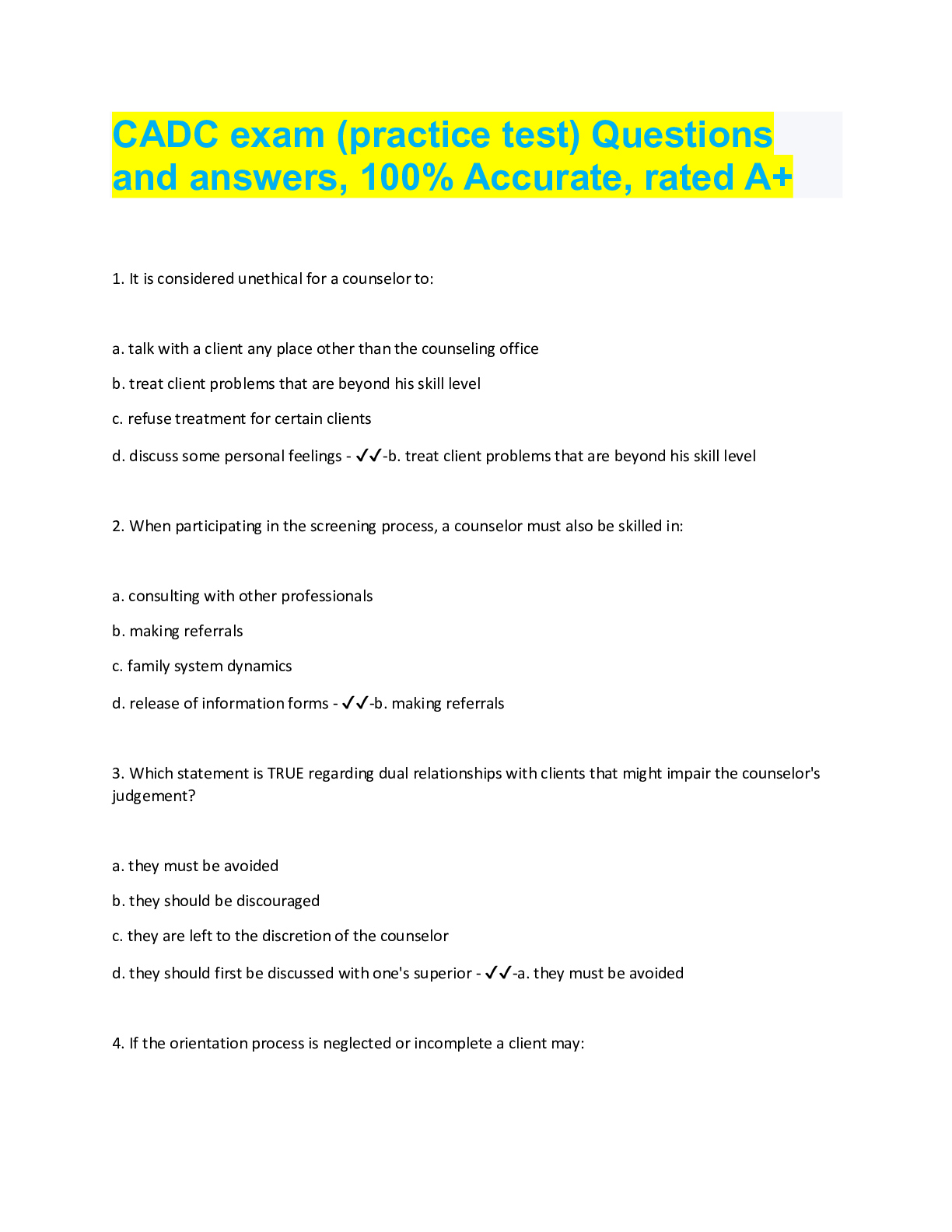
CADC exam (practice test) Questions
and answers, 100% Accurate, rated A+
1. It is considered unethical for a counselor to:
a. talk with a client any place other than the counseling office
b. treat client problems that are beyond his skill level
c. refuse treatment for certain clients
d. discuss some personal feelings - ✔✔-b. treat client problems that are beyond his skill level
2. When participating in the screening process, a counselor must also be skilled in:
a. consulting with other professionals
b. making referrals
c. family system dynamics
d. release of information forms - ✔✔-b. making referrals
3. Which statement is TRUE regarding dual relationships with clients that might impair the counselor's
judgement?
a. they must be avoided
b. they should be discouraged
c. they are left to the discretion of the counselor
d. they should first be discussed with one's superior - ✔✔-a. they must be avoided
4. If the orientation process is neglected or incomplete a client may:
a. remain in denial about his/her addiction and leave against staff advice
b. have incorrect information and unanswered questions about the program
c. need to be referred to an outside agency for additional counseling
d. need additional education about addiction and its effects on the body. - ✔✔-b. have incorrect
information and unanswered questions about the program
5. A common error that counselors make when conducting an assessment is:
a. processing the data collected from the client
b. asking too many questions and interrupting the client
c. moving too quickly from data collection to treatment planning
d. focusing on strengths and weaknesses rather than relationships - ✔✔-c. moving too quickly from data
collection to treatment planning
6. Which of the following is essential for successful recovery from addiction?
a. admitting to a drinking and/or drug problem
b. working all 12 steps of a 12-step program
c. inpatient treatment and aftercare
d. resolving family issues - ✔✔-a. admitting to a drinking and/or drug problem
7. Interventions by a group counselor should:
a. be governed by group content as outlined during the orientation process
b. address issues critical to the functioning of the group as a whole
c. disregard the group process when it is deemed necessary
d. only be made to halt potential violence - ✔✔-b. address issues critical to the functioning of the group
as a whole
8. When clients ask directly for advice, it is usually helpful for counselors to:
a. avoid offering advice, since it negatively effects communication with the client
b. encourage the client to explore various alternatives
c. discuss with the client his/her request for advice
d. give advice since it encourages independence in the counseling relationship - ✔✔-b. encourage the
client to explore various alternatives
9. Which of the following does NOT have to appear on a "Release of Information" form?
a. purpose of the release of information
b. name of the recipient of information
c. signature of counselor
d. signature of client - ✔✔-c. signature of counselor
10. A client experiences a crisis situation. As a counselor, your MOST important function is:
a. to solve the client's presenting problem
b. to refer him/her to the nearest psychiatrist
c. to help convert the emergency into a solvable problem
d. to try not to get the client any more upset than they already are - ✔✔-c. to help convert the
emergency into a solvable problem
11. While progress has been made, society still disapproves much more strongly of substance abuse by
women than by men. Which of the following statements is NOT true?
a. women have customarily been expected to live up to a higher standard of moral and social behavior
b. society perceives female substance abusers as promiscuous, immoral, and unfeminine
c. mothers bear the additional burden of guilt over how substance abuse has interfered with their
childrearing responsibilities
d. a number of roles traditionally deemed female - in particular, nurturing and maternal duties - are
perceived as incompatible with drug-affected behavior - ✔✔-c. mothers bear the additional burden of
guilt over how substance abuse has interfered with their childrearing responsibilities
12. Which of the following would be MOST appropriate in providing linkage between a treatment
program and AA?
a. counselors should take their clients to AA meetings
b. counselors should assign the client an AA sponsor
c. an AA representative should be invited to visit the program
d. counselors should visit AA meetings and have a list of meetings to share with clients - ✔✔-d.
counselors should visit AA meetings and have a list of meetings to share with clients
13. Concise and accurate reporting is necessary in order to:
a. assist in client education
b. ensure continuity of client care
c. demonstrate counselor competence
d. identify client strengths and weaknesses - ✔✔-b. ensure continuity of client care
14. Consultations are an important component of the treatment process because:
a. they are mandated by most funding sources
b. they are reviewed and deemed medically necessary
c. counselor's caseloads are generally too large to manage alone
d. input and information from others will assist the treatment process - ✔✔-d. input and information
from others will assist the treatment process
15. Which of the following bodily fluids has the highest risk of potential infection?
a. tears
b. breast milk
c. spinal fluid
d. vaginal secretions - ✔✔-d. vaginal secretions
16. Which of the following is an example of exploitation?
a. going to the same AA meeting as a former client
b. purposely buying groceries at a store that you know is owned by your client
c. leaking to the public the name of a celebrity who is in treatment at your facility
d. referring a client to someone you personally know for their aftercare sessions - ✔✔-c. leaking to the
public the name of a celebrity who is in treatment at your facility
17. In a crisis interview with a client, you are most concerned with:
a. the client's family dynamics as they relate to the specific dynamics of the crisis situation
b. getting all the information that you can from the client and available family members
c. focusing questions about the present situation and the client's means of coping with the stress
d. what your immediate response should be regardless of the cleint's response to questions - ✔✔-c.
focusing questions about the present situation and the client's means of coping with the stress
18. The style of counseling in which a counselor has made a decision to be committed to equality for all
people and acts to treat all people alike, regardless of race or cultural background, is known as:
a. cultural ignorance
b. covert (hidden) prejudice
c. overt racism and hostility
d. the "color-blind" counselor - ✔✔-d. the "color-blind" counselor
19. A person wants to accept a party invitation because he/she is very social but is concerned because
there will be a lot of drinking and he/she is a member of AA. He/she is experiencing a(an):
a. mixed blessing dilemma
b. approach-avoidance conflict
c. double-avoidance conflict
d. relapse conflict - ✔✔-b. approach-avoidance conflict
20. The first stage in the process of family change is:
a. a referral to a licensed family therapist
b. a period of sobriety for all family members
c. development of a 3-generation genogram
d. interruption of ongoing patterns with confrontation or disengagement - ✔✔-d. interruption of
ongoing patterns with confrontation or disengagement
21. Hallucinogens work on the brain by interfering with various neurotransmitters, causing an overlap of
the senses to occur. The term for this overlap of the senses is:
a. synergy
b. synthesis
c. synesthesia
d. synaptic overload - ✔✔-c. synesthesia
22. In alcohol and drug abuse, denial is:
a. stronger in males than in females
b. not a problem after one year of sobriety
c. not a problem for the non-substance abusing family m
[Show More]