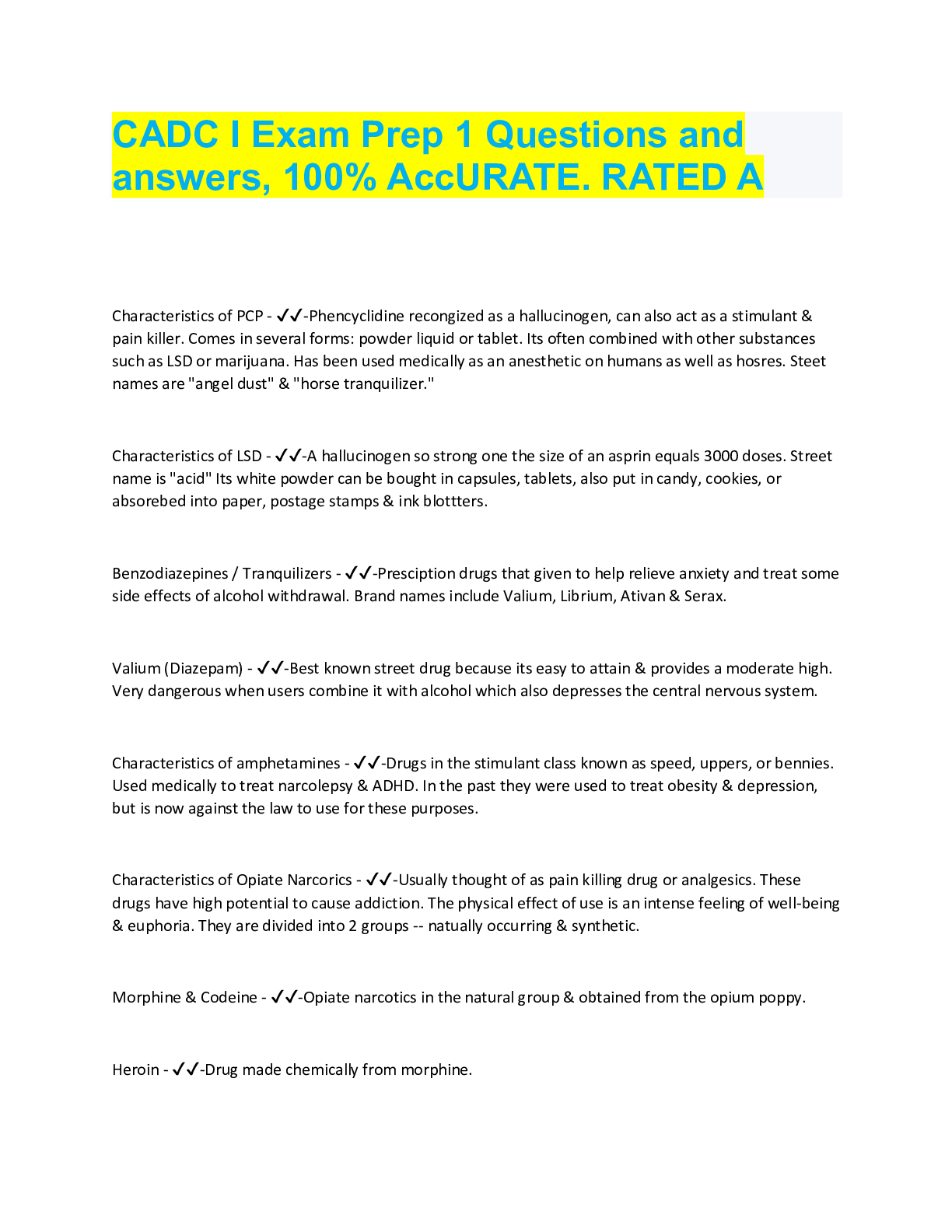
CADC I Exam Prep 1 Questions and
answers, 100% AccURATE. RATED A
Characteristics of PCP - ✔✔-Phencyclidine recongized as a hallucinogen, can also act as a stimulant &
pain killer. Comes in several forms: powder liqu
...
CADC I Exam Prep 1 Questions and
answers, 100% AccURATE. RATED A
Characteristics of PCP - ✔✔-Phencyclidine recongized as a hallucinogen, can also act as a stimulant &
pain killer. Comes in several forms: powder liquid or tablet. Its often combined with other substances
such as LSD or marijuana. Has been used medically as an anesthetic on humans as well as hosres. Steet
names are "angel dust" & "horse tranquilizer."
Characteristics of LSD - ✔✔-A hallucinogen so strong one the size of an asprin equals 3000 doses. Street
name is "acid" Its white powder can be bought in capsules, tablets, also put in candy, cookies, or
absorebed into paper, postage stamps & ink blottters.
Benzodiazepines / Tranquilizers - ✔✔-Presciption drugs that given to help relieve anxiety and treat some
side effects of alcohol withdrawal. Brand names include Valium, Librium, Ativan & Serax.
Valium (Diazepam) - ✔✔-Best known street drug because its easy to attain & provides a moderate high.
Very dangerous when users combine it with alcohol which also depresses the central nervous system.
Characteristics of amphetamines - ✔✔-Drugs in the stimulant class known as speed, uppers, or bennies.
Used medically to treat narcolepsy & ADHD. In the past they were used to treat obesity & depression,
but is now against the law to use for these purposes.
Characteristics of Opiate Narcorics - ✔✔-Usually thought of as pain killing drug or analgesics. These
drugs have high potential to cause addiction. The physical effect of use is an intense feeling of well-being
& euphoria. They are divided into 2 groups -- natually occurring & synthetic.
Morphine & Codeine - ✔✔-Opiate narcotics in the natural group & obtained from the opium poppy.
Heroin - ✔✔-Drug made chemically from morphine.
Demerol, Talwin, & Methadone - ✔✔-Drugs in the synthetic-group of Opiate Narcotics made in a
laboratory.
Withdrawal Symptoms of Opiates - ✔✔-Stomach cramps, diarrhea, runny nose, tears, yawning, goose
bumps, & genneral sense of insecurity. They lessen in severity in a few days, but may take weeks or
months to completely subside.
Characteristics of Crack - ✔✔-Stimulant drug made from cocaine powder street named "rock." Smoking
it provides a quicker rush than sniffing cocaine. Use creates euphoria often prescribed as a whole body
orgasm, followed vy a crash which includes anxiety, paranoia, & extreme fatigue.
Characteristics of Cocaine - ✔✔-Stimulant in fine white powder form. Use causes the brain to relase
dopamine & norepinephrine causing a euphoric state. Street names include coke snow flake & stardust.
Users sniff inject or smoke it known as free basing.
Characteristics of Cannabis - ✔✔-Mood altering drug made from the flowers of the plant cannabis
sativa. Forms include marijuana, hashish & hash Oil. It is usually smoked but can be put into food &
eaten.
THC / Tetrahydrocannabinol - ✔✔-Psychoactive chemical in cannabis which causes its mood altering
effects. Hash oil contains up to 60% where as marijuana contains 7-15%.
Alcohol - ✔✔-A sedative that depresses rhe central nervous system. Effecta include lowering of
inhibitions relaxation & inhibition of good judgement decreased reaction time & fine muscle
coordination.
Short-term effect of PCP - ✔✔-Effects vary greatly from person to person because it can act as both a
stimulant & depressant. Some find it difficult to concentrate & communicate. Some have a sense of
separation from surroundings, confusion, unreal perceptions of time, space & body images.
Long-term effects of PCP - ✔✔-Known effects include speech problems memory loss depression &
anxiety. Flashbacks can occur days or even months after use which may include hallucinations &
sensations felt during use.
Short-term effects of LSD - ✔✔-Effects begin w/in a few minutes & can last as long as 12 hours. Sight
hearing & taste can be affected. Causes increase in blood pressure dialated pupils nausea chills & fever
numbness & rapid heart beat. Long-term memory is exceptionally clear & strong while short-term
memory is almost non-existent.
Long-term effects of LSD - ✔✔-Effects are most often manifested in flashbacks where all of the short�term effects are experienced all over again. Heavy users are characterized by apathy no interest in the
future very little patience or ability to cope with frustration. Also run the risk of developing chronic
psychosis.
Short-term effects of Tranquilizer use - ✔✔-Effects include reduced anxiety tensoin calmness drowsiness
slight problems w/ memory & thinking. Fatigue reduced inhibition & clumsiness have also been noted.
Long-term effects of Tranquilizers - ✔✔-Headaches lack of energy irritability & sexual problems. Abuse
can cause problems w/ memory thinking judgement muscle weakness slurring of speech anxiety &
insomnia. An overdose can cause coma.
Short-term effects of Amphetamines - ✔✔-Effect very individually. Increase in blood sugar inability to
sleep increased alertness & tremors are all possible. Other side effects might include diarrhea rapid
heartbeat increase urine output dry mouth or rapid breathing. Higher dosage use can produce panic
depression & irritability .
Long-term effects of Amphetamine - ✔✔-Insomnia elevated blood pressure skin rashes irregular
heartbeat. Eating disorders & nutritional problems result from appetite-suppressant effects. High doses
over a long period of time mental problems chronic psychosis which is like paranoid schizophrenia can
develop.
Short-term effects of Opiate - ✔✔-Depends on the amount taken the individual's mood prior to use
other drug usage & even the environment. They depress the CNS but stimulate the brain centers. Causes
rush of great pleasure after injected. Nausea constipation & drowsiness can occur at low doses. High
doses can cause severe respiratory system problems clammy blue skin pin prick pupils & dry mouth.
Long-term effects of Opiate - ✔✔-Decreased sexual drive menstrual irregularity & constipation. Injection
can lead to liver disease AIDS & infections related to dirty needles can occur.
Short-tern effects of crack - ✔✔-Feeling of euphoria high energy decreased appetite increase heart rate
& body temp. Large doses can cause convulsions nausea blood pressure elevation twitching & fever.
Overdosing can result in respiratory failure caused by seizures stroke &/or heart failure which can lead
to death.
Long-term effects of Crack - ✔✔-Constipation insomnia impotence &/or weight loss. Lung damage is
also possible due to inhalation of the vapors. Because it users get an intense high in a very short time
followed by feelings of deep depression addiction often results.
Short-term effects of Cocaine - ✔✔-Dilation of the pupils rapid heart rate & breathing sweating
heightened alertness feeling of confidence & well being. A decrease in appetite can also occur. Heavy
use effect are blurred vision high blood pressure hallucinations violent behavior muscle spasms loss of
coordination stroke nausea twitching fever & chest pain. Many experience stuffy nose &/or insomnia.
Long-term effects of Cocaine - ✔✔-Hallucinations weight loss impotence difficultly urinating
constipation insomnia restlessness excitability & a suspicious nature. Users are lethargic apathetic &
cannot sleep which lead to abuse of other drugs to alleviate symptoms.
Short-term effects of Cannabis - ✔✔-Relaxation & lowered inhibition after just a few puffs. User may
become very talkative or quiet. Increase in the sharpness of the senses & plain everyday items take on
special meanings or properties. Attention span & concentration become shorter. Judging distance
becomes difficult. Time passage has little meaning. Other effects include red eyes drowsiness balance
problems increased appetite & dry mouth.
Long-term effects of Cannabis - ✔✔-Lung damage apathy failure to set goals difficulty performing simple
tasks neglect of personal appearance slow mental responses & difficulty with speech.
Inhalants - ✔✔-Vapors that are inhaled in order to produce mind-altering effects. They are chemicals
most often found in household products.
Methamphetamines - ✔✔-Chemically made stimulants related to amphetamines but the effects are
much greater. Can be injected taken orally snorted or smoked.
Methamphetamine - ✔✔-Smoking or or injection causes a high or rush that is very pleasurable. Snorting
or oral use produces a euphoric high but no rush.
Psychoactive Chemical Abuse - ✔✔-A faulty adaptation pattern of behavior I which the use of chemicals
has led to at least one of the following in a 12 month period:
Repeated use resulting in inability to meet responsibilities at work home or school
Repeated use in dangerous situations
Repeated use leading to legal issues
Repeated use despite repeated social or person issues
Psychoactive Chemical Dependence - ✔✔-A faulty adaptation pattern of behavior in which the use of
chemicals has to at least 3 of the following in a 12 month period:
Tolerance
Withdrawal
Increased amount of chemical is taken over a longer period of time
Strong desire to reduce or quit use with unsuccessful results
Great amount of time is spent getting using & recovering from effects
Continued use despite know physical & psychological problems occur
Physiological Dependence - ✔✔-The body's adaptation to the presence of a chemical. When the
chemical is not present the body reacts in a negative manner called withdrawal.
Primary or Acute Withdrawal - ✔✔-Last from 2-7 days & is characterized by the strongest symptoms
usually the opposite of the positive effects of the drug.
Secondary or Prolonged Withdrawal - ✔✔-Last for weeks or months. Symptoms include nervousness
problems sleeping mood swings & changes in body functions.
Detoxification - ✔✔-The first step of the treatment of substance abuse. The body must be cleansed from
the short-term effects of the chemical before treatment can begin. Alcohol & other depressants opiates
& cocaine require this.
Psychological or Behavioral Dependence - ✔✔-When a person takes a chemical to satisfy a feeling or an
emotional need. It is described as a craving. It usually appears with the physiological version but not
always.
Abuse Liability - ✔✔-Involves the question "What are the chances or odds of a dangerous drug causing
addiction."
Controlled Substance - ✔✔-Any drug that has an abuse potential and is placed on restricted use by the
DEA.
Poly-chemical Abuse - ✔✔-When more than one psychoactive chemical is used at the same time.
Antagonist - ✔✔-Psychoactive chemicals that reverse the effects of another drug.
Agonist - ✔✔-Psychoactive chemicals that enhance the effects of another drug.
Schedules I-V - ✔✔-The groups that drugs are put into according to their:
abuse liability
medical usefulness
History of use & a use
Risk to public health
political considerations.
Schedule I - ✔✔-Drug that have no medical use & high abuse potential. They include: heroin, LSD,
marijuana, peyote, psilocybin, mescaline, & MDMA.
Schedule II - ✔✔-Drugs with a high abuse potential with severe psychic or physical dependence liability
even though they have medical uses. These include: methamphetamin
[Show More]