IC & RC Exam CAADC, Exam questions
and answers, 100%Accurate, graded A+
1. _________is the essential first step in determining the possible causes of
addiction for the person and the most appropriate treatment modali
...
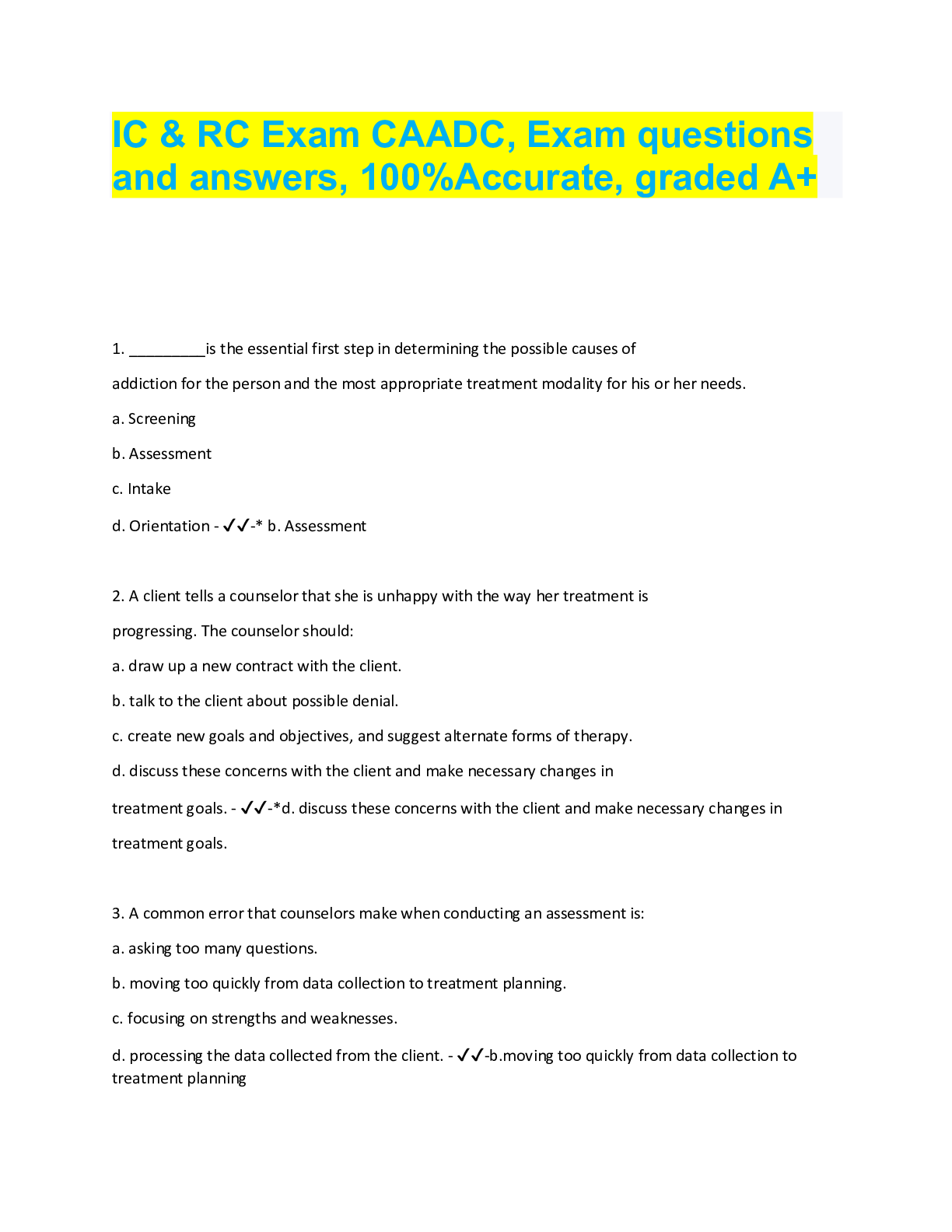
IC & RC Exam CAADC, Exam questions
and answers, 100%Accurate, graded A+
1. _________is the essential first step in determining the possible causes of
addiction for the person and the most appropriate treatment modality for his or her needs.
a. Screening
b. Assessment
c. Intake
d. Orientation - ✔✔-* b. Assessment
2. A client tells a counselor that she is unhappy with the way her treatment is
progressing. The counselor should:
a. draw up a new contract with the client.
b. talk to the client about possible denial.
c. create new goals and objectives, and suggest alternate forms of therapy.
d. discuss these concerns with the client and make necessary changes in
treatment goals. - ✔✔-*d. discuss these concerns with the client and make necessary changes in
treatment goals.
3. A common error that counselors make when conducting an assessment is:
a. asking too many questions.
b. moving too quickly from data collection to treatment planning.
c. focusing on strengths and weaknesses.
d. processing the data collected from the client. - ✔✔-b.moving too quickly from data collection to
treatment planning
4. A female client reports that she has some concerns about the relationship
between her husband and her 14-year-old daughter from a previous
marriage. She reports that her husband and daughter frequently argue,
that her daughter refuses to take direction from her stepfather, mid that her
daughter regularly complains about her stepfather's "faults" and describes
how her biological father is better. The MOST relevant professional to
whom a referral should be made is a:
a. Social worker.
b. Clinical psychologist.
c. Licensed professional counselor.
d. Marriage and family therapist. - ✔✔-d. Marriage and family therapist
5. A key factor for counselors to consider is that in a counseling relationship,
the counselor has differential power. One of the best safeguards is:
a. to be alert to and understand the power relationship.
b. to utilize the differential power to motivate the client.
c. to realize the importance of this power in client interventions.
d. to use differential power to get the client to try new behaviors. - ✔✔-a. to be alert to and understand
the power relationship.
6. A pretreatment period is frequently the result of waiting lists or client
reluctance to become fully engaged in primary treatment. What might be a
danger of this pretreatment period?
a. The pretreatment period may be when clients lose interest in treatment.
b. A client may receive enough help so as not to need the services of the
program or agency.
c. Successful pretreatment may result in a client needing services that an
agency doesn't have, thus losing the potential admission.
d. There is really no danger with pretreatment - recovery will require much
more programming than pretreatment can offer. - ✔✔-a. The pretreatment period may be when clients
lose interest in treatment.
7. According,to Marlatt's model of the relapse process, which of the following statements is NOT true?
a. Clients should be taught skills for anticipating, avoiding, and coping with
their personal high-risk situations.
b. Clients should be taught constructive responses to cope with lapses when
they do occur.
c. Clients should be helped to recognize that one or more temporary lapses
are likely to occur and are permitted.
d. Any positive expectations that clients have about drug use should be
countered with reminders about the lows that follow the highs and about
the long-term negative consequences of substance abuse. - ✔✔-c. Clients should be helped to recognize
that one or more temporary lapses
are likely to occur and are permitted.
8. According to the DSM-IV-TR, all of the following are criteria for psychoactive substance dependence
EXCEPT:
a. substance often taken in larger amounts than the person intended.
b. marked lack of initiative, interest or energy.
c. frequent intoxication when expected to fulfill major role obligations.
d. one or more unsuccessful efforts to cut down substance use. - ✔✔-b. marked lack of initiative,
interest or energy.
9. All of the following are goals of person-centered therapy EXCEPT:
a. teaching clients to formulate and carry out plans to change their behavior.
b. focusing on the person instead of the presenting problem.
c. assisting clients in enhancing their coping skills.
d. individualizing the treatment plan. - ✔✔-a. teaching clients to formulate and carry out plans to
change their behavior.
10. Bob is a case manager in an intensive inpatient treatment facility. He
recently was assigned a client, Mary, who presents not only with
alcoholism but has also been diagnosed with AIDS. To assist Mary in her
treatment and recovery needs, Bob would probably need to have
knowledge of all of the following areas EXCEPT:
a. AIDS epidemiology and transmission routes.
b. the disease's clinical progression.
c. new medication used in treatment regimens.
d. available social services for AIDS clients. - ✔✔-c. new medication used in treatment regimens.
11. Therapeutic communities differ from Synanon because:
a. these communities try to return clients to society.
b. these communities are based on individual psychotherapy rather than
group encounter.
c. these communities keep the patients busy rather than engaging in
contemplative thought.
d. these communities rely on professional psychologists rather than former
addicts or abusers. - ✔✔-a. these communities try to return clients to society.
12. During the screening process, a critical task that the counselor has is to:
a. complete a mental status exam.
b. engage the client's family in treatment.
c. develop a treatment plan.
d. establish rapport with the client. - ✔✔-d. establish rapport with the client.
13. During the assessment process, your alcohol and tranquilizer abusing
client reveals a history of self-destructiveness when frustrated and an
inability to delay impulses. The MOST appropriate assessment battery in
this case is:
a. the Beck Depression Scale , the MAST test, and the MMPI.
b. the Beck Depression Scale , the MAST test, and the Stanford-Binet.
c. the MAST test, the Strong-Campbell, and the Stanford-Binet.
d. the MMPI, the Strong-Campbell, and the Stanford-Binet. - ✔✔-a. the Beck Depression Scale , the
MAST test, and the MMPI
14. The primary purpose of the screening process is to:
a. develop a treatment plan.
b. have the client sign appropriate documents.
c. determine one's appropriateness and eligibility for admission.
d. identify the client's strengths and weaknesses. - ✔✔-c. determine one's appropriateness and
eligibility for admission.
15. Effective case management for persons in need of multiple services
requires:
a. monitoring, feedback, and evaluation of services.
b. frequent face-to-face contact with the client.
c collaboration with family members.
d. careful matching with appropriate 12-step groups. - ✔✔-a. monitoring, feedback, and evaluation of
services.
16. In determining whether a chemically dependent patient should be treated in an inpatient or
outpatient program, all of the following should be considered EXCEPT:
a. whether the patient has a history of sobriety during the last several years.
b. whether the patient's job and family are likely to give him another chance if
this treatment fails.
c. whether the patient has family support for sobriety.
d. whether the patient has a history of failed treatment on an outpatient or
inpatient basis. - ✔✔-b. whether the patient's job and family are likely to give him another chance if
this treatment fails.
17. Alcohol decreases resistance to HIV infection by:
a. compromising T-cell functions.
b. impairing frontal cortical functions.
c. increasing serotonin levels in the synaptic gap.
d. decreasing cardiopulmonary functioning. - ✔✔-a. compromising T-cell functions.
18. It is crucial for the case manager to be aware of what may inhibit
minorities' participation in the substance abuse treatment continuum.
Suppose that you are a case manager, working in an outpatient program
with a Somali client. AA is an integral part of your program, yet you are
aware of the fact that while "accepting one's powerlessness" is a central
tenet of 12-Step self-help programs, members of oppressed groups may
not accept it, given their own societal powerlessness. What would be the
best thing to do in such a case?
a. Ask the client to participate, never-the-less, and suggest he simply "do his
best" when dealing with the issue of powerlessness.
b. Let the client know that participation in AA is mandatory, and that if he
doesn't participate, he could be discharged for "noncompliance."
c. Be sensitive to such cultural differences and seek out other recovery
resources that are relevant to the individual's values.
d. Seek out another Somali who is in a local AA group and ask the he or she
sponsor your client. - ✔✔-c. Be sensitive to such cultural differences and seek out other recovery
resources that are relevant to the indi
[Show More]