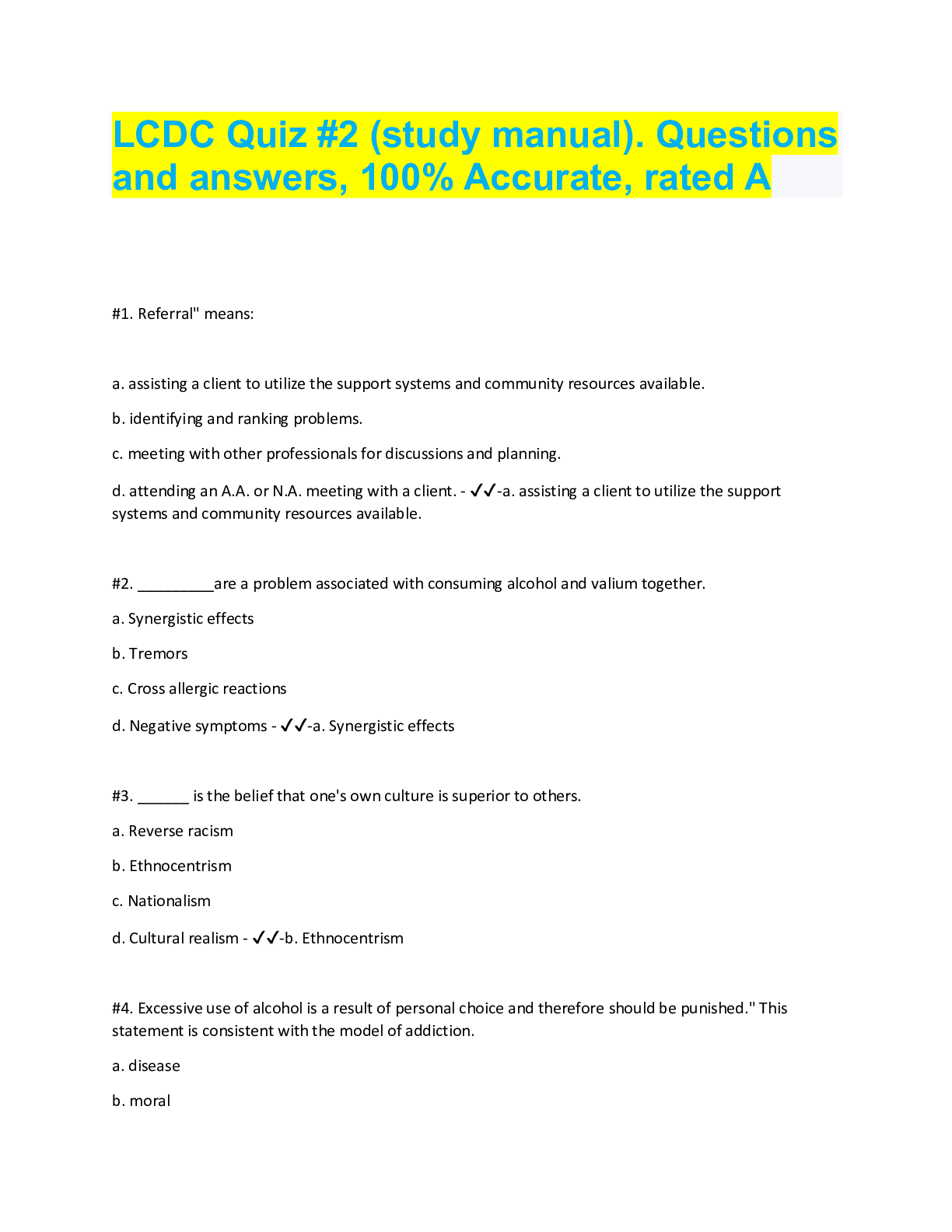
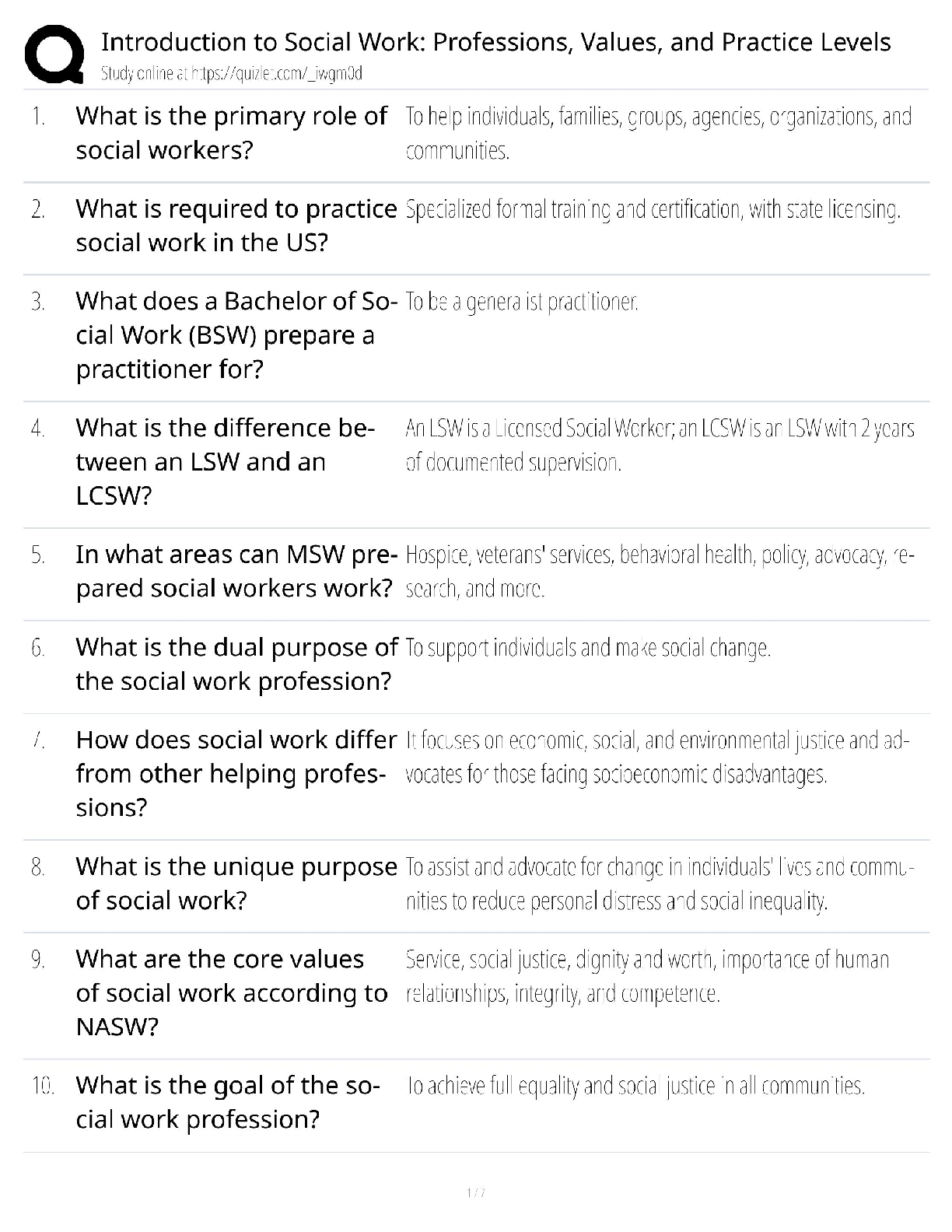
LCDC Quiz #2 (study manual). Questions
and answers, 100% Accurate, rated A
#1. Referral" means:
a. assisting a client to utilize the support systems and community resources available.
b. identifying and ranking prob
...
LCDC Quiz #2 (study manual). Questions
and answers, 100% Accurate, rated A
#1. Referral" means:
a. assisting a client to utilize the support systems and community resources available.
b. identifying and ranking problems.
c. meeting with other professionals for discussions and planning.
d. attending an A.A. or N.A. meeting with a client. - ✔✔-a. assisting a client to utilize the support
systems and community resources available.
#2. _________are a problem associated with consuming alcohol and valium together.
a. Synergistic effects
b. Tremors
c. Cross allergic reactions
d. Negative symptoms - ✔✔-a. Synergistic effects
#3. ______ is the belief that one's own culture is superior to others.
a. Reverse racism
b. Ethnocentrism
c. Nationalism
d. Cultural realism - ✔✔-b. Ethnocentrism
#4. Excessive use of alcohol is a result of personal choice and therefore should be punished." This
statement is consistent with the model of addiction.
a. disease
b. moral
c. social
d. sociocultural - ✔✔-b. moral
#5. A common problem for beginning counselors is:
a. trying to use a variety of techniques, rather than becoming skilled at one approach.
b. failing to identify an approach that is appropriate to the client.
c. their bias against working with clients who have a dual diagnosis.
d. that they allow for conflicting values to exist in the counseling relationship. - ✔✔-b. failing to identify
an approach that is appropriate to the client.
#6. A counselor wants to record a counseling session with a client so that the counselor could listen to
the tape, along with her supervisor, as part of ongoing training. According to ethical best practices, the
counselor's plans are:
a. ethical.
b. unethical.
c. ethical, as long as the client granted permission beforehand.
d. unethical, unless the supervisor observes the session. - ✔✔-c. ethical, as long as the client granted
permission beforehand.
#7. A major criticism of self-report instruments is that the questions are so obvious that these tests
cannot possibly detect alcoholics who deny having a
problem. This issue is the dilemma of questions.
a. measureable
b. face valid
c. multi-factor
d. analytical - ✔✔-b. face valid
#8. A mental status exam does NOT assess:
a. education level.
b. appearance.
c. speech.
d. thought processes. - ✔✔-a. education level.
#9. Abstinence is to harm reduction as:
a. IV drug use is to drinking.
b. controlled drinking is to willpower.
c. Alcoholics Anonymous is to needle exchange.
d. Methadone is to Antabuse. - ✔✔-c. Alcoholics Anonymous is to needle exchange.
#10. Appropriate treatment goals must be:
a. stated generally, in order to encourage small progress.
b. typed and signed in order to ensure compliance by an unwilling client.
c. written in the order that they will be addressed in treatment.
d. agreed upon by the client and counselor. - ✔✔-d. agreed upon by the client and counselor.
#11. Arbitrary inferences and selective abstractions are examples of.
a. cognitive distortions.
b. defense mechanisms.
c. attention-seeking.
d. developmental difficulties. - ✔✔-a. cognitive distortions.
#12. Beneficence is the ethical principle that means:
a. help.
b. show equal respect for gender.
c. do no harm.
d. respect confidentiality. - ✔✔-a. help.
#13. Client education on HIV and other sexually transmitted diseases:
a. is only done at the request of the client.
b. should be given in specialty groups to those clients that are considered "high risk" to protect
confidentiality.
c. should be contracted out to a physician or professional medical personnel who have expertise in this
area.
d. is important information to incorporate in the treatment process of every client. - ✔✔-d. is important
information to incorporate in the treatment process of every client.
#14. Completing necessary documentation for admission to a particular treatment program occurs
during the _______ process.
a. intake
b. assessment
c. admission
d. screening - ✔✔-a. intake
#15. Concise and accurate reporting is necessary in order to:
a. assist in client education.
b. ensure continuity of client care
c. identify client strengths and weaknesses.
d. demonstrate counselor competence - ✔✔-b. ensure continuity of care
#16. Counselor self-disclosure is BEST limited to:
a. the time when the client is ready for discharge.
b. ideas and emotional reactions in the counseling session.
c. early childhood experiences.
d. opinions the counselor has about the client and his or her family. - ✔✔-b. ideas and emotional
reactions in the counseling session.
#17. Drowsiness or coma, slurred speech, impairment in attention or memory are all signs or symptoms
of:
a. caffeine intoxication
b. cocaine intoxication
c. alcohol intoxication
d. opioid intoxication - ✔✔-d. opioid intoxication
#18. Generally, the Tarasoff requirement has been interpreted as:
a. a duty to hospitalize or otherwise confine the person making the threat.
b. a duty to make a reasonable effort to prevent the patient from carrying out the threat.
c. a duty to warn the client of possible consequences.
d. a duty to warn the intended victim and/or the police. - ✔✔-d. a duty to warn the intended victim
and/or the police.
#19. In his second counseling session, a client reveals to the counselor that he is HIV positive. The
counselor's BEST course of action is to:
a. discharge the client as a precautionary measure against infecting other clients.
b. offer to refer the client to a counselor with AIDS, since that counselor will understand the special
issues involved.
c. send the client a letter informing him that he will be transferred to another facility.
d. discuss the client's case with a clinical supervisor in order to meet the needs of this client. - ✔✔-d.
discuss the client's case with a clinical supervisor in order to meet the needs of this client.
#20. In which situation is it NOT acceptable to release confidential information without prior consent
from the client?
a. when the client has stolen property from the treatment facility.
b. if law enforcement officials request information in writing.
c. if the client is in a serious accident requiring medical care.
d. when the client admits to abusing a child. - ✔✔-b. if law enforcement officials request information in
writing.
#21. Jackie is recently discharged from the Air Force. His counselor suspects that he has PTSD, due to his
experiences during active duty in Afghanistan. The counselor contacted the Veteran's Administration
and located a clinic in the
area with special groups for Vets with PTSD. The counselor then made arrangements for Jackie to be
attend these groups while he is still in primary
treatment for substance abuse. The counselor's actions are BEST described as:
a. consultation.
b. case management.
c. client education
d. ethical responsibility. - ✔✔-b. case management.
#22. Methadone maintenance programs can BEST be described as:
a. continued substance abuse in disguise.
b. harm reduction focused.
c. a secular recovery method.
d. a community organization intervention. - ✔✔-b. harm reduc
[Show More]