LCDC TX Exam Questions and answers,
100% Accurate. Predictor questions
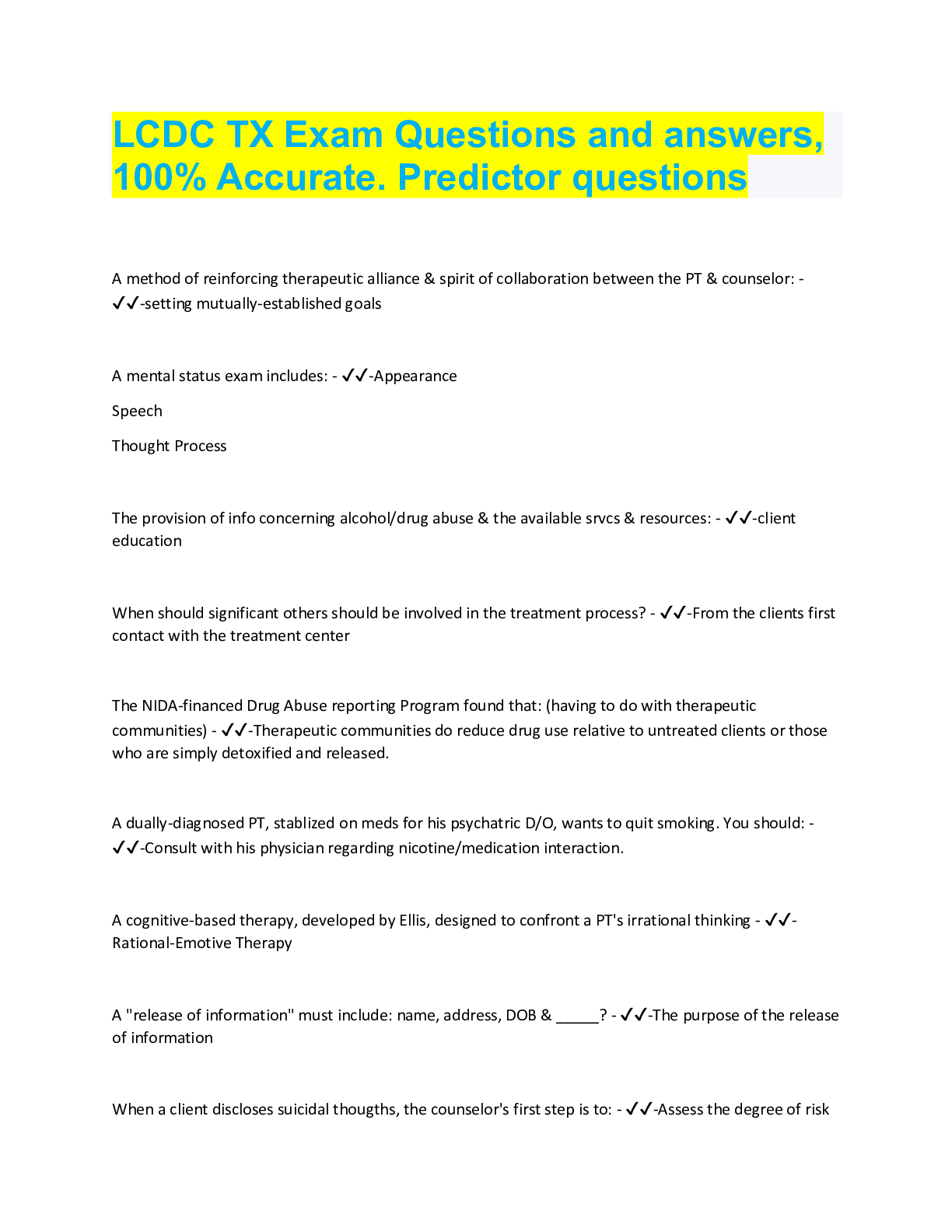
A method of reinforcing therapeutic alliance & spirit of collaboration between the PT & counselor: -
✔✔-setting mutually-established goals
A men
...
LCDC TX Exam Questions and answers,
100% Accurate. Predictor questions
A method of reinforcing therapeutic alliance & spirit of collaboration between the PT & counselor: -
✔✔-setting mutually-established goals
A mental status exam includes: - ✔✔-Appearance
Speech
Thought Process
The provision of info concerning alcohol/drug abuse & the available srvcs & resources: - ✔✔-client
education
When should significant others should be involved in the treatment process? - ✔✔-From the clients first
contact with the treatment center
The NIDA-financed Drug Abuse reporting Program found that: (having to do with therapeutic
communities) - ✔✔-Therapeutic communities do reduce drug use relative to untreated clients or those
who are simply detoxified and released.
A dually-diagnosed PT, stablized on meds for his psychatric D/O, wants to quit smoking. You should: -
✔✔-Consult with his physician regarding nicotine/medication interaction.
A cognitive-based therapy, developed by Ellis, designed to confront a PT's irrational thinking - ✔✔-
Rational-Emotive Therapy
A "release of information" must include: name, address, DOB & _____? - ✔✔-The purpose of the release
of information
When a client discloses suicidal thougths, the counselor's first step is to: - ✔✔-Assess the degree of risk
When conducting an assessment what is the counselor's primary focus? - ✔✔-Identifying the clients
problems and needs, strengths and weaknessess.
The BEST indicator if an individual is physically dependent upon alcohol or another drug is: - ✔✔-The
presence of withdrawal symptoms.
Guilt and ___ are painful emotions that are part of grieving. - ✔✔-Anger
Despite vast personality differences, virtually all substance abusers experience: - ✔✔-remorse, self�hatred and shame
You are having difficultiy with a client early on in the case. The BEST thing for you to do is: - ✔✔-Seek
out supervision with a colleage or supervisor
Self report screening instrument consists of 4 Y/N questions. Requires aprox 1 min to complete - ✔✔-
CAGE questionnaire
Drug Offender Profile Evaluation/Refferal Strategies - ✔✔-D.O.P.E.R.S.
Michigan Alcoholism Screening Test - ✔✔-MAST
Self Administered Alcoholism Screening Test - ✔✔-SAAST
Short Michigan Alcoholism Screening Test - ✔✔-SMAST
Substance Abuse Subtle Screening Inventory - Adult or Adolescent Version - ✔✔-SASSI
Addiction Severity Index - ✔✔-ASI
Diagnostic and Statistical Manual of Mental Disorders - ✔✔-DSM
Adapted Short Michigan Alcoholism Screening Test for Fathers - ✔✔-F-SMAST
Global Appraisal of Individual Needs - ✔✔-GAIN
Minnesota Multiphasic Personality Inventory - ✔✔-MMPI
Minnosota Substance Abuse Problems Scale - ✔✔-MSAPS
Readiness To Change Questionnair - ✔✔-TRCQ
Substance Abuse Subtle Screening Invnetory for Adolescents - ✔✔-SASSI-A
Human Immunodeficiency Virus - ✔✔-HIV
The Stages of Change : - ✔✔-1) pre-contemplation
2) contemplation
3) preparation
4) action
5) maintenance
6) relapse
(SCM) Not yeat acknowledging that there is a problem behavoir that needs to be changed - ✔✔-Pre�Contemplation
(SCM) Acknowledging that there is a problem but not yet ready or sure of wanting to make a change -
✔✔-Contemplation
(SCM) Getting ready to change - ✔✔-Preparation
(SCM) Changing behavior - ✔✔-Action
SCM) Maintaining the behavior change - ✔✔-Maintenance
(SCM) Returning to older behaviors and abandoning the new changes - ✔✔-relapse
The Stages of Change Model was originally developed in the late 1970's and early 1980's by... - ✔✔-
James Prochaska, Carlo DiClemente
Bio-psychosocial perspective - ✔✔-This recognizes that there are biological, psychological and social
causes of substance abuse and dependence.
Biological factors - ✔✔-These include brain chemistry problems, which may be genetic, making some
people particularly vulnerable to addiction to certain drugs once they try them.
Psychological factors - ✔✔-These include cognitive styles, personality traits, and early developmental
experiences that may contribute to a client's causes of substance abuse and dependence.
Social factors - ✔✔-These include poverty, oppression, poorly developed social skills, and family
dysfunction that may contribute to a client's causes of substance abuse and dependence.
Motivational interviewing - ✔✔-This is a style of interacting with clents, used not only for assessment,
but for all phases of treatment, that is particularly helpful for reducing defensiveness and encouraging
therapeutic collaboration between the counselor and client. Uses the interpersonal process to enhance
clients' motivation to change, and encourages clients to move on to the next stage of readiness for
change.
Assessment Instruments - ✔✔-These aid in the identification of, and treatment planning for substance
related disorders.
Reliability - ✔✔-This refers to the consistency with which an assessment instrument measures.
Validity - ✔✔-This refers to what an assessment instrument measures and how it is used.
Screening Instrument - ✔✔-This distinguishes individuals who do not have a disorder from those who
might have one.
` - ✔✔-`
CAGE - ✔✔-4 questions - Yes to 1 indicates possibility of alcohol dependence. Cut down? Annoyed by
criticism of drinking behavior? Guilty about drinking? Eye-opener?
DAST - ✔✔-Drug Abuse Screening Test (adapted from MAST) used to detect abuse or dependence on
drugs other than alcohol.
MAST - ✔✔-Michigan Alcoholism Screening Test - yes or no to 25 questions.
RAPS-4 (Rapid Alcohol Problems Screen) - ✔✔-An answer of yes to one or more questions indcates the
possibility of alcohol dependence during the past year. The questions have to do with remorse, amnesia,
performance of life duties, and starting the day with alcohol.
SASSI (Substance Abuse Subtle Screening Inventory) - ✔✔-This brief self-report is designed to identify
individuals with a high probability of having a substance related disorder.
SASSI-A2 - ✔✔-Substance Abuse Subtle Screening Inventory for Adolescents ages 12 to 18.
TLFB (Time Line Follow Back Procedure) - ✔✔-This is a Comprehensive Measure of Drinking which
makes connections between significant events in the client's life and alcohol/drug use patterns and
intensity, for the past year.
ADS (Alcohol Dependence Scale) - ✔✔-This diagnostic instrument is a 25-item instrument that provides
a quantitative measure of the severity of alcohol dependence.
DIS-IV (Diagnostic Interview Schedule - Alcohol Module) - ✔✔-This diagnostic instrument asks 28
questions that permit diagnosis of alcohol abuse or dependence.
ICS (Impaired Control Scale) - ✔✔-This diagnostic instrument is a pencil and paper self-administered
insturment that measures clients' attempts to control drinking during the last 6 months and their
perception of their ability to control it now.
OCDS - ✔✔-Obsessive Compulsive Drinking Scale
SADD - ✔✔-Short Alcohol Dependence Data
SDSS - ✔✔-Substance Dependence Severity Scale
ASI (Addiction Severity Index) - ✔✔-This is a semi-structured interview with seven subscales addressing
problems in the areas of family/social status, medical status, employment and support, drug use, alcohol
use, legal status, and psychiatric status. It is useful for treatment planning and outcome evaluation with
adult clients.
AUI (Alcohol Use Inventory) - ✔✔-This self-report inventory is in multiple-choice format, for ages 16 and
up. It is based on the multiple condition theory, which takes into account individuals' different styles of
drinking, perceptions of alcohol's benefits and consequences, and how they want to deal with drinking
problems.
CBI (Coping Behaviors Index) - ✔✔-This instrument measures factors related to relapse risk: positive
thinking, negative thinking, avoidance/distraction, and seeking social supports.
WAIS-III (Wechsler Adult Intelligence Scale) - ✔✔-This is a popular intelligence test.
The Strong Interest Inventory - ✔✔-A vocational interest scale that compares clients' interests to those
of people who are happy in different occupations.
MMPI-2 - ✔✔-The Minnesorta Multiphasic Personality Inventory contaings several clinical scales that
detect pathology including the MacAndrew Alcoholism Scale.
The Mental Status Exam - ✔✔-A series of observations about a client's appearance, behavior, attention,
mood, affect, perceptual and thought processes, judgement, and memory at a given point in time.
Includes observations of a client's orientation to time, place and person.
MBTI (The Myers-Briggs Type Indicator) - ✔✔-This is a personality inventory that looks at clients'
preferred ways of being in the world and assigns them to 1 of 16 personality types. Frequently used in
vocational and relationship counseling.
The Beck Depression Inventory II - ✔✔-Used to track changing levels of depression over the course of
treatment for clients age 13 and over. Individuals rate themselves on 21 groups of statements that tap
the affective, behavioral, cognitive, and physiological symptoms of depression for the 2 weeks prior to
testing.
Biomarkers - ✔✔-Measuring these physiological markers at intervals throughout treatment may provide
early identification of relapse.
EMIT - ✔✔-Enzyme Multiplied Immunoassay Test - this urine testing kit uses antibodies that react to the
presence of a drug or its metabolites.
GGT - ✔✔-Gamma-glutamyltransferase - indicates prolonged, rather than episodic drinking.
ASAT - ✔✔-Aspartate aminotransferase - screens for heavy drinking.
ALAT - ✔✔-Alanine aminotransferase - screens for heavy drinking.
CDT - ✔✔-Carbohydrate Deficient Transferrin - sensitive enough to pick up moderate drinking over a
peoiod of a few weeks.
SOCRATES - ✔✔-A readiness-to-change scale that stands for Stages Of Change Readiness And Treatment
Eagerness Scale.
URICA - ✔✔-A readiness-to-change scale that stands for the University of Rhode Island Change
Assessment.
FTQ - ✔✔-Family Tree Questionnaire helps clients report information about the incidence of alcohol
problems in their blood relatives.
Genogram - ✔✔-A pictorial representation of family structure, using a least three generations and a
standard set of symbols.
DSM-IV-TR - ✔✔-Diagnostic and Statistical Manual of Mental Disorders, Fourth Edition, Text Revision
(APA, 2000).
Axis I - ✔✔-Contains 16 categories of clinical disorders, one of which is Substance Related Disorders.
Substance Related Disorders - ✔✔-This category of clinical disorders in Axis I of the DSM IV-TR includes
both Substance Use Disorders and Substance Induced Disorders.
Substance Use Disorders - ✔✔-This sub-category of Substance Related Disorders includes both
Substance Abuse and Substance Dependence.
Substance Induced Disorders - ✔✔-These Axis I disorders are a sub-category of Substance Related
Disorders and can include Substance Intoxication and Substance Withdrawal, Substance induced
delirium, persisting dementia, persisting amnesic disorder, psychotic disorder, mood disorder, anxiety
disorder, sexual dysfunction disorder, and sleep disorder.
Axis II - ✔✔-This axis of the DSM IV- TR includes the personality disorders as well as mental retardation.
Cluster A - ✔✔-Axis II disorders that feature odd, eccentric, isolative, or suspicious behavior. They
include Paranoid, Schizoid, and Schizotypal personality disorders.
Cluster B - ✔✔-Axis II disorders that often co-occur with substance abuse and dependence, and are
characterized by dramatic, emotional, erratic, or impulsive behavior, or a reduced capacity for empathy.
They include Antisocial Personality Disorder, BPD, Histrionic Personality Disorder and Narcissistic
Personality Disorder.
Antisocial Personality Disorder - ✔✔-This personality disorder features a pervasive pattern of disregard
for and violation of the rights of others.
Borderline Personality Disorder - ✔✔-This personality disorder features a pervasive pattern of instability
in interpersonal relationships, self-image, affect, and control over inpulses. Features may include frantic
attempts to avoid real or imagined abandonment, impulsivity in at least two areas that are self�damaging, chronic feelings of emptiness.
Histrionic Personality Disorder - ✔✔-This personality disorder features a pervasive pattern of excessive
emotionality and attention seeking, often with provocative dress.
Narcissistic Personality Disorder - ✔✔-This personality disorder features a pervasive pattern of
grandiosity, need for admiration, and lack of empathy.
Cluster C - ✔✔-These Axis II personality disorders feature anxious, fearful, and perfectionistic behavior.
They are the Avoidant, Dependent, and Obsessive-Compulsive personality disorders.
` - ✔✔-`
Axis V - ✔✔-This axis of the DSM IV -TR is the Global Assessment of Functioning (GAF) scale, which
assigns a number from 1 to 100 to the counselor's judgement of the client's overall level of
psychological, social and occupational functioning.
Substance Abuse - ✔✔-A maladaptive pattern of substance use leading to clinically significant
impairment or distress, as manifested by at least one of the four following criteria occurring within a 12-
month period: recurrent substance use resulting in a failure to fulfill major obligations at home, school
or work, recurrent substance use in situations in which it is physically hazardous, recurrent substance
use legal problems, and continued substance use despite having persistent or recurring problems caused
or exacerbated by the effects of the substance.
Substance Dependence - ✔✔-A maladaptive pattern of substance use, leading to clinically significant
impairment or distress, as manifested by 3 or more of the following 7 criteria: tolerance, withdrawal,
increased dose or dosing for longer periods of time, attempts to cut down unsuccessfully, time spent
obtaining, using, recovering from use, important social, occupational and recreational activities given up
or reduced because of use, physical or psychological problems caused or exacerbated by continued use.
Physiological Dependence - ✔✔-Indicated by whether tolerance and withdrawal are present.
Withdrawal - ✔✔-Defined by either the characteristic withdrawal syndrome for the substance or the
same or a closely related substance being taken to relieve or avoid withdrawal symptoms.
Specifiers - ✔✔-Used for Substance Dependence Diagnosis, these 6 categories are: Early full remission,
early partial remission, sustained full remission, sustained partial remission, on agonist therapy, in a
controlled environment.
Polysubstance Dependence - ✔✔-The proper diagnosis for a client who has repeatedly taken at least
three groups of substances, and who meets creiteria for dependence for the substances as a group, but
not for the substances individually.
Dually-Diagnosed - ✔✔-This client has one or more other psychiatric disorders along with substance
abuse or substance dependence. Also known as co-occurring disorders. All disorders should be treated
concurrently and aggressively.
Affect - ✔✔-The external expression of an internal emotional state.
Mood - ✔✔-A sustained emotion. Changes less frequently than affect.
Delusions - ✔✔-False beliefs that are maintained despite proof against their truth.
Hallucinations - ✔✔-Perceiving something in the absence of a sensory input. May be auditory, visual,
olfactory, gustatory or tactile.
Illusions - ✔✔-Misperceptions of actual sensory input.
Problem Statement - ✔✔-Component of a MTP that should be stated in client's words whenever
possible. Answers the question, "Why are you here?" Include statement of problem and evidence for it.
Goal Statement - ✔✔-Component of a MTP that should be acceptable to the client and answers the
question, "What is necessary to remedy the problem?" Should be stated positively - eg. "Client will
maintain abstinence," rather than, "Client will not drink."
Objectives - ✔✔-Component of a MTP that states specific things the client will do to meet the goal.
Stated in behavioral terms, and are observable, realistic, time specific, appropriate to the level of
treatment and measurable.
Strategies - ✔✔-Component of a MTP that states what the counselor will do to help meet the client's
objectives. Includes the theoretical model to be used, (eg. reality therapy) and the specific techniques to
be employed (eg. assertiveness training or refusal skills training). These are sometimes also called
"Interventions".
Axis I, IV and V - ✔✔-CASACs are responible for these three axes on the Written Assessment Summary.
Other axes can be written up as "deferred" or list symptoms eg. deferred, reports frequent headaches.
AUDIT - ✔✔-world health organization, over 8 suggests harmful consumption, looks at frequency
` - ✔✔-`
DAST - ✔✔-drug dependence other than alc...lifetime severity
RAPS4 - ✔✔-Remorse, amnesia, personal respon, start day with drink...alc dependence
SASSI - ✔✔-allows diagnosis of cohabitating disorders...self report
TWEAK - ✔✔-use/abuse during pregn
[Show More]