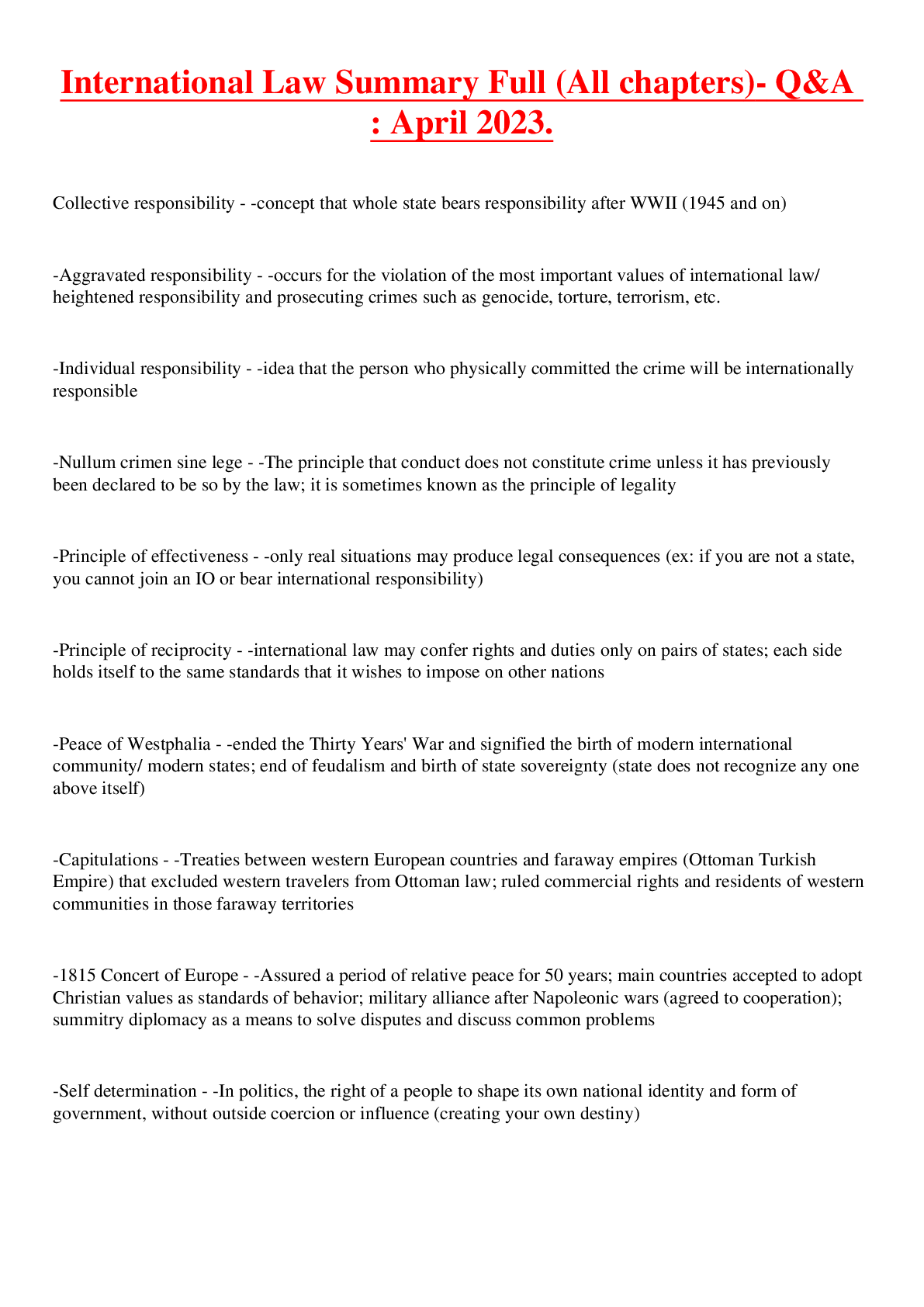
Collective responsibility - -concept that whole state bears responsibility after WWII (1945 and on)
-Aggravated responsibility - -occurs for the violation of the most important values of international law/ heightened
...
Collective responsibility - -concept that whole state bears responsibility after WWII (1945 and on)
-Aggravated responsibility - -occurs for the violation of the most important values of international law/ heightened responsibility and prosecuting crimes such as genocide, torture, terrorism, etc.
-Individual responsibility - -idea that the person who physically committed the crime will be internationally responsible
-Nullum crimen sine lege - -The principle that conduct does not constitute crime unless it has previously been declared to be so by the law; it is sometimes known as the principle of legality
-Principle of effectiveness - -only real situations may produce legal consequences (ex: if you are not a state, you cannot join an IO or bear international responsibility)
-Principle of reciprocity - -international law may confer rights and duties only on pairs of states; each side holds itself to the same standards that it wishes to impose on other nations
-Peace of Westphalia - -ended the Thirty Years' War and signified the birth of modern international community/ modern states; end of feudalism and birth of state sovereignty (state does not recognize any one above itself)
-Capitulations - -Treaties between western European countries and faraway empires (Ottoman Turkish Empire) that excluded western travelers from Ottoman law; ruled commercial rights and residents of western communities in those faraway territories
-1815 Concert of Europe - -Assured a period of relative peace for 50 years; main countries accepted to adopt Christian values as standards of behavior; military alliance after Napoleonic wars (agreed to cooperation); summitry diplomacy as a means to solve disputes and discuss common problems
-Self determination - -In politics, the right of a people to shape its own national identity and form of government, without outside coercion or influence (creating your own destiny)
-The League of Nations - -The first attempt of the international community to reduce use of war to solve international conflict and disputes; "cooling off" period of 3 months before war, but was a failure because no real ban on use of force was enacted
-The foundation of the UN - -For the first time, idea posed that war cannot EVER be the solution; first and most important international organization; success in terms of trust of organization and accepting message of peace
-Nuremberg Trials - -Prosecution for war crimes/ crimes against humanity; such crimes were finally defined and idea of aggravated/ individual responsibility apparent; individuals are accountable (way to acknowledge that certain acts were intolerable even in state of wars)
-Decolonization (in the Cold War period) - -implementation of principle of self determination; colonies becoming sovereign states
-What is a state? - -4 requirements: has a central governing authority and a clearly defined territory, a permanent population, and capacity to enter into relations with other states
-Declaratory theory of recognition - -The act of recognition is merely a political act that does not produce any legal consequences
-Constitutive theory of recognition - -The act of recognition has legal consequences (an entity is not a state if it is not recognized as such by the international community)
-How do states recognize other states? - -explicit recognition (public announcement); implicit recognition (ex: opening embassies); collective recognition (acknowledged by group of states)
-Localized treaties - -Treaties that give rights and obligations with regard to specific territories (ex: Scotland bound by treaties they signed when a part of the UK)
-non-Localized treaties - -Treaties that refer to the state as a whole; if newly independent states were former colonies, then non-localized treaties do not bind them (ex: Algeria, Morocco, etc.)
-1983 Vienna Convention - -Ensured continuity with regard to state property and archive; debts would be split with equitable proportion; international organizations (Scotland would have to re-apply to the UN)
-Law of the sea - -Continental shelf:
Territorial sea = 12 nautical miles (state has full sovereignty but subject to innocent passage of military shelf)
Contiguous zone - beyond the territorial sea, extended 24 nautical miles (state exercises criminal jurisdiction for prevention and punishment of infringement of its customs, sanitary laws, migration, and fiscal laws)
Exclusive economic zone - beyond and adjacent to the territorial sea, extends up to 200 nautical miles (coastal state enjoys sovereignty only for the purpose of exploring and exploiting national resources)
High seas (free for every state- each state has exclusive jurisdiction over its own ships)
-Res communis ominum - -Air is open to everyone for exploration and use
-Residual sovereignty - -There may be two rulers within the same territory; authority that has the ultimate power to dispose of the territory has residual territory (ex: Gadafi had residual sovereignty in Libya)
[Show More]