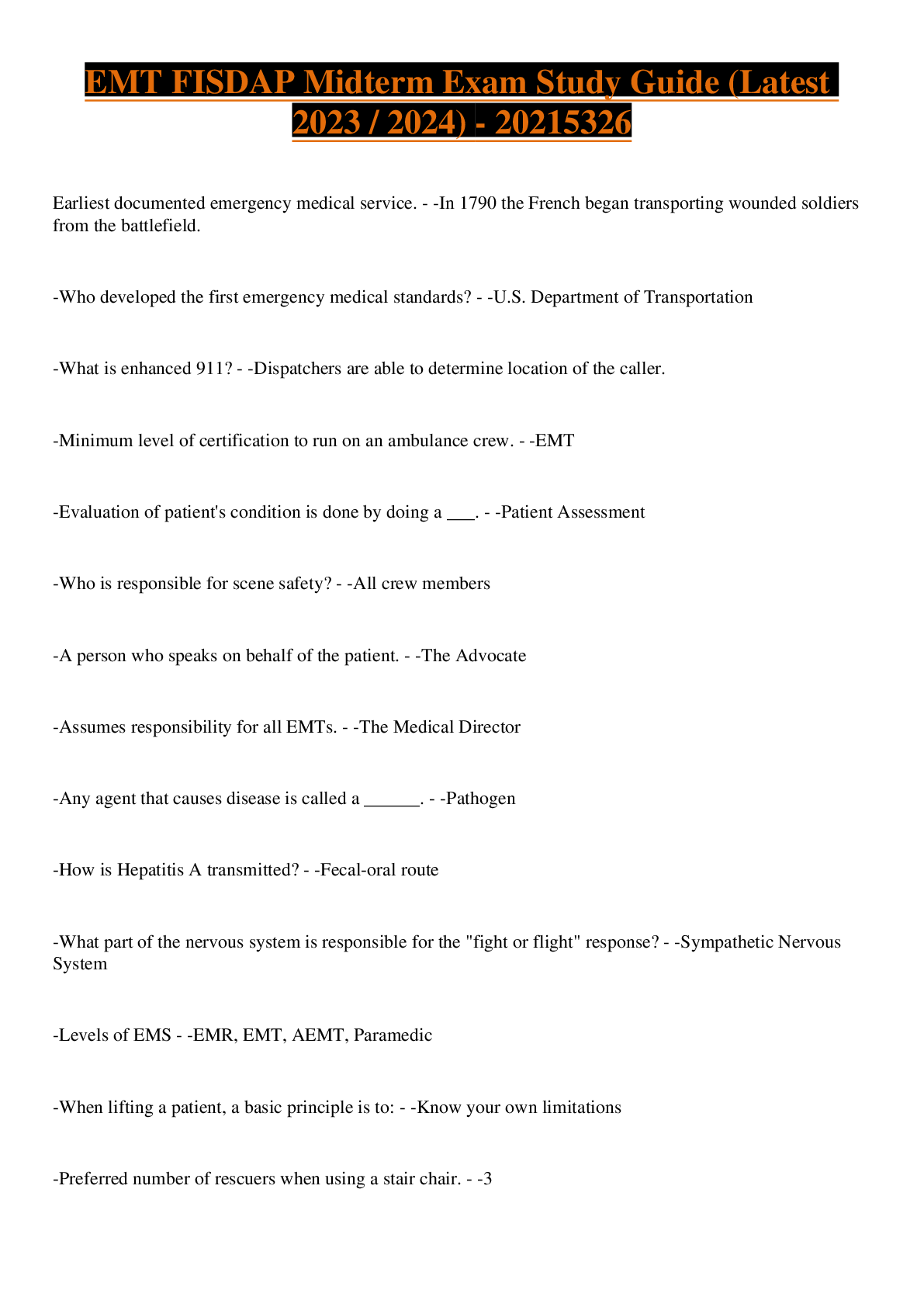
Earliest documented emergency medical service. - -In 1790 the French began transporting wounded soldiers from the battlefield.
-Who developed the first emergency medical standards? - -U.S. Department of Transportation
...
Earliest documented emergency medical service. - -In 1790 the French began transporting wounded soldiers from the battlefield.
-Who developed the first emergency medical standards? - -U.S. Department of Transportation
-What is enhanced 911? - -Dispatchers are able to determine location of the caller.
-Minimum level of certification to run on an ambulance crew. - -EMT
-Evaluation of patient's condition is done by doing a ___. - -Patient Assessment
-Who is responsible for scene safety? - -All crew members
-A person who speaks on behalf of the patient. - -The Advocate
-Assumes responsibility for all EMTs. - -The Medical Director
-Any agent that causes disease is called a ______. - -Pathogen
-How is Hepatitis A transmitted? - -Fecal-oral route
-What part of the nervous system is responsible for the "fight or flight" response? - -Sympathetic Nervous System
-Levels of EMS - -EMR, EMT, AEMT, Paramedic
-When lifting a patient, a basic principle is to: - -Know your own limitations
-Preferred number of rescuers when using a stair chair. - -3
-Set of limitations that defines the legal actions and limitations placed on the EMT. - -Scope of Practice
-Consent given by a school principal to treat a minor on behalf of the parents. - -In loco parentis (in place of the parent)
-An EMT's legal and ethical obligation to provide care to a patient. - -Duty to Act
-Act that governs patient confidentiality. - -HIPAA
-EMTs role at a crime scene. - -Care of the patient
-What is anatomy? - -The structures of the human body.
-What is physiology? - -The function of the human body.
-Sharing information about a patient's history or condition. - -Breach of confidentiality
-Medial - -Middle
-Lateral - -Outside
-Standing erect, facing the observer, with arms down and the palms of the hands facing forward. - -Anatomical Position
-Prone - -Face down
-Supine - -Face up
-Proximal - -Near to
-Distal - -Away from
-Patient is sitting straight up. - -Fowler's position
-Shock is also called _____. - -Hypoperfusion
-The two areas of the spine most easily injured. - -Cervical and Lumbar
-Arteries always carry blood ______ from the heart. - -away
-Veins always care blood _____ the heart. - -towards
-The clotting components of blood. - -Platelets
-The arteries the feed blood to the heart. - -Coronary arteries
-The pressure created by the contraction of the left ventricle - -Systolic
-The pressure remaining in the arteries when the left ventricle relaxes. - -Diastolic
-The system of the body that produces chemicals and hormones that regulate most of the body's activities and functions. - -Endocrine System
-Main function of the liver. - -Detoxifies harmful substances, stores sugar, and assists in the production of blood products.
-The most muscular and strongest part of the heart. - -Left Ventricle
-Primary organs of the renal system. - -Kidneys
-Carries deoxygenated blood to the lungs. - -Pulmonary artery
-Carries oxygenated blood from the lungs to the heart. - -Pulmonary veins
-A source of major airway obstruction in children. - -The tongue
-The amount of air the moves in and out of the chest in one normal breathing cycle. - -Tidal volume
-Tidal volume x Breaths per minute = ? - -Minute volume
-What is ATP? - -The cell's internally created fuel that is responsible for powering all cellular function.
-When glucose and other nutrients are converted into energy. - -Cellular Respiration
-The byproducts of anaerobic respiration. - -Lactic acid and carbon dioxide
-The byproduct of cellular respiration that is removed from the blood and released through exhalation. - -Carbon dioxide
-The main control center of respiratory control. - -Medulla Oblongata
-Pathway of air from the nose to the alveoli. - -nose, nasopharynx, pharynx, hypopharynx, larynx, trachea, bronchi, lungs, alveoli.
-A condition that is caused by a decreased number of red blood cells. - -Anemia
-Respiratory drive is triggered by changes in levels of ___. - -Carbon dioxide
-Birth to one year. - -Infancy
-A reflex in an newborn where it throws its arms out when started. - -Moro reflex
-Age group most concerned with body image - -Adolescence
-High-pitched upper airway obstruction. - -Stridor
-How to open the airway when a s
[Show More]