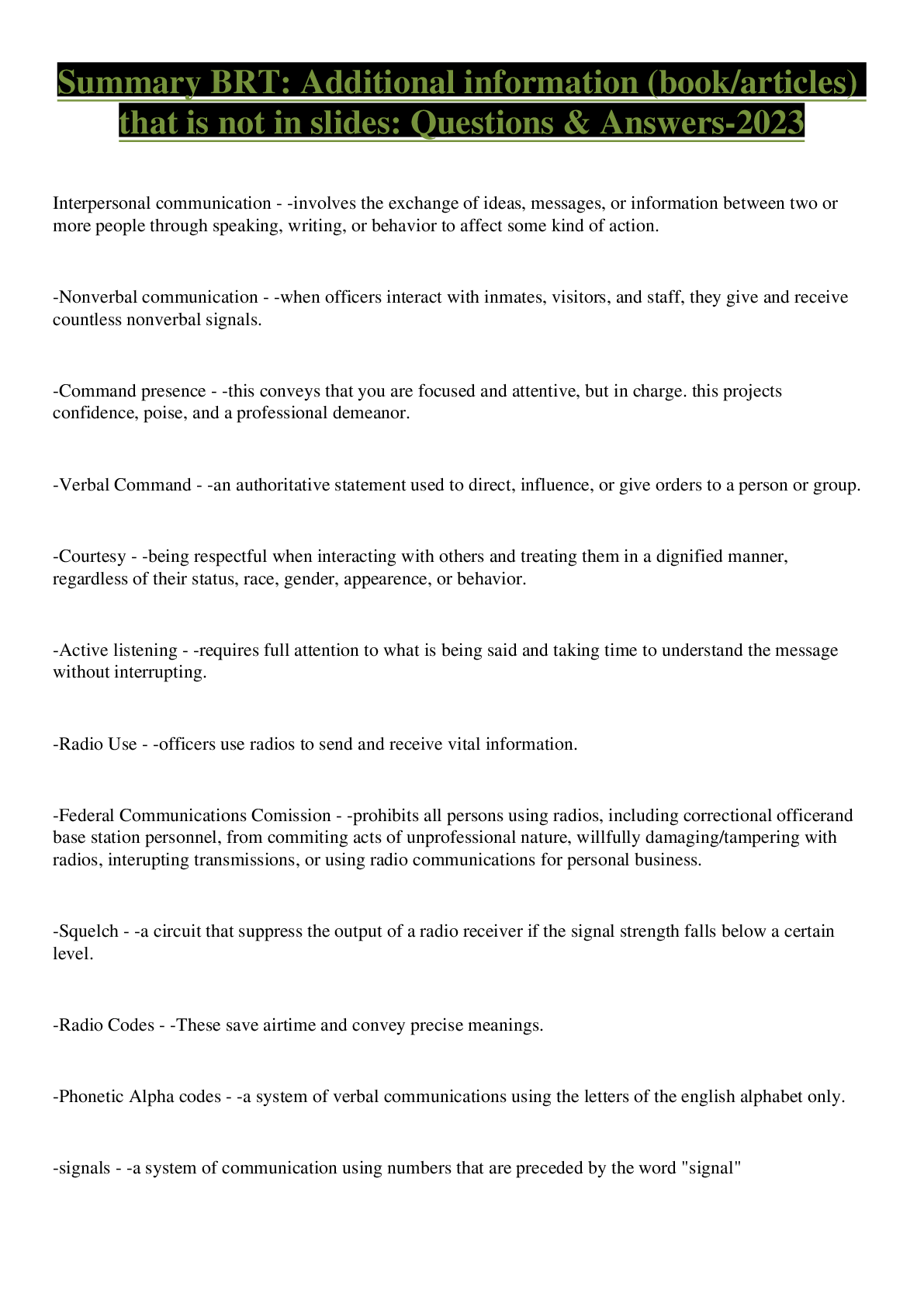
Interpersonal communication - -involves the exchange of ideas, messages, or information between two or more people through speaking, writing, or behavior to affect some kind of action.
-Nonverbal communication - -when
...
Interpersonal communication - -involves the exchange of ideas, messages, or information between two or more people through speaking, writing, or behavior to affect some kind of action.
-Nonverbal communication - -when officers interact with inmates, visitors, and staff, they give and receive countless nonverbal signals.
-Command presence - -this conveys that you are focused and attentive, but in charge. this projects confidence, poise, and a professional demeanor.
-Verbal Command - -an authoritative statement used to direct, influence, or give orders to a person or group.
-Courtesy - -being respectful when interacting with others and treating them in a dignified manner, regardless of their status, race, gender, appearence, or behavior.
-Active listening - -requires full attention to what is being said and taking time to understand the message without interrupting.
-Radio Use - -officers use radios to send and receive vital information.
-Federal Communications Comission - -prohibits all persons using radios, including correctional officerand base station personnel, from commiting acts of unprofessional nature, willfully damaging/tampering with radios, interupting transmissions, or using radio communications for personal business.
-Squelch - -a circuit that suppress the output of a radio receiver if the signal strength falls below a certain level.
-Radio Codes - -These save airtime and convey precise meanings.
-Phonetic Alpha codes - -a system of verbal communications using the letters of the english alphabet only.
-signals - -a system of communication using numbers that are preceded by the word "signal"
-Ten or numeric codes - -a system of communication by which "10" precedes numbers that stand for specific activities.
-Numeric alpha codes - -a system of communication that combines numbers and letters of the alphabet, or the combination of some or all of the above to transmit messages.
-Interview - -a conversation between a correctional officer and an interviewee with the goal of obtaining factual information.
-open-ended questions - -encourage conversation and require the interviewee to think, reflect, and provide their opinion and feelings.
-Close ended questions - -asked with a specific yes or no answer in mind.
-Leading questions - -should be avoided because they are asked in such a way as to produce a specific response from the person being questioned.
-Direct questions - -a combination of close ended and leading questions.
-Forced choice questions - -asked to obtain a precise answer to an important fit or preference question by defining the range in which answers can be given. this format requires the questioner to rank a series of possible responses, often in order of desirability, to provide the interviewee with specific insight into their expectations.
-Statement - -a permanent verbal or written record of a persons account of an incident or occurence, which may or may not be made under oath.
-Report - -a permanent written account that communicates all available facts of an incident or event in a correctional setting.
-Incident report - -used in many correctional facilities to report in detail any incidents involving inmates.
-Corrective Consultation - -used for minor disciplinary infractions, it details the counseling and corrective actions taken.
-Disciplinary Report - -provides a detailed account of the facts surroundint an inmates rule violation.
-Use of Force Report - -completed any time force is used and is attached to an incident or disciplinary report.
-Counts Form - -used to record inmate counts as required by Florida Statutes
-Special Watch Form - -used to record activities of inmates under any type of special watch, such as suicide watch, 15 minute watch, and direct observation.
-Equipment check form - -used to record location of all equipment at each post.
-Note Taking - -consists of writing down a brief observations or, if an interview, quotes from people involved.
-Chronologically - -the grouping of recorded information by date and time of occurence.
-Categorically - -the grouping of recorded information into types such as informants, victims, witnesses, suspects, weapons, rule violations, evidence, and crime elements.
-Sentence - -a group of words that contains a subject, a verb, an object, and that expresses a complete thought.
-Sentence Fragment - -a group of words that lacks a subject or verb, or fails to express a complete thought.
-Homophones - -are words that are easily confused in use and spelling.
-Format - -the way information is organized and presented.
-Content - -the significant facts of the incident.
-Introduction - -date and time, location of incident, the case number, and the officers assignment or location.
-Body - -the detailed account of the incident.
-Closing - -explains action taken or how the incident was resolves; how the information and evidence was handled, including the need for further investigation; and any recommendations for disciplinary action.
-Jargon - -defined as words used by a particular trade or profession that are not commonly understood by the general public.
-Slang - -an informal vocabulary composed of invented words or expressions that are often used by a specific group, region, trade, or profession.
-Textspeak - -language used in text messages and digital communications, typically using abbreviations, acronyms, or initials, and usually not following standard grammer, spelling or punctuation.
-Editing - -the process of ensuring that all pertinent facts have been included in a report in an organized and accurate manner.
-Proofreading - -the checking of a report to ensure that all words are spelled correctly, punctation is used accurately, appropriate words are capitalized, proper grammar is used.
- - -
[Show More]