Types of Multivariate Techniques - -1. Principal components and common factor analysis
2. Multiple regression and Multiple correlation
3. Multiple discriminant analysis and logistic regression
4. Canonical correlation
...
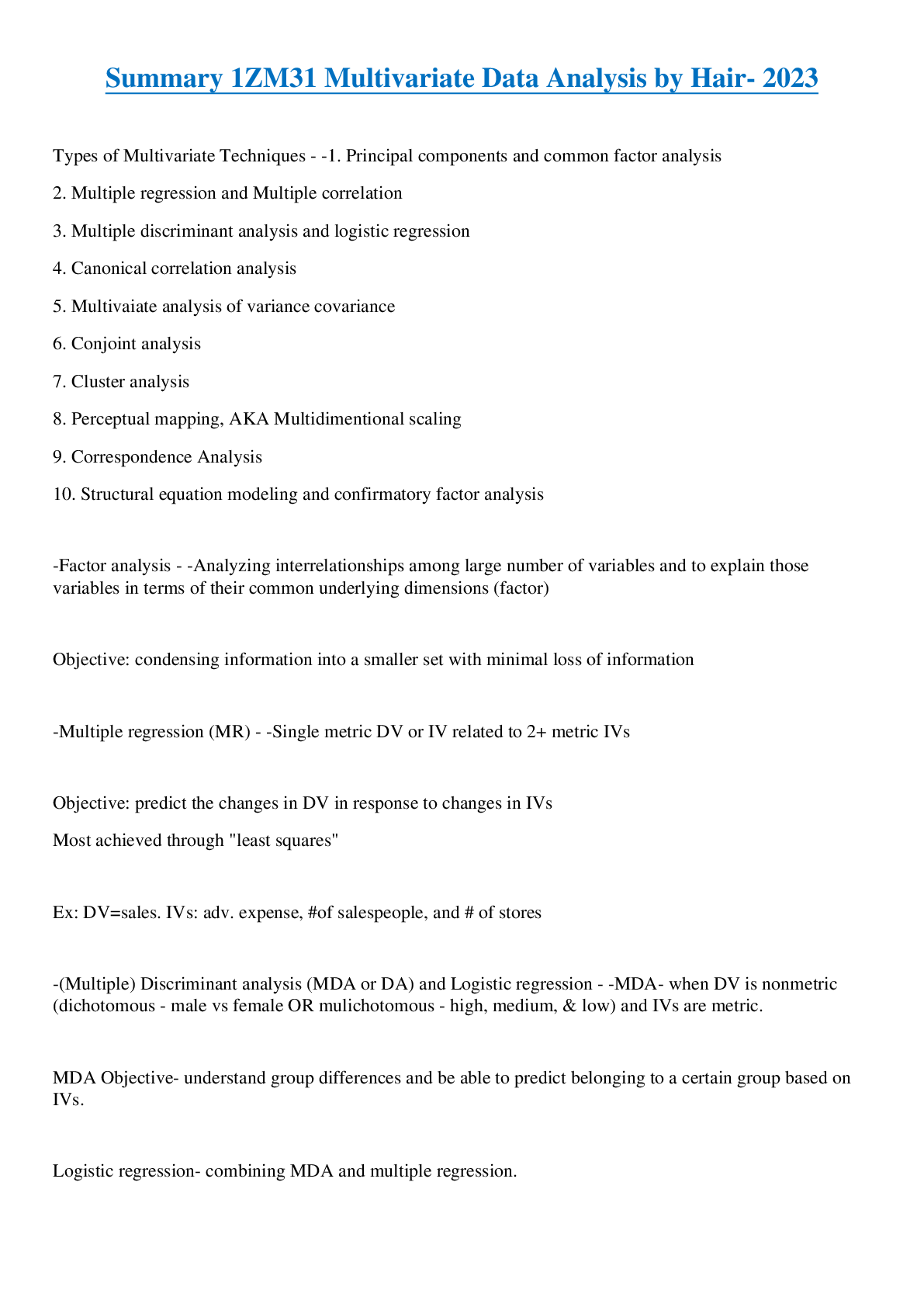
Types of Multivariate Techniques - -1. Principal components and common factor analysis
2. Multiple regression and Multiple correlation
3. Multiple discriminant analysis and logistic regression
4. Canonical correlation analysis
5. Multivaiate analysis of variance covariance
6. Conjoint analysis
7. Cluster analysis
8. Perceptual mapping, AKA Multidimentional scaling
9. Correspondence Analysis
10. Structural equation modeling and confirmatory factor analysis
-Factor analysis - -Analyzing interrelationships among large number of variables and to explain those variables in terms of their common underlying dimensions (factor)
Objective: condensing information into a smaller set with minimal loss of information
-Multiple regression (MR) - -Single metric DV or IV related to 2+ metric IVs
Objective: predict the changes in DV in response to changes in IVs
Most achieved through "least squares"
Ex: DV=sales. IVs: adv. expense, #of salespeople, and # of stores
-(Multiple) Discriminant analysis (MDA or DA) and Logistic regression - -MDA- when DV is nonmetric (dichotomous - male vs female OR mulichotomous - high, medium, & low) and IVs are metric.
MDA Objective- understand group differences and be able to predict belonging to a certain group based on IVs.
Logistic regression- combining MDA and multiple regression.
Objective: to David into groups, then analyze DV on IVs within groups. Can be used to compare groups to show differences in predicting the groups.
-Canonical correlation - -Multiple metric DVs with multiple metric IVs.
Objective: to develop a linear combination of each set of variables (both IVs and DVs) in a manner that maximizes the correlation between the two sets.
ex. A company being compared to world-class companies on 50 metrically measured questions. The company can see the differences it has from the world-class companies as well as examine the correlation between the 50 questions within the company.
-Mutlivariate analysis of Variance and Covariance (MANOVA) and (MANCOVA) - -a statistical technique to simultaneously explore the relationship between several nonmetric IVs to 2+ metric DVs.
An extention of Univariate Analysis of Variance (ANOVA - nonmetric IVs to 1 metric DV)
MANCOVA - multiple analysis of covariance - used in conjunction with MANOVA to remove (after an experiment) the effect of any uncontrolled metric IV) - similar to bivariate partial correlation wheere the effect of a 3rd IV is removed from the correlation.
ex. customers see a humorous and non-humorous commercial and then rate the company on multiple factors --such as modern vs. traditional, high vs. low quality. MANOVA would determine the extent of any statistical difference between perceptions between the two commercials.
-Conjount Analysis - -Most direct application is in NEW PRODUCT DEV.
Whereby researchers are able to assess the importance of attributes as well as the levels of each attribute while consumers evaluate only a few product profiles, which are combinations of product levels.
ex. If a product has 3 attributes (price, quality, and color) instead of having to evaluate all possible combinations (3x3x3=27), a subset of 9 or more can be evaluated. The researcher knows the level of each attribute this way. (if Red is preferred 90% of the time then, yellow and blue are only 10% - etc.)
-Cluster Analysis - -an analytical technique for developing meaningful subgroups. (profiling within groups)
ex. finding out why customers come to a certain business. data could be collected on perception of price, quality, etc... then the owner would know what motivates the subgroups.
-Perceptual Mapping - -AKA Multidimensional Scaling (basically comparing factors and then showing a graphical presentation) - transform consumer judgments of similarity or preference into distances represented in multidimensional space.
ex. looking at 1 store - Burger King - who wants to know who their stronger competitor is between Wendys and McDonalds. A sample rates the pairs of restaurants from most similar to least similar. Results conclude Wendys is more like BK, therefore that is their bigger competitor. Follow up analysis can look at the specific similarities.
-Correspondence Analysis - -A way to see interdependence for non-metric data through perceptual mapping and multivariate representation. (as compared to perceptual mapping...looking at multiple stores variety of similarities/differences)
ex. brand preferences being cross-tabulated on demographic variables (gender, income categories, and occupation) then a 2 or 3 dimensional map of all brand
[Show More]