Foundations of Reading: NH Latest 2023
Rated A+
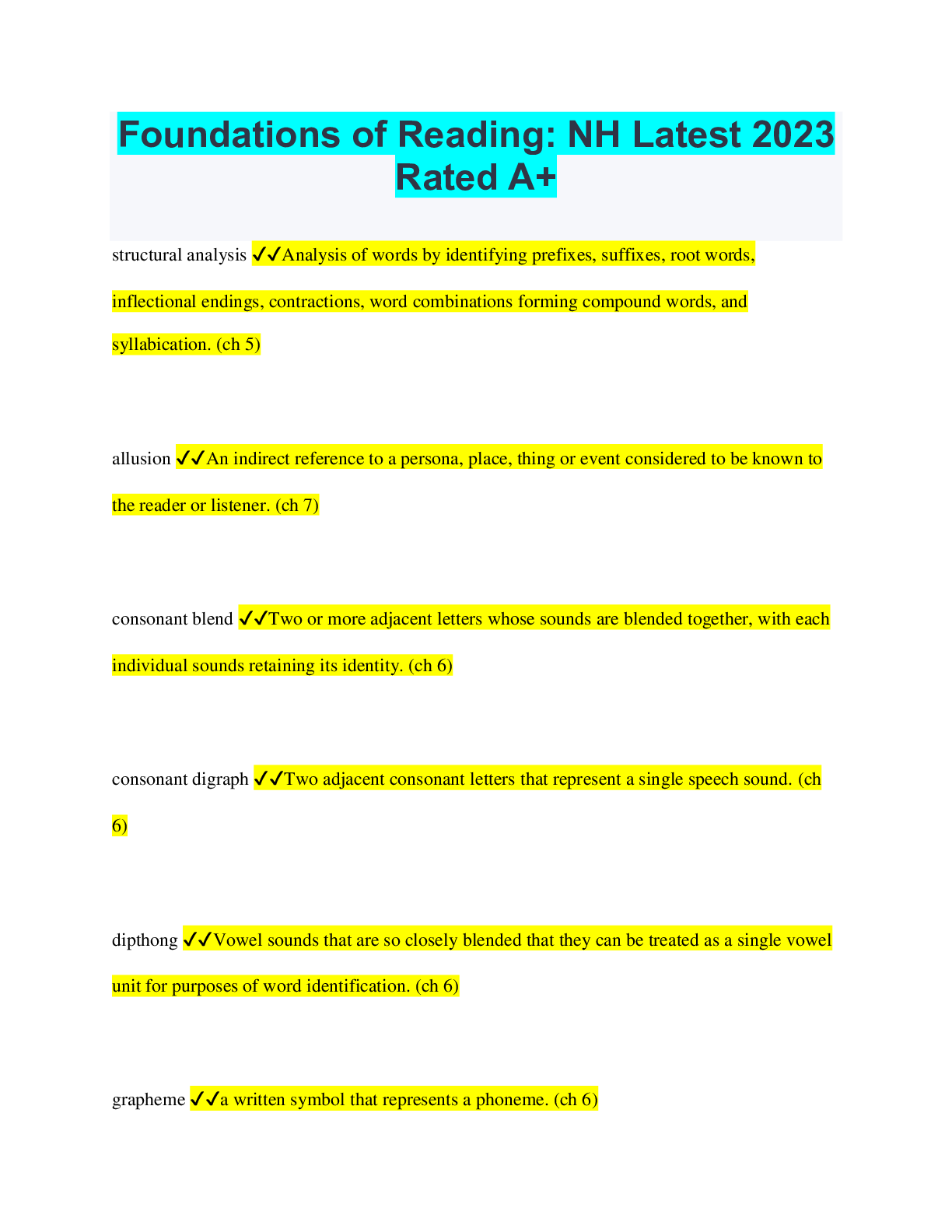
structural analysis ✔✔Analysis of words by identifying prefixes, suffixes, root words,
inflectional endings, contractions, word combinations forming compound words, and
...
Foundations of Reading: NH Latest 2023
Rated A+
structural analysis ✔✔Analysis of words by identifying prefixes, suffixes, root words,
inflectional endings, contractions, word combinations forming compound words, and
syllabication. (ch 5)
allusion ✔✔An indirect reference to a persona, place, thing or event considered to be known to
the reader or listener. (ch 7)
consonant blend ✔✔Two or more adjacent letters whose sounds are blended together, with each
individual sounds retaining its identity. (ch 6)
consonant digraph ✔✔Two adjacent consonant letters that represent a single speech sound. (ch
6)
dipthong ✔✔Vowel sounds that are so closely blended that they can be treated as a single vowel
unit for purposes of word identification. (ch 6)
grapheme ✔✔a written symbol that represents a phoneme. (ch 6)
onsets ✔✔consonants or consonant clusters at the beginning of a syllable. (ch. 6)
rimes ✔✔vowels, vowel combinations or any consonants that follow the initial consonant of a
syllable. (ch 6)
vowel digraph ✔✔two adjacent vowel letters that represent a single speech sound. (ch 6)
analogies ✔✔Comparisons of two like relationships. Eg., Author is to book as artist is to
painting. (ch 7)
appositive ✔✔A word or phrase placed by another word or phrase as a restatement. (ch 7)
morphemes ✔✔The smallest units of meaning in a language. (ch 7)
metacognition ✔✔A person's knowledge of the functioning of his/her own mind, and conscious
efforts to monitor or control this functioning. (ch 8)
anaphora ✔✔use of a word as a substitute for another word or group of words. (ch 9)
ellipsis ✔✔The omission of a word or group of words that are to be "understood" by the reader.
(ch 9)
dialect ✔✔Regional or social adaptations of a language; distinguishing features may include
pronunciation, vocabulary or syntax. (ch 10)
linguist ✔✔A person who makes a scientific study of human speech. (ch 10)
Caldecott Award ✔✔an annual award for excellence in illustration. (ch 11)
Coretta Scott King Award ✔✔an award that recognizes African-American authors and
illustrators whose books promote peace and world brotherhood. (ch 11)
fables ✔✔brief moral tales in which animals or inanimate objects speak. (ch 11)
myths ✔✔Traditional literature selections featuring characters such as gods, heroes, or
supernatural beings. (ch 11)
Newberry Award ✔✔An annual award for the most distinguished contribution to American
literature for children. (ch 11)
traditional literature ✔✔a literary genre of stories, without identified authors, which are passed
down through oral narration. (ch 11)
writing process ✔✔A student-centered procedure for writing consisting of (1) prewriting, (2)
drafting, (3) revising, (4) editing, (5) publishing. (ch 11)
expository style ✔✔a precise, factual writing style. (ch 13)
language arts ✔✔listening, speaking, reading, writing, viewing, and visually representing. (ch
13)
interactive theory ✔✔a theory that depicts reading as a combination of reader-based and textbased processes. (ch. 1)
modality ✔✔a sensory system for receiving and processing information (visual, auditory,
kinesthetic, tactile). (ch 1)
metacognitive strategies ✔✔techniques for thinking about and monitoring one's own thought
processes. (ch 1)
fluency ✔✔the ability to read with automaticity, appropriate rate, good expression, and good
comprehension. (ch 1)
transactive theory ✔✔A theory based on Rosenblatt's idea that every reading act is a transaction
that involves a reader and a text and occurs at a particular time in a specific context, with
meaning coming into being during the transaction between the reader and the text. (ch 1)
semantic cues/clues ✔✔a meaning clue. (ch. 1)
schemata ✔✔a preexisting knowledge structure (cluster of information) developed about a
persona, place, thing, or idea. (ch 1)
syntactic cues/clues ✔✔a clue derived from the word order in sentences. (ch 1)
visual discrimination ✔✔the ability to visually differentiate between different shapes. (ch 1)
subskill theory ✔✔a theory that depicts reading as a set of subskills that children must master
and integrate. (ch 1)
cloze procedure ✔✔A technique in which the teacher deletes words or structures from a passage
and the students fill int he blanks using context from surrounding material. (ch 3)
miscue ✔✔an unexpected oral-reading response that deviates from the text. (ch 3)
running record ✔✔a strategy for recording miscues during the student's oral reading. (ch 3)
alphabetic principle ✔✔The concept that letters represent speech sounds. (ch 4)
emergent literacy ✔✔developing awareness of the interrelatedness of oral and written language.
(ch 4)
phonological awareness ✔✔The awareness of sound patterns in words, such as phonemes, onsets
and rimes, and syllables. (ch 4)
phonemic awareness ✔✔the understanding that speech consists of a series of small units of
sound, or phonemes. (ch 4)
genre ✔✔a type of classification of literature, such as historical fiction or biography. (ch 11)
automaticity ✔✔the ability to carry out a task without giving it much attention. (ch 1)
auditory acuity ✔✔sharpness of hearing. (ch 1)
value-added assessment ✔✔a statistical way to compare students' scores on a standardized test
from one year to another in order to determine the growth a student made during a given year.
(ch 3)
prosody ✔✔the rhythmic patterns of oral language or speech. (ch 4)
sight word ✔✔words that are recognized immediately, without having to resort to analysis. (ch
4)
scaffolding ✔✔providing support through modelling or feedback, and then withdrawing the
support gradually as the learner gains confidence. (ch 4)
zone of proximal development ✔✔the span between a child's actual skill level and potential
level; a period where assistance should be provided. (ch 4)
context clues ✔✔clues to word meanings or pronunciations found in the surrounding words or
sentences. (ch 5)
homographs ✔✔words that have identical spellings but different meanings. (ch 5)
inflectional endings ✔✔endings that when added to nouns change the number, case, or gender;
when added to verbs change the person or tense; and when added to adjectives change the
degree. (ch 5)
antonyms ✔✔a pair of words that have opposite meanings. (ch 7)
etymology ✔✔the origin and history of words. (ch 7)
euphemism ✔✔the substitution of a less offensive word or phrase for an unpleasant term or
expression. (ch 7)
homographs ✔✔words with the same spelling but different meanings. (ch 7)
homonyms/homophones ✔✔Pairs or groups of words that are spelled differently but are
pronounced alike. (ch 7)
hyperbole ✔✔extreme exaggeration. (ch 7)
idiom ✔✔a group of words that, taken as a whole, has a meaning different from the meanings of
the individual words. (ch 7)
metaphor ✔✔a direct comparison not using "like" or "as." (ch. 7)
simile ✔✔a comparison using "like" or "as." (ch 7)
KWL model ✔✔a teaching model for expository text.
K- what I KNOW/ think I KNOW
W- what I WANT to know
L- what I LEARNED. (ch 8)
story grammar ✔✔a set of rules that define story structures. (ch 9)
cumulative tales ✔✔A type of folktale that features a repetitive plot sequence that adds another
element with each repetition. (ch 11)
fantasy ✔✔a genre of literature including highly imaginative, fictional stories, with fanciful or
supernatural elements. (ch 11)
fiction ✔✔stories that are not true, written in a narrative style, for the purpose of entertainment.
(ch 11)
legends ✔✔unverified historical stories that originated orally. (ch 11)
nonfiction ✔✔true stories or information designed to inform or instruct. (ch 11)
content-area textbooks ✔✔Textbooks in areas of study, such as English, social studies, science,
or mathematics. (ch 13)
narrative style ✔✔story-like presentation. (ch 13)
readability ✔✔an objective measure of the difficulty of written material. (ch 13)
semantic maps ✔✔graphic representations of relationships among words and phrases in written
materials. (ch 7)
phoneme ✔✔the smallest unit of sound in a language. (ch 1)
grapheme ✔✔a written symbol that represents a phoneme. (ch 1)
cognitive development ✔✔the development of the ability to think and reason. (ch 4)
guided reading ✔✔instructional model of delivery that provides structure and purpose for
reading. (ch 4)
frustration level ✔✔reading with below 90% word accuracy.
figurative language ✔✔nonliteral language. (ch. 7)
word sorts ✔✔categorization activities that involve classifying words into categories. (ch 7)
environmental print ✔✔words that children frequently see in the world around them. (ch 4)
direct instruction ✔✔teacher control of the learning environment through structured lessons, goal
setting, choice of activities, and feedback. (ch 4)
word wall ✔✔a wall displaying vocabulary words students are working with.
Beck's Three tiers of vocabulary ✔✔Tier 1: common words students already know
Tier 2: words use frequently by mature language users
Tier 3: highly specialized content words.
5 steps for new words ✔✔1. Look at the picture
2. read ahead, then go back and see if the context helped you.
3. get your mouth ready for the first sound.
4. look for parts or "chunks" that you already know.
5. sound it out.
levels of Bloom's taxonomy ✔✔knowledge
comprehension
application
analysis
synthesis
evaluation
Steps in pre-reading ✔✔questioning, previewing, predicting, KWL, pre-write
Steps during reading ✔✔modeling, direct instruction and think-alouds; check for
comprehension; integrate new/existing knowledge; make inferences; identify main idea
Steps after reading ✔✔summarize, identify main events, confirm predictions, retell, visual
representations, journaling
literal comprehension ✔✔acquiring information that is directly stated in the text; details of who,
what, etc.; sequence; cause/effect.
higher-order comprehension ✔✔based on interpretation and analysis (higher on Bloom's
taxonomy); predictions; questioning; visualizing; inferences; making connections; interpreting
anaphora; synthesizing; comparisons/mood/feelings.
anticipation guides ✔✔sets of declarative statements related to materials about to be read that are
designed to stimulate thinking and discussion. (ch 8)
Point of view ✔✔view from which story is written. (ch 9)
The six traits of writing ✔✔1) ideas 2) organization 3) voice 4) word choice 5) sentence fluency,
conventions 6) presentation.
phonemic blending ✔✔the ability to combine a sequence of speech sounds (phonemes) together
to form a word.
phonogram ✔✔a common spelling pattern used to spell the rime of a group (or "family") of
single-syllable words.
The role of phonological awareness and phonemic awareness in reading development ✔✔
[Show More]