Philosophy > DISCUSSION POST > PHIL-447N Week 1 Discussion Question 1 – Making Claims (All)
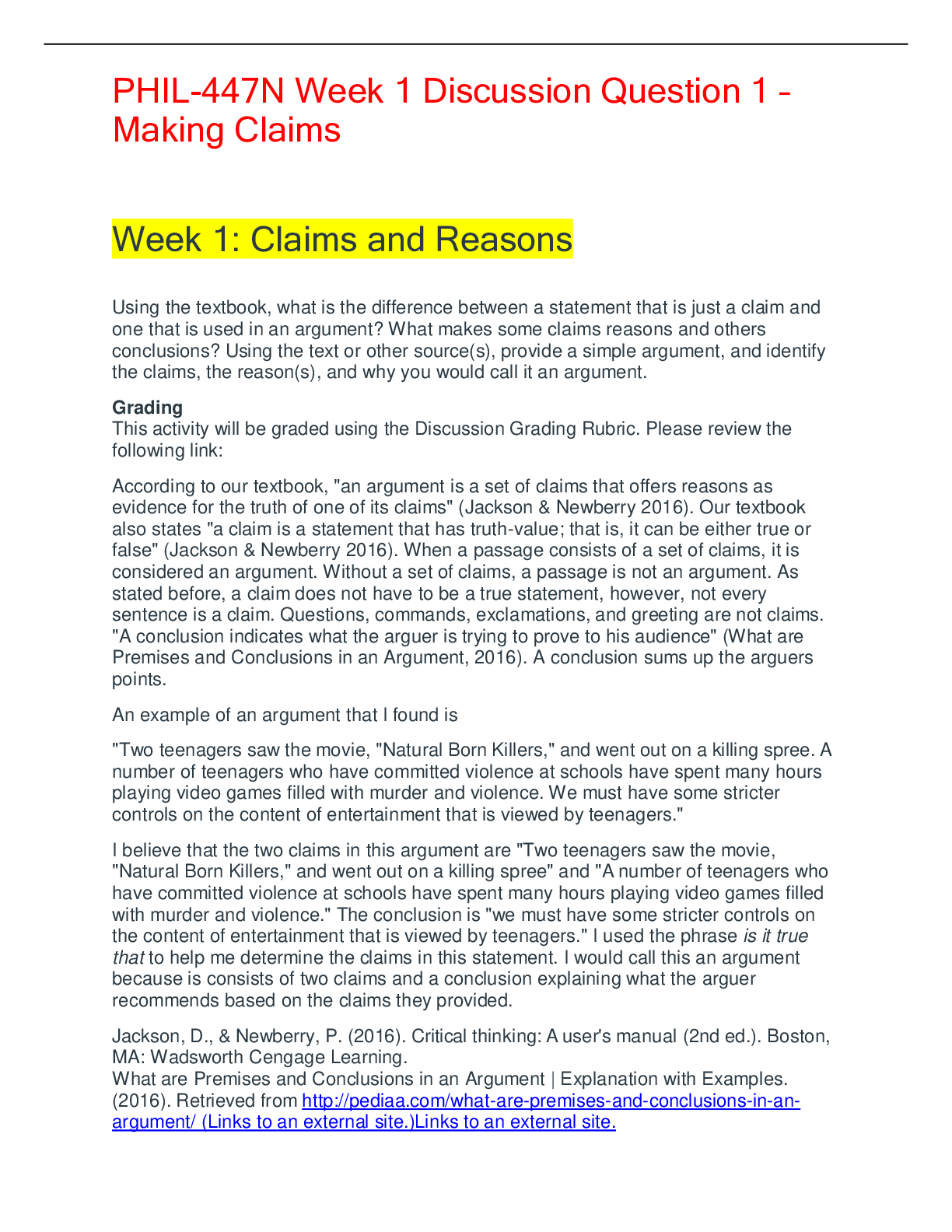
PHIL-447N Week 1 Discussion Question 1 – Making Claims
Document Content and Description Below
Last updated: 3 years ago
Preview 1 out of 2 pages
Instant download
Buy this Document to get the Full Access Instantly
Provided by Students Who Aced it
We Verify Document Content to Gurantee Accuracy
Also available in bundle (1)
Click Below to Access Bundle(s)

PHIL 447N: Logic & Critical Thinking
PHIL 447N Week 1 Assignment; Short Paper on Execution PHIL 447N Week 1 Quiz (MCQs) PHIL-447N Week 1 Discussion Question 1 – Making Claims (graded) PHIL 447N Week 1 Discussion Question 2 – Cog...
By Doc.Mukai Edyth 3 years ago
$20
19
Reviews( 0 )
Document information
Connected school, study & course
About the document
Uploaded On
May 03, 2023
Number of pages
2
Written in
All

Additional information
This document has been written for:
Uploaded
May 03, 2023
Downloads
0
Views
129
Topic Tags
Related Subjects & Courses
Explore similar study resources and related concepts.
Recommended For You
Get more on DISCUSSION POST »
PHIl Ethics_ Sophia final Milestone, Latest 2020/2020, Complet...

Liberty University Online Academy - PHIL 201 Test 3 Questions...

West Georgia Technical College - PHILOSOPHY 201 > 2019 Latest...

PHI 2000 Sophia Ethics Milestones. Introduction to Ethics Fina...

University of the PeoplePHIL 1402 1402DISCUSSION FORUM ASSIGNM...
University of the People - PHIL 1404PHIL 1404 Discussion Forum...
University of the People - PHIL 1404PHIL 1404 Discussion Forum...
University of the People - PHIL 1404PHIL 1404 Discussion Forum...
University of the People - PHIL 1404PHIL 1404 Discussion Forum...

University of the People - PHIL 1404PHIL 1404 Discussion Forum...
University of the People - PHIL 1404PHIL 1404 Discussion Forum...
University of the People - PHIL 1404PHIL 1404 Discussion Forum...