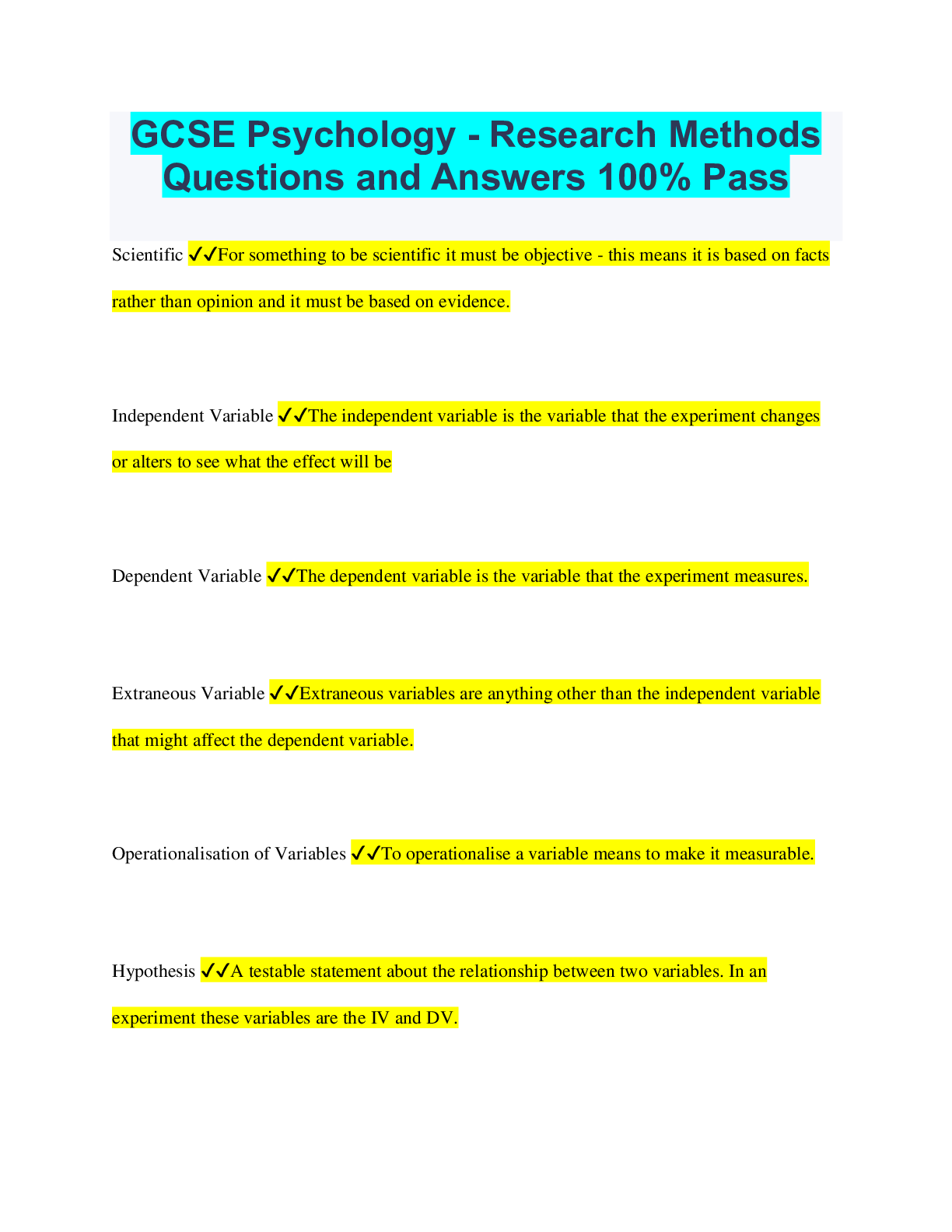
GCSE Psychology - Research Methods
Questions and Answers 100% Pass
Scientific ✔✔For something to be scientific it must be objective - this means it is based on facts
rather than opinion and it must be based on evidenc
...
GCSE Psychology - Research Methods
Questions and Answers 100% Pass
Scientific ✔✔For something to be scientific it must be objective - this means it is based on facts
rather than opinion and it must be based on evidence.
Independent Variable ✔✔The independent variable is the variable that the experiment changes
or alters to see what the effect will be
Dependent Variable ✔✔The dependent variable is the variable that the experiment measures.
Extraneous Variable ✔✔Extraneous variables are anything other than the independent variable
that might affect the dependent variable.
Operationalisation of Variables ✔✔To operationalise a variable means to make it measurable.
Hypothesis ✔✔A testable statement about the relationship between two variables. In an
experiment these variables are the IV and DV.
How do you write a hypothesis? ✔✔This experiment is looking at the effect of (IV) on (DV)
The first gap is filled in with the IV or two conditions of the experiment that are being altered or
manipulated by the experimenter. The second gap will be filled in with the DV or performance
of the participant that the experimenter plans to measure.
Independent Groups ✔✔The available people for the experiment are divided into two groups.
One group takes part in one of the conditions of the experiment and the other group takes part in
the remaining condition of the experiment.
Repeated Measures ✔✔There is one group of participants. The participants take part in both
conditions of the experiment.
Matched Pairs ✔✔The available people for the experiment are tested before taking part and are
matched for qualities into pairs. They could be identified as Pair Aa, Pair Bb and so on. One
member of the pair takes part in one condition of the study (that group comprises A, B, C and so
on). The other member takes part in the other condition (that group comprises a, b, c and so on).
Identical twins are often considered to be perfect matched pairs in psychology research.
What are the advantages and disadvantages of independent groups? ✔✔Advantages:
There are no order effects because people only take part in one condition.
Often the same material can be used for the task in both conditions.
Participants cannot work out the aim of the study because they only take part in one condition.
Disadvantages:
There are different people (participant variables) in the two conditions so that may be why the
results are different.
You need more people for the study. To get 10 in each group you need 20 people.
What are the advantages and disadvantages of repeated measures? ✔✔Advantages:
The people in both conditions are the same so there are no participant variables.
You only need 10 people to get 20 results because each person produces two 'scores'.
Disadvantages:
There are order effects as people have to do two tasks.
You may need two tasks (they cannot learn the same list twice).
Participants may work out the aim of the study because they take part in both conditions.
What are the advantages and disadvantages of matched pairs? ✔✔Advantages:
Participant variables are reduced.
There are no order effects.
Often the same material can be used for the task in both conditions.
Disadvantages:
Matching is difficult, time consuming and not always successful.
Some participant variables are still present.
Order Effect ✔✔This occurs when a participant's performance in the second condition of an
experiment is affected because they have already done the first condition. They may do better
because of practice or worse because of tiredness. This may happen in a repeated measure
design.
Participant Variables ✔✔The differences between the people who take part in the study. These
may affect the results of an experiment that uses uses an independent groups design.
Standardised Procedures ✔✔A set order is carrying out a study that is applied to all participants
when necessary.
Random allocation ✔✔A procedure of putting participants into conditions by chance.
Counterbalancing ✔✔A procedure for evening out the order in his participants complete both
conditions of an experiment.
Randomisation ✔✔Using chance to produce an order for a procedure.
Sample ✔✔The small group of people who represent the target population and who are studied.
Target Population ✔✔The large group of people the researcher wishes to study.
Representive ✔✔The sample of participants is made up of people who have the same
characteristics and abilities as the target population.
Generalised ✔✔The results from the sample can be said to apply to the target population.
Random Sample ✔✔Every member of the target population has an equal chance of being
selected for the sample.
Opportunity Sample ✔✔People who are members of the target population and are available and
willing to take part.
Systematic Sample ✔✔Every 'nth' member of the target population is selected for the sample.
Stratified Sample ✔✔To obtain this type of sample, the different subgroups in the target
population are identified, then people are randomly selected from these subgroups in proportion
to their numbers in the target population.
What are the advantages and limitations of the random sampling method? ✔✔Advantages:
No researcher bias.
Likely to be representative.
Limitations:
Time-consuming
What are the advantages and limitations of the opportunity sampling method? ✔✔Advantage:
Quick and easy
Limitation:
Not likely to be representative and may have researcher bias.
What are the advantages and limitations of the systematic sampling method? ✔✔Advantage:
Simple procedure with no researcher bias.
Limitation:
Sample may not be representative.
What are the advantages and limitations of the stratified sampling method? ✔✔Advantage:
Very representative.
Limitation:
Very time-consuming.
Raw Data ✔✔The scores collected in a study that have not been analysed or summarised.
Mean ✔✔A statistic calculated by adding all the scores in a set of values and dividing the total
by the number of values in the set.
Median ✔✔The middle value in a set of values when the values have been placed in ascending
order.
Range ✔✔The difference between the lowest and highest value in a set of values.
Ethical Issues ✔✔Points of concern about what is morally right.
British Psychological Society (BPS) Guidelines ✔✔The ethical guidelines produced by the BPS
in its 'Code of Ethics and Conduct' (2006) that govern the work of all practising and research
psychologists and also of psychology students in the UK.
[Show More]