Started: Apr 09, 2019 | Patient Exam Time: 33 min All Lines (87) Interview Questions (41) Statements (1) Exam Actions (45)
Hello!
Question
04/09/19
9:27 AM
EDT
Hi. I'm Preceptor Diana. I will explain the
details o
...
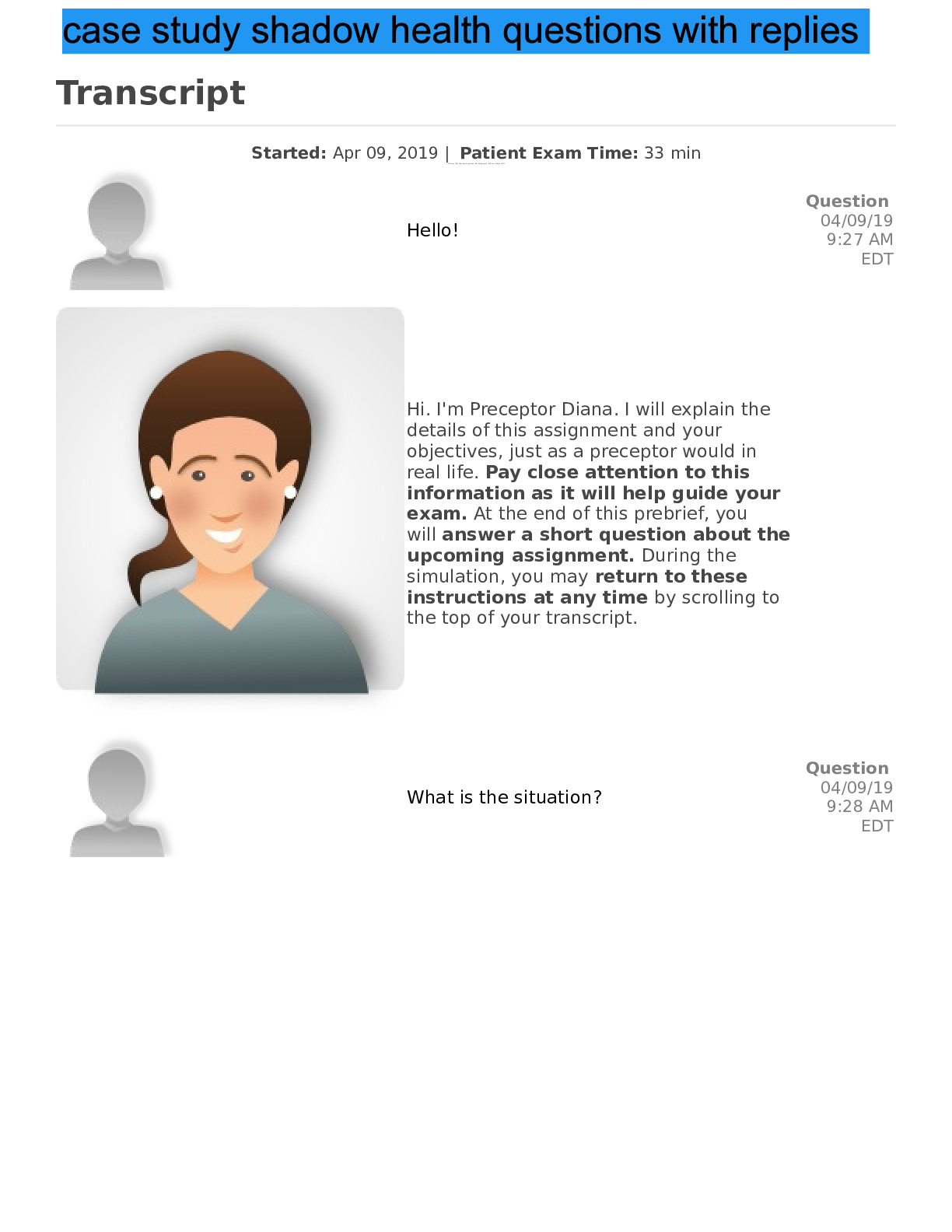
Started: Apr 09, 2019 | Patient Exam Time: 33 min All Lines (87) Interview Questions (41) Statements (1) Exam Actions (45)
Hello!
Question
04/09/19
9:27 AM
EDT
Hi. I'm Preceptor Diana. I will explain the
details of this assignment and your
objectives, just as a preceptor would in
real life. Pay close attention to this
information as it will help guide your
exam. At the end of this prebrief, you
will answer a short question about the
upcoming assignment. During the
simulation, you may return to these
instructions at any time by scrolling to
the top of your transcript.
What is the situation?
Question
04/09/19
9:28 AM
EDT
It's noon on Tina Jones' first day as a
patient here at Shadow General Hospital.
Your role in this simulation is that of a
healthcare provider who will perform a
full respiratory exam on Ms.
Jones given her history of asthma.
What are my objectives in this
assessment?
Question
04/09/19
9:28 AM
EDT
In your interview with Ms. Jones, you
will ask about her respiratory system
and identify any risk factors so that
you can determine any current and
potential issues. If you discover any
disease states, ask about symptoms
and the patient's experiences of
them. Your questioning should cover a
broad array of the symptoms'
characteristics. You will also inquire into
the health history of Ms. Jones' family
with regards to the respiratory
system so you can determine her genetic
predisposition to any diseases. Regardless
of whether you have assessed Tina
previously, ask all questions that are
medically relevant to her respiratory
system. In addition to collecting
subjective data, you will perform a
physical exam on Ms. Jones'
respiratory system to gather objective
data about the system's health and
physiology. While you
should communicate with patients
using accessible, everyday
language, it is standard practice to use
professional medical terminology
everywhere else, such as in
documenting physical findings and
nursing notes. You may complete the
exam activities in any order and move
between them as needed.
What else will this exam involve?
Question
04/09/19
9:29 AM
EDT
You will complete nursing tasks to
protect the patients safety, privacy,
and health.You can document your
findings, including vital signs, in the
Electronic Health Record. This record
provides necessary information for
healthcare professionals who will continue
patient care. Activities other than
Subjective and Objective Data Collection,
such as Documentation and Education and
Empathy, provide valuable practice for
their real-world counterparts. However,
they are not automatically graded by the
simulation.
How will I be evaluated?
Question
04/09/19
9:29 AM
EDT
In this assignment, you will be
evaluated on your Subjective and
Objective Data Collection. The
evaluation of your interview is dependent
on how you word your questions
therapeutically and
precisely and explore all relevant
topics with comprehensive breadth
and depth. The evaluation of your
physical exam is based on how
successfully you report on your physical
findings by selecting among clinical
terms in the Electronic Health
Record. This assignment takes on
average between 40 and 50
minutes. You can pause and resume
the assignment at any time; your work
is always saved automatically.
How does this assignment prepare me for
the real world?
Question
04/09/19
9:30 AM
EDT
In this assessment, you will become
familiarized with the structure and content
of respiratory exams so that with real-life
patients, you can: º ask effective and
comprehensive questions º use
therapeutic language º evaluate the
patient's risk of disease, infection,
injury, and complications º and obtain
and assess objective data.
In 1 or 2 sentences, answer this
question to help prepare for the
upcoming exam: Based on your current
knowledge, explain the pathophysiology of
asthma.
Trigger irritants enter the respiratory tract
and cause the bronchi to constrict making
it hard to breath.
[Show More]