Philosophy  >  DISCUSSION POST  >  PHIL-447N Week 4 Discussion Question 1 – Inventing New Examples (All)

PHIL-447N Week 4 Discussion Question 1 – Inventing New Examples

Document Content and Description Below

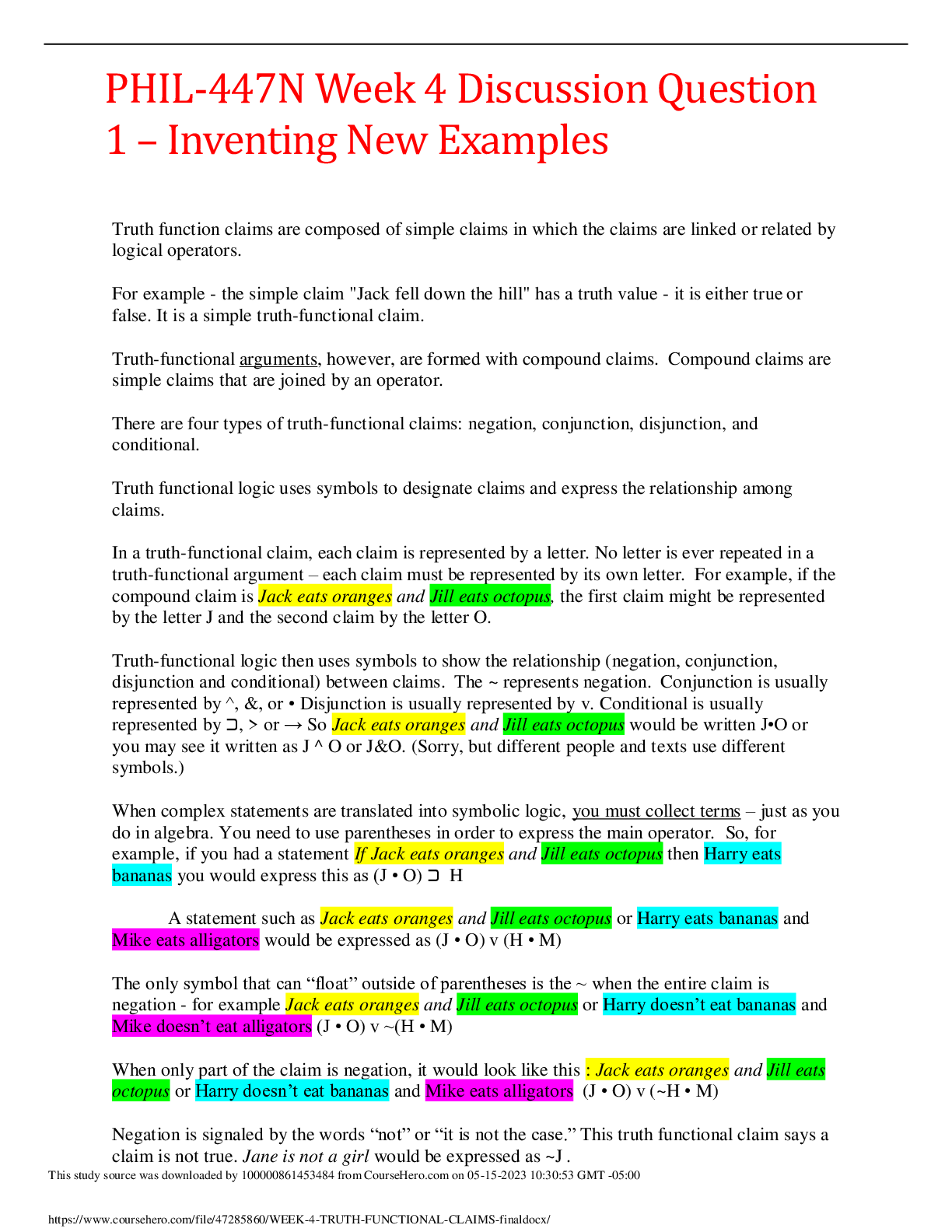
Truth function claims are composed of simple claims in which the claims are linked or related by logical operators. For example - the simple claim "Jack fell down the hill" has a truth value - it i ... s either true or false. It is a simple truth-functional claim. Truth-functional arguments, however, are formed with compound claims. Compound claims are simple claims that are joined by an operator. There are four types of truth-functional claims: negation, conjunction, disjunction, and conditional. Truth functional logic uses symbols to designate claims and express the relationship among claims. In a truth-functional claim, each claim is represented by a letter. No letter is ever repeated in a truth-functional argument – each claim must be represented by its own letter. For example, if the compound claim is Jack eats oranges and Jill eats octopus, the first claim might be represented by the letter J and the second claim by the letter O. Truth-functional logic then uses symbols to show the relationship (negation, conjunction, disjunction and conditional) between claims. The ~ represents negation. Conjunction is usually represented by ^, &, or • Disjunction is usually represented by v. Conditional is usually represented by ﬤ, > or → So Jack eats oranges and Jill eats octopus would be written J•O or you may see it written as J ^ O or J&O. (Sorry, but different people and texts use different symbols.) When complex statements are translated into symbolic logic, you must collect terms – just as you do in algebra. You need to use parentheses in order to express the main operator. So, for example, if you had a statement If Jack eats oranges and Jill eats octopus then Harry eats bananas you would express this as (J • O) ﬤ H A statement such as Jack eats oranges and Jill eats octopus or Harry eats bananas and Mike eats alligators would be expressed as (J • O) v (H • M) The only symbol that can “float” outside of parentheses is the ~ when the entire claim is negation - for example Jack eats oranges and Jill eats octopus or Harry doesn’t eat bananas and Mike doesn’t eat alligators (J • O) v ~(H • M) When only part of the claim is negation, it would look like this : Jack eats oranges and Jill eats octopus or Harry doesn’t eat bananas and Mike eats alligators (J • O) v (~H • M) Negation is signaled by the words “not” or “it is not the case.” This truth functional claim says a claim is not true. Jane is not a girl would be expressed as ~J . Conjunction is signaled by the word “and.” This truth-functional claim says both simple claims are true. Jane is a girl and she is in the sixth grade. Expressed as J • S. Disjunction is signaled by words such as “or” and “unless.” This type of truth-functional claim says either one or the other of the simple claims is true – but not both. Either you are with me or you are against me. Expressed as W v A Conditional is signaled by the word “if.” This type of truth-functional claim says that if one claim is true, then the other claim is true; the truth of one claim is dependent on the truth of the other claim. If you pass anatomy and physiology then you can remain in the program. Expressed as A ﬤR. A statement such as “It is not the case that the light bulb was not invented by Henry Ford” – a double negation – you can translate that as ~(~L) or L – because, remember, two negatives make a positive. You can reverse the claims in a conjunction (Mary ate peaches and John ate pears can be M • J ot it can be J • M. You can reverse the claims in a disjunction (Mary ate peaches or John ate pears can be M v J or it can be J v M. You cannot reverse the claims in a conditional – the antecedent claim must always come before the operator and the consequent after the operator. “You will have a better income if you graduate from college.” The antecedent (what comes first) is “if you graduate from college” and the consequent is what follows “you will have a better income.” G ﬤ I. In a conditional, always determine the sequence of events. A simple way to know which is to remember only if if antecedent consequent consequent antecedent NOTE: For future classes, you should be aware that the validity of truth-functional arguments is determined by truth tables. Each truth functional form has a standard truth table (negation, conjunction, disjunction, conditional) These tables are in the text and they are always the same. There is also a standard methodology for forming a truth table for compound and complex claims. The best tutorial for that, I think, is the You Tube https://www.youtube.com/watch?v=- z3fRn9V3jM You will be relieved to learn that there are no truth-table exercises on the final. [Show More]

Last updated: 2 years ago

Preview 1 out of 3 pages

Buy Now

Instant download

We Accept:

Payment methods accepted on Scholarfriends (We Accept)
Preview image of PHIL-447N Week 4 Discussion Question 1 – Inventing New Examples document

Buy this document to get the full access instantly

Instant Download Access after purchase

Buy Now

Instant download

We Accept:

Payment methods accepted on Scholarfriends (We Accept)

Also available in bundle (1)

Click Below to Access Bundle(s)

PHIL 447N: Logic & Critical Thinking

PHIL 447N Week 1 Assignment; Short Paper on Execution PHIL 447N Week 1 Quiz (MCQs) PHIL-447N Week 1 Discussion Question 1 – Making Claims (graded) PHIL 447N Week 1 Discussion Question 2 – Cog...

By Doc.Mukai Edyth 2 years ago

$20

19  

Reviews( 0 )

$10.00

Buy Now

We Accept:

Payment methods accepted on Scholarfriends (We Accept)

Instant download

Can't find what you want? Try our AI powered Search

98
0

Document information


Connected school, study & course


About the document


Uploaded On

May 15, 2023

Number of pages

3

Written in

All

Seller


Profile illustration for Doc.Mukai Edyth
Doc.Mukai Edyth

Member since 2 years

0 Documents Sold

Additional information

This document has been written for:

Uploaded

May 15, 2023

Downloads

 0

Views

 98

Document Keyword Tags

More From Doc.Mukai Edyth

View all Doc.Mukai Edyth's documents »

Recommended For You

Get more on DISCUSSION POST »
$10.00
What is Scholarfriends

Scholarfriends.com Online Platform by Browsegrades Inc. 651N South Broad St, Middletown DE. United States.

We are here to help

We're available through e-mail, Twitter, and live chat.
 FAQ
 Questions? Leave a message!


Copyright © Scholarfriends · High quality services·