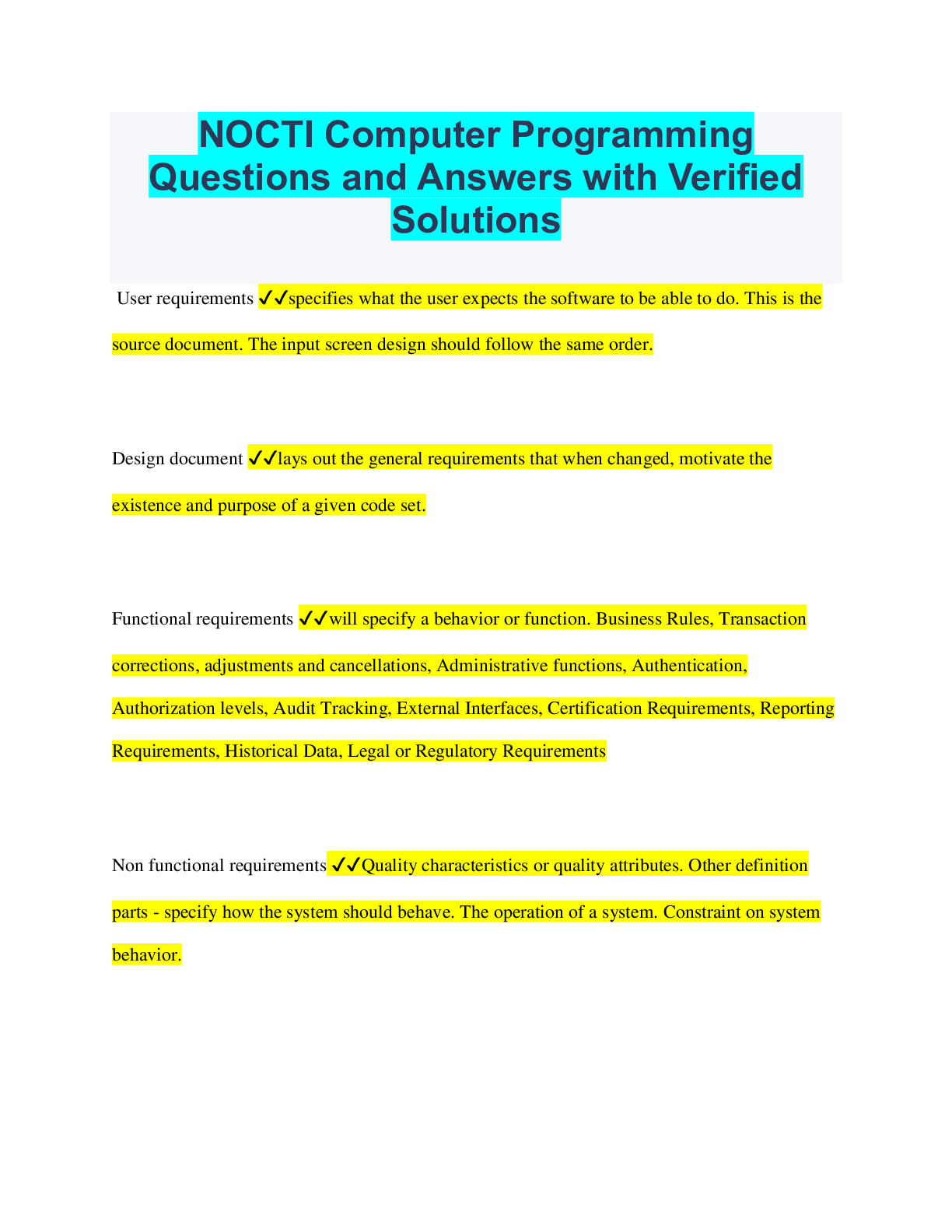
NOCTI Computer Programming
Questions and Answers with Verified
Solutions
User requirements ✔✔specifies what the user expects the software to be able to do. This is the
source document. The input screen design should
...
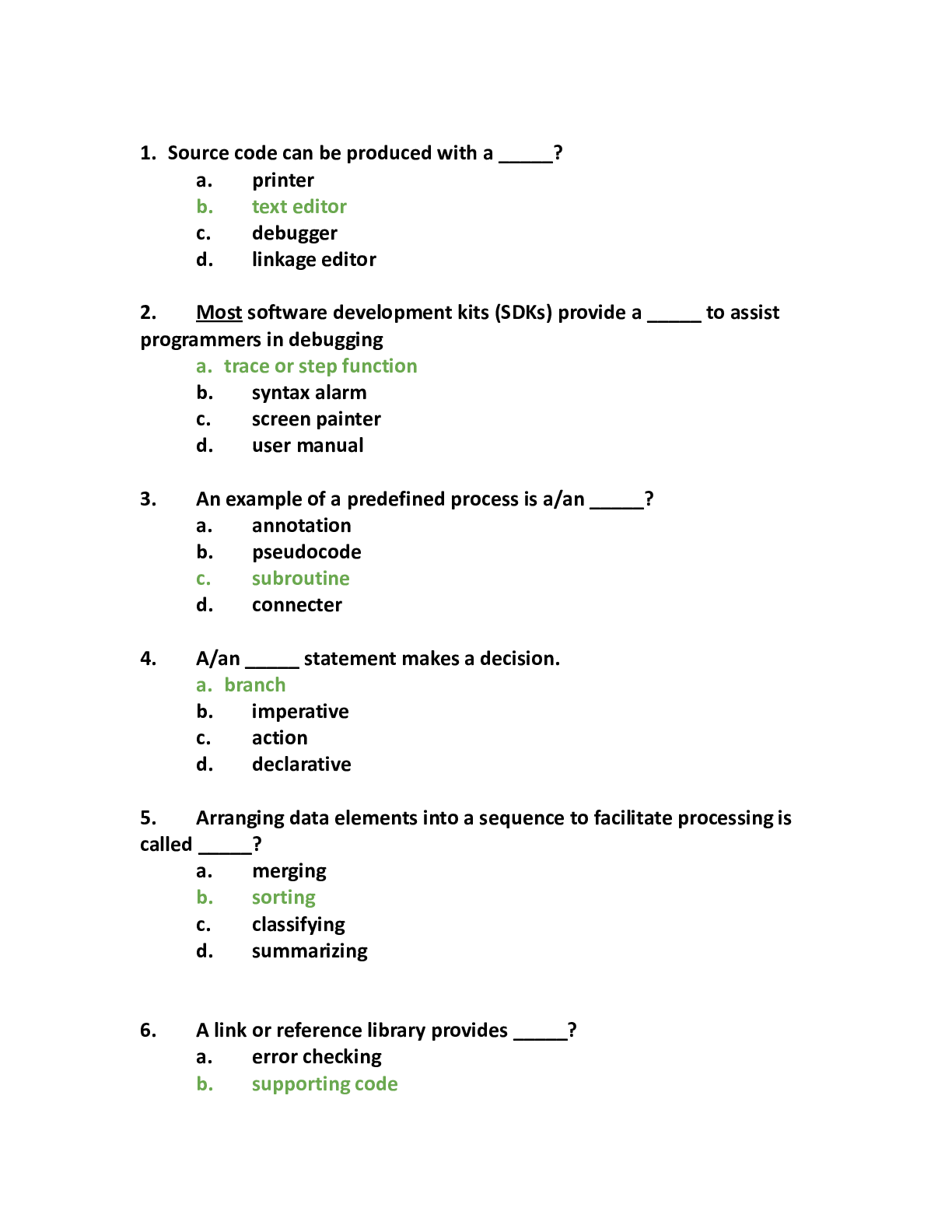
NOCTI Computer Programming
Questions and Answers with Verified
Solutions
User requirements ✔✔specifies what the user expects the software to be able to do. This is the
source document. The input screen design should follow the same order.
Design document ✔✔lays out the general requirements that when changed, motivate the
existence and purpose of a given code set.
Functional requirements ✔✔will specify a behavior or function. Business Rules, Transaction
corrections, adjustments and cancellations, Administrative functions, Authentication,
Authorization levels, Audit Tracking, External Interfaces, Certification Requirements, Reporting
Requirements, Historical Data, Legal or Regulatory Requirements
Non functional requirements ✔✔Quality characteristics or quality attributes. Other definition
parts - specify how the system should behave. The operation of a system. Constraint on system
behavior.
Performance ✔✔for example Response Time, Throughput, Utilization, Static Volumetric,
Scalability, Capacity, Availability, Reliability, Recoverability, Maintainability, Serviceability,
Security, Regulatory, Manageability, Environmental, Data Integrity, Usability, Interoperability
Input format ✔✔how to interpret the contents of an input field as a number or a string.
Output format ✔✔print and write formats. Automatically generated from the input formats.
Oval ✔✔terminator. start/end
Parallelogram ✔✔input/output
Rectangle ✔✔process. Either single step or an entire sub-process.
Diamond ✔✔decision.
Circle ✔✔connectors.
Requirements specifications ✔✔establishes the basis for agreement between customs,
contractors, or suppliers on what the software product is to do as well as what it is not expected
to do.
Software design ✔✔involves planning a software solution in a sequence of steps that enables the
designer to describe all aspects of the software to be built.
Implementation and integration ✔✔brings together systems utilizing many techniques: computer
networking, enterprise application integration, business process management, programming.
Testing ✔✔can be stated as the process of validating and verifying that a computer
program/application/product: meets the requirements that guided its design and development and
works as expected
Deployment ✔✔is all of the following activities that make a software system available for use:
Release, Install and Activate, Deactivate, Adapt, Update, Built-in, Version Tracking, Uninstall,
Retire
Maintenance ✔✔the modification of a software product after delivery to correct faults, to
improve performance or other attributes.
Design Program Solutions ✔✔
Primary storage ✔✔RAM.
Stack ✔✔
Heap ✔✔
Distributed computing ✔✔a field of computer science that studies distributed systems. A
distributed system is a model in which components located on networked computers
communicate and coordinate their actions by passing messages. The components interact with
each other in order to achieve a common goal.
Data Storage Field length ✔✔the amount of characters the field can hold.
Data Storage Record length ✔✔the length, in bytes, of each record in the data set. Of all the
fields.
Data formats Delimited ✔✔a character is used to separate the values (comma, tab, colon).
Data formats Fixed length ✔✔
Rapid application development ✔✔a software development methodology that uses minimal
planning in favor of rapid prototyping. The process of writing the software itself involves the
planning required for developing the product. Follows an iterative and incremental model. Makes
reusable prototypes.
RAD language ✔✔It is very quick and easy to create an application. It is paired with an IDE.
C++, Java, Delphi
A code review ✔✔systematic examination (sometimes referred to as peer review) of computer
source code. It is intended to find mistakes overlooked in the initial development phase,
improving the overall quality of software.
A design review ✔✔a milestone within a product development process whereby a design is
evaluated against its requirements in order to verify the outcomes of previous activities and
identify issues before committing to - and if need to be re-prioritize - further work.
Appropriate variable names ✔✔camelCase, No reserved words, No spaces, No reserved
symbols, Be descriptive.
Data types ✔✔follows what type of data it is.
Logic patterns ✔✔Simple sequence, Selection, Loop, Branch.
Structured programming ✔✔three basic control structures to form highly structured units of
code. Subroutines, Block structures, Loops
SQL ✔✔Structured query language. Uses plain english queries.
Perl ✔✔Scripting languages. Syntax: Has DO UNTIL.
Fortran ✔✔One of the oldest programming languages, the FORTRAN was developed by a team
of programmers at IBM led by John Backus, and was first published in 1957. The name
FORTRAN is an acronym for FORmula TRANslation, because it was designed to allow easy
translation of math formulas into code.
BASIC ✔✔CAPITAL reserved words, FOR TO: the TO is included in how many times it runs.
Beta ✔✔point: (# x, y: @integer #)
Unit testing ✔✔a software testing method by which individual units of source code, sets of one
or more computer program modules together with associated control data, usage procedures, and
operating procedures, are tested to determine whether they are fit for use.
Script ✔✔a sequence of events to follow so they can be repeated. Interpreted.
Test data ✔✔data for use in tests.
Truncation error ✔✔the data has been accidentally truncated.
Rounding error ✔✔the data has been accidentally rounded.
Run time error ✔✔An error that occurs during the execution of a program. Runtime errors
indicate bugs in the program or problems that the designers had anticipated but could do nothing
about.
Boundary error ✔✔the data has accidentally stepped out of bounds.
Logical error ✔✔the program produces unintended or undesired behavior. An issue with logic
statements.
Arithmetic error ✔✔the data has had a calculation error.
Semantic error ✔✔valid syntax but does not do what the programmer intended.
Linker error ✔✔problem during linking process
Syntax error ✔✔problem with source code.
Compile errors ✔✔caused by bad syntax.
Maintenance ✔✔refers to changes to a system in operating arising from Error corrections,
Performance improvements, Changes in the business environment, Enhancements in functions
How to provide user instructions on program modifications ✔✔One method of ensuring that
updates to documentation are efficiently distributed is to make changes in an online help system
rather than print sources.
How to develop a documentation narrative (e.g., writing program documentation) ✔✔Use
language that is clear and at the level of the end user.
data dictionary ✔✔a set of information describing the contents, format, and structure of a
database and the relationship between its elements, used to control access to and manipulation of
the database.
Compiler ✔✔takes in the entire program, checks for errors, compiles it, and then executes it.
Interpreter ✔✔takes the program line by line, checks for errors, and executes it.
Injuries ✔✔bursitis, tendon injuries, osteoarthritis, carpal tunnel syndrome.
To prevent injuries ✔✔adjust chair so feet are flat on floor, support lower back, top of computer
monitor should be ~eye level, wrists should be in a straight neutral position in line with forearms.
Network ✔✔a group of two or more computers.
Bus ✔✔passes data.
CPU ✔✔Central Processing Unit. Processes instructions
RAM ✔✔Random Access Memory. Information is loaded onto the RAM for faster run time.
Data hierarchies ✔✔the systematic organization of data, often in a hierarchical form. Data
organization involves characters, fields, records, files and so on.
Access methods ✔✔methods to access data on external devices.
Manipulation methods ✔✔methods to manipulate data.
[Show More]