Splunk Questions and Answers Already
Passed
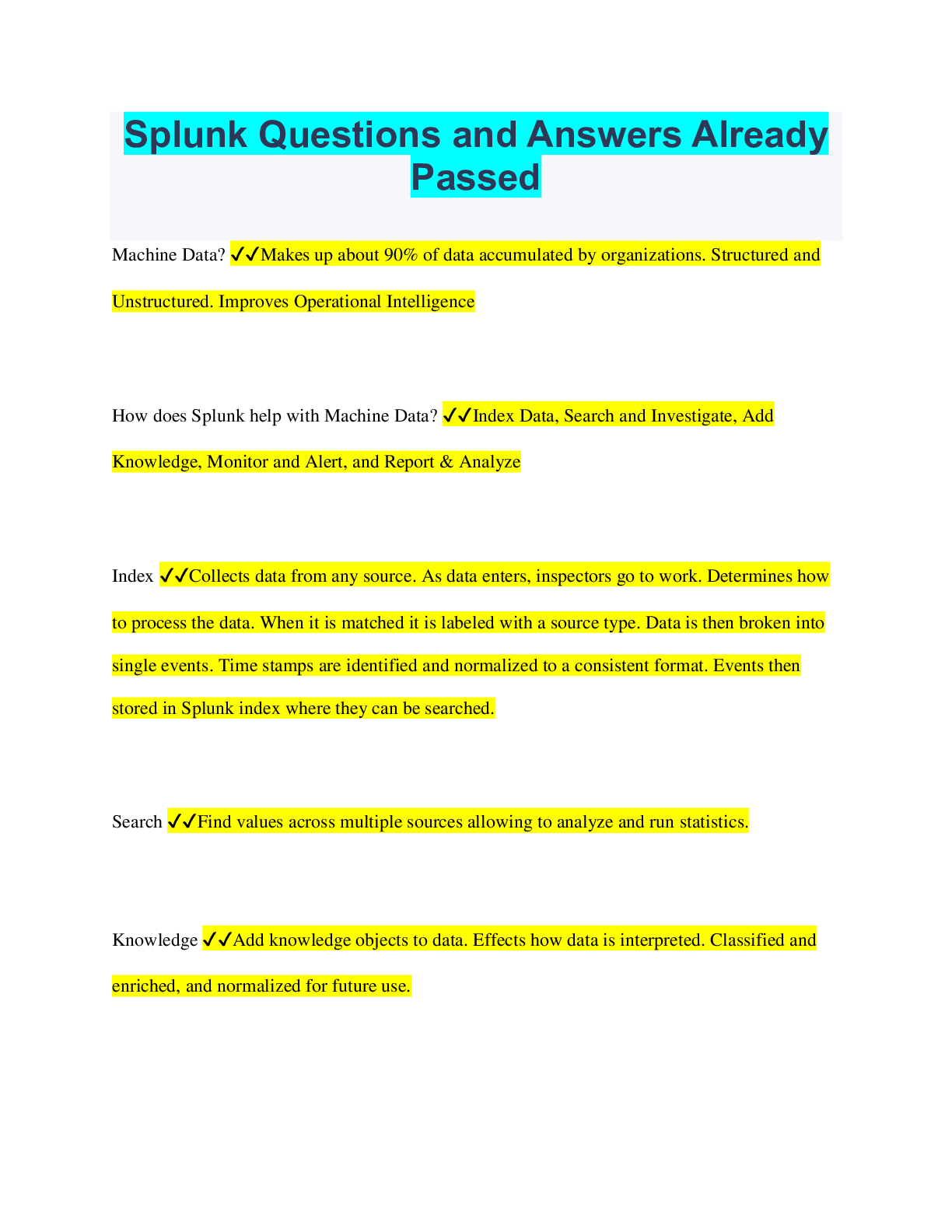
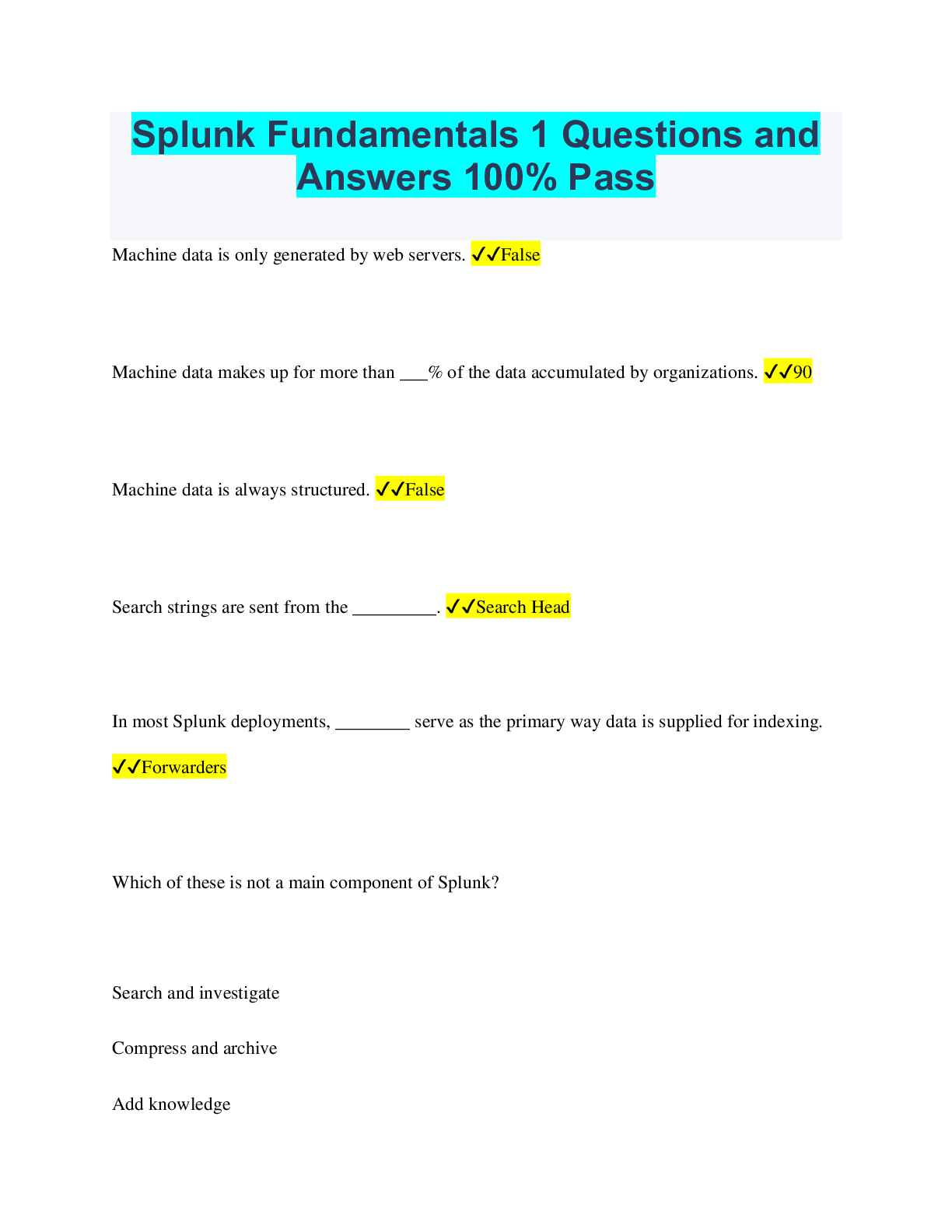
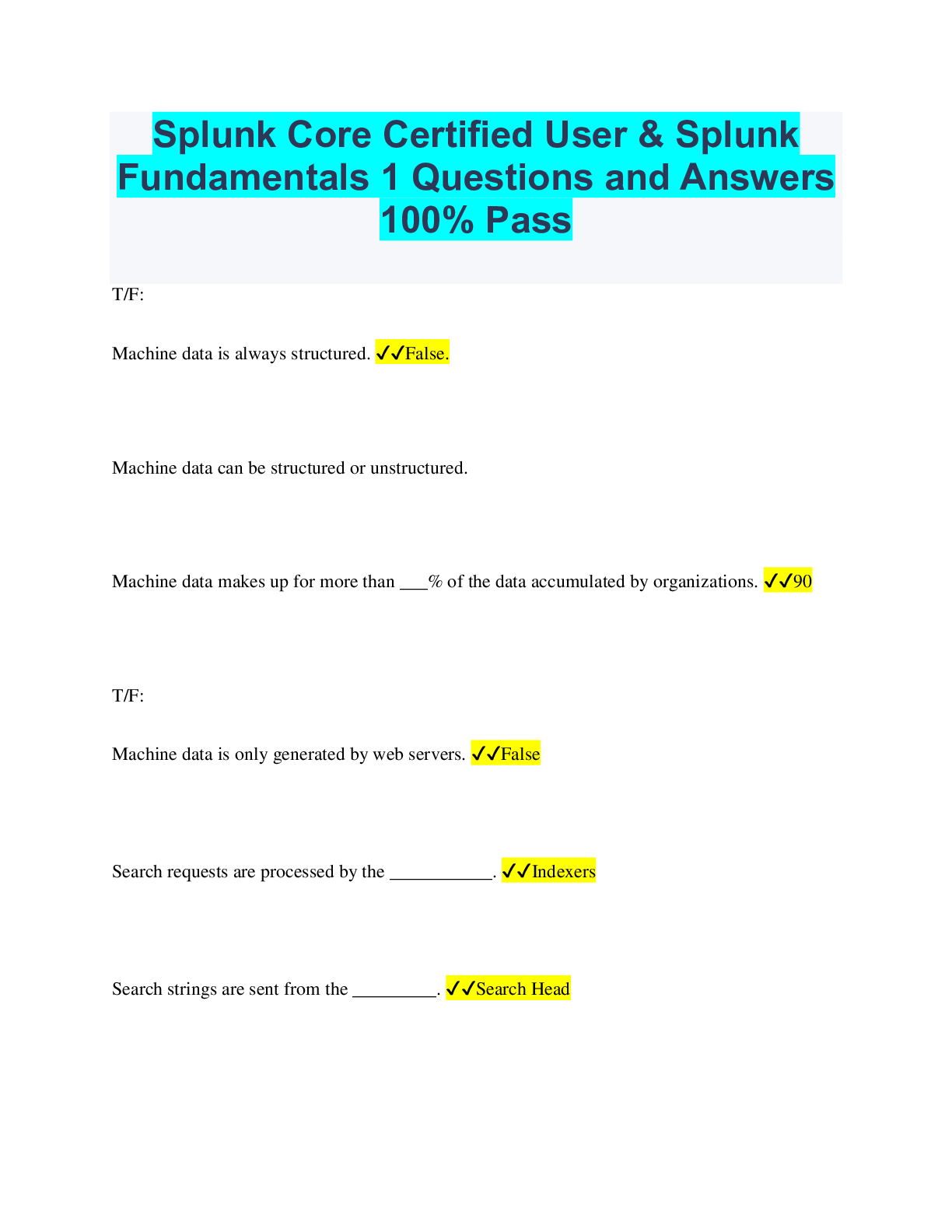
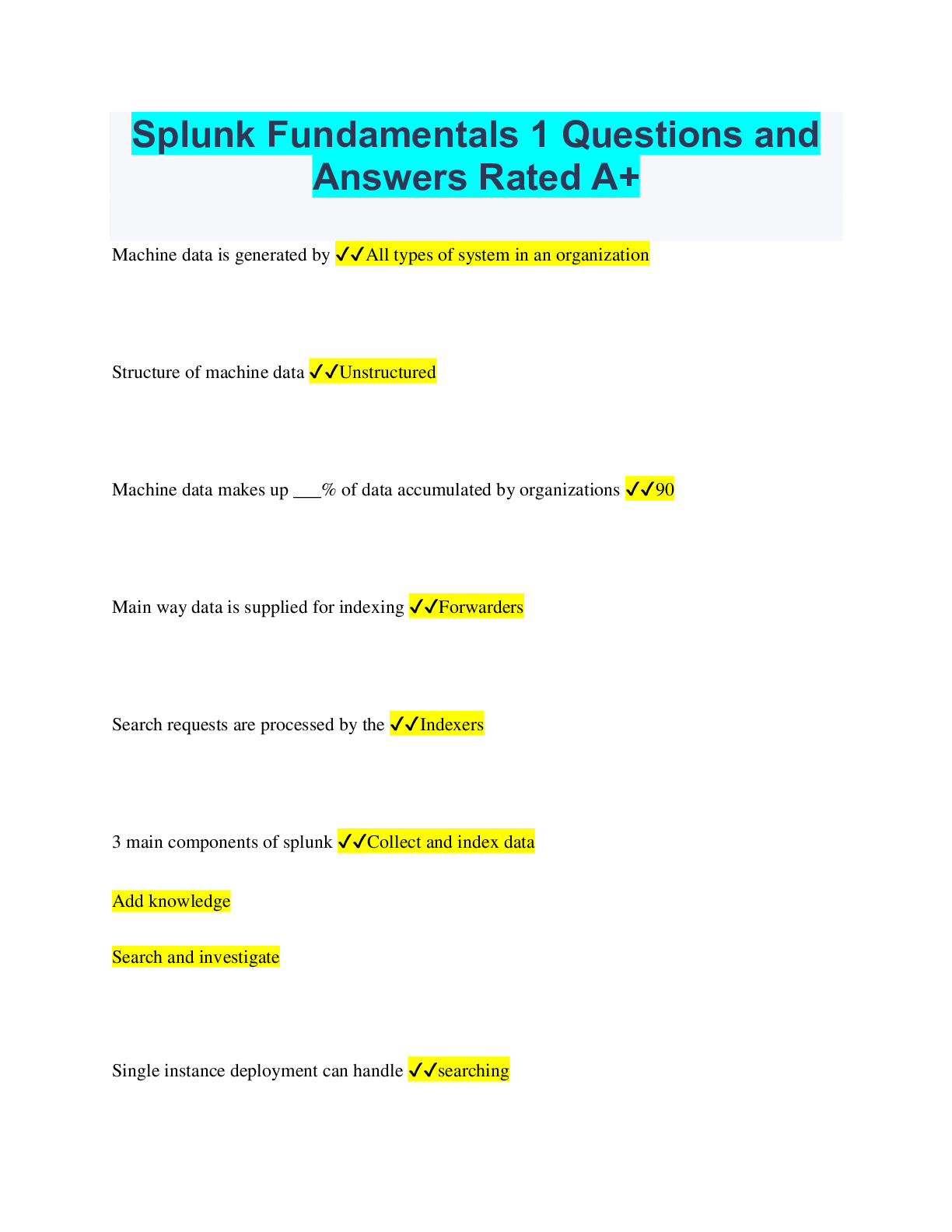
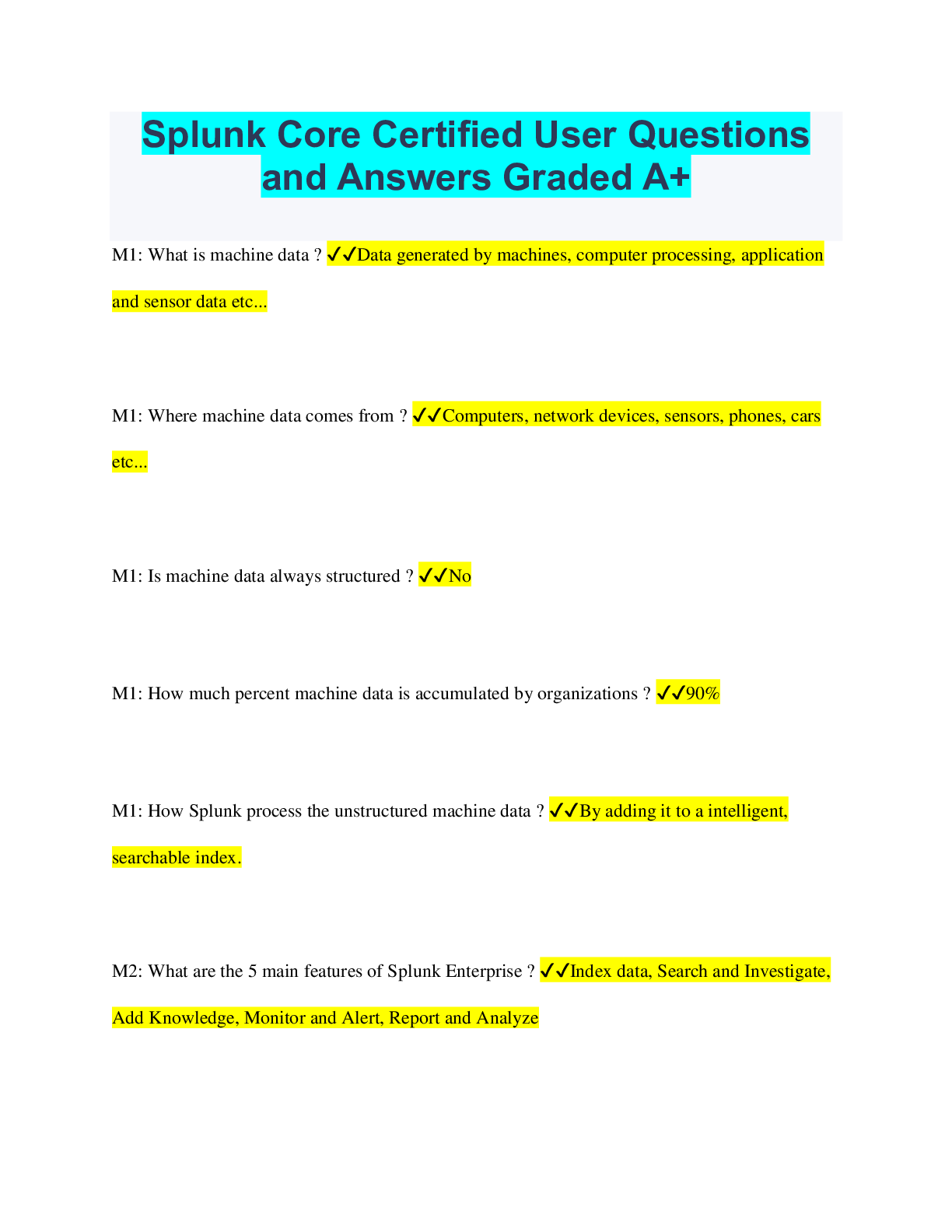
Machine Data? ✔✔Makes up about 90% of data accumulated by organizations. Structured and
Unstructured. Improves Operational Intelligence
How does Splunk help with Machine Da
...
Splunk Questions and Answers Already
Passed
Machine Data? ✔✔Makes up about 90% of data accumulated by organizations. Structured and
Unstructured. Improves Operational Intelligence
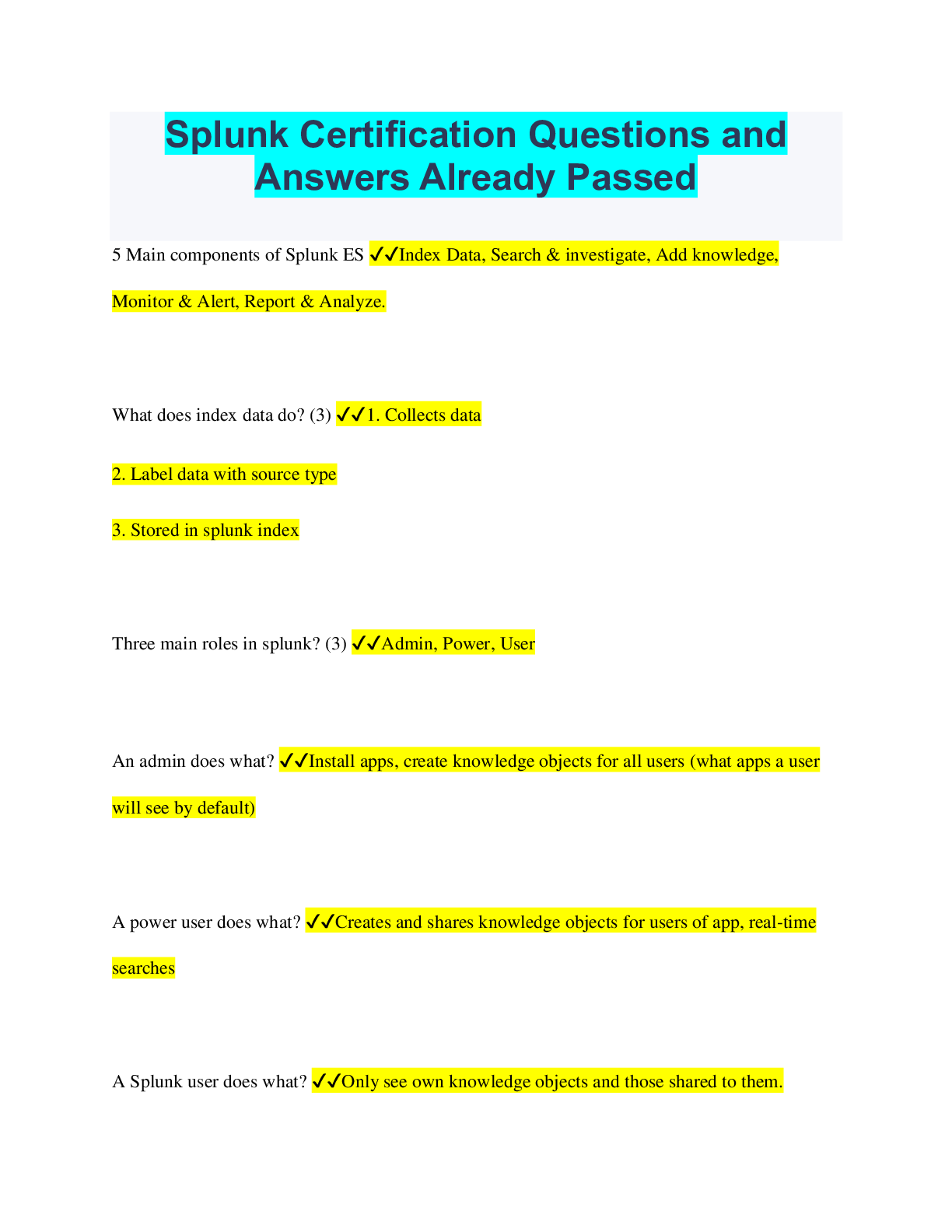
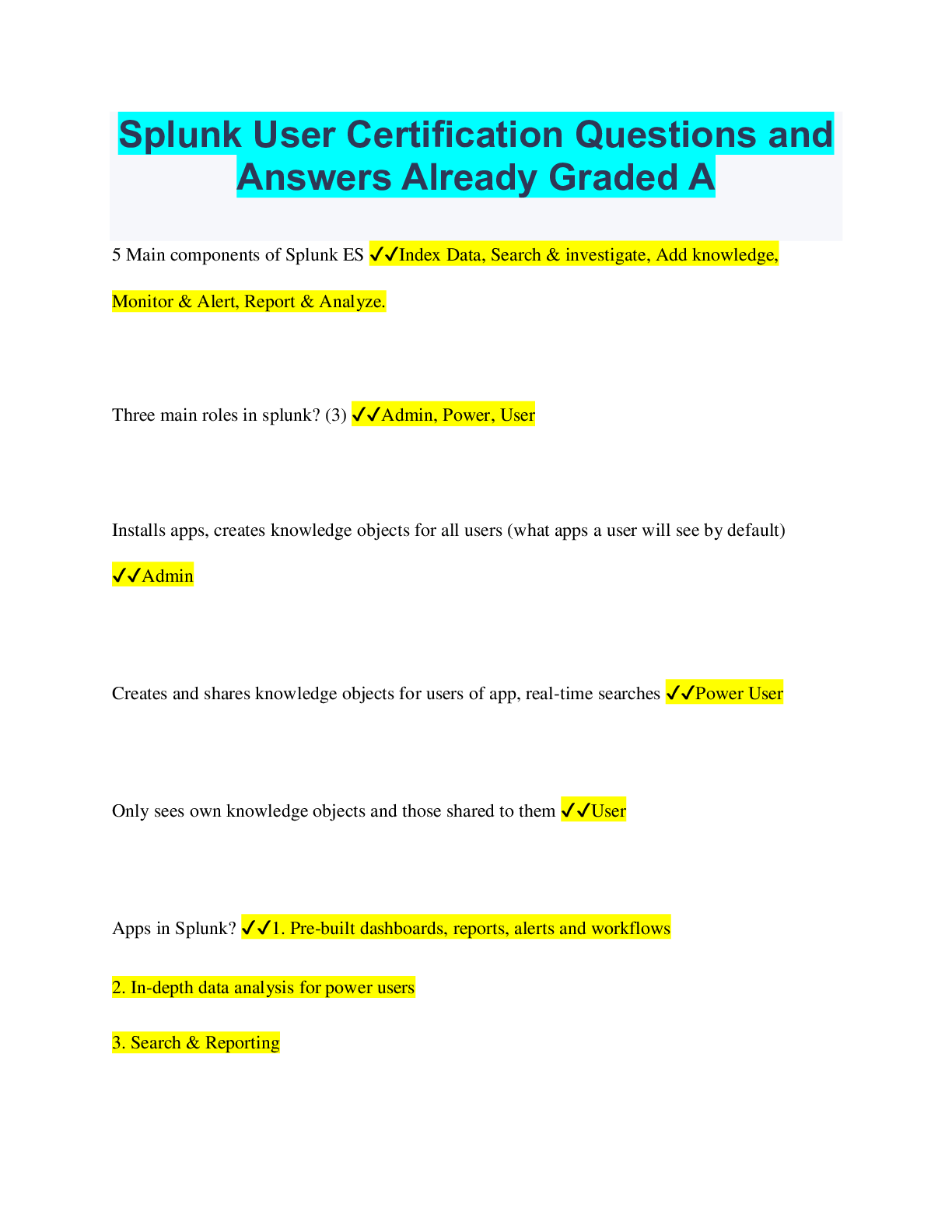
How does Splunk help with Machine Data? ✔✔Index Data, Search and Investigate, Add
Knowledge, Monitor and Alert, and Report & Analyze
Index ✔✔Collects data from any source. As data enters, inspectors go to work. Determines how
to process the data. When it is matched it is labeled with a source type. Data is then broken into
single events. Time stamps are identified and normalized to a consistent format. Events then
stored in Splunk index where they can be searched.
Search ✔✔Find values across multiple sources allowing to analyze and run statistics.
Knowledge ✔✔Add knowledge objects to data. Effects how data is interpreted. Classified and
enriched, and normalized for future use.
Monitor & Alert ✔✔Can Monitor infrastructure in real time to identify issues, problems, and
attacks before they impact customers and services. Create alerts and automatically respond with
a variety of actions.
Reports ✔✔Provides reports and the ability to do dashboards empowering groups in the
organization by giving them the information they need organized into a single pane.
3 Main Splunk Processing Components ✔✔Indexers, Search Heads, and Forwarders.
Indexer ✔✔Processes incoming data storing it as indexes as events. As the indexer indexes data,
it creates a number of files in directories by age (time).
Search ✔✔When you search the data Splunk will only need to open the directories that match
the timeframe of search making searches more efficient.
Search head ✔✔Allows users to use the Splunk search language to search the index data. Search
heads handle search requests from users and distribute requests to the indexers which perform
the actual searches on the data. Search heads then consolidate and enrich the results from the
indexers before returning them to the user.
3 Things Search can produce ✔✔Dashboards, Reports and Visualization to assist the search
experience.
Forwarders ✔✔Splunk enterprise instances that consume data and forward it to the indexers for
processing.
Forwarder Characteristics ✔✔(1) Require minimal resources, (2)little impact on performance,
(3) Reside on the machine where the data originates.
Example of Forwarder ✔✔Have a web server we want to monitor we would install the forwarder
on the web server and have it send data to the indexer
Splunk Deployment Scalibility ✔✔Single Instance to a full distributed infrastructure.
Single Instance Deployment Splunk Instance ✔✔Input, Parsing, Indexing and Searching
When would you use a single-instance deployment ✔✔Perfect environment for proof of concept,
personal use, learning, and night serve the need of small department-sized environments.
What would we have to do in a Full Scale Infrastructure Deployment? ✔✔Split the functionality
across multiple specialized instances of Splunk enterprise. Add forwarders to send data to our
indexers and eventually add multiple search heads and indexers to increase our indexing and
search capacity. Search heads and indexes can also be clustered making sure data is always
available and searchable.
Search requests are processed by? ✔✔Indexers
In most Splunk Deployments, this servers as the primary way data is supplied for indexing.
✔✔Forwarder
Main Components of Splunk ✔✔Collect and index data, search and investigate.Add knowledge
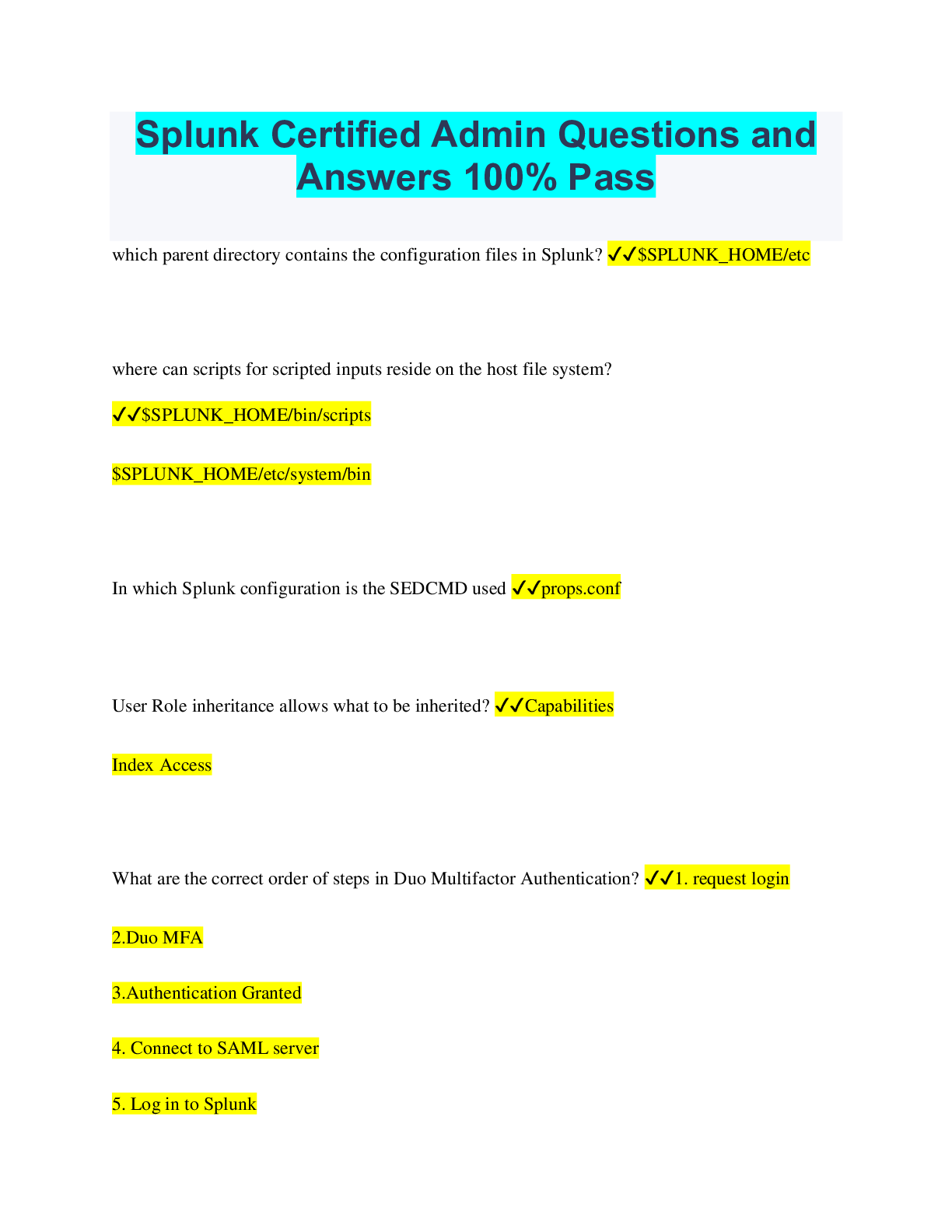
Which function is not a part of a single instance deployment? ✔✔Clustering
3 Roles in Splunk? ✔✔Admin, Power User, and End-User.
Admin Role ✔✔Install Apps, Create Knowledge Objects for All Users
Power User Role ✔✔Create and share Knowledge Objects for Users of an app and do real time
searches.
End User Role ✔✔Will only see their own knowledge objects and those shared with them.
Roles ✔✔Define what users can do in Splunk.
Index ✔✔Directories where the data is stored
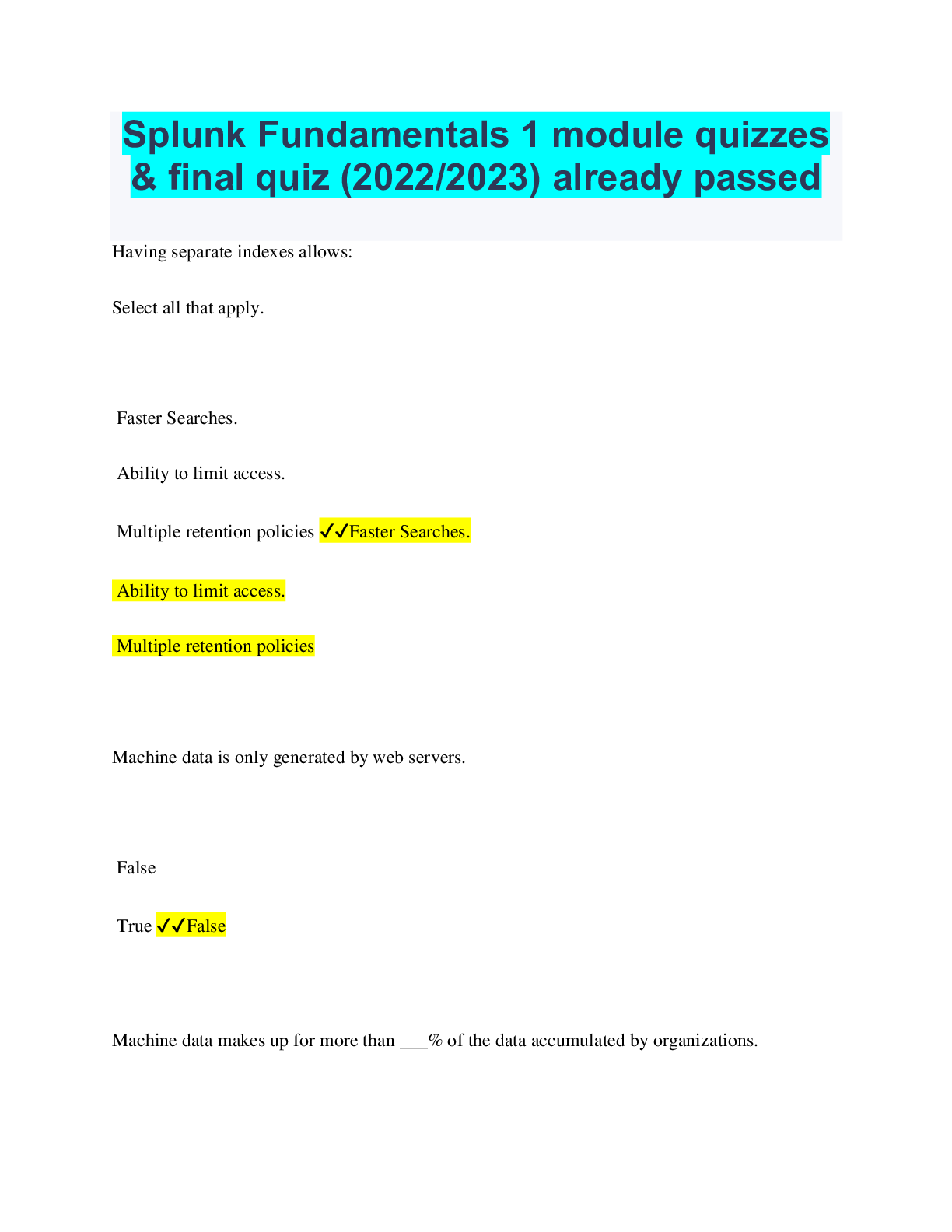
Reasons to Split Indexes ✔✔Separate indexes can make searches faster. Limits data amount
Splunk searches. Returns events only from that index.Multiple indexes allow limiting access by
user role in order to control who sees what data. Also helps with retention policies
Search ✔✔Limiting a search to time frame is a best practice.
Commands that Create Statistics and Visualizations ✔✔Called Transforming Commands which
transform data into data tables.
Time for Search Job ✔✔By default will remain active for 10 minutes
Time for Shared Search Job ✔✔Remain active for 7 days
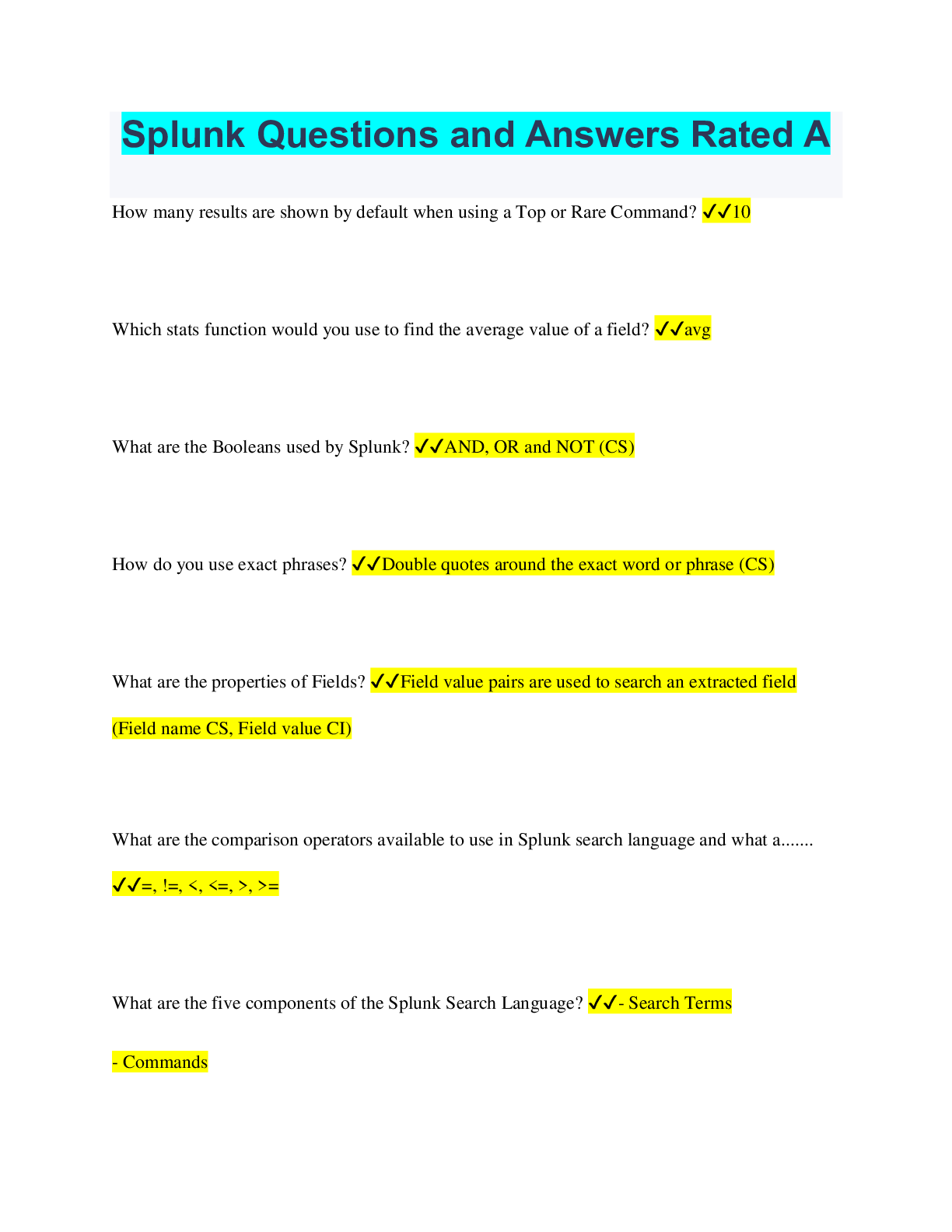
Search Booleans ✔✔Not, Or, And. Add parenthesis: Keyword 1 NOT (Keyword2 OR Keyword
2)
Wildcard Search ✔✔KeyWord*
Exact Search ✔✔"Keyword"
Escaping characters in Search ✔✔add backslash info="keyword1\"keyword2\"not in db"
Best Practices ✔✔Search by Time, inclusion is better than exclusion,filter command as early as
possible in search,
Splunk Search Language Sytnax ✔✔1. Search Terms. 2. Commands. 3. Functions 4. Arguments
5. Clauses
Commands ✔✔Tells Splunk what we want to do with Search Results such as creating charts,
computing statisitcs, and formatting
Functins ✔✔Explain how we want to chart, compute, and evaluate the results.
Arguments ✔✔Variables we want to apply to the functions
Clauses ✔✔Explain how we want the results grouped or defined.
Search Language Example ✔✔Search Term, Commands, Functions
[Show More]