Food Handler Certification – Ontario
Questions and Answers Already
Graded A
Why food safety is so important? ✔✔To avoiding food contamination and outbreaks, to make
sure that the food preparation, transport and stora
...
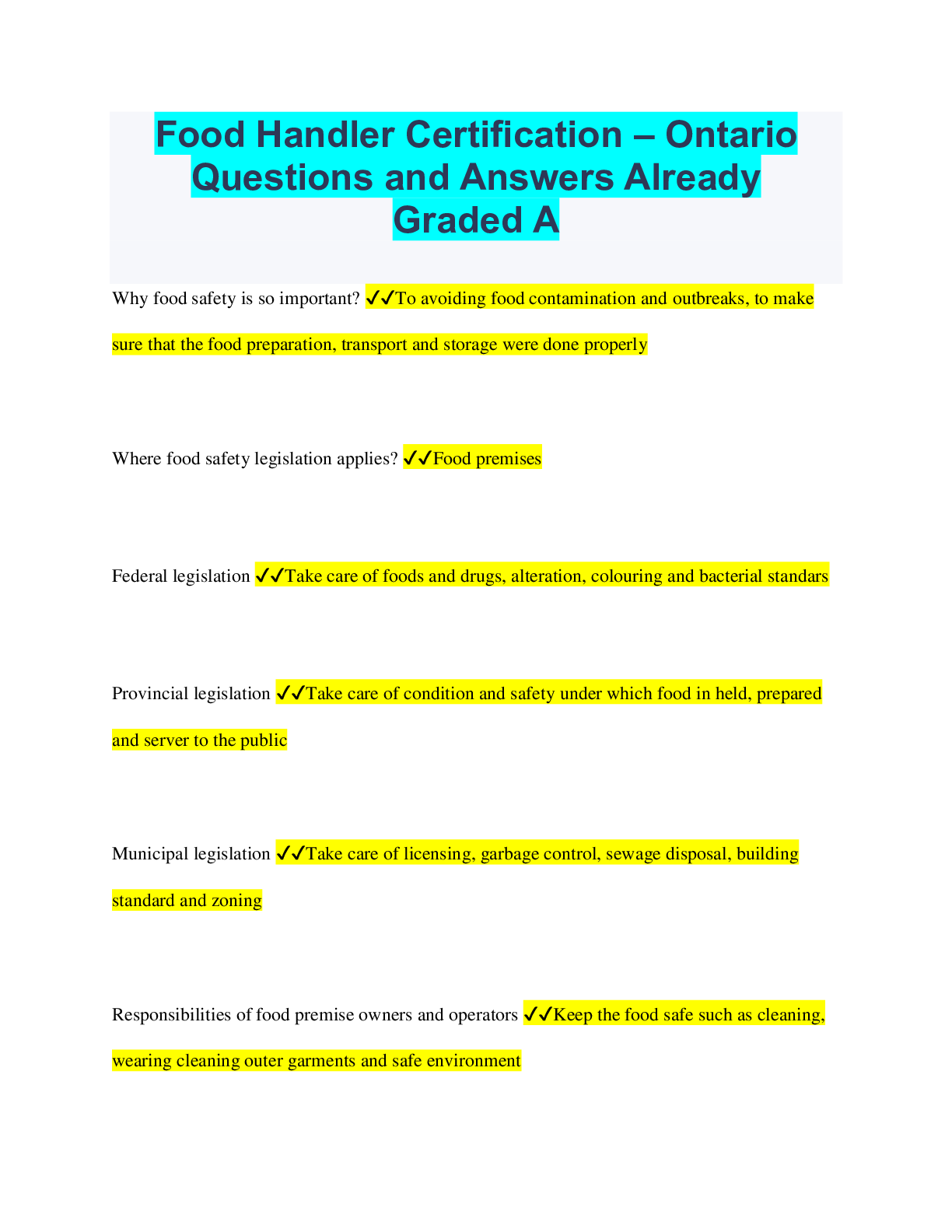
Food Handler Certification – Ontario
Questions and Answers Already
Graded A
Why food safety is so important? ✔✔To avoiding food contamination and outbreaks, to make
sure that the food preparation, transport and storage were done properly
Where food safety legislation applies? ✔✔Food premises
Federal legislation ✔✔Take care of foods and drugs, alteration, colouring and bacterial standars
Provincial legislation ✔✔Take care of condition and safety under which food in held, prepared
and server to the public
Municipal legislation ✔✔Take care of licensing, garbage control, sewage disposal, building
standard and zoning
Responsibilities of food premise owners and operators ✔✔Keep the food safe such as cleaning,
wearing cleaning outer garments and safe environment
Benefits of following safe food handling practices ✔✔Customers went places with safe food, no
need to spend money on lawsuits, lower insurance costs, happier customers and not wasting
money by throwing food away .
Common symptoms of food borne illness ✔✔Stomach cramps, nausea, diarrhea, vomiting, fever
and headache.
When foodborne illness is food poisoning? ✔✔Cause by chemicals such as cleanser or even
sulphites or monosodium glutamate (MSG)
3 Types of chemical food poisoning ✔✔Metal (dissolved metal in food), Intentional additives
(products to add color, thicken, firm or preserve food) and Incidental additives (poisonous
chemical such as insecticides, rodenticides or cleaning chemicals)
Dangers and types of physical hazards in food ✔✔Dirt, hair, nails, bits of metal. These. can
cause from small cuts to chocking
The impact of foodborne illness on people and businesses ✔✔Medical costs, investigation costs,
loss of productivity, sicking people missing work, legal and insurance costs
Microorganisms that can be good for us ✔✔Yeast (used to make bread and produce alcohol),
Bacteria (used to help us digest food) and Mould (used to ripens and flavours cheese such as blue
cheese)
Types of pathogenic microorganisms that causes food borne illness ✔✔Viruses, parasites, yeasts,
mould and bacteria
What`s similar and what`s different about pathogens? ✔✔Viruses (the most common way is
from human hands) and Parasites (contaminated water) don`t grow in food. Yeasts (need
moisture and sugar), mould (colonies are fuzzy) and bacterias (good: lactobacillus and harmful:
salmonella - raw poulty and eggs; E. Colli - under cooked meat and water)
Sources of microorganisms ✔✔Proteins such as fish, poultry. Dairy, foods at 4°C to 60°C
temperature, contaminated water, human hands, cross-contamination.
Foodborne illnesses pathogenic can causes ✔✔Hepatitis A, avian flu, rotavirus, toxins,
salmonella, E. Colli and botulinum
Symptoms of foodborne illnesses ✔✔Nausea, headache, stomach pain, diarrhea, muscle
weakness, vomiting, dizziness and even death.
Why some kinds of food contamination are more likely than others to make people sick?
✔✔Because they have potentially hazardous (moist foods, pH above 4.5, dairy products, meat,
fish, poultry, eggs and some raw fruits and vegetables.
Why are some people more likely to get sick than others? ✔✔They are part of the risk group:
young children, elderly, pregnant and weak immune system people, also the amount of pathogen
in food, type of microorganism (protozoa are more likely to cause illness)
How carries can transfer microorganisms to food? ✔✔Basically through hands and crosscontamination (pass from one type of food to another)
What bacteria needs in order to grow up? ✔✔Foods at 4°C to 60°C temperature, oxygen or lack
of it, pH above 4.5, moisture and protein.
What makes a food potentially hazardous? ✔✔Moist foods, pH above 4.5, dairy, meat, fish,
poultry, eggs, raw fruits and vegetables.
When do you need to recalibrate your probe thermometer? ✔✔After an extreme temperature fall
and If it`s has been dropped.
How do you recalibrate your probe thermometer? ✔✔1- Mix a 50/50 of crushed ice and water in
a container. The temperature should be always 0°C 2- Set the probe thermometer in the mixture
and be sure it isn`t touching sides or bottom and wait until the needle stops moving. If it`s not
0°C must be adjusted.
3- Adjust and keep the thermometer int the mixture to make sure it`s accurate.
The correct temperature to store frozen and refrigerated foods ✔✔Frozen must be -18°C and
refrigerated must be kept at 4°C or lower.
Safe methods to thawing foods ✔✔In the refrigerator at 4°C (it takes 10h/kg), in a sink with cold
running water, as part of a continuous cooking process or in the microwave.
How to properly monitor freezer and refrigerator temperatures ✔✔The thermometer should be in
the warmest part of the equipment (near the door and near the top), monitor several times a day
and once a week the probe thermometer should be used to make sure the temperature.
Which are the stages that food are in the danger zone? ✔✔Preparation, cooking, cooling and
reheating
How to cool food safely by minimizing time in the danger zone? ✔✔The food must be placed on
ice or refrigerated before it drops below 60°C. Within 2 hours must drop to 40°C and in the next
4 hours to 4°C Put in shallow pans help to drop the temperature faster.
Safe temperature for Pork ✔✔71°C for at least 15 seconds
Safe temperature for Poultry (whole) ✔✔82°C for at least 15 seconds
Safe temperature for Poultry (pieces or ground) ✔✔74°C for at least 15 seconds
Safe temperature for ground meat ✔✔71°C for at least 15 seconds
Safe temperature for fish ✔✔70°C for at least 15 seconds
Safe temperature for food mixtures with poultry, meat, eggs, etc ✔✔74 °C for at least 15 seconds
How to safely hold food at hot temperature? ✔✔Food held in a buffet kept at least 60°C
How to safely hold food in cold? ✔✔Must be held at 4°C or lower. Use metal container because
conducts colds better than plastic
How to safely hold food in room temperature? ✔✔Not for more than 2 hours. Should be marked
the time they were placed at room temperature and never mix old food with new.
The different shipment and storage requirements for differents types of foods ✔✔The
temperature for refrigerated foods must be at 4°C or less and frozen at -18°C or less; cans
without feathers, cracked, feces; meat with government stamp; if best before date it`s ok, dairy
products with pasteurized milk..
What to do when you need to reject a shipment? ✔✔Keep the rejected food separated from other
foods, tell the delivery person the exact problem with food, show the reason you are rejecting,
record the rejection in a delivery log
Using the FIFO rule to ensure food is used in the right order ✔✔All food should be arranged
using FIFO (first in, first out), sort foods by expiration date or `best before`. New foods should
be put behind older. Do not order more than you can use.
How to keep microorganisms from being transferred into food that is being prepared, served,
stored os displayed. ✔✔Avoid cross-contamination from food to food, equipment to food and
people to food; do not storage ready-to-eat food with raw meat, poultry etc; do not store food
uncovered; do not mixture old food with new food; Any food that has been served and not eaten
must be thrown out.
The importance of keeping kitchen equipment and utensils clean ✔✔To avoid crosscontamination
How to prevent cross-contamination ✔✔Keep foods separated as they are prepared, storage and
always clean the equipment after use.
Why it`s so important to keep your hands clean ✔✔To avoid cross-contamination, because hands
can pick up germs very easily
Some of the ways your hands get contaminated ✔✔Handling raw food, garbage, bottom of
boxes, money, dirty dishes, etc
How to properly wash your hands before handling food ✔✔1- Wet hands with warm water
2- Liquid soap
3- Lather well for 20 seconds. Clean wrists, palm, back of hand and between fingers
4- Rinse with warm water
5- Dry with paper or air dryer
6- Use a paper to turn off the water
Ways to handling food without touching ✔✔Use utensils like spoons, forks, clamp, tongs.
Because they act as a barrier between food and you. Use waxed paper to pick up donuts, bread
etc, that way you won`t touch them
Why it`s so important to clean and sanitize food contact surfaces and other areas of your
premises ✔✔To avoid cross-contamination, control microorganisms and keep the food safe
How to clean and sanitize different areas and equipment ✔✔Clean: remove any obvious pieces
of dirty. Use cleaning chemical and friction to remove the rest. Rinse with hot water to remove
cleaning chemicals. Sanitizing: Always clean before sanitizing. Use hot water (at least 77 °C) for
45 seconds. Use test strips to make sure everything is sanitized.
Two-compartment dish washing method ✔✔1- Scrape on pre-rinse
2- Wash and rinse (sink 1)
3- Sanitize (sink 2): Submerging dishes and utensils in hot water ( at least 77 °C) for 45 seconds
4- Air dry on a sanitized surface
Three-compartment dish washing method ✔✔1- Scrape on pre-rinse
2- Wash (sink 1)
3- Rinse (sink 2) with water at 43°C)
4- Sanitize (sink 3): Submerging dishes and utensils in hot water ( at least 77°C) for 45 seconds
or in a chemical solution at least 24°C)
4- Air dry on a sanitized surface
Mechanized dish washing method ✔✔High-temperature machines -> cycle must reach at least
82 °C
Low-temperature machines -> cycle must use chemicals to remove any leftover and clean the
dishes.
Once the equipment have been cleaned, keeped at least 15cm off the floor and never use towel to
dry them. Use air dry instead.
How the layout of a food premise can facilitate cleaning and sanitizing ✔✔With a hand washing
sink easy to get to, fridge close to food preparation, separate dishwashing areas for food
preparation, allow people to move easily from place to place.
The different kinds of pests to look out for in food premises ✔✔cockroaches, flies, rodents,
beetles, ants, etc.
What can you do to keep pests from being attracted to your food premise? ✔✔Hire a pest control
company, seal gaps, cracks in the floor. Repair any leaky plumbing, use screens to protect doors,
windows and vents, store foods at least 15cm off the floor, do not keep cardboard around
Why it`s more effective and less expensive to prevent pest infestation ✔✔Because you do not
have to hire a pest control company, it can be used only in emergencies cases
The seven principles of HACCP (Hazard analysis critical control point) ✔✔1- Conduct a hazard
analysis
2- Determine the CCPs (critical control points)
3- Establish critical limits
4- Establish a system to monitor control of the CCPs
5- Establish the corrective action to be taken monitoring indicates that a particular CCP isn`t
under control
6- Establish procedures for verification to confirm that HACCP is working great
7- Establish documentation concerning all procedures and records appropriate to these principles
and their application
How to identify CCPs (critical control points) and how to set limits for them ✔✔You can
identify watching carefully all the food processing steps and identify where food could be at risk.
Setting limits is to define what act should be done to avoid the hazard
What do you need to monitor and verify your HACCP System ✔✔All food steps. Since
receiving, storage, preparation, etc.
Documentation you need to create for HACCP ✔✔Documentation refers to policies, procedures
and others for all steps.
[Show More]



.png)