Food handlers course: multiple choice
questions with certified solutions
Personal hygiene:
(Why is it important to wear light clothing) ✔✔•Shows dirt more easily, dirt which may contain
microorganisms
Why is it impo
...
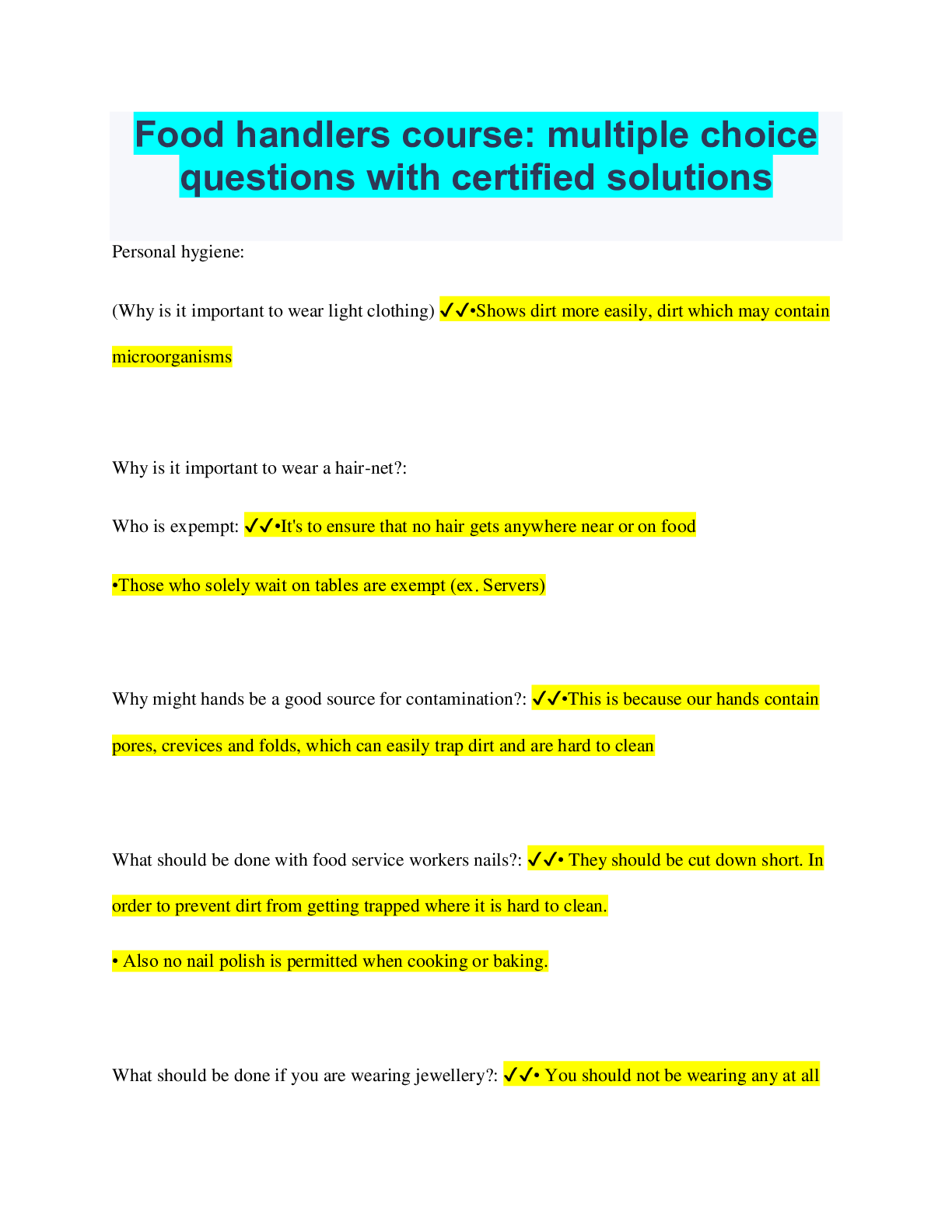
Food handlers course: multiple choice
questions with certified solutions
Personal hygiene:
(Why is it important to wear light clothing) ✔✔•Shows dirt more easily, dirt which may contain
microorganisms
Why is it important to wear a hair-net?:
Who is expempt: ✔✔•It's to ensure that no hair gets anywhere near or on food
•Those who solely wait on tables are exempt (ex. Servers)
Why might hands be a good source for contamination?: ✔✔•This is because our hands contain
pores, crevices and folds, which can easily trap dirt and are hard to clean
What should be done with food service workers nails?: ✔✔• They should be cut down short. In
order to prevent dirt from getting trapped where it is hard to clean.
• Also no nail polish is permitted when cooking or baking.
What should be done if you are wearing jewellery?: ✔✔• You should not be wearing any at all
Most important step in preventing food borne illness?: ✔✔•WASHING YOUR HANDS!!
(3) Specific times when a food handler should wash their hands?: ✔✔1) when touching money
2)when touching hair
3)if you cough or sneeze
What is recommended when wearing gloves to prepare food?: ✔✔• Switch when there might be
cross-contamination!
Why is it important for a food premise regulation to have a separate sink for hand washing?:
Where must it be located?: ✔✔• To keep the germs from our hands away from clean dishes and
food. To prevent bacteria from spreading.
• Close to the kitchens (easy access)
The six steps to hand washing: ✔✔1) wet hands
2) soap
3) lather
4) rinse
5) towel dry
6) turn tap off with towel
(3) personal habits to avoid?: ✔✔• Avoid touching hair and face
• Avoid chewing nails
• Avoid touching clothes
What is the food premise law as it pertains to illness?: ✔✔• If you are sick it is best to just stay
home, so that you will not make others sick as well. If you are sick with diarrhea or vomiting you
must stay home for 48 hours. (Best to just get it all out)
The flow of food:
(Why is it important to keep food out of the danger zone) ✔✔It is important to ensure food is
kept out of the danger zone because between the temperature of 4-60'C it is very easy for
bacteria to grow
(3) tips for safe RECEIVING of food: ✔✔1) check the temp
2) use only grade A eggs, pasteurized milk products and meat
3) check cans for dents & packages for leak and tears
(3) tips for safe STORAGE of food: ✔✔1) keep all food labelled (dates)
2) rotate stock-use FIFO (first in, first out)
3) keep food in appropriate containers/ packages and keep covered
FIFO: ✔✔• First-in-first-out (used to rotate stock)
(4) acceptable methods for thawing food: ✔✔1) put under cold running water
2) put at bottom shelf of fridge
3) microwave if immediately cooking
4) cook from frozen
Why might the Preparation of food be considered "dangerous": ✔✔• Crosses in the danger zone
(4-60'C) chances of contamination/ temp abuse
(3) tips for safe preparation of food: ✔✔1) wash hands before handing food and after each
change of task
2) use only clean and sanitized equipment
3) keep raw meat separate from ready-to-eat-food
(Do not cross-contaminate)
What is the recommended method for checking a foods temperature: ✔✔• By using a calibrated
probe thermometer to ensure the food gets cooked completely
Minimum internal temperature for all food: ✔✔•74'
Why is beef an exception: ✔✔• This is because customers can prefer how they like their beef
cooked. Bacteria usually grow only on the outside of beef, therefore it kills off the bacteria
What is an acceptable temperature to "hold" food at, (ex. On a "steam table" at a buffet: ✔✔•The
acceptable temperature to reheat food at must be reheated to an internal temp that is at least as
high as the minimum internal temp to which it was cooked to in the first place.
Why is cooling an important step in safe food handling: ✔✔• Cooling is an important part in safe
food handling because it must pass through the danger zone again, quickly in case of any
bacteria showing up, that were not killed during cooking
(3) tips to ensure rapid cooling: ✔✔1) place large pots of soups, gravy etc in sink of ice water
(15-30 min)
2) transfer food from large containers to shallow pans
3) use ice cubes or pop bottles filled with ice
What two recommendations should be used when reheating food: ✔✔1) only reheat once
2) also reheat to 74'C as quickly as possible
Within 2 hours
Two examples for safe serving of wait staff in a restaurant: ✔✔1) serving staff must not touch
the end of knives, forks or spoons
2) use a metal or plastic scoop to serve ice cubes, never a glass
Two examples for safe serving by self serve restaurants: ✔✔1) provide adequate spoons or tongs
to reduce the temptation of the customer using their hands
2) protect food with sneeze guards or other shielding
What does HACCP stand for: ✔✔H- hazards
A- analysis
C- critical
C- control
P- point
Food safety hazards:
(3) types of food safety categories ✔✔1) chemical hazards
2) physical hazards
3) biological hazards
Chemical hazards: ✔✔• May contaminate by accidental addition to food during its storage,
preparation or transportation (ex cleaning supplies)
Physical hazards: ✔✔• Solid pieces of other things found in your food that are not supposed to
be in there (ex hair clips)
Biological hazards: ✔✔• It is living organisms which may already be present in the food when
purchased it they may enter food after purchase (viruses, moulds and bacteria)
Are all microorganisms bad: ✔✔• Not they are not more than 99% or more are harmless
(2) types of harmful bacteria: ✔✔1) infection producing bacteria
2) toxin producing bacteria
What is important to note about disease-causing bacteria in food: ✔✔• It is Important to note that
you cannot see, taste or smell disease-causing bacteria
How does the food premise regulation define a hazardous food: ✔✔"Any food capable of
supporting the growth of pathogenic organisms or the production of the toxins of such
organisms"
What are the six factors that affect the growth of microorganisms: ✔✔1) moisture
2) protein
3) oxygen
4) acidity
5) temperature
6) time
What temperature range is ideal for microorganisms growth: ✔✔• 4-60'C
What is this range called: ✔✔•The danger zone
At what rate do bacteria multiply: ✔✔•Bacteria grow rapidly
Food premises sanitation: (define cleaning) ✔✔•Cleaning- refers to the removal of dirt which
may contain or hide microbes
How is proper cleaning accomplished: ✔✔•Proper cleaning is accomplished with the use of
detergents (soap) which help lift dirt off and keep it in the water
The five steps (5) necessary to complete the 3 sink method: ✔✔1) scraping: remove majority of
food waste
2) sink #1: washing in clean, warm water with a detergent to remove all organic material
3) sink #2: rinsing in clean water with a minimum temp of 43'C
4) sink #3: sanitizing by soaking in hot water, minimum 77'C or a chemical sanitizer of
appropriate concentration for at least 45 seconds
5) drying: should be done by air drying on a dish rack
Why is the hot water method not recommended: ✔✔•This is because it is to hot and you could
burn your hands. Most are not set this high.
Define "in place cleaning": ✔✔•This is when you clean equipment that cannot be moved but
must be "cleaned in place"
What strength should a chemical sanitizer be for this method of cleaning: ✔✔• The strength
should be doubled. In order to ensure all bacteria get killed off.
List (2) reasons why chlorine is the usual choice of sanitization: ✔✔1) most available
2) cheapest sanitizer
List the measurements/ratio for a chlorine Sanitizer/water: ✔✔•2 teaspoons of bleach for every 4
litres of water
List two (2) rules regulating equipment or utensils: ✔✔1) all equipment must be constructed in
such a manner that they can be readily cleaned and sanitized
2) any equipment or utensils which touch food must be corrosive resistant, non-toxic, and free
from cracks, crevices and open seams.
What should be noted about damp wiping cloths: ✔✔•Damp wipe cloths provide the perfect
place for microorganisms to grow. Using dirty cloth just spreads bacteria around.
What is recommended for the safe use of cloths in the kitchen: ✔✔• To put them in the laundry
regularly and after they touch juices from raw meat. Or soak them in a sanitization solution.
Why is it important to keep rodents and insects out of the kitchens: ✔✔• This is because they are
capable of carrying diseases from organisms. Rodents and insects carry dirt and microbes on
their feet, hair and feces, all of which may end up in a food product.
List the premise for insects and rodents control:
Why is it important: ✔✔• The premise for insects and rodents control is simple; deny them food
and shelter.
• Once an infection starts it is very hard to eliminate completely, so recent ion is very important.
List two (2) ways to prevent insect and rodent infestation: ✔✔1) use screen doors and windows
to keep flies out
2) keep garbage covered
[Show More]


.png)