TEXAS Food Handler Training Course
Questions and Answers Already
Graded A
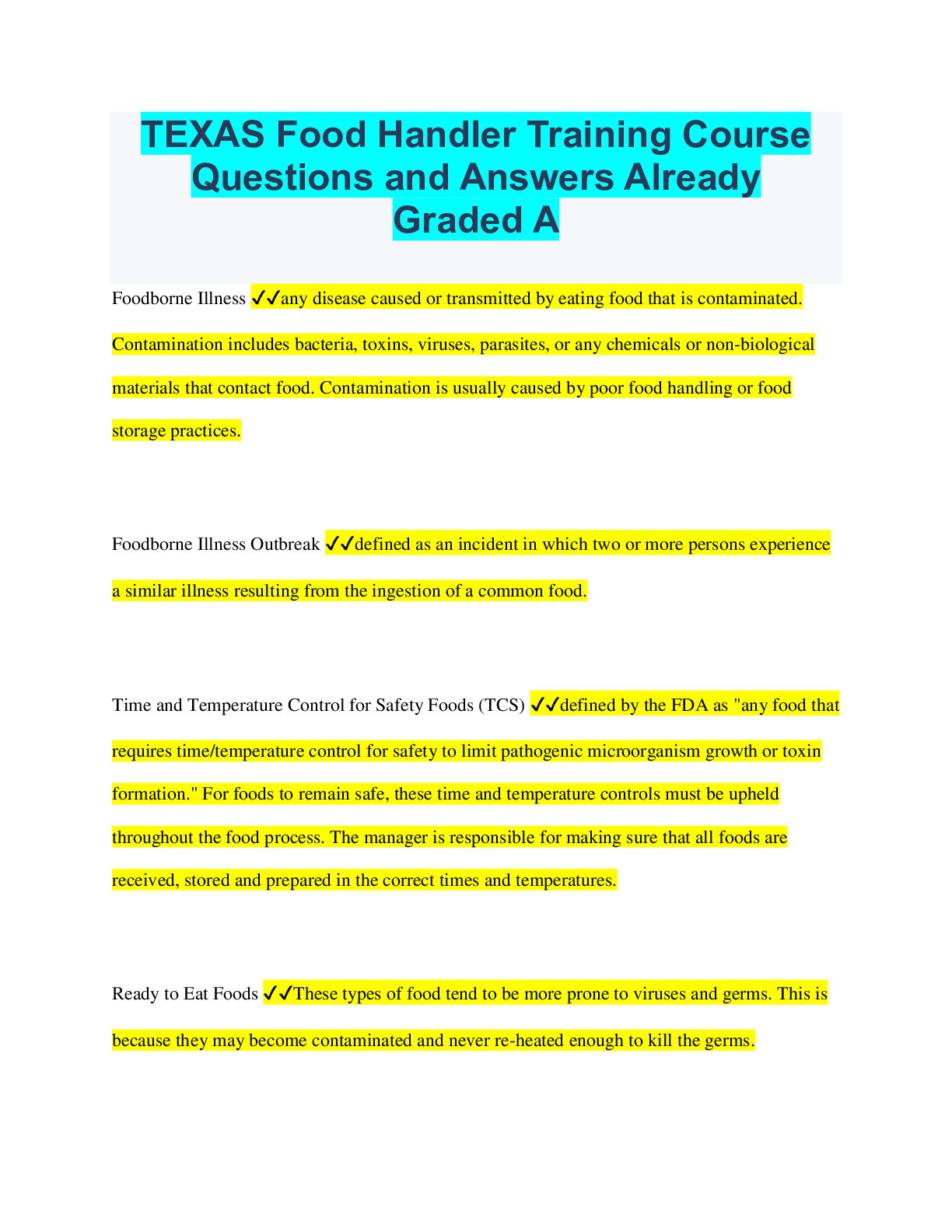
Foodborne Illness ✔✔any disease caused or transmitted by eating food that is contaminated.
Contamination includes bacteria, toxins, viruses, p
...
TEXAS Food Handler Training Course
Questions and Answers Already
Graded A
Foodborne Illness ✔✔any disease caused or transmitted by eating food that is contaminated.
Contamination includes bacteria, toxins, viruses, parasites, or any chemicals or non-biological
materials that contact food. Contamination is usually caused by poor food handling or food
storage practices.
Foodborne Illness Outbreak ✔✔defined as an incident in which two or more persons experience
a similar illness resulting from the ingestion of a common food.
Time and Temperature Control for Safety Foods (TCS) ✔✔defined by the FDA as "any food that
requires time/temperature control for safety to limit pathogenic microorganism growth or toxin
formation." For foods to remain safe, these time and temperature controls must be upheld
throughout the food process. The manager is responsible for making sure that all foods are
received, stored and prepared in the correct times and temperatures.
Ready to Eat Foods ✔✔These types of food tend to be more prone to viruses and germs. This is
because they may become contaminated and never re-heated enough to kill the germs.
Examples of "__________" foods include: ✔✔Sliced meats
Fruits and vegetables
Cheese
Tuna/Chicken Salad
Hot dogs
Hard boiled eggs
Melons such as honeydew and cantaloupe
Highly Susceptible Populations (HSP) ✔✔There are certain categories of people that are at
greater risk of contracting a foodborne illness. We call these groups the
HSP include ✔✔People with reduced immune systems (HIV, chemotherapy, etc.)
The elderly
Children
Women who are pregnant
HSP ✔✔highly susceptible populations
TSC ✔✔Time and Temperature Control for Safety Foods
Contamination ✔✔occurs when harmful substances are present in food
Chemical Contaminants ✔✔contaminants can include pesticides, herbicides, and cleaning
solutions.
Biological contaminates ✔✔contaminants can include viruses, bacteria and/or parasites
Physical contaiminates ✔✔contaminants are anything artificial like metal shavings from cutlery,
pieces of wrapping or plastic, or other items commonly found in kitchen work areas
Foodborne Illness Risk Factors - improper food holding ✔✔Foods, especially TCS foods, should
be held at temperatures colder than 41°F or hotter than 135°F to slow the growth of pathogens
Foodborne Illness Risk Factors- inadequate cooking ✔✔It is recommended that certain foods are
cooked to a minimum internal temperature depending on the food
Foodborne Illness Risk Factors- contaminated equiment ✔✔Food equipment and food contact
surfaces can become contaminated with use unless proper and adequate cleaning and sanitizing
operations are in place
Foodborne Illness Risk Factors- approved source ✔✔All foods arrive at your location with
germs already on them. It is important that you only purchase foods from reputable and safe food
providers
Foodborne Illness Risk Factors- poor personal hyginene ✔✔Your own personal hygiene habits
are a risk when preparing and serving food. Proper hygiene, such as frequent handwashing,
greatly reduces these risks.
Work attire ✔✔- Your clothes should be clean. Wearing long sleeves is also a good idea. You
should always wear a clean apron, and change it whenever moving from raw foods to "ready-toeat" foods.
Clean shaven ✔✔- Facial hair can attract numerous bacteria and germs. It is a good idea to be
clean shaven at all times when working with foods.
Little or no jewelry ✔✔- Contaminants can collect on and around jewelry items such as rings
and bracelets. You should wear no jewelry except for a plain wedding band.
Hair ✔✔- Your hair should be clean and pulled back or restrained using a quality hair restraint.
Fingernails ✔✔- Your fingernails can cause multiple types of problems. Long nails can chip or
break and fall into food. If you wear nail polish it can also flake off into food items. Bacteria and
dirt can also get stuck under longer nails so it is a good idea to keep your nails short and clean.
The "Big Six" Illnesses ✔✔Norovirus
Hepatitis A
Salmonella Typhi
Nontyphoidal Salmonella (NTS)
Shigella, spp
Escherichia (e.coli)
Norovirus ✔✔symptoms include vomiting, nausea, fever, and aches. This illness is usually
transmitted by an infected person handling food items.
Hepatitis A ✔✔is an illness that affects the liver. It is very dangerous if left untreated. Symptoms
include headache, fever and jaundice (yellowing of the eyes and skin.)
Salmonella typhi ✔✔is a type of typhoid fever. It is highly contagious and you are required to
report any diagnosis during the last 90 days to your employer.
non-typhoidal salmonella ✔✔symptoms include nausea, vomiting, abdominal cramps, diarrhea,
fever, headache.
Shigella ✔✔causes extreme stomach/intestinal illness and is usually caused by improper
handwashing techniques.
E.coli ✔✔this illness can be harmless, but some strains are quite dangerous. Causes include
improper handwashing and improper food storage.
[Show More]