*NURSING > A-Level Mark Scheme > NAADAC ETHICAL & PROFESSIONAL ISSUES IN ADDICTION COUNSELING 2023 LATEST UPDATE (All)
NAADAC ETHICAL & PROFESSIONAL ISSUES IN ADDICTION COUNSELING 2023 LATEST UPDATE
Document Content and Description Below
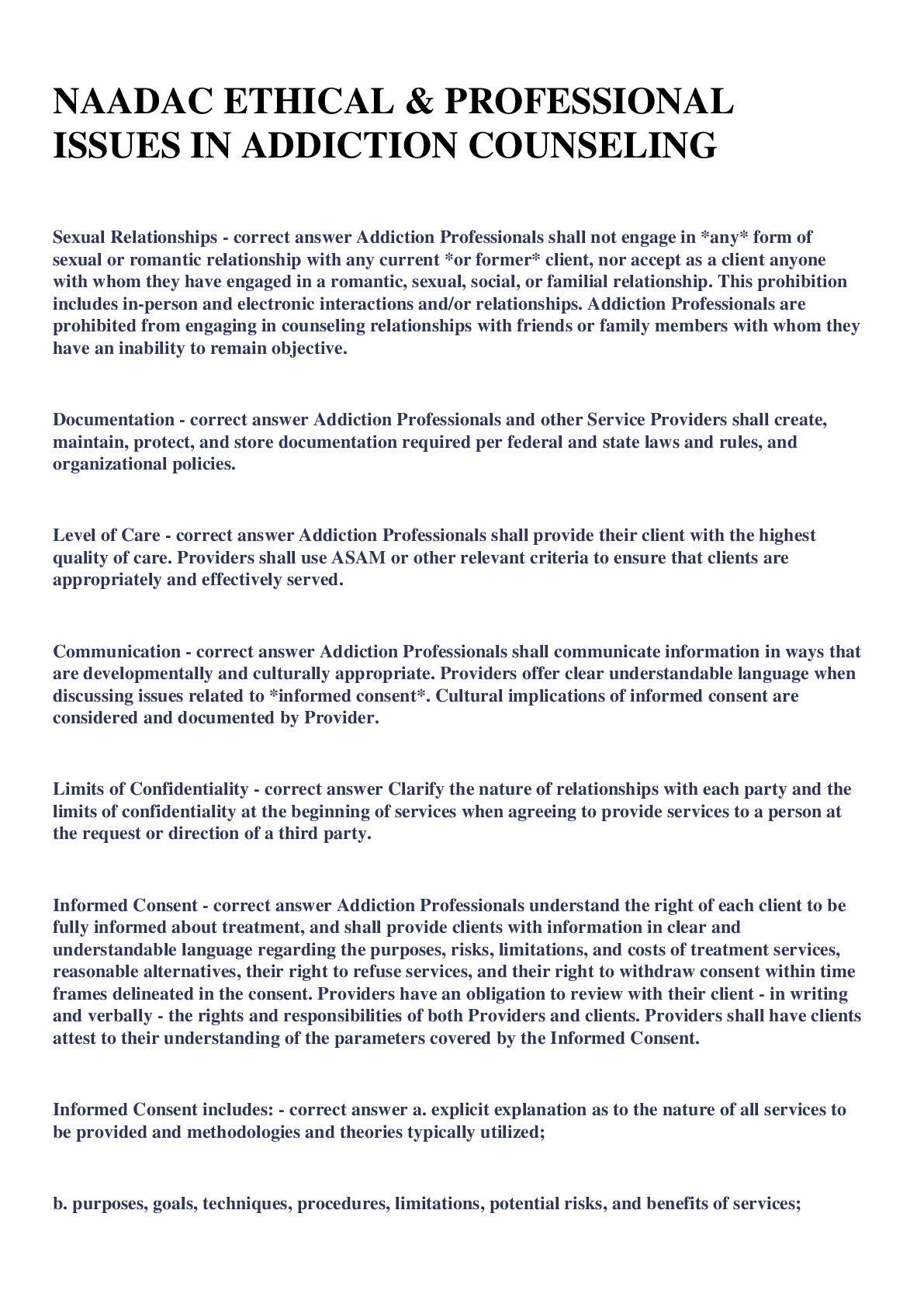
Sexual Relationships Addiction Professionals shall not engage in any form of sexual or romantic relationship with any current or former client, nor accept as a client anyone with whom they have engag ... ed in a romantic, sexual, social, or familial relationship. This prohibition includes in-person and electronic interactions and/or relationships. Addiction Professionals are prohibited from engaging in counseling relationships with friends or family members with whom they have an inability to remain objective. Documentation Addiction Professionals and other Service Providers shall create, maintain, protect, and store documentation required per federal and state laws and rules, and organizational policies. Level of Care Addiction Professionals shall provide their client with the highest quality of care. Providers shall use ASAM or other relevant criteria to ensure that clients are appropriately and effectively served. Communication Addiction Professionals shall communicate information in ways that are developmentally and culturally appropriate. Providers offer clear understandable language when discussing issues related to informed consent. Cultural implications of informed consent are considered and documented by Provider. Limits of Confidentiality Clarify the nature of relationships with each party and the limits of confidentiality at the beginning of services when agreeing to provide services to a person at the request or direction of a third party. Informed Consent Addiction Professionals understand the right of each client to be fully informed about treatment, and shall provide clients with information in clear and understandable language regarding the purposes, risks, limitations, and costs of treatment services, reasonable alternatives, their right to refuse services, and their right to withdraw consent within time frames delineated in the consent. Providers have an obligation to review with their client - in writing and verbally - the rights and responsibilities of both Providers and clients. Providers shall have clients attest to their understanding of the parameters covered by the Informed Consent. Informed Consent includes: a. explicit explanation as to the nature of all services to be provided and methodologies and theories typically utilized; b. purposes, goals, techniques, procedures, limitations, potential risks, and benefits of services; c. the addiction professional's qualifications, credentials, relevant experience, and approach to counseling; d. right to confidentiality and explanation of its limits including duty to warn; e. policies regarding continuation of services upon the incapacitation or death of the counselor; f. the role of technology, including boundaries around electronic transmissions with clients and social networking; g. implications of diagnosis and the intended use of tests and reports; h. fees and billing, nonpayment, policies for collecting nonpayment; i. specifics about clinical supervision and consultation; j. their right to refuse services, and k. their right to refuse to be treated by a person-in-training, without fear of retribution. Mandated Clients When you work with clients who have been ordered to attend counseling and related services, discuss legal and ethical limitations to confidentiality. Explain confidentiality, limits to confidentiality, and the sharing of information for supervision and consultation purposes before the beginning of therapeutic or service relationship. If the client refuses services, discuss with the client the potential consequences of refusing the mandated services, while respecting client autonomy (right to choose for themselves). Previous Clients Addiction Professionals considering initiating contact with or a relationship with a previous client shall seek documented consultation or supervision prior to its initiation. Advocacy You are called to advocate on behalf of your clients at the individual, group, institutional, and societal levels. You have an obligation to speak out about barriers and obstacles that impede growth and development of clients. When advocating for a specific client, Providers obtain written consent prior to engaging in advocacy efforts. [Show More]
Last updated: 2 years ago
Preview 1 out of 5 pages
Buy this document to get the full access instantly
Instant Download Access after purchase
Buy NowInstant download
We Accept:

Reviews( 0 )
$14.00
Can't find what you want? Try our AI powered Search
Document information
Connected school, study & course
About the document
Uploaded On
Aug 18, 2023
Number of pages
5
Written in
All

Additional information
This document has been written for:
Uploaded
Aug 18, 2023
Downloads
0
Views
184