CGAP International - Domain III - Government
Auditing Skills and Techniques
What are the two types of management? What are their definitions? - ✔✔
Autocratic Management:
- Managers make decisions themselves
- Issue
...
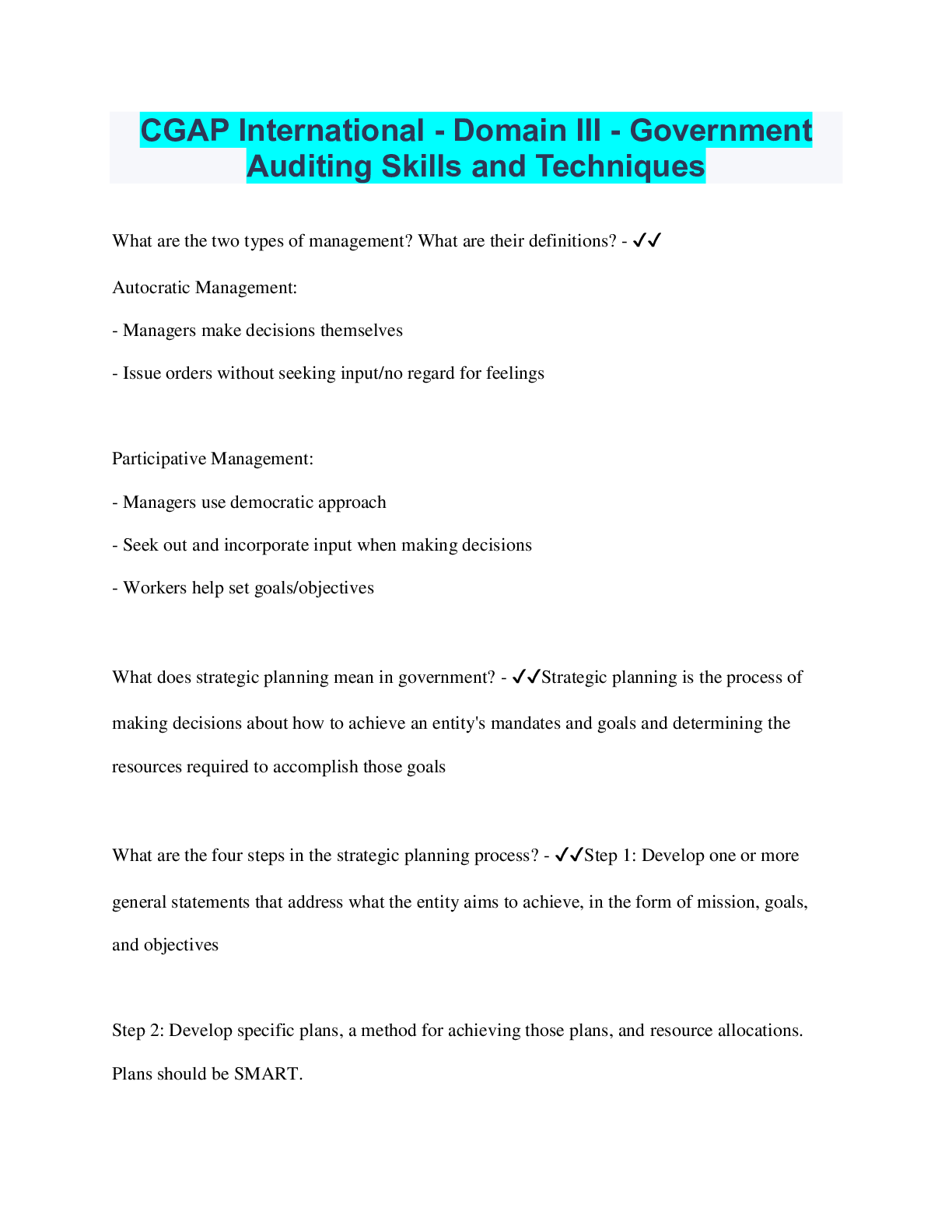
CGAP International - Domain III - Government
Auditing Skills and Techniques
What are the two types of management? What are their definitions? - ✔✔
Autocratic Management:
- Managers make decisions themselves
- Issue orders without seeking input/no regard for feelings
Participative Management:
- Managers use democratic approach
- Seek out and incorporate input when making decisions
- Workers help set goals/objectives
What does strategic planning mean in government? - ✔✔Strategic planning is the process of
making decisions about how to achieve an entity's mandates and goals and determining the
resources required to accomplish those goals
What are the four steps in the strategic planning process? - ✔✔Step 1: Develop one or more
general statements that address what the entity aims to achieve, in the form of mission, goals,
and objectives
Step 2: Develop specific plans, a method for achieving those plans, and resource allocations.
Plans should be SMART.
Step 3: Communicate the plan to affected staff
Step 4: Monitor the plan and its effectiveness
What does a Bureaucracy do? - ✔✔Creates a division of labour that allows employees to have
specific function of duties.
Buffer governmental functions and staff from the effects of the political processes that surround
them
Why can a Bureaucracy breed inefficiencies? - ✔✔Excessive layers of management
Overemphasis on control
What are the goals of a well functioning group? - ✔✔- Group makes decisions based on sound
logic and evidence
- Should recognize that individuals have different strengths and weaknesses
- Time should be spent on solving major problems instead of personal conflicts
- Achieving the overall goals of the group should be the priority of all group members
Name 4 objectives of centralized management (out of 6) - ✔✔- Setting standards
-Establishing reporting requirements
- Collecting and analyzing reports
- Overseeing compliance with standards and requirements
- Reducing the need for the development of guidelines by each component agency
- Reducing the need for independent oversight activities
Name 4 disadvantages of centralized management approach (of 7) - ✔✔- Processing delays
- Emphasis on process, rather than on result
- Additional layer of bureacracy
- Potential new base of political power that can impeded progress
- Can become extremely powerful
- Ability to influence speed of delivery of services through requirements and enforcement actions
- "Government red tape"
What are the 4 advantages of a decentralized management approach? - ✔✔1. Customer-driven
approach geared towards developing and retaining the customer base
2. Promotes ability to react and adapt to customer needs
3. Provide services in an efficient and effective manner
4. Can improve the quality of service to each customer
What are the two disadvantages of a decentralized management approach? - ✔✔1. Staff try to
react quickly and forgo adherence to standards and guidelines
2. Higher potential for conflicting interests to influence use of resources
What are the specific elements related to planning for change in change management? - ✔✔-
Looking towards the future
- Continuously assessing the effectiveness of programs
- Maintaining effective management controls
- Benchmarking best practices
- Developing strong communication channels
What is the definition of Performance Measurement? - ✔✔The ongoing monitoring and
reporting of program accomplishments
What are the four main categories of performance measures? and their definitions? - ✔✔Input
measures: Quantity of resources used/planned
Process measures: Means for evaluating use of inputs to achieve outputs
Output measures: Quantity of products or services delivered by a program
Outcome measures: Evaluation of results achieved as per delivery of products or services by a
program
What are the four major components of a performance management system? - ✔✔1. Strategic
and annual planning
2. Performance budgeting
3. Performance measurement and reporting
4. Performance-based decision making
What are the four key steps in conducting a measurement-based performance audit? - ✔✔1.
Determining what program or activity is to be audited
2. Determining what the expectations or goals of the program/activity are
3. Determining whether management is accomplishing the expectations or goals.
4. If not, determining what needs to be done to accomplish the expectations/goals
What are some steps to identifying specific performance measures? - ✔✔- Identify stakeholder
needs
- Document major processes
- Assess performance using benchmarking
- Determine whether recommendations for improvement/change are warranted
What are the criteria used to select performance measures and data collection? (7 total) - ✔✔1.
Appropriateness and validity
2. Uniqueness
3. Completeness
4. Comprehensibility
5. Controllability
6. Cost
7. Timeliness of feedback
8. Accuracy and reliability
What are some suggested approaches when an auditor has incomplete data? - ✔✔- Obtain as
much missing data as possible
- Omit missing data from analysis
- Change objective of evaluation to focus on available data
What are some suggested approaches when an audtior has irrelevant data? - ✔✔- Request new
summary information from client
- Obtain raw data directly from client records
-Identify surrogate measures from existing data as a substitute
What are some suggested approaches when an auditor has non-comparable data? - ✔✔- Exclude
non comparable data
- Modify data as appropriate to make it as comparable as possible
- Add clarifying footnotes that indicate the limitations of data being used
What are descriptive statistics? - ✔✔Methods designed to describe or summarize the
characteristics of a data set
What does Inferential Statistics mean? What is a method of inferential statistics? - ✔✔Refers to
methods designed to allow estimates (inferences) to be made about characteristics of a data set.
Sampling is a method of inferential statistics.
What are some major classifications of statistical sampling? - ✔✔Statistical samples -
Probability of selecting an item is known before sample is chosen
Simple random sample - Each item in sample has an equal chance of being selected
Stratified sample - Population is divided into groups and sample is selected from groups
What is stop-or-go sampling? - ✔✔Evaluating each sample as they are taken to see if they the
sample supports the desired conclusion. Once conclusion is supported, sampling stops.
What is discovery sampling? - ✔✔Sampling an area you think will have only a certain threshold
of deviation. Sampling continues until deviation is found and then it is determined as to whether
this is above or below the specified percentage threshold of deviation.
When should a sample size be increased? - ✔✔- When the population increases
- When variability within the population increases
- When the expected error rate increases
- When the confidence level increases
What are some charts/diagrams used as analytic tools and techniques by auditors? (9 total) - ✔✔-
Run chart analysis
- Control chart analysis
- Radar chart analysis
- Histogram analysis
- Pareto analysis
- Cause-and-effect diagram
- Scatter diagram
- Sequence flow chart
- Force field analysis
When are survey questionnaires used? - ✔✔Developed/used to obtain information from
stakeholders that is not readily available in the organization
s data sources. Can be used to quantify qualitative information, such as employee opinions.
When should you write interview notes? - ✔✔Promptly upon completion of an interview
What are two methods of analyzing data for summative evalatuations? - ✔✔1. Content analysis -
Investigates the meaning of data
2. Contract summary form - Contains series of focusing questions
What steps should be taken by an auditor when an integrity violation is first suspected? - ✔✔1.
Establish that a loss occurred or that there was a risk of loss
2. Identify who committed the violation
3. Prove who committed the violation and that it was done with malicious intent
4. Recover lost assets
5. Prevent repeat violations
If an integrity violation has been proven to have occurred upon investigation, what steps should
an auditor take? - ✔✔1. Determine whether management is involved/collusion.
2. Notify management immediately if appropriate
3. Write report that describes findings, conclusions, recommendations and corrective actions
4. Consult legal counsel
What are two major categories of logical fallacies that auditors should be framilar with? - ✔✔1.
Inductive fallacies - Evidence is used inccorectly to support a conclusion
2. Deductive fallacies - Failure to follow the logic of a series of statements
What are some types of logical fallacies? - ✔✔1. Slippery slope - An idea or course of action
which could potential lead to disaster, negative outcome
2. Non sequitur - "it does not follow" - Conclusion or statement that does not follow from the
previous arguement or statement - Example: The school in which my child goes to school is big.
The classroom must be big.
3. Post hoc, ergo propter hoc - "after this, therefor because of this"
4. Hasty generalization
5. Ad hominem - "against the man"
6. False use of authority
[Show More]