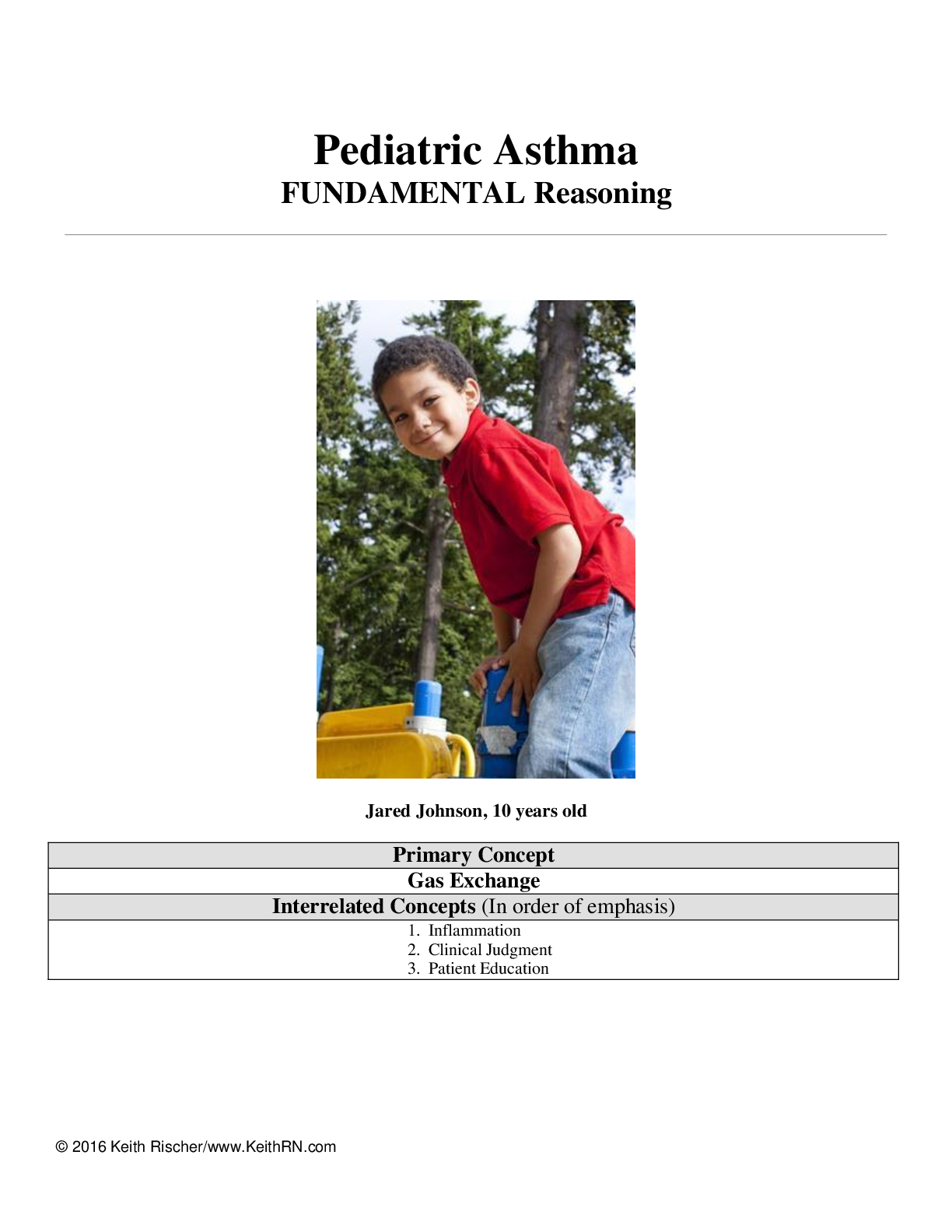
Pediatric Asthma
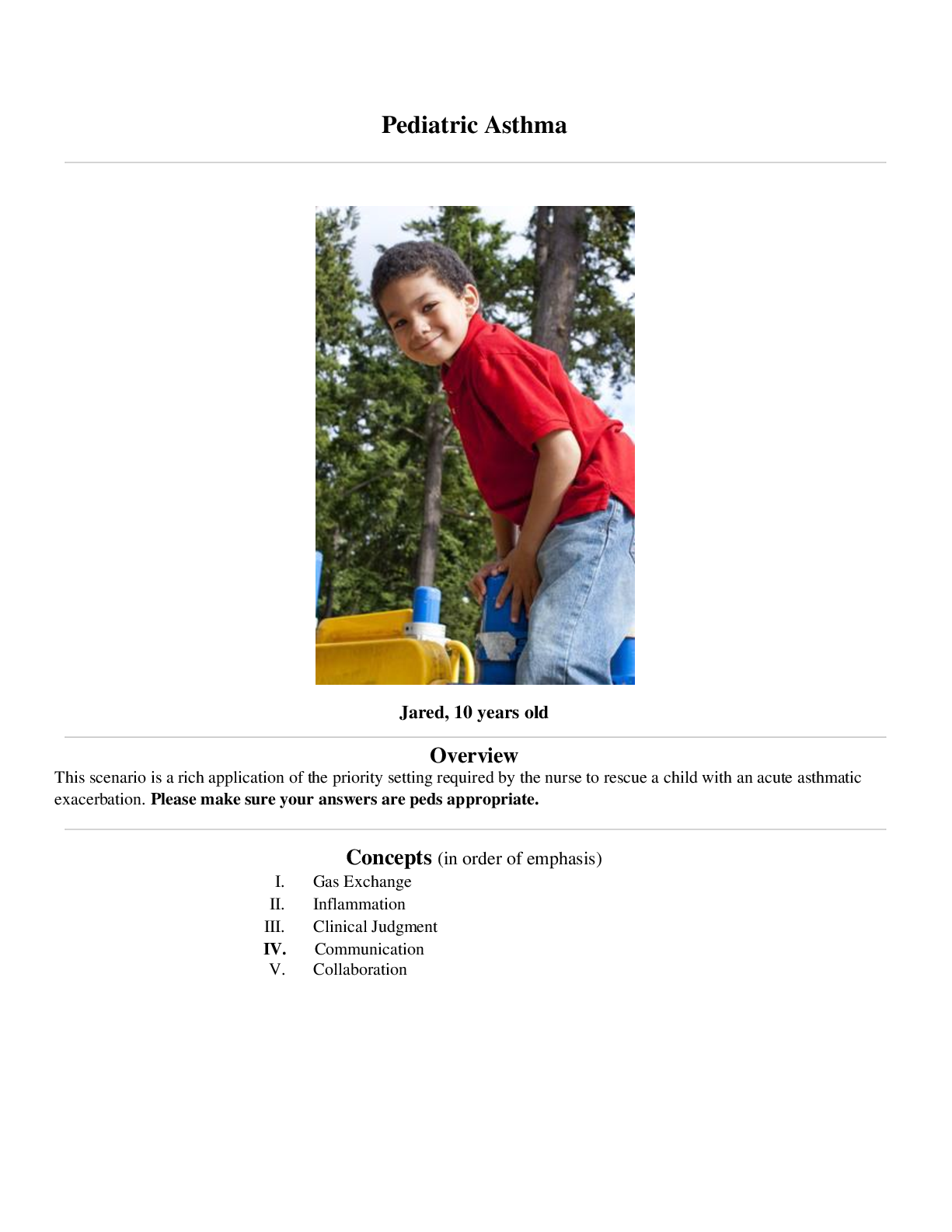
Jared, 10 years old
Overview
This scenario is a rich application of the priority setting required by the nurse to rescue a child with an acute asthmatic
exacerbation. Please make sure your answers ar
...
Pediatric Asthma
Jared, 10 years old
Overview
This scenario is a rich application of the priority setting required by the nurse to rescue a child with an acute asthmatic
exacerbation. Please make sure your answers are peds appropriate.
Concepts (in order of emphasis)
I. Gas Exchange
II. Inflammation
III. Clinical Judgment
IV. Communication
V. CollaborationPediatric Asthma
I. Clinical Relevance/Significance
History of Present Problem:
Jared is a 10 year-old African-American boy with a history of moderate persistent asthma. He is being admitted to the
pediatric unit of the hospital from the walk-in clinic with an acute asthma exacerbation. Jared started complaining of
increased chest tightness and shortness of breath one day prior to admission. He has been at 50% of his personal best
measurement for his peak expiratory flow (PEF) meter reading which did not improve with the use of albuterol metered
dose inhaler (MDI) (per his written asthma management plan).
In the walk-in clinic Jared is alert, speaking in short sentences due to breathlessness at rest. He has coarse expiratory
wheezes throughout both lung fields with decreased breath sounds at the right base. His oxygen saturation on room air is
90%. His color is pale and he has dark circles under his eyes. He is sitting upright and using his accessory chest muscles
to breath and has moderate intercostal and substernal retractions. He is complaining of tightness in his chest. Jared was
diagnosed with asthma at age 6 years and has 3 prior hospitalizations for asthma with one admission to the pediatric
intensive care unit. He has never had to be intubated with these episodes.
Personal/Social History:
He is accompanied by his mother and 16-year-old sister. Jared lives with his mother, maternal grandmother and sister
in an older housing development in the inter-city. He is in the 5th grade and a good student despite 2-3 absences per
school year for his asthma. He likes to ride his bike and is the goalie on the soccer team. He says that he has lots of
friends at school and likes his teacher Mr. Bates who is also his soccer coach. Both Jared and his mother deny tobacco
smoke at home
What data from the histories is important & RELEVANT; therefore it has clinical significance to the nurse?
RELEVANT Data from Present Problem: Clinical Significance:
1. a history of moderate persistent asthma
2. increased chest tightness and shortness of
breath one day prior to admission.
3. has been at 50% of his personal best for
PEFM → did not improve with the use of
albuterol MDI
4. coarse expiratory wheezes throughout both
lung fields
5. decreased breath sounds at the right base
6. room air is SAT 90%
7. pale and he has dark circles under his eyes
8. using his accessory chest muscles to
breathe→ moderate intercostal and
substernal retractions
9. complaining of tightness in his chest
10. 3 prior hospitalizations for asthma
11. never had to be intubated
1. This is a chronic illness for this child→ not a new onset
2. Patient was already in the yellow zone for asthma action plan the
day prior to admission
3. > 50%, patient is in danger (red) zone for his asthma action plan
warning that he is in significant distress and rescue medications
will not alleviate symptoms.
4. Patient is having a hard time moving air with the narrowing of the
airways.
5. Decreased or absent lung sounds are a significant finding of
respiratory failure which can lead to respiratory arrest also patient
may have significant mucous buildup over the alveoli which air
trapped in base cannot escape or have gas exchange.
6. Patient is having a hard time moving air with the narrowing of the
airways and with the mucous buildup causing hypoxia → limited
gas exchange is occurring.
7. Signs of physical exhaustion
8. Work of breathing has increased to the point where child is trying
to expand his chest due to increased intrathoracic pressure
9. Chest tightness is coming from bronchiole constriction.
10. His asthma has gotten severe enough that he had to be hospitalized
with an admission to the PICU
11. Pertinent negative, asthma has never gotten severe enough to
warrant intubation.
RELEVANT Data from Social History: Clinical Significance:
1. older housing development in the inter-city
2. Rides his bike and is the goalie on the
soccer team
3. Jared and his mother deny tobacco smoke
at home
1. Older home could have triggers within; dust mites, mold, air
pollution
2. Patient lives an active lifestyle; normal activities for his age;
asthma possibly not induced by his normal daily exercise.
3. Patient and mother deny smoking which is a trigger for asthma
attacks-→ Sister? Grandmother?Lab/diagnostic Results:
What lab results are RELEVANT that must be recognized as clinically significant to the nurse?
Radiology Reports:
What diagnostic results are RELEVANT that must be recognized as clinically significant to the nurse?
II. Nurse Collected Clinical Data:
What VS data is RELEVANT that must be recognized as clinically significant?
Basic Metabolic Panel (BMP): Current: High/Low/WNL?
Sodium (135-145 mEq/L) 138 WNL
Potassium (3.5-5.0 mEq/L) 3.7 WNL
Glucose (70-110 mg/dL) 80 WNL
Creatinine (0.6-1.2 mg/dL) 0.5 LOW
Complete Blood Count (CBC): Current: High/Low/WNL?
WBC (4.5-11.0 mm) 12.8 HIGH
Hgb (12-16 g/dL) 14.0 WNL
Platelets(150-450x 103/µl) 350 WNL
Neutrophil % (42-72) 55 WNL
RELEVANT Lab(s): Clinical Significance:
WBC 12.8 Indicative of possible infection
RELEVANT Results: Clinical Significance:
Chest X-Ray (frontal
and lateral views):
hyper-expansion of
airways with otherwise
clear lung fields
abnormal finding, indicative obstruction, air trapping, and increased airway resistance in an
asthmatic experiencing an acute attack (Papiris, Kotanidou, Malagari, & Roussos, 2002).
Current VS: WILDA Pain Assessment (5th VS):
T: 99.9 F (oral) Words: “My chest feels tight”
P: 120 (regular) Intensity: 8/10 on 0-10 scale
R: 30 (regular) Location: Across anterior chest
BP: 114/78 Duration: Constant
O2 sat:
90% on room air
RELEVANT VS Data: Clinical Significance:
1. Temperature
2. Pulse
3. Respirations
4. SPO2
5. Words
6. Aggravation/alleviation
1. Indicative of a possible infection
2. Indicative of distress→ increased work of breathing increased heart rate
3. Indicative of respiratory distress → air hunger, hypoxia
4. Indicative of decreased oxygenation and gas exchange and inability to
compensate
5. Chest tightness due to bronchiole constriction
6. Prevents adequate chest expansion→ if the child is in too much pain, it will
discourage him from taking a deep breath.
Aggravate:
Alleviate:
Worsens when tries to take a deep breath. Feels better when allowed to sit
upright on gurneyWhat assessment data is RELEVANT that must be recognized as clinically significant?
III. Fill out the table
Pharmacology:
Pale, anxious appearing, moderate respiratory distress. Sitting upright on gurney.
Only able to talk in short sentences due to breathlessness. Has intercostal and
substernal retractions with increased respiratory rate, using accessory muscles to
breath (sternocleidomastoid muscles)
RESP: Breath sounds with inspiratory and expiratory wheezing and prolonged expiration.
Has tight sounding nonproductive cough.
CARDIAC: Pale, warm & moist at forehead, no edema, heart sounds regular with no abnormal
beats, pulses strong, equal with palpation at radial/pedal/post-tibial landmarks
NEURO: Alert & oriented to person, place, time, and situation (x4)
GI: Abdomen soft/nontender, bowel sounds audible per auscultation in all four
quadrants
GU: Voiding without difficulty, urine clear/yellow
SKIN: Skin integrity intact, moist on forehead
-
-
-
-
-
--
-
-
-
-
-
-
Continued
[Show More]