HESI A2 Anatomy and Physiology
Already Passed
Anatomic Position
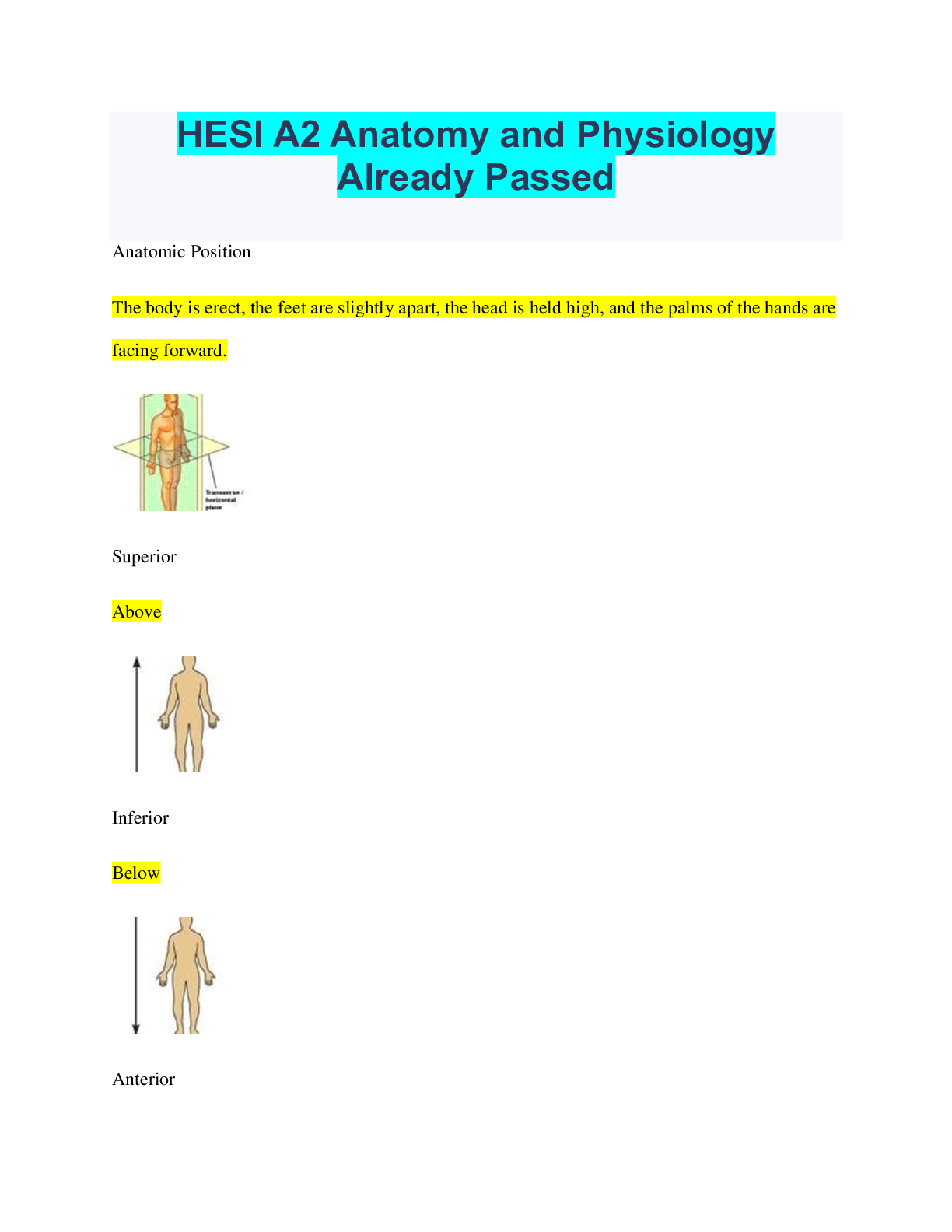
The body is erect, the feet are slightly apart, the head is held high, and the palms of the hands are
facing forward.
Superior
Above
Inferior
Below
...
HESI A2 Anatomy and Physiology
Already Passed
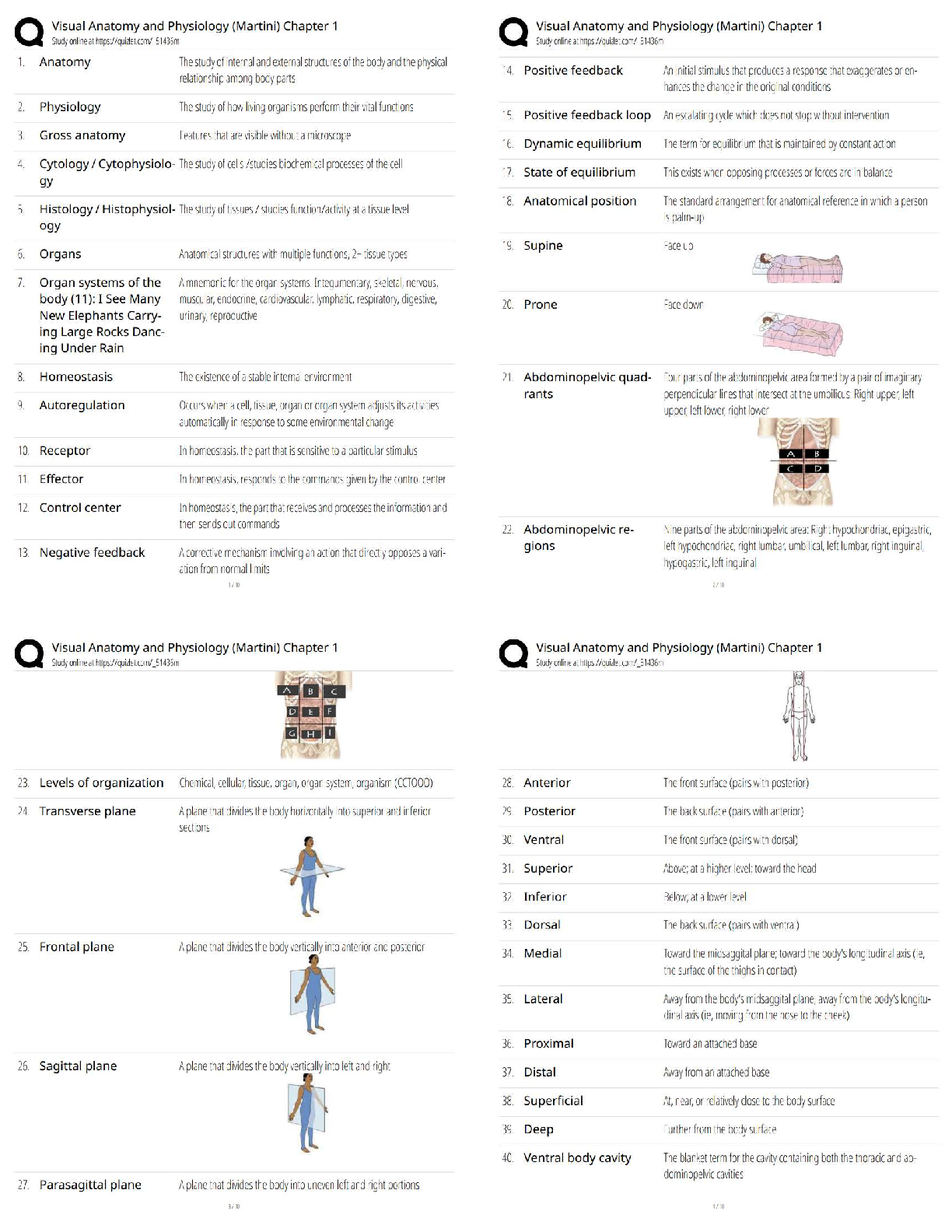
Anatomic Position
The body is erect, the feet are slightly apart, the head is held high, and the palms of the hands are
facing forward.
Superior
Above
Inferior
Below
Anterior
Facing forward
Posterior
Toward the back
Medial
Toward the midline
Lateral
Away from the midline; towards the side
Proximal
closer to point of attachment
Distal
Farther away from point of attachment
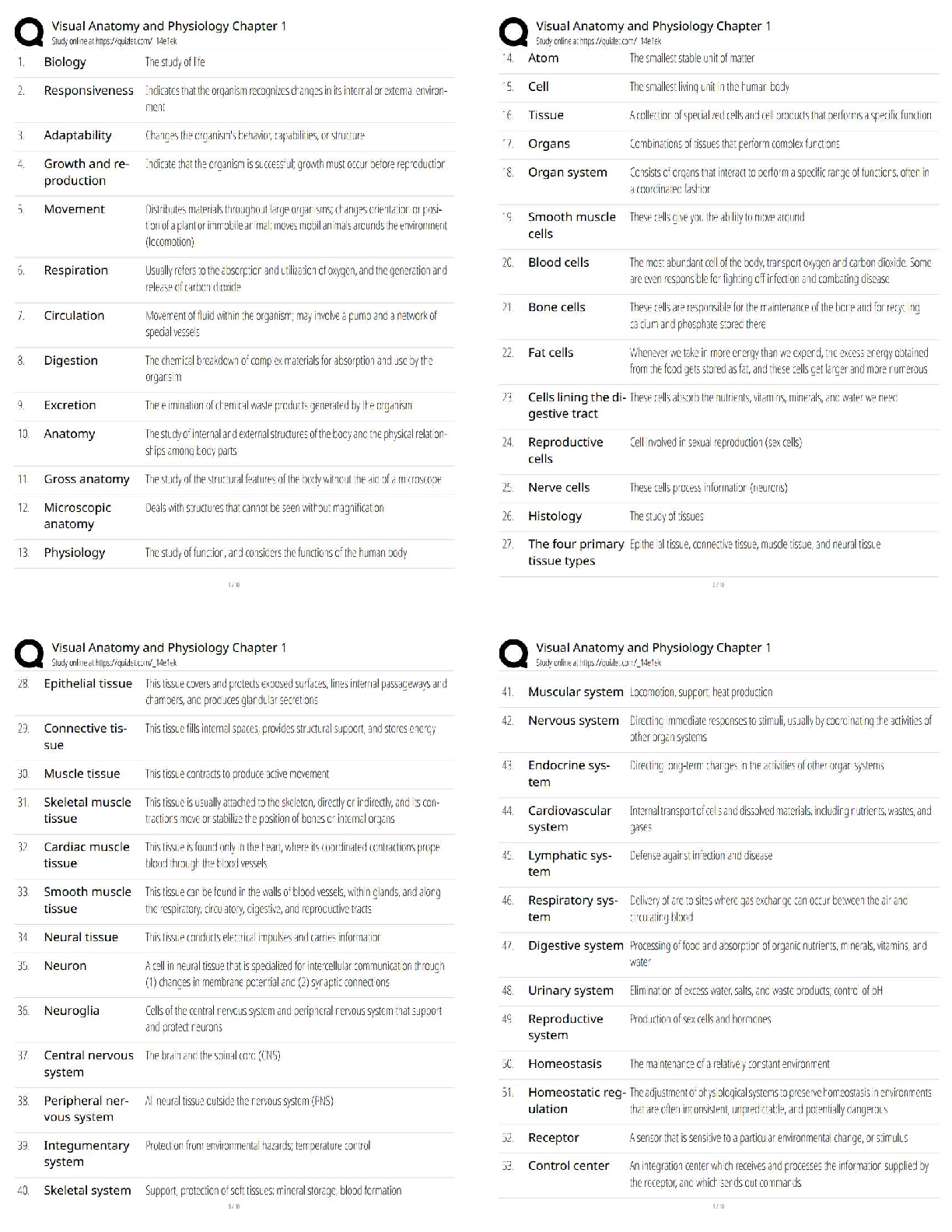
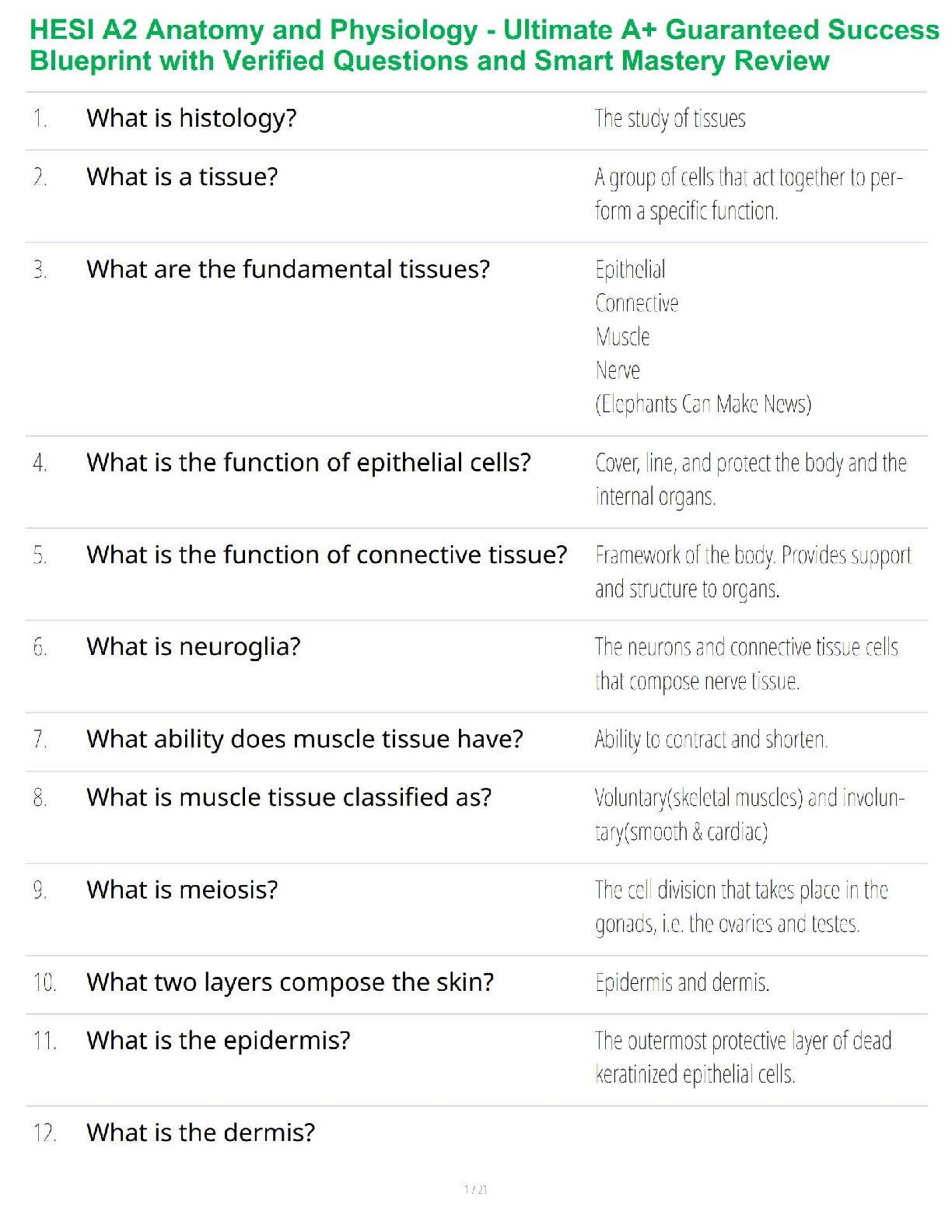
Histology
Study of tissues
Epithelial cells
Cover, line, and protect the body and its internal organs
Connective tissue
Framework of the body, providing support and structure for the organs; Types of Connective
Tissue: Cartilage, Adipose, and Smooth
Nerve Tissue
Composed of neurons
Tissue
Group of cells that act together to perform specific functions
Neuroglia
Neurons and connective tissue cells that make of nerve tissue
Muscle Tissue
-Classified as voluntary muscle (skeletal muscle) or involuntary muscle (smooth and cardiac
muscle tissue)
-Have the ability to contract or shorten
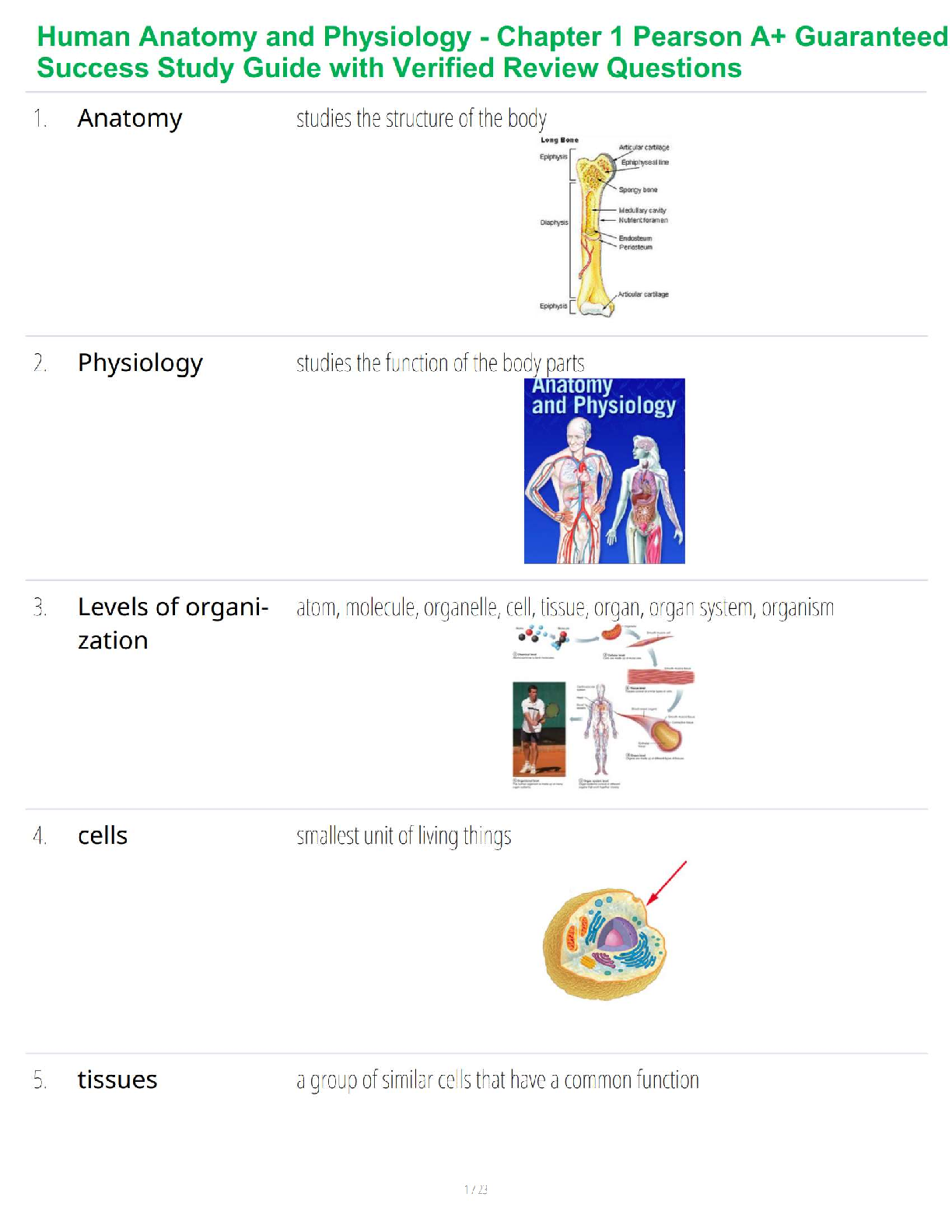
Cell
Basic unit of life and the building blocks of tissues and organs
Nucleus
Contains DNA
Ribosomes
-Synthesis of proteins
-Proteins include the enzymes that regulate all chemical reactions within the body
Mitosis
-Necessary for growth and repair
-DNA is duplicated and distributed evenly to two daughter cells
Meiosis
-Cell division that takes place in the gonads (ovaries and testes);
-Chromosome number reduced from 46 to 23 so when the egg and the sperm unite in
fertilization, the zygote will have correct number of chromosomes
Skin
-Largest organ in the body
-Epidermis (outermost); Dermis (underlying)
Epidermis
Outermost protective layer made of dead, keratinized epithelial cells
Dermis
-Underlying layer of connective tissue with blood vessels, nerve endings, hair follicles, glands,
and the associated skin structures
-rests on subcutaneous tissue that connects the skin to the superficial muscles
Layers of Epidermis (Outer to Inner)
(C)ome (L)et's (G)et (S)un (B)urned!
1. Stratum corneum
2. Stratum Lucidum
3. Stratum granulosum
4. Stratum germinativum (stratum basale and stratum spinosum) This is where mitosis occurs
Melanin
Epidermal cells contain this which protects against radiation from the sun
Eccrine
Most widely distributed sweat gland, regulates body temperature by releasing watery secretions
that evaporate on the surface of the skin
Apocrine
-Sweat gland in the armpits and groin area
-This secretion contains bits of cytoplasm from the secreting cells
-This cell debris attracts bacteria resulting in body odor
Sebaceous glands
Releases an oily secretion (sebum) through hair follicles that lubricates the skin and prevents
them from dying
Holocrine
-Sebum is produced by holocrine secretion
-These glands are susceptible to becoming clogged and attracting bacteria
Keratin
strong protein that hair and nails are composed of
Skeletal System Functions
Support, movement, blood cell formation (HEMOPOIESIS), protection of internal organs,
detoxification, provision for muscle attachment and mineral storage (particularly Ca and P)
Hemopoiesis
Blood cell formation
Long bone
-Has an irregular epiphysis at each end
-Composed mainly of spongy (needle-like structures) (cancellous) bone
-Shaft or diaphysis composed mainly of compact bone
Short Bone
-As long as they are wide, cube shaped or round
-Carpal bones of wrist, tarsal bone of foot
Flat Bone
-No medullar cavity, thin, thinner on one end
-Ribs, hip bone, frontal, parietal, occipital bones of skull
Irregular Bone
-Do not fit criteria of long, short or flat
-Vertebrae, sacrum
Sesamoid Bone
-Only 2
-Patella and pisiform bones
Osteoblasts
-Cells that form compact bone
-When they become fixed in the dense bone matrix, they stop dividing but continue to maintain
bone tissue as Osteocytes
Axial Skeleton
Consists of: Skull, vertebral column, 12 pairs of ribs, and sternum
Skull is comprised of how many bones?
-28 bones (14 facial, and 14 cranial vault bones)
Facial bones include
-2 nasal bones, two maxillary bones, two zygomatic bones, one mandible (only moveable bone
of the skull), two palatine bones, one vomer, two lacrimal bones, and two inferior nasal conchae
Bones of the cranium
-Single occipital, frontal, ethmoid, and sphenoid
- Paired parietal, temporal, and ossicles of the ear (malleus, incus, and stapes)
Bones of the Vertebral column
-7 cervical
-12 thoracic
-5 lumbar
-5 sacral (fuse to form the sacrum
-coccygeal (tailbone)
Appendicular Skeleton
Includes; girdles and the limbs
Bones of the arm
-Humerus, radiums, ulna, carpals, metacarpals, and the phalanges
Bones of the coxae
-Ilium, ischium, and pubis
Bones of the leg
-Femur: thigh bone
-Tibia: lower leg bone that bears majority of body weight
-Fibula: smaller than tibia, mostly used for muscle attachment
-Tarsals
-Metatarsals
-Phalanges
Muscular System
Produces movement by contracting response to nervous stimulation
Muscle cells consist of
-myofibrils
What must be present for a muscle to contract?
-Calcium and adenosine triphosphate (ATP)
Skeletal muscles
-called voluntary muscles because they are under conscious control
Prime mover
-skeletal muscle that executes a given movement
Antagonist
-skeletal muscle that produces the opposite movement
Synergists
-work in cooperation with the prime mover
Flexors
-muscles that reduce the angle at the joint
Extensors
-increase the angle at the joint
Abductors
-draw a limb away from the midline
Adductors
-return the limb back toward the body
Nervous system consists of
-the brain
-the spinal cord (white and gray matter: integrates reflexes to stimuli)
-the nerves
Nervous system
-enables us to perceive many of the changes that takes place in our external and internal
environment and respond to the changes (the five senses)
-enables us to think, reason, remember, and carry out abstract activities
Actions of the nervous system depend on?
-The transmission of nerve impulses over neurons, or nerve cells, the functional units of the
nervous system
Neurons consists of
-cell body
-axon
-dendrites
All actions of the nervous system depend on the transmission of nerve impulses from
NEURONS
Dendrites
-transmit the impulse TOWARD the cell body
Axons
-transmit the impulse AWAY from the cell body
Central Nervous System (CNS)
-comprised of the spinal cord and brain
-has a protective covering known as the meninges. Layers: Pia Mater: Rests on outside of bran
and spinal cord , Arachnoid Mater: thinner and more delicate and lines the inside of the dura
mater, Dura Mater: most superficial layer and thickest/toughest layer, composed of collagen
fibers and blood vessels to protect cns
Peripheral Nervous System (PNS)
-composed of all other neurons in the body
Sensory (afferent) Neurons
-transmit nerve impulses TOWARD the CNS
Motor (efferent) Neurons
-transmit nerve impulses AWAY from the CNS toward effector organs: muscles, glands,
digestive organs
Cerebrum
-associated with movement and sensory input
Cerebellum
-responsible for muscular coordination
Medulla Oblongata
-controls many of the vital functions such as respiration and heart rate
Spinal cord is how many inches long?
-18 inches (extends from the base of the skull to the first or second lumbar vertebra)
How many pairs of spinal nerves?
-31 pairs
Endocrine System
-assists the nervous system in homeostasis and plays an important role in growth and sexual
maturation
Where do the nervous and endocrine system meet?
-At the hypothalamus and pituitary gland
The hypothalamus governs which gland?
-Pituitary and is in turn controlled by the feedback hormones in the blood
Hormones
Chemical messengers, control growth, differentiation, and metabolism of specific cells.
-Steroid and Non Steroid
Steroid Hormones
-enter the target cells and have a direct effect on the DNA of the nucleus
Non steroid hormones
-protein hormones; remain at the cell surface and act through a second messenger (adenosine
monophosphate AMP)
What is the main function of each endocrine gland?
-Produce hormones
What is released from the adrenal cortex?
-Cortisol which reduces inflammation, raises blood sugar level, and inhibits the release of
histamine
Pituitary gland (master gland)
-attached to hypothalamus by a stalk called the infundibulum
-anterior lobe (adenohypophysis); called tropic hormones because they act mainly on the
endocrine glands
-posterior lobe (neurohypophysis)
Anterior lobe of the pituitary gland
-Growth hormone (somatotropin)
-ACTH
-TSH
-FSH
-LH
Posterior lobe of the pituitary gland
-Oxytocin (labor hormone)
-Antidiuretic hormone (ADH)
Thyroid
Responsible for metabolism control
Parathyroid Gland
-Plays vital role in proper bone development
-Regulates calcium and phosphorous levels
Adrenal Glands
-Responsible for distribution of stored fat and carbohydrate
-Also controls blood sugar
Pancreas
Endocrine system gland mainly responsible for maintaining healthy blood sugar levels
Gonads
-Ovaries and Testes
Blood consists of
-55% plasma
-45% erythrocytes (red blood cells), leukocytes (white blood cells), and platelets
Formed elements
-erythrocytes (red blood cells), leukocytes (white blood cells), and platelets
-all are produces from stem cells in red bone marrow
Erythrocytes
-modified for transport of oxygen
-bound to protein hemoglobin
Leukocytes
-distinguished on the bases of size, appearance, properties, pressure of cytoplasmic granules
-active in phagocytosis (neutrophils and monocytes) and antibody formation (lymphocytes)
Platelets
-Active in the process of blood clotting
-Produced by a bone marrow process called Thrombopoiesis
Blood serves to
-transport oxygen and nutrients to body cells
-to carry away carbon dioxide and metabolic wastes
The heart is a
-double pump that sends blood to the lungs for oxygenation through the pulmonary circuit and
remainder to the systemic circuit
-primary organ of the circulatory system
Blood is received by
-The atria and pumped into circulation by the ventricles
Valve on the right side of the heart
-Tricuspid
Valve on the left side of the heart
-Bicuspid
Semilunar valves are found
-at the entrances of the pulmonary trunk and the aorta
Blood is supplied to heart muscle (myocardium) by
-coronary arteries
Blood drains from the myocardium directly into the
-right atrium through the coronary sinus
What wave of electrical activity is measured on the electrocardiogram (ECG)?
-intrinsic beat of the heart initiated by the sinoatrial node
The contraction phase of the cardiac cycle is
-The systole
The relaxation phase of the cardiac cycle is
- The diastole
Arteries
-carry blood AWAY from the heart
-thick and elastic
-carry blood under high pressure
-vasoconstriction/vasodilation
-oxygenated blood
Veins
-carry blood TOWARD the heart
-thin and less elastic
-carry blood under low pressure
-deoxygenated blood
Capillaries
-smallest of vessels
-Where EXCHANGE of water, nutrients, and waste products take place between the blood and
surrounding tissues
Arterioles
-smallest arteries
Aorta
-sends branches to all parts of the body
Superior/inferior Venae cavae
-large veins that empty into right atrium of heart
Components of Respiratory System
-nose
-pharynx
-larynx
-trachea
-bronchi
-lungs (alveoli, diaphragm, muscles surrounding ribs)
Respiration is controlled by
-the respiratory control center in the medulla of the brain
The respiratory system supplies
-oxygen to the body and eliminates carbon dioxide
External respiration
-exchange of gases between the atmosphere and the blood through the alveoli
Internal respiration
-exchange of gases between the blood and body cells
Inhalation requires
-contraction of the diaphragm to enlarge the thoracic cavity and draw air into lungs
Exhalation
-passive process during which the lungs recoil as the respiratory muscles relax and the thorax
decreases in size
Oxygen in the blood is bound to
-hemoglobin (protein that gives RBC color) in red blood cells
Carbon dioxide is a regulator of
-blood pH
Alimentary Canal (digestive tubes)
-consists of mouth, pharynx, esophagus, stomach, small intestine, large intestine, rectum, and
anus
Accessory organs of digestion
-liver, pancreas, gall bladder
Mastication (Chewing)
-food starts in the mouth where it is mechanically broken down by the teeth and the tongue
Saliva
-produced by 3 pairs of salivary glands, lubricates and dilutes the chewed food
-contains enzyme amylase that starts the digestion of complex carbohydrates
Bolus
-ball of food that is formed
Pharynx
-constrictive muscles of the pharynx force the food into the upper portion of the esophagus and
the food is swallowed
Esophagus
-a narrow tube leading from the pharynx to the stomach
Layers of the digestive tract
-Innermost to outermost: the mucous membrane, sub mucous layer, muscular layer, serous layer
Stomach
-gastric glands secrete hydrochloric acid that breaks down food
-stores food and regulates the movement of food into the small intestine
Chyme
-stomach muscles churns and mixes bolus of food, turning mass into a soupy substance called
chyme
Small intestine
-digestion and absorption occur here
-nutrients of absorbed through the walls of S.I
-food is acted on by various enzymes from small intestine and pancreas and by bile from the
liver
-consists of duodenum, jejunum, ileum
Pancreas (digestive system)
-contributes water that dilutes the chyme and bicarbonate ions to neutralize the acid from
stomach
Liver
-all nutrients enter the hepatic portal vein to be routed to the liver for decontamination
Increase the surface area of the intestinal wall:
Villi
Large intestine
-reabsorbs water and stores and eliminates undigested food
-ascending colon, transverse colon, descending colon, sigmoid colon, rectum
Anus
-opening for defecation (expelling of stool)
Urinary system
-consists of two kidneys, two ureters, a urinary bladder, and the urethra
-regulate blood pressure
Kidneys
-filter the blood
Ureters
-tubes that transport urine to the urinary bladder
Urinary bladder
-Urine is stored here before urination through the urethra to the outside
Nephrons
-FUNCTIONAL UNITS OF THE KIDNEYS
-small coiled tubes
-filter waste material out of blood brought to the kidney by renal artery
Glomerulus
-actual filtration process occurs here in the Bowman's capsule of the nephron
-filtration occurs under force of blood pressure
-as glomerular filtrate passes through the nephron, components needed by body (water, ions)
leave the nephron by diffusion and reenter blood
Final product of nephrons
-Urine
Female and male sex organs
-Testes and Ovaries
Functions of sex organs
-production of GAMETES (sex cells, formed by mieosis)
-production of HORMONES
-Under the control of tropic hormones from pituitary
Reproductive activity
Women: Cyclic
Men: Continuous
Testosterone
-produced interstitial cells
-influences sperm cell development and also produces the male secondary sex characteristics
(facial hair, body hair, deep voice)
Sperm is stored in
-the epididymis of each testis
Pathway of ejaculation
-vas deferens ejaculatory duct, urethra
-Include: seminal vesicles, prostate gland, and bulbourethral (Cowper's) glands
[Show More]