COM 312 Test 1 & 2 |49 Questions with Verified Answers
Conflict - CORRECT ANSWER an expressed struggle between at least two interdependent parties who perceive incompatible goals, scarce resources, and interference fr
...
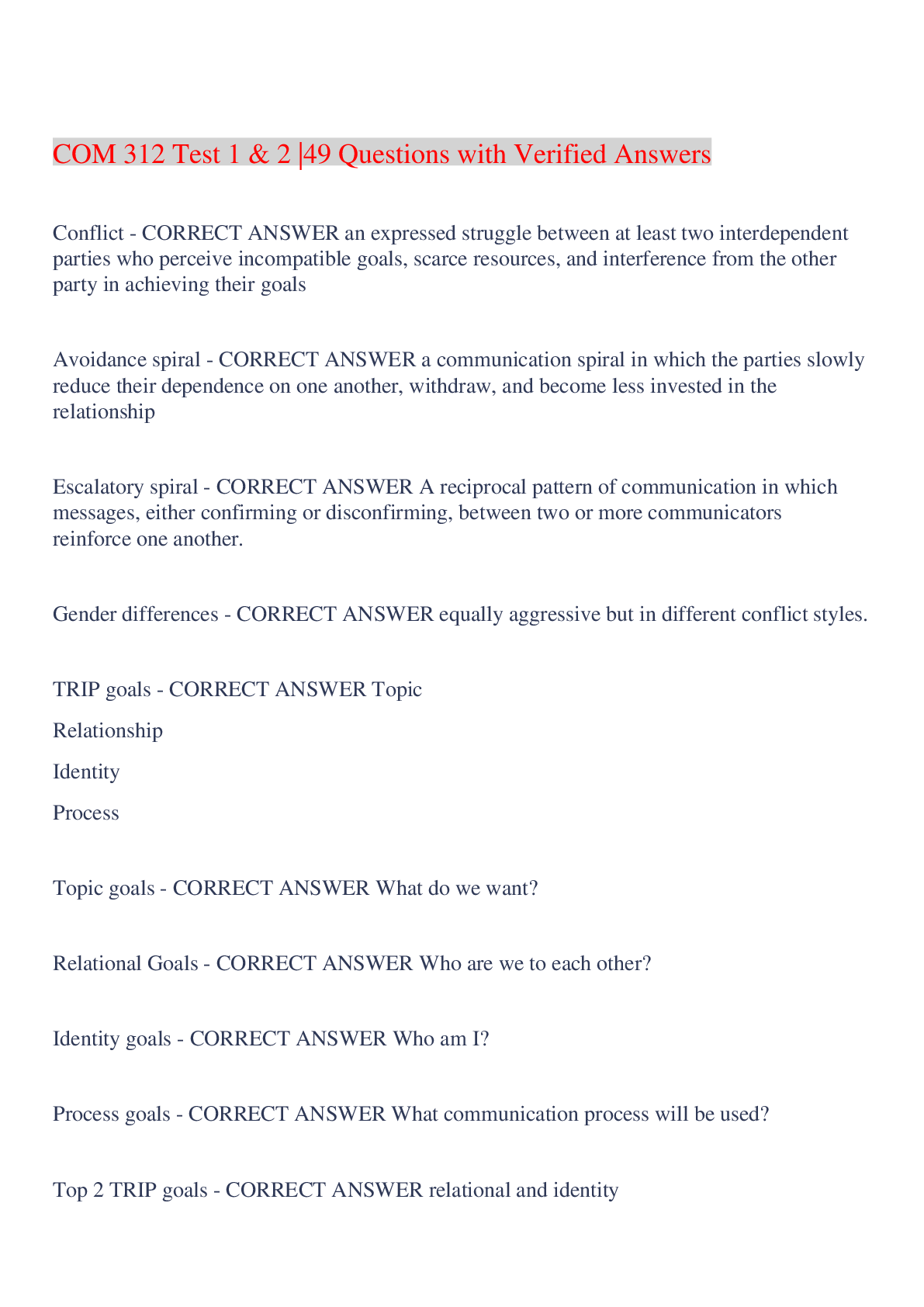
COM 312 Test 1 & 2 |49 Questions with Verified Answers
Conflict - CORRECT ANSWER an expressed struggle between at least two interdependent parties who perceive incompatible goals, scarce resources, and interference from the other party in achieving their goals
Avoidance spiral - CORRECT ANSWER a communication spiral in which the parties slowly reduce their dependence on one another, withdraw, and become less invested in the relationship
Escalatory spiral - CORRECT ANSWER A reciprocal pattern of communication in which messages, either confirming or disconfirming, between two or more communicators reinforce one another.
Gender differences - CORRECT ANSWER equally aggressive but in different conflict styles.
TRIP goals - CORRECT ANSWER Topic
Relationship
Identity
Process
Topic goals - CORRECT ANSWER What do we want?
Relational Goals - CORRECT ANSWER Who are we to each other?
Identity goals - CORRECT ANSWER Who am I?
Process goals - CORRECT ANSWER What communication process will be used?
Top 2 TRIP goals - CORRECT ANSWER relational and identity
Prospective goals - CORRECT ANSWER Intentions people hold before they engage in conflict
Transactive goals - CORRECT ANSWER Goals discovered during conflict itself
Retrospective goals - CORRECT ANSWER goals that emerge after the conflict is over
Solution goals - CORRECT ANSWER clear goals can be shared, discussed, changed, and obtained
RICE power currencies - CORRECT ANSWER Resource control
Interpersonal linkages
Communication skills
Expertise
Resource control - CORRECT ANSWER formal position in an organization or group
Interpersonal linkages - CORRECT ANSWER Power based on who you know
Communication skills - CORRECT ANSWER methods for expressing your thought and listening to what others say
Expertise - CORRECT ANSWER specialized skill or technical knowledge; know-how; expertness
Balancing power - CORRECT ANSWER developing your repertoire (a stock of skills or types of behavior that a person habitually uses)
Low power - CORRECT ANSWER corrupts your view of others & self.
Help: care about their goals/avoid giving up
High power - CORRECT ANSWER ruins relationships.
Helps: exercise restraint
3 elements of a threat - CORRECT ANSWER willing, able, & if they care.
5 Conflict styles - CORRECT ANSWER 1. Avoidance
2. Accommodation
3. Competition
4. Compromise
5. Collaboration
Power - CORRECT ANSWER is a product of the communicative relationship
Patterns of violence - CORRECT ANSWER 1. Physical aggression is almost always preceded by verbal aggression
2. Intimate violence is usually reciprocal—Both participate
3. Women and children suffer many more injuries
4. Victims of abuse are in a no-win situation
5. Perpetrators and victims have discrepant narratives about violence
Systems theory principles - CORRECT ANSWER conflicts occur in chain reactions
each member gets labeled
cooperation is necessary
develop rules and norms
System theory - CORRECT ANSWER Wholeness: entire system
Organization: unit patterns
Patterning: what function do they serve
Microevents - CORRECT ANSWER Repetitive loops of observable interpersonal behaviors with a redundant outcome
Coalitions - CORRECT ANSWER form when some are closer to each other than they are to others.
A private bond emerges.
Chart order for conflict styles - CORRECT ANSWER 1. Dominating
2. Avoiding
3. Compromising
4. Accommodating
5. Integrating
Distributive - CORRECT ANSWER (Win/Lose, Zero-Sum bargaining) competitive negotiation strategy used to decide how to distributive limited resources.
Integrative - CORRECT ANSWER (Win/Win, Non Zero-Sum bargaining) negotiation strategy where parties collaborate to develop a mutual beneficial agreement based on the interests of the other party.
Identify the characteristics of a negotiation situation - CORRECT ANSWER -Two or more parties involved
-Conflict of interests between parties
-Parties negotiating voluntarily
-Parties expect a give & take process (modifying initial stance)
-Search for agreement rather than fight openly
-Involves management of tangibles (price, offer, terms of agreement)
-As well as resolution of tangibles (underlying psychological motivators indirectly or directly influencing
How does interdependence or relationship impact the type of negotiation employed ? - CORRECT ANSWER -Zero sum, or distributive
--- One winner
- Non zero sum or integrative
--- Mutual gains
What is the dual concern model? - CORRECT ANSWER A two dimensional framework assuming that people engaging in conflict have two major underlying concerns: Concern for their own outcomes, Concern for other's outcomes.
How do alternatives work in negotiation? - CORRECT ANSWER - Alternatives give the negotiator power to walk away from the negotiation
- If alternatives are attractive, negotiators can:
-- Set their goals higher
-- Make fewer concessions
-- If there are no attractive alternatives:
-- Negotiators have much less bargaining power
What is a BATNA? - CORRECT ANSWER Best Alternative to a Negotiation Agreement
The dilemmas in mutual adjustment - CORRECT ANSWER Dilemma of honesty
Dilemma of trust
Describe the distributive bargaining/negotiation situation - CORRECT ANSWER Starting points (initial offers)
- initial offer and stance
Target points
- what the party wants to spend/acquire
Resistance points
- the point at which it is more advantageous to walk
Alternative outcomes
- more attractive other options
Value of concessions - CORRECT ANSWER Immediate concessions are perceived as less valuable than gradual, delayed concessions which appear to increase the perceived value of the concession.
Commitments in distributive negotiation - CORRECT ANSWER Public pronouncement
- the more people who hear/see the commitment the harder it is to renegotiate
Linking with an outside base
- develop links to other people/agencies to back up the choice
Increase the prominence of demands
- repetition of value
Reinforce the threat or promise
- remind the other of the threat or promise regularly
Strategies for closing the deal - CORRECT ANSWER -Provide alternatives
-Assume the close
-Split the difference (concession to something the other wanted, meeting in middle)
-Exploding offers
Hardball tactics - CORRECT ANSWER -Good cop/Bad cop= though/lenient
-Low ball/High ball= extreme offers to change neg settlements
-Bogey= pretending
-Nibble= small concession
-Chicken= bluff/threat
-Intimidation= anger, force, fear
-Aggressive Behavior= relentless requests for more concessions/better deals aggressively
-Snow Job= overwhelming the other party with so much information they cannot make sense of it
Key steps in integrative negotiation - CORRECT ANSWER - Identify and define the problem
- Understand the problem fully
---- identify interests and needs on both sides
- Generate alternative solutions
- Evaluate and select among alternatives
What characteristics are necessary for a integrative negotiation? - CORRECT ANSWER -Focus on Commonalities Not Differences
-Address Needs/Interests Not Positions
-Commit to meeting the needs of all involved parties
-Exchange of free flowing info & ideas
-Invent options for mutual gain
-Use objective criteria for standard of performance
What are common goals and what are joint goals - CORRECT ANSWER -- Common goals: all parties share equally, each one ebnifiting in a way that would not be possible if they did not work together.
-- Joint goals: is one that involves individuals with different personal goals agreeing to combine them in a collective effort.
Interests and alternative solutions - CORRECT ANSWER **Interests: the underlying concerns, needs, desires, or fears that motivate a negotiator
-Substantive interests relate to key issues in the negotiation
-Process interests are related to the way the dispute is settled
-Relationship interests indicate that one or both parties value their relationship
-Interests in principle: doing what is fair, right, acceptable, ethical may be shared by the parties
**Alternatives: Invent options by redefining the problem set through:
-Compromise
-Logroll
-Modify the pie
-Expand the pie
-Find a bridge solution
-Cut the costs for compliance
-Non specific compensation
-Subordination
Facilitating successful integrative negotiations - CORRECT ANSWER -Same common objective or goal
-Faith in one's own problem-solving ability
-A belief in the validity of one's own position and the other's perspective
The motivation and commitment to work together
[Show More]