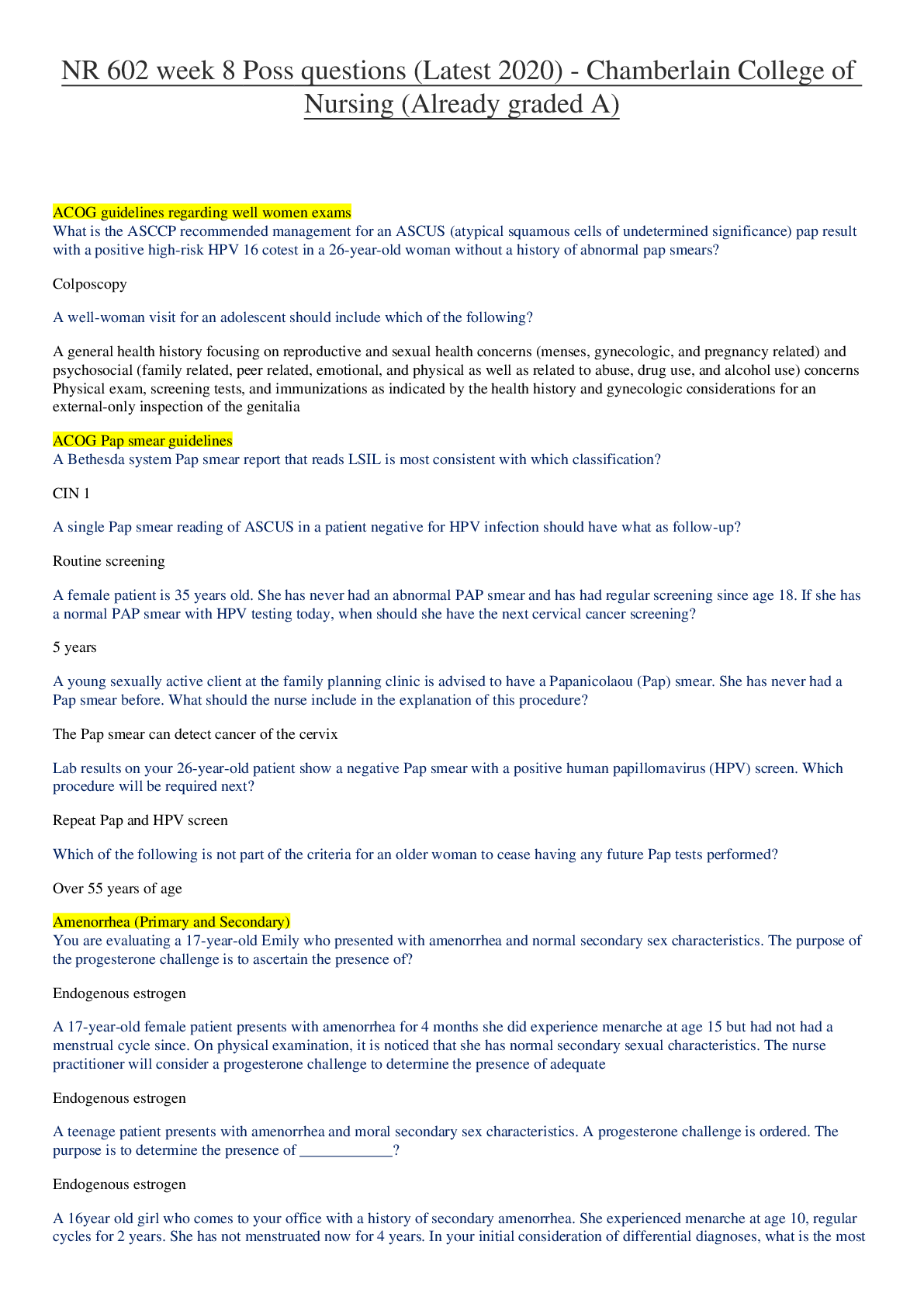
NURS 261 Mid-Term Exam Study Guide
Health Assessment for Nursing Practice
Virginia Commonwealth University
School of Nursing
Study Guide for Midterm
• What are the different types of health assessments, and
...
NURS 261 Mid-Term Exam Study Guide
Health Assessment for Nursing Practice
Virginia Commonwealth University
School of Nursing
Study Guide for Midterm
• What are the different types of health assessments, and when would each be performed? P. 3 Box 1-3
• Comprehensive onset in primary care, admission to hospital, long term care (detailed hx and physical examination)
• Problem-Based/Focus walk-in clinic, ER (assessment limited to a specific problem) e.g. sprained ankle
• Episodic/Follow-up when a pt is following up with a healthcare provider about a previously identified problem or an individual being treated for an ongoing illness (e.g. diabetes; follow up after taking antibiotics)
• Shift changes of each shift for hospitalized patients
• Screening/Examination health care provider office- preventative care or health fair
• What are the purposes of a nursing health assessment? P1
• Systematic model of collecting and analyzing data for the purpose of planning patient centered care. Develop a plan of care that will help maximize patient’s potential.
• Objective and Subjective information
• What the patient feels/communicates (subjective)
• Clinical findings (objective) collected during physical examination
• What are the steps in clinical judgement process? P. 5 (thinking like a nurse)
• What are the factors in symptom analysis? P. 15
• Systematic method of collecting data about the history and status of symptoms
• Onset, location, duration, characteristics, aggravating and alleviating factors, related symptoms, treatment, severity of symptoms
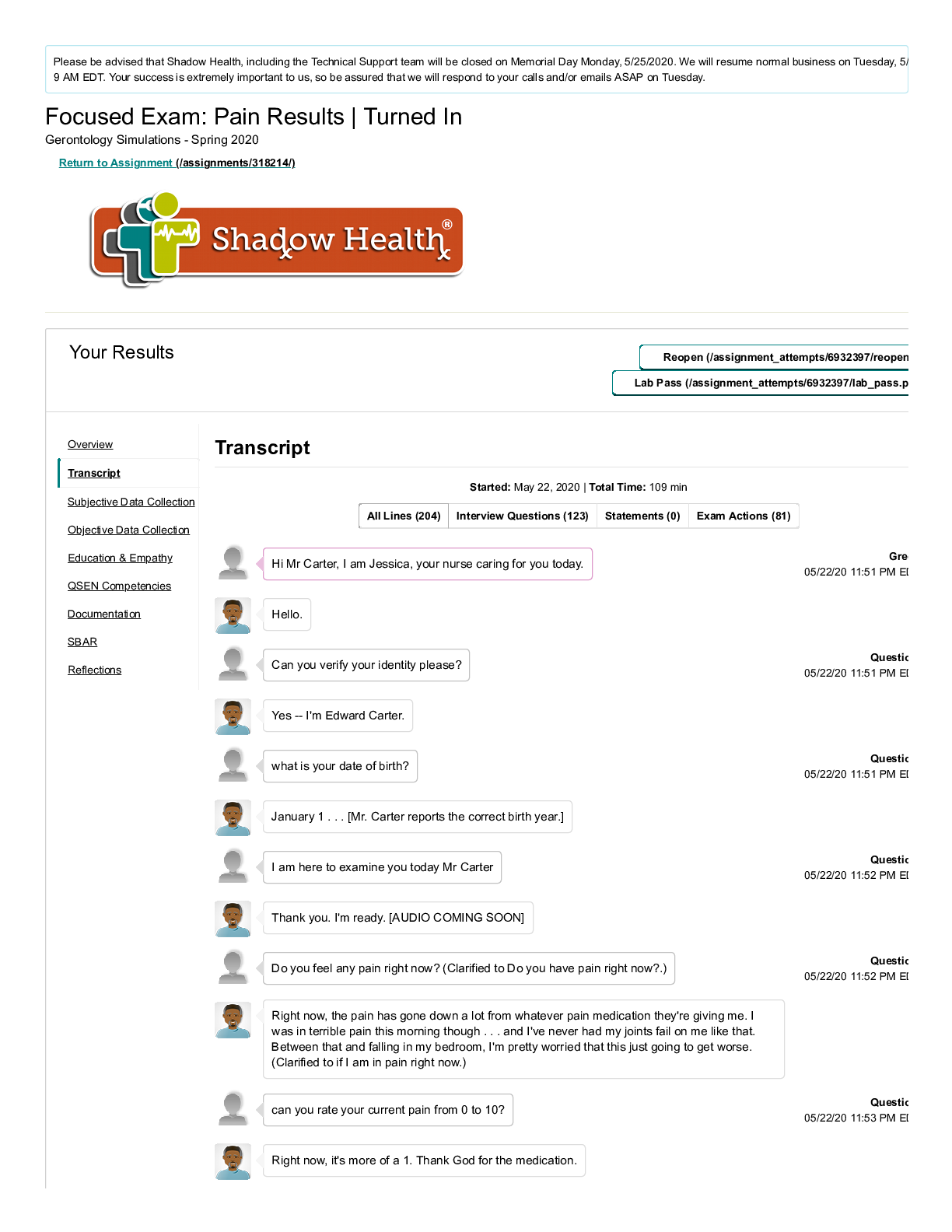
• How does the nurse assess pain?
• Collect subjective data, interviews patients about present health status, how they manage their pain. Use OLD CARTS
• Rely on self-report of patient
• Pain Scales
• Numeric (NRS) 0-10 , 0 no pain 5 moderate 10 worst pain possible
• Wong-Baker FACES, No Hurt-Hurts to Hurts Worst Alternative coding 0-10 (2)
• Compare health promotion and health protection. P. 5 Table 1-1
• Health Promotion- desire to increase well-being (individual)
• Primary- prevent a disease from developing (immunizations)
• Secondary-screening effort (BP screening)
• Tertiary-acute or chronic disease minimize, max health benefits (diabetes mgt)
• Health Protection- desire to actively avoid illness (guidelines prevent spread of communicable diseases)
• Detect illness early
• Maintaining functioning within its constraints
• Describe the differences between a screening assessment and a follow up assessment. P. 3
• Screening assessment- short exam focused on disease detection/prevention
• Blood pressure, glucose, cholesterol, colorectal
• Follow-up assessment- previously identified problem
• Pneumonia after antibiotics
• Diabetes follow ups
• Identify infection control procedures to be used when conducting a health assessment. (i.e. when do you wear gloves, and when don’t you) Box 3-1 P. 22
• Gloves
• To protect from bloodborne pathogens carried by patient
• To protect patient from microorganism on the hands of the nurse
• To reduce the potential of infection transmission from patient to patient via the nurse
• giving an injection
• emptying a urinary catheter drainage bag
• giving a bed bath
• inserting a peripheral IV (an IV in a smaller vein)
• removing a peripheral IV
• removing a urinary catheter
• Mask, Eye/Face shield
• During procedures that may result in splashes or sprays of blood, fluids, secretions
• Not usually done during health assessment.
• Gowns
• To protect arms-exposed skin and prevent contamination of clothing with patients’ blood or fluids
• What are the differences between subjective and objective data? See above
• Symptoms are considered subjective data
• data that is perceived and reported by the patient (e.g. pain, itching, nausea)
• Signs are considered objective data
• data that can observed, felt, heard, or measured (e.g. rash, swelling)
• What assessment techniques are used to evaluate vital signs? P. 23
• BP
• Pulse
• RR
• Pulse O2
• Temperature
• Techniques of Physical Assessment:
• Inspection- Pain, Respiration, Visual exam of body, movement and posture.
• Palpation- HR hands to feel texture, size, shape, consistency, pulsation
• Percussion-evaluate size, boarders, consistency of internal organs (fluid)
• Auscultation- BP listening to sounds heat blood vessels, lungs, intestine.
• Define orthostatic hypotension and describe how to assess for it. P. 42
• Series of BP measurements Lying, sitting and standing position
• It is a 20 to 30 mm drop when patient goes from lying to sitting position to standing
• State the rationale and technique for the two step blood pressure measurement.
• requires that you take the blood pressure by feeling the brachial artery and then using a stethoscope. So, in a sense you will be taking the blood pressure twice using the same arm but with two methods.
• Give an example of how each physical assessment technique is used: inspection, palpation, percussion, and auscultation. See Q19
• Inspection: e.g. using a penlight to inspect jugular vein pulsation
• Palpation: e.g involves hands to feel
• Percussion:
• Auscultation: the use of the stethoscope
• Identify the use of the bell and diaphragm of a stethoscope. 28
• Bell Low(soft) pitch sounds- extra heart sounds, vascular (bruit-whooshing)
• Diaphragm high pitch sounds breath, bowel, normal heart
• What is meant by “general survey”, and what are the elements included? P 483
• Collected during the history, Physical Exam
LOC/
Mental Status Personal Hygiene Skin Color Posture/position Breathing
effort Mobility Ability to hear and speak
Example: Cooperative, oriented, alert women; sitting with erect position; maintains eye contact; appropriately groomed and dressed; Vital signs BP 110/7; P7; R14; T 98: Wt 137; Ht 5’3; BMI 24.3
• What is the usual order of physical assessment techniques?
GENERAL:
• Inspection, Palpation, Percussion, Auscultation
ABDOMEN:
• Inspect, auscultate, percuss, then palpate an abdomen
• What are the four domains of mental status that are assessed by a nurse? P. 69
Mental Status is defined as degree of competency show:
• Intellectual
• Emotional
• Psychological
• Personality
Changes in Mental status when changes to: Orientation, Time, Person, Place and Situation
Four main headings to Mental Status Assessment:
• Appearance
• Behavior
• Cognition
• Thought Process
• What are the components of a health history? Be able to give an example of each element. P 14
• Biographical Data- Name, Gender, DOB
• Reason for seeking care- Chief complaint
• History of present illness- symptom analysis (OLD CARTS)
• Present Health Status- Acute and Chronic conditions, medications, allergies
• Past Health History- Childhood illnesses, Surgeries, Hospitalizations, Accidents,
Immunizations, last exam, Obstetric
• Family-History-Blood relatives identify illnesses of genetic, environmental that may
affect current or future health
• Personal and Psychosocial History - affects it reflects physical or mental health
• How do you feel about yourself?
• Role in family
• Diet-nutrition
• Functional ability self-care ADL
• Mental Health- Stress
• Tobacco, Alcohol, Drug use
• Health promotion activities- specific routines: exercise? Stress mgt? seatbelt use?
• Environment potential hazards w/in home, work?
• Review of Systems - past and present health, symptom analysis if symptom indicated. P. 17
• Integumentary
• Head and Neck
• Breasts
• Respiratory
• Cardiovascular
• GI
• Urinary
• Reproductive
• Musculoskeletal
• Neurological
• What is symptom analysis (OLDCARTS) and how is it performed?
OLD CARTS
Onset- Where did the symptoms begin?
Location- Where are the symptoms?
Duration- How long do the symptoms last?
Characteristics – Describe the characteristics of the symptoms.
Aggravation and alleviating factors- What affects the symptoms
Related symptoms-Are other symptoms present?
Treatment-Describe self-treatment before seeking care.
-
-
-
-
-
-
-
-
Continued
[Show More]





.png)