CHEM120 Week 4 Virtual Lab: Acids and Bases Part I and Part II
Learning Objectives
• Give examples of acids and bases from everyday life
• Define pH and identify acids and bases using the pH scale
• Apply the Bronste
...
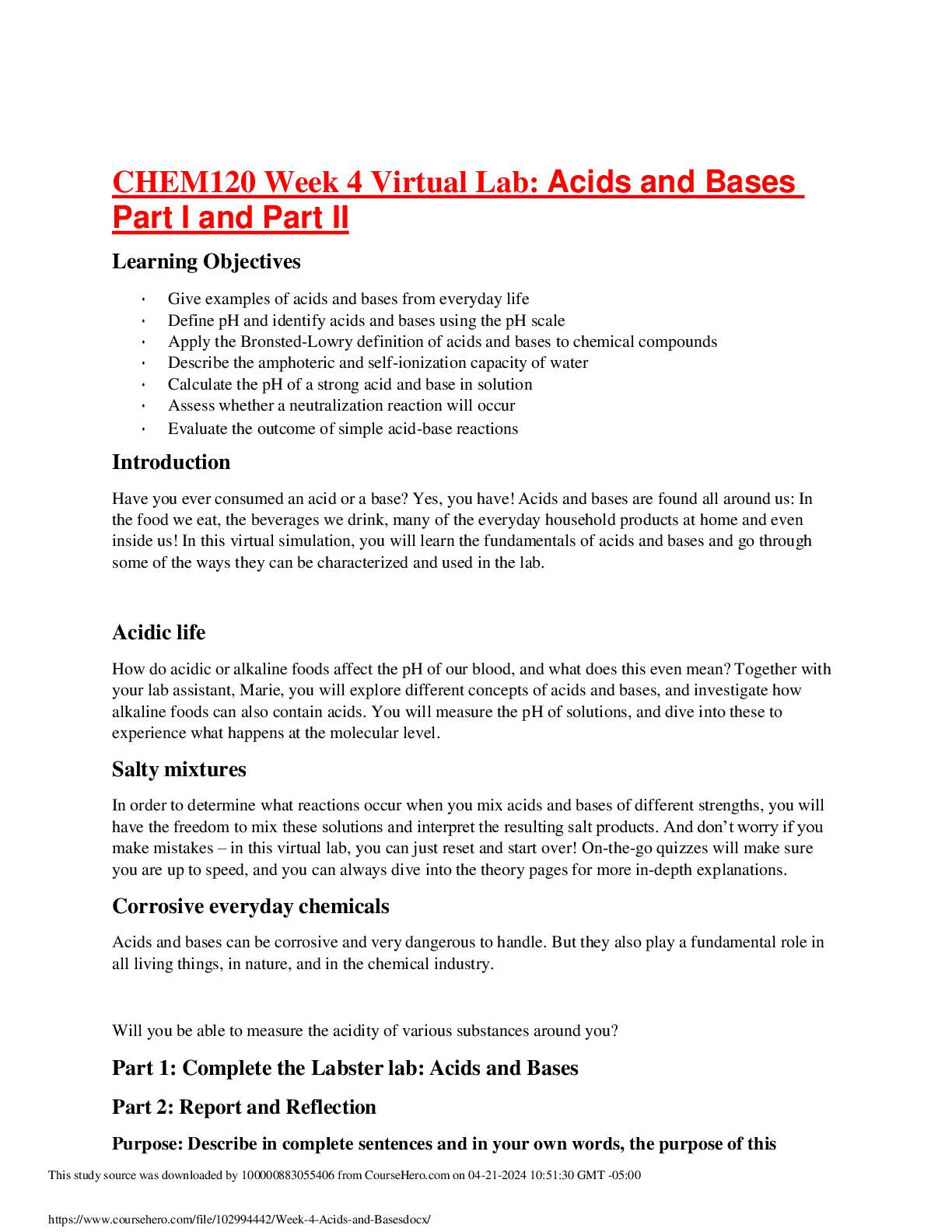
CHEM120 Week 4 Virtual Lab: Acids and Bases Part I and Part II
Learning Objectives
• Give examples of acids and bases from everyday life
• Define pH and identify acids and bases using the pH scale
• Apply the Bronsted-Lowry definition of acids and bases to chemical compounds
• Describe the amphoteric and self-ionization capacity of water
• Calculate the pH of a strong acid and base in solution
• Assess whether a neutralization reaction will occur
• Evaluate the outcome of simple acid-base reactions
Introduction
Have you ever consumed an acid or a base? Yes, you have! Acids and bases are found all around us: In the food we eat, the beverages we drink, many of the everyday household products at home and even inside us! In this virtual simulation, you will learn the fundamentals of acids and bases and go through some of the ways they can be characterized and used in the lab.
Acidic life
How do acidic or alkaline foods affect the pH of our blood, and what does this even mean? Together with your lab assistant, Marie, you will explore different concepts of acids and bases, and investigate how alkaline foods can also contain acids. You will measure the pH of solutions, and dive into these to experience what happens at the molecular level.
Salty mixtures
In order to determine what reactions occur when you mix acids and bases of different strengths, you will have the freedom to mix these solutions and interpret the resulting salt products. And don’t worry if you make mistakes – in this virtual lab, you can just reset and start over! On-the-go quizzes will make sure you are up to speed, and you can always dive into the theory pages for more in-depth explanations.
Corrosive everyday chemicals
Acids and bases can be corrosive and very dangerous to handle. But they also play a fundamental role in all living things, in nature, and in the chemical industry.
Will you be able to measure the acidity of various substances around you?
Part 1: Complete the Labster lab: Acids and Bases
Part 2: Report and Reflection
Purpose: Describe in complete sentences and in your own words, the purpose of this experiment.
The purpose was to explore measuring pH of solutions. The main test was to find out if veggies were more alkaline or acidic.
Observations: Record three observations from the simulation.
1) I used a pH meter to find out the pH of several solutions.
2) Then I put a set of 5 beakers in the correct position based on their pH and concentration of H+
3) I solved a puzzle which I had to put different items in order by their pH.
Answer the questions below
1. In your own words, describe how to determine which substance acts an acid and which substance acts as a base in the forward direction of the following reaction:
H2S + H2O ⇌ H3O+ + HS-
Acid + Base
Acid releases H+ to base The reaction is reversable
2. Predict the two products of the following neutralization reaction and label each product using acid/base terminology:
HCl + RbOH → Rbcl + H2O
3. In your own words, describe the relationship between proton (H+) concentration, and pH. (2 points)
Is a measurement meant to describe the relationship of H+ and pH. The more the H+ the higher the pH and the inverse is also true.
4. Reflection: Consider what you learned from this simulation. Reflect on three to four key concepts that you learned in this lab exercise. How could the lessons have learned in this virtual lab related to a real-world situation in the community/world or your future career? Be specific in your answer (this should require 5-10 sentences).
During the simulation we learned how to the pH meter to find the pH of solution. I also learned that the H+ has direct relationship with pH. Meaning the less the H+ the less the pH and the inverse is true also. I also learned that salad is more alkaline, but tomatoes do have a high acidity. Also, when you eat higher acidic items it doesn’t affect your blood pH.
[Show More]