Mike Kelly Hypertension: UNFOLDING/ RAPID Reasoning Case Study-STUDENT
I. Data Collection
History of Present Problem:
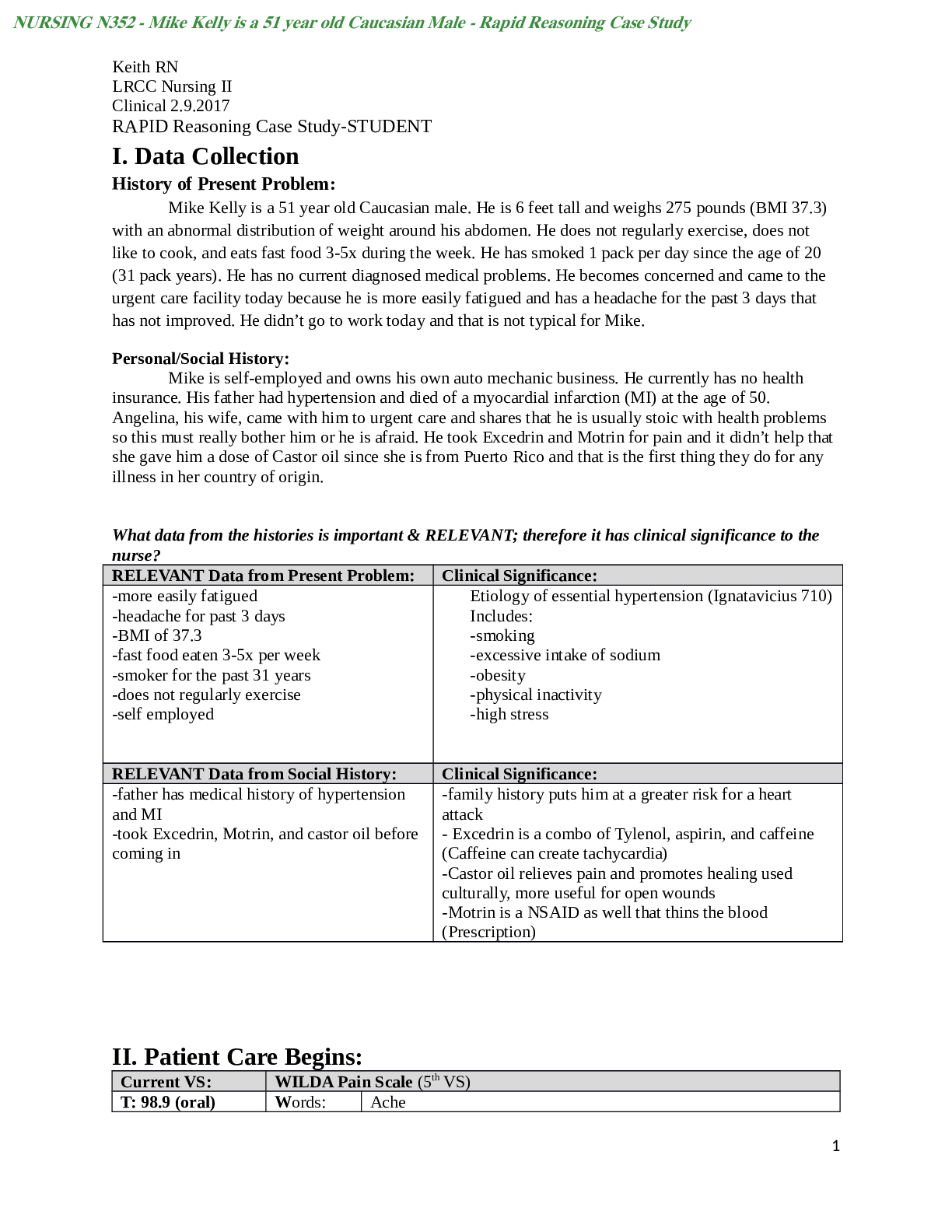
Mike Kelly is a 51 year old Caucasian male. He is 6 feet tall and weighs 275 pounds (BMI 37.3
...
Mike Kelly Hypertension: UNFOLDING/ RAPID Reasoning Case Study-STUDENT
I. Data Collection
History of Present Problem:
Mike Kelly is a 51 year old Caucasian male. He is 6 feet tall and weighs 275 pounds (BMI 37.3) with an abnormal distribution of weight around his abdomen. He does not regularly exercise, does not like to cook, and eats fast food 3-5x during the week. He has smoked 1 pack per day since the age of 20 (31 pack years). He has no current diagnosed medical problems. He becomes concerned and came to the urgent care facility today because he is more easily fatigued and has a headache for the past 3 days that has not improved. He didn’t go to work today and that is not typical for Mike.
Personal/Social History:
Mike is self-employed and owns his own auto mechanic business. He currently has no health insurance. His father had hypertension and died of a myocardial infarction (MI) at the age of 50. Angelina, his wife, came with him to urgent care and shares that he is usually stoic with health problems so this must really bother him or he is afraid. He took Excedrin and Motrin for pain and it didn’t help that she gave him a dose of Castor oil since she is from Puerto Rico and that is the first thing they do for any illness in her country of origin.
What data from the histories is important & RELEVANT; therefore it has clinical significance to the nurse?
RELEVANT Data from Present Problem: Clinical Significance:
-more easily fatigued
-headache for past 3 days
-BMI of 37.3
-fast food eaten 3-5x per week
-smoker for the past 31 years
-does not regularly exercise
-self employed
RELEVANT Data from Social History: Clinical Significance:
-father has medical history of hypertension and MI
-took Excedrin, Motrin, and castor oil before coming in
II. Patient Care Begins:
Current VS: WILDA Pain Scale (5th VS)
T: 98.9 (oral) Words: Ache
P: 88 (regular) Intensity: 8/10
R: 20
BP: 220/118
O2 sat: 95% RA
What VS data is RELEVANT that must be recognized as clinically significant to the nurse?
RELEVANT VS Data: Clinical Significance:
-BP 220/118
Pain: Ache, 8/10
Headache
Continuous
-
Current Assessment:
GENERAL APPEARANCE:
RESP:
CARDIAC:
NEURO:
GI:
GU:
SKIN:
What assessment data is RELEVANT that must be recognized as clinically significant to the nurse?
RELEVANT Assessment Data: Clinical Significance:
III. Clinical Reasoning Begins…
1. What is the primary problem that your patient is most likely presenting with?
2. What is the underlying cause/pathophysiology of this problem?
3. What nursing priority(s) will guide your plan of care?(if more than one-list in order of PRIORITY)
4. What interventions will you initiate based on this priority?
Nursing Interventions: Rationale: Expected Outcome:
1. Start an IV(Ignatavicius 713)
2. ECG
3. Monitor BP
4. Observe for complications
(Ignatavicius 713)
1.
5. What body system(s) will you most thoroughly assess based on the primary/priority concern?
.
6. What is the worst possible/most likely complication to anticipate?
7. What nursing assessments will you need to initiate to identify this complication if it develops?
8. What will be the consequences of uncontrolled hypertension to the rest of Mike’s body if it remains out of control? List body systems and potential permanent injury.
Body System: Potential permanent injury:
Cardiac
Neuro
Urinary
Endocrine
(Ignatavicius 709)
Medical Management: Rationale for Treatment & Expected Outcomes
Care Provider Orders: Rationale: Expected Outcome:
Basic metabolic panel (BMP)
Complete cell count (CBC)
BNP (B-natriuretic Peptide)
Lipid profile
Urine analysis (UA)
12 lead EKG
Chest x-ray
Labetalol (Trandate) 10-20 mg IV push every 15 “. Goal BP: 160/100
12 Lead EKG:
Nursing II: Reading an EKG strip is done by someone who has had advanced cardiac life support (ACLS) training. For the purpose of the scenario the results have been provided for you as being Normal Sinus Rhythm.
Interpretation: Normal Sinus Rhythm
Clinical Significance: He is not in early signs of MI, but he is at high risk
Medication Dosage Calculation:
Medication/Dose:
Mechanism of Action: Volume/time frame to Safely Administer: Nursing Assessment/Considerations:
Labetolol (Trandate) 20 mg IV push
5mg/mL vial
4mL
Normal Range:
(high/low/avg?)
Produces decrease in BP without reflex tachycardia or significant reduction in heart rate. (Skidmore 672)
Loading dose (672)
IV Push:
Volume every 15 seconds?
IV 20mg/2minutes Q 10minutes would be safe
Assess BP, and pulse (Skidmore 674)
Assess for therapeutic response or a radical decrease in blood pressure
Watch for orthostatic hypotension
Radiology Reports:
What diagnostic results are RELEVANT that must be recognized as clinically significant to the nruse?
RELEVANT Results: Clinical Significance:
Chest x-ray:
Complete Blood Count (CBC) Current High/Low/WNL?
WBC (4.5-11.0 mm 3)
Hgb (12-16 g/dL)
Platelets(150-450x 103/µl)
Neutrophil % (42-72)
Band forms (3-5%) 1 LOW
What lab results are RELEVANT that must be recognized as clinically significant to the nurse?
RELEVANT Lab(s): Clinical Significance:
Basic Metabolic Panel (BMP) Current High/Low/WNL?
Sodium (135-145 mEq/L)
Potassium (3.5-5.0 mEq/L)
Chloride (95-105 mEq/L)
CO2 (Bicarb) 21-31 mmol/L)
Anion Gap (AG) (7-16 mEq/l)
Glucose (70-110 mg/dL)
Calcium (8.4-10.2 mg/dL)
BUN (7-25 mg/dl)
Creatinine (0.6-1.2 mg/dL) 1.5 HIGH
What lab results are RELEVANT that must be recognized as clinically significant to the nurse?
RELEVANT Lab(s): Clinical Significance:
Cardiac Labs: Current: High/Low/WNL? Most Recent:
BNP (B-ntriuretic Peptide) (<100 mg/L) 758 High 758
RELEVANT Lab(s): Clinical Significance: TREND: Improve/Worsening/Stable:
BNP
RELEVANT Lab(s): Clinical Significance:
Lab Planning: Creating a Plan of Care with a PRIORITY Lab:
Lab:
Normal Value: <100 Why Relevant? Nursing Assessment/Interventions Required:
BNP
(B-natriuretic Peptide)
Value: 758
MICRO: Current High/Low/WNL?
RBCs (<5) 8 High
WBCs (<5) 6 High
Bacteria (neg) Negative WNL
Epithelial (neg) Negative WNL
IV. Evaluation:
Two hours later:
Current VS: Most Recent: WILDA Pain Scale (5th VS) Most Recent:
T: 98.6 (oral) T: 98.9 (oral) Words: Ache Ache
P: 82 (regular) P: 88 (regular)
R: 16 R: 20
BP: 176/104 BP: 220/118
O2 sat: 96% RA O2 sat: 95% RA
Current Assessment:
GENERAL APPEARANCE:
RESP:
CARDIAC:
NEURO:
GI:
GU:
SKIN:
1. What clinical data is RELEVANT that must be recognized as clinically significant?
RELEVANT VS Data: Clinical Significance:
BP 176/104
RELEVANT Assessment Data: Clinical Significance:
2. Has the status improved or not as expected to this point?
It has improved, but has not met the goal yet.
3. Does your nursing priority or plan of care need to be modified in any way after this evaluation assessment?
4. Based on your current evaluation, what are your nursing priorities and plan of care?
You communicate the following SBAR verbally to the ED primary care provider based on your evaluation:
Situation:
Background:
Assessment:
Recommendation:
The ED primary care provider decides to admit Jim to the hospital. The admitting physician writes the following orders:
Care Provider Orders: Rationale: Expected Outcome:
Heart echocardiogram in the morning
Hemoglobin A1c
Hydrocodone 5 mg/acetaminophen 325 mg (Norco) 1-2 tabs every 4 hours prn-HA
Hydrochlorothiazide (HCTZ) 25 mg po daily
Lisinopril (Zestril) 10 mg po daily
Simvastatin (Zocor) 20 mg po daily
Aspirin 81 mg po daily
Cardiac diet
Situation:
Background:
Assessment:
Recommendation:
V. Education Priorities/Discharge Planning:
1. What will be the most important discharge/education priorities you will reinforce with their medical condition to prevent future readmission with the same problem?
2. What are some practical ways you as the nurse can assess the effectiveness of your teaching with this patient?
VI. Caring and the “Art” of Nursing:
1. What is the patient likely experiencing/feeling right now in this situation?
2. What can you do to engage yourself with this patient’s experience, and show that he/she matters to you as a person?
References
Ignatavicius, D. D., & Workman, M. L. (2013). Medical-surgical nursing: Patient-centered collaborative care. St. Louis: Elsevier Saunders.
Lab Values: Cheat sheet. (n.d.). Allen's College. Retrieved February 9, 2017, from https://www.allencollege.edu/filesimages/Current%20Students/Academic%20Resources/lab%20values%20cheat%20sheet.pdf
Prescription Drug Information, Interactions & Side Effects. (n.d.). Retrieved from https://www.drugs.com/
Skidmore-Roth, L. (2017). Mosby's 2017 nursing drug reference. St. Louis, MO: Elsevier.
Swearingen, P. L. (2016). All-in-one nursing care planning resource: Medical-surgical, pediatric, maternity, and psychiatric-mental health. St. Louis, MO: Elsevier.
[Show More]