QUESTION 1
Which of the following statements is most accurate with regard to Piaget’s theory?
Piaget firmly believed that children who were at a particular stage of cognitive development
had the same level of understa
...
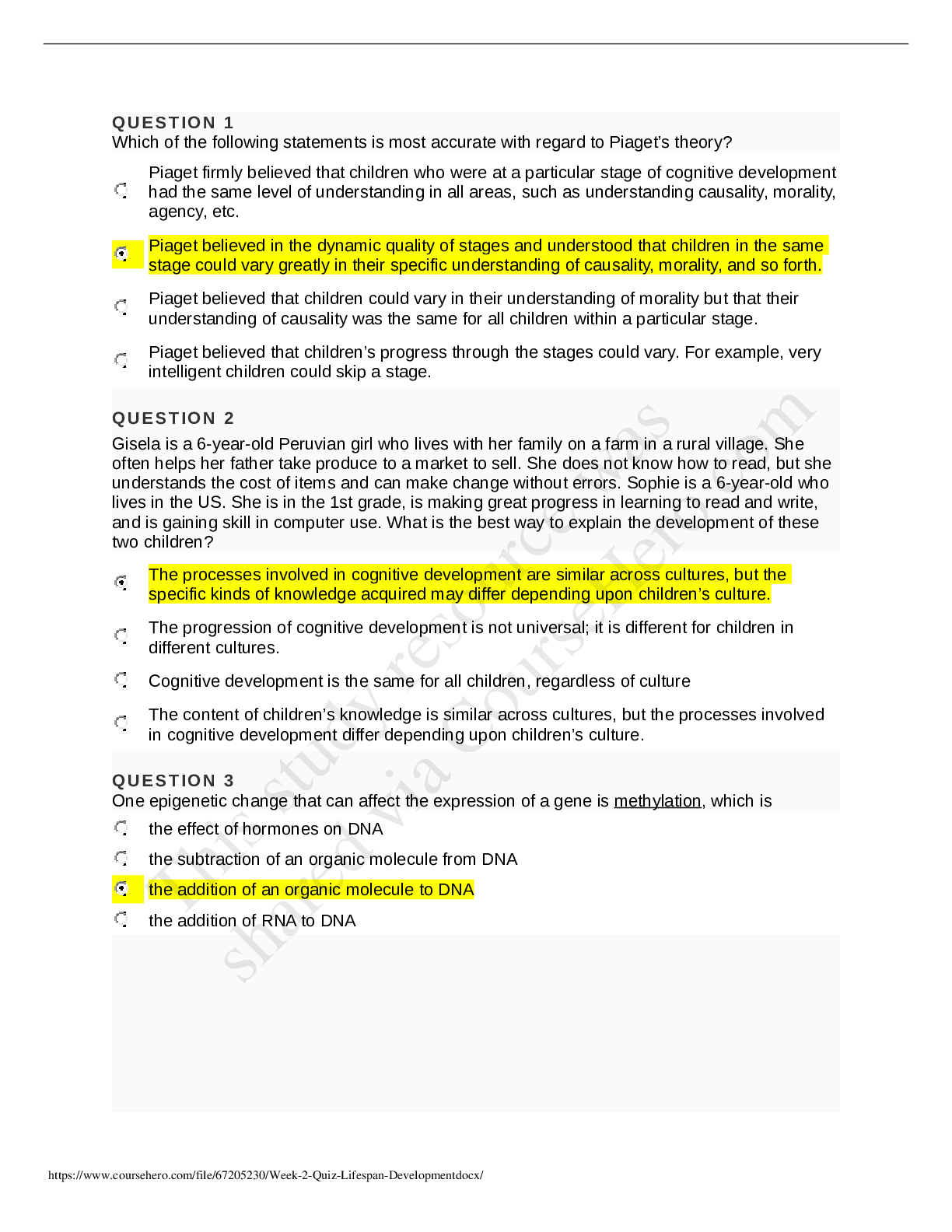
QUESTION 1
Which of the following statements is most accurate with regard to Piaget’s theory?
Piaget firmly believed that children who were at a particular stage of cognitive development
had the same level of understanding in all areas, such as understanding causality, morality,
agency, etc.
Piaget believed in the dynamic quality of stages and understood that children in the same
stage could vary greatly in their specific understanding of causality, morality, and so forth.
Piaget believed that children could vary in their understanding of morality but that their
understanding of causality was the same for all children within a particular stage.
Piaget believed that children’s progress through the stages could vary. For example, very
intelligent children could skip a stage.
QUESTION 2
Gisela is a 6-year-old Peruvian girl who lives with her family on a farm in a rural village. She
often helps her father take produce to a market to sell. She does not know how to read, but she
understands the cost of items and can make change without errors. Sophie is a 6-year-old who
lives in the US. She is in the 1st grade, is making great progress in learning to read and write,
and is gaining skill in computer use. What is the best way to explain the development of these
two children?
The processes involved in cognitive development are similar across cultures, but the
specific kinds of knowledge acquired may differ depending upon children’s culture.
The progression of cognitive development is not universal; it is different for children in
different cultures.
Cognitive development is the same for all children, regardless of culture
The content of children’s knowledge is similar across cultures, but the processes involved
in cognitive development differ depending upon children’s culture.
QUESTION 3
One epigenetic change that can affect the expression of a gene is methylation, which is
the effect of hormones on DNA
the subtraction of an organic molecule from DNA
the addition of an organic molecule to DNA
the addition of RNA to DNA
https://www.coursehero.com/file/67205230/Week-2-Quiz-Lifespan-Developmentdocx/
This study resource was
shared via CourseHero.com
QUESTION 4
Mrs. Washington is conducting her weekly group counseling session for single young adults.
Karen, a lonely young professional woman, talks about feeling abandoned by her boyfriend. The
other group members listen patiently and respond empathically. Mrs. Washington reflects
Karen’s feeling with concern and sensitivity. What would operant learning theory predict about
Karen’s behavior in the next group session?
Karen will not self-disclose because she fears the group will lose patience.
Karen will be embarrassed about her past self-disclosures and feel anxious about
speaking up.
Karen will not self-disclose because her problems have been resolved.
Karen will speak openly because she has previously received attention and support.
QUESTION 5
Bea is the mother of 4-month-old Alex. She has been depressed since Alex’s birth and is
frequently withdrawn. Brain research indicates that, in comparison to other infants his age, Alex
will have
more rapid brain development.
brain activation patterns indicating overall reduced activity.
brain activation patterns resembling those of fearful and inhibited children.
nothing unusual about his brain activation patterns.
QUESTION 6
Which of the following statements is true about the effects of teratogens on the developing
fetus?
Ancient Greeks believed in teratogens, but modern science has been unable to identify
any.
The kind of damage done depends on the stage of development during exposure.
A teratogen will usually have the same effect regardless of how much exposure the fetus
has to that teratogen.
Any given teratogen usually has the same effect regardless of when in prenatal
development exposure occurs.
QUESTION 7
Infants form multiple attachments, to both mother and father and perhaps to a sibling,
grandparent, and so on. Which of the following statements is most consistent with available data
on the impact of these attachments?
The primary attachment (usually with the mother) is the only one that is predictive of later
development.
No data are available.
The good effects of a secure attachment with one parent are canceled by the bad effects
of an insecure attachment with the other parent.
More than one secure attachment adds value, serving as a further protective factor.
https://www.coursehero.com/file/67205230/Week-2-Quiz-Lifespan-Developmentdocx/
This study resource was
shared via CourseHero.com
QUESTION 8
Which cognitive achievement underlies a baby’s ability to form an attachment to a specific adult,
like a parent or other caregiver?
Code switching.
Agency.
Object permanence.
Conservation.
QUESTION 9
The quality of a children’s attachments has been found to affect
whether children achieve major motor milestones.
children’s social anxiety, but not their response to stress.
how children respond to new social situations.
children’s temperamental responses.
QUESTION 10
Complete the following analogy: geneotype is to phenotype as
gene is to chromosome
code is to expression
DNA is to RNA
night is to day
QUESTION 11
The belief that individuals create their own knowledge by interpreting new experience in the light
of past experience is a fundamental proposition of
behaviorism.
constructivism.
transactionalism.
rationalism.
https://www.coursehero.com/file/67205230/Week-2-Quiz-Lifespan-Developmentdocx/
This study resource was
shared via CourseHero.com
QUESTION 12
A kitten whose eyes are covered during the first months of its life loses the ability to see clearly
in ways that would have been possible without the loss of early visual stimulation. This effect
remains despite later attempts to remediate the loss. This is an example of which of the
following?
Critical period.
Behavior genetics.
Plasticity.
Visual demand.
QUESTION 13
A counselor works with Mrs. Jacobs, who has a 1-month-old daughter. Mrs. Jacobs finds her
daughter intense, demanding and hard to soothe. Most likely, this is because
her baby has a significant medical problem
her baby has been spoiled by too much attention.
her baby has formed an insecure attachment with her mother.
her baby has a more difficult temperament.
QUESTION 14
Contemporary developmentalists focus on which question concerning nature and nurture?
Is nurture the most important determinant of developmental change?
How do we explain the mechanisms by which nature and nurture interact to affect
development?
Is nature the most important determinant of developmental change?
Why is nurture most influential at certain developmental periods?
QUESTION 15
Counselors who work with young children to enhance their mental health should take an active
role in
becoming an attachment figure for the young child.
creating therapeutic experiences for the child that teach self-monitoring.
providing the child with group exposure to other children of the same age.
providing support and information for parents.
https://www.coursehero.com/file/67205230/Week-2-Quiz-Lifespan-Developmentdocx/
This study resource was
shared via CourseHero.com
QUESTION 16
When clinicians assess a client’s presenting problem(s) in order to plan for treatment, which of
the following approaches to diagnosis reflects a developmental viewpoint?
Count the number of symptoms currently manifested in order to reach a specific diagnosis.
Consider those issues in a client’s life which result from multifinality.
Assess the nature of the problem by considering the person’s unique history, interpersonal
context, and challenges in the extrapersonal environment.
Assess the person’s level of symptomology on a checklist and assign a diagnosis only
when a certain percentile has been reached.
QUESTION 17
The available data indicate that chronic maternal stress during pregnancy has which of the
following effects on the fetus?
Causes long term psychopathology
No effects
Is related to newborn hyperactivity and irritability
Arouses the fetus’s own stress response temporarily, but has no lasting effects
QUESTION 18
When Tamara responds to the crying of her 4-month-old baby, Jessie, she tries to figure out
what has caused the baby’s distress (hunger, wet diaper, etc.) while making soothing sounds
and holding the baby. Tamara’s actions are ____________ Jessie’s developing emotion
regulation abilities.
irrelevant to
blocking
disorganizing
scaffolding
QUESTION 19
Which of the following is the best example of neuroplasticity?
Fetal brains grow quickly, increasing in weight over the course of pregnancy.
The 3-year-old’s brain is approximately three-fourths of its adult size.
Cells from the hippocampus are instrumental in encoding memories.
Neurons that are transplanted from the auditory cortex to the visual cortex begin to
perceive light.
https://www.coursehero.com/file/67205230/Week-2-Quiz-Lifespan-Developmentdocx/
This study resource was
shared via CourseHero.com
QUESTION 20
Models of development which hold that change typically occurs in shifts between periods of
relative stability and periods of disequilibrium are called
incremental models.
information-processing models.
stage models.
multidimensional model.
QUESTION 21
Sam is at home with his two children, 3-year-old Daria and 6-week-old Keith. Sam is reading a
story to Daria when baby Keith wakes up and screams for his bottle. Daria gets very upset when
Sam leaves her to tend to the baby. Sam tries to explain to his daughter that her baby brother
can’t wait, but Daria continues to insist. Sam is concerned that Daria is not accepting her new
baby brother. Based on your understanding of preschoolers cognitive development, what would
you tell Sam?
Daria is probably exhibiting separation distress which is normal for children her age.
Daria is probably exhibiting normal cognitive egocentrism because she cannot fully
understand the needs of another person yet.
Daria is probably exhibiting a failure to show empathy and needs more training in this area.
Daria is probably exhibiting a stress response that suggests the family may need some
counseling.
QUESTION 22
The idea that children’s development is affected by biological factors, and that biological factors
are also affected by the environment and experience, is part of
social learning theories
multidimensional systems theories
developmental stage theories
incremental developmental theories
https://www.coursehero.com/file/67205230/Week-2-Quiz-Lifespan-Developmentdocx/
This study resource was
shared via CourseHero.com
QUESTION 23
Mrs. Harmon, the mother of 18-month-old Bryce, is concerned that Bryce has not learned to
speak very well. He has a limited vocabulary and seems content to point to the things he wants.
Mrs. Harmon has read several child development books which indicate that Bryce should be in
the stage of language learning. Mrs. Harmon fears that Bryce is not keeping up
developmentally. Based on your understanding of the timing of developmental stages, what
would be your best advice?
Since Bryce appears developmentally delayed, he should be referred immediately for a
speech and language evaluation.
Developmental stages can be useful guidelines, but there is a range of normal
development within stages.
Don’t pay attention to developmental milestones and treat each child as an individual.
Mrs. Harmon should use exercises such as flashcards with Bryce to increase his
knowledge of vocabulary.
QUESTION 24
In Bowlby’s attachment theory, which of the following represents a primary outcome of the
formation of attachments in infancy?
A sense of the power structure of a family.
A belief in God.
Basic trust in others, but not a sense of self or of relationships.
A working model of self, of others, and of relationships.
QUESTION 25
The epigenome is the full set of factors, from the cell to the outside world that controls the
expression of
recessive genes.
the zygote.
histones.
hereditary
material.
https://www.coursehero.com/file/67205230/Week-2-Quiz-Lifespan-Developmentdocx/
This study resource was
shared via CourseHero.com Powered by TCPDF (www.tcpdf.org)
[Show More]