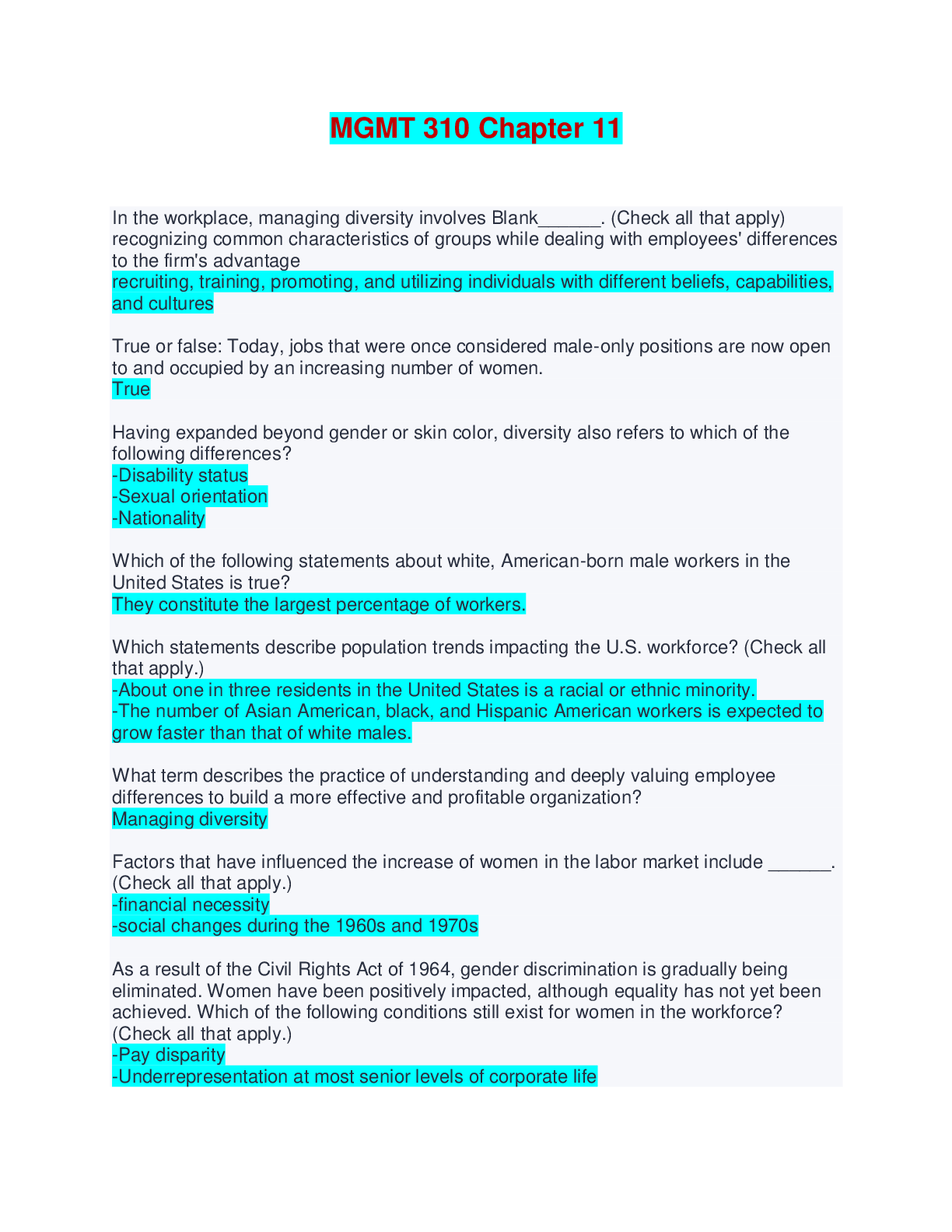
MGMT 310 TEST 3 STUDY GUIDE (CH 9-12)
MGMT 310 Test 3 Study Guide (Ch. 9-12)
CHAPTER 9
• Authority- RIGHT to influence others
• Power- ABILITY to influence others
o Influence- power put into action
o Control- exert
...
MGMT 310 TEST 3 STUDY GUIDE (CH 9-12)
MGMT 310 Test 3 Study Guide (Ch. 9-12)
CHAPTER 9
• Authority- RIGHT to influence others
• Power- ABILITY to influence others
o Influence- power put into action
o Control- exertion of enough influence to change others’ behavior
• Dependency- B’s relation to A when A possesses something B requires
• Nature of Power:
o Latent: just b/c you have it does not mean you use it; having it could make use unnecessary
o Relative: one person’s power over another depends on things like expertise and hierarchal level
o Perceived: based on one’s beliefs that another has certain characteristics
o Dynamic: power relationships evolve over time; indiv’s gain/lose power over others
• Uses of Power:
o Power Over: “dominance”; used to make another act a certain way
o Power To: “empowerment”; gives others the means to act more freely themselves
o Power From: “resistance”; protects us from power of others
• Compliance to Power:
o Coercive power- forcing someone to comply w/ wishes
o Utilitarian power- desire for rewards compliance
o Normative power- employees’ belief that org. should govern behavior
• Formal Power is established by an individual’s position in an org.
Conveys ability to coerce/reward
Bases of Power
o Coercive power- a power base dependent on fear
o Reward Power- compliance achieved based on ability to distribute rewards seen as valuable
o Legitimate Power- power received as result of formal position in org.
Can be culturally specific; ex: age in some cultures
Can come from acceptance of social structure
Designated by legitimizing agent; ex: CEO’s assistant
o Expert Power- influence based on special skills/knowledge
o Referent Power- based on indiv’s possession of desirable resources/traits
Social Influence- use of power in interpersonal relationships
Rational persuasion, Liking and Ingratiation, and emotional appeals
• Social Influence Tactics/Approaches:
o Consultation- seeking participation in marking/planning implementation of idea
o Rational persuasion- using logical arguments/facts to persuade
o Inspirational appeals- making an emotional request/proposal that appeals to values or increases confidence
o Ingratiating tactics- seeking to get someone in good mood/to like you before request
o Coalition tactics- seeking aid of others to persuade someone
o Pressure tactics-¬ demands/threats/intimidation
o Upward appeals-¬ persuade that request is approved at higher levels
o Exchange tactics- promising rewards in exchange
• Social Proof- convincing someone that others are taking the same actions
o Bartenders adding a few dollar bills to tip jar
o Bernie Madoff Ponzi scheme
• Reactions to Influence:
o Compliance: people do something b/c they don’t want costs of not doing it
o Identification: influence flows from person’s charisma/favorable position
o Internalization: do something b/c “it’s the right thing to do”
Empowering Others:
• Powerlessness: created by..
o Learned helplessness- condition resulting from belief that one’s behaviors don’t make a difference
o Org. Factors:
Org. values, ambiguity, counternorms, competition, level in org.
• Pfeffer’s Political Strategies:
o Make power unobtrusive: power is most effective when it is subtle
o Build legitimacy: power most effective when power and decision process appear legit
o Build support base: obtain power for the actor or goodwill from other powerful actors
CHAPTER 10
Conflict Premises
• Conflict and disagreement are normal in human relationships
• Conflict maybe be good:
o Diagnose sources of problems
o motivate search for new approaches
o opportunity to realize value of opinion
o both parties get to learn and improve
• avoiding it can be costly
• Mismanagement can have long-term consequences
• Conflict altered based on framing
o Relationship/task- do conflicting parties focus on conflict or task at hand?
o Emotional/intellectual- do parties pay attention to emotions in dispute (anger/jealousy) or actions that occur apart from those emotions?
o Cooperate/win- do parties focus on maximizing joint outcomes or maximizing own gain?
• A mutually acceptable solution can often be found
• Any of the parties in conflict can contribute to its resolution by taking personal responsibility and initiating communications
o When you change relationships change
o Waiting for change = no change
o Others treat you the way you “trained” them
o Risk-taking is part of conflict mgmt.
• You can gain trust by giving trust
• Consensus and Synergy are only likely when people cooperate in win-win relationships rather than competing
• Emotional impairments (fear, rigidity, paranoia, etc.) keep some conflicts from ever being solved
Views of Conflict: Good or Bad?
• Traditional Views:
o Cause negative emotions
o Disrupts relationships
o Distracts from work
• Human relations View
o Lessens social tensions
o Ends groupthink
o better allocation of resources
• Managed-conflict View- can do all of the above
Causes of Conflict
1. Competition over scarce resources
2. Ambiguity over Responsibility/Jurisdiction
3. Task Interdependence
a. Pooled task interdependence- members work independently w/o interaction
i. X + Y + Z
b. Sequential task interdependence
i. X Y Z
c. Reciprocal task interdependence- units provide input to one another
i. X / Y / Z
4. Goal Incompatibility
5. Competitive Reward Systems
6. Differentiation
a. Each department copes w/ its environment’s specific demands diff. values/risk preferences/etc.
7. Personality Factors
a. Abrasive personality characteristics: perfectionist, analytical, independent
?? Conflict stimulation techniques: improve communication, bringing in outsiders, devil’s advocate, restructuring the org.
• Felt conflict- experienced as discomfort and tension
o Motivates person to reduce these feelings
o Can be from in or outside org. (home life)
• Perceived conflict- awareness off being in conflict situation
o Learn of budget cuts realization of scare resource
o Know boss is watching better performance
Conflict and Unit Performance (+ graph)
• Functional Conflict: improves/supports group’s goals HIGH performance
o optimal self-critical, innovative
• Dysfunctional conflict: LOW performance
o Low/none stagnant, resistant to change, no new ideas
Conflict styles differ on emphasis of assertiveness and cooperativeness
o Avoiding- NOT assertive or cooperative; sidestep the conflict
o win/lose
o Competing- very assertive, NOT cooperative; tries to satisfy own needs @ other’s expense
o lose/lose
o Compromising- moderately assertive + co-op; no side 100% satisfied but pain is shared
o No need to negotiate; parties differ too much
o Accommodating- NOT assertive + co-op; satisfy others’ needs but not own
o win/lose
o Collaborating- assert + co-op; focused on satisfying needs of both parties
o Potential for win/win
o Tries to resolve issue
Contingency Factors for Handling Conflict
• Competing usually resentment
o May be necessary when time is of the essence/ 100% sure you’re correct
• Avoiding generally unproductive
o Appropriate temporarily or if conflict is trivial
• Accommodating can lead to greater demands/show weakness
o Use if other party has great power or issue is unimportant to us
• Compromising looks for satisfactory middle ground, equally unsatisfying outcome
o Necessary if little chance of agreement, parties have = power, time constraints
• Collaborating looks for win/win situation to fully satisfy both parties
o Requires trust, creativity, sharing of info
Negotiating – process where 2 or more parties decide how to allocate scarce resources
• Distributive bargaining (“zero-sum”)- gain for one is at expense of another
- Get as much of pie as possible
- Low info sharing
- Short relationships
• Integrative bargaining (“non-0 sum”)- joint-decisions decide amts.; looks for win/win
- Expand the pie
- High info sharing
- Long relationships
• Fisher and Ury’s “On Getting to Yes” Negotiation Model:
1. Separate people from the problem; objective mindset
2. Focus on interests not positions; look @ problem from their POV
3. Invent options for mutual gain; collaborative win-win mentality
4. Agree on objective criteria and insist on using it
• BATNA: “Best Alternative to a Negotiated Agreement”; best you can do if other party refuses to negotiate/best without them
CHAPTER 11 Managing Teams
Groups vs. Teams
• Groups:
o Goal: share info
o Synergy: neutral/ neg.
o Accountability: individual
o Skills: random and varied
• Teams:
o Goal: collective performance
o Synergy: positive
o Accountability: individual and mutual
o Skills: complementary
Different Types of Teams:
• Functional team: a supervisor + subordinates in chain of command
o “command team/vertical team”
• Cross-functional team: members from diff. departments in an org.
o Members of invoicing, inventories, and shipping creating cross-fn. Team
• Self-Managing team: able to make key decisions on how work is done
o Take over managerial duties
o Quick Response time closeness to customer
o Value autonomy and opp’s to participate
o Intrinsic Motivation
o Take ownership of decisions
• Virtual team: members are geographically distributed and work electronically
o Studies show benefits outweigh costs
Potential Advantages vs. Disadvantages of teams
• Advantages:
o Provide many perspectives, skills and resources
o Participation increases acceptance and understanding of team’s outcomes
o Participation is empowering
o Working in teams is stimulating
Social presence effects- adrenaline ^ in presence of others leading to better performance
Team decisions usually more reliable than indiv’s
Participation is a developmental experience (backup QB gets exp.)
• Disadvantages: “process losses” b/c they make it difficult to achieve process gains
o Can be controlled by dominant/controlling members
o Some members are reluctant to participate
o Some may focus on personal goals
o Time and resources taken from other activities
o Social loafing/free riding- relying on others to carry the load
o Some afraid to “rock the coat” groupthink
• Polarization- tendency of groups to make initial tendencies more polar
o Risky shift phenomenon: groups usually make riskier financial decisions than individuals
Stages of group development (forming, storming, norming, performing, adjourning)
• Forming: team members getting acquainted and oriented to the task
• Storming: members become more assertive in roles, personalities clearer
o Conflict is likely
• Norming: conflicts largely resolved, team becoming more cohesive
• Performing stage: mature and performing @ high level
o Learned norms, settled in roles, settle disagreements
• Adjourning: team dissolves after achieving purpose or internal/external forces
Punctuated equilibrium: Transition @ halfway point
Roles (task-oriented, relations-oriented, self-oriented)
• Task-oriented roles: members who initiate tasks, gather info, motivate others to perform
o Necessary to complete job
• Relations-oriented roles: resolve disputes, encourage members as they face barriers
o Needed to keep team healthy and members satisfied
• Self-oriented roles: focus on personal gain; recognition seekers, avoiders
o Hamper team performance
• Things that cause Role Stress
o Role ambiguity is caused by unclear expectations
Conflicting expectations role conflict
o Role overload- expected to do too many things
Cohesiveness- high levels of team spirit
o Members usually communicate better and are more satisfied, less tense
• Guidelines to build Cohesion:
o Make membership to team attractive
o Praise and publicize team accomplishments
o Keep the team small
o Identify and communicate outside threats/pressures
Team size: choose 5 or 7 person team unless compelled to do otherwise
• Dyad- two members
o Anxious, uncomfortable
o Unable to effectively solve stalemates
• Triads- 3 people
o 2 vs. 1 split makes one person feel isolated
• 4 and 6 person teams can lead to stalemates
CHAPTER 12 Organizational Culture- pattern of shared assumptions, values, and beliefs that are taught to new members as the correct way to perceive think and react
• Elements of org. culture (from book, not PPT or study guide)
o Values- deep-seated, personal standards that influence judgments, reactions, and commitment
o Symbols- things that stand for/suggest something else
Dress codes suggest levels of formality; “Lambeau Leap”
o Narratives- written/spoken accounts used by members of the organization to make sense experiences and express feelings/beliefs
Stories- dramatize ordinary events in org.’s to convey cultural meanings
Legends- more uplifting and events defy explanation
o Heroes- company role models; they highlight values the co. reinforces
o Rites- combine cultural forms into public performance
o Rituals- simple combos of repetitive behaviors that are brief and unconscious
Forces That Shape Organizational culture: *People, Rewards and Recognition + last 2
• Selection: define elements of the new culture
• Orientation: communicate new culture and realign org. policies/practice
• Socialization: new culture is accepted by employees and becomes norm
o Best practices for Socialization:
Involvement of top mgmt.
Clear objectives measures and outcomes
Continually reinforce messages
Develop cohort identity
Socialization as ongoing process
• Top Management: Leaders are signal generators, sending conscious and unconscious messages w/ actions and words
• “Culture is an iceberg” easier to change artifacts/policies than values slow change
The Cultural Iceberg (Slideshow):
• Cultural Artifacts: “Above the Surface”; symbols
o Behavioral Symbols
Rituals/ceremonies
o Physical Symbols
Value statement posters
o Verbal Symbols:
Stories/myths, slogans/jargon
• Formal Policies and Informal Norms: “Water level/surface” *know the 4*
Policy manuals, org. structure, HR practices, perks/benefits, dress norms, etc.
o Hiring Policies: Customers involved in Southwest’s interviews
o Orientation Program: Haworth includes families @ orientation
o Benefits Package: encourage long hours vs. balanced life
o Recognition
• Core Values: “Just below the surface”
o Values being used (not ones written on poster)
o Priorities/goals
o Beliefs of what should/shouldn’t be done
• Assumptions: “Very Bottom”
o Social principles that guide perceptions
o Deeply held beliefs
o Often unconscious
Why Does Culture matter?
Culture shapes attitudes and behavior in org.’s and affects important outcomes
Function of Culture
• What Culture Does:
o Improved Cooperation
o Improved decision-making
o Enhanced control: 3 control mechanisms in Org’s
Market control- results
[Show More]
Last updated: 3 years ago
Preview 1 out of 10 pages
.png)






.png)

![Preview of NR667 Complete Question Bank with Correct Answers: Final Exam Study Guide [2026 Updated]](https://browseimages.nyc3.digitaloceanspaces.com/paper-images/2026/02/25/AULA53fD2026-02-25-02-58699ee3d811bc7.png)