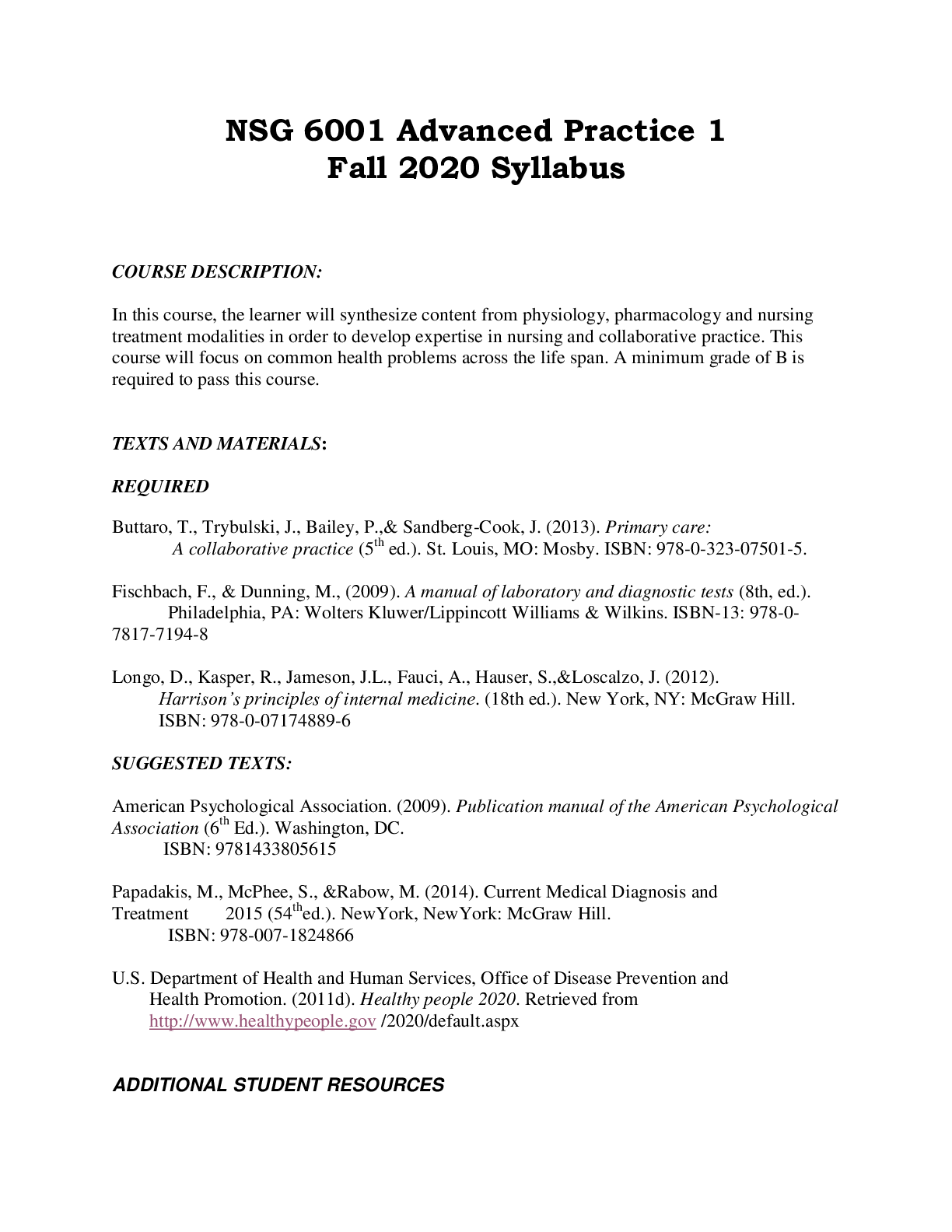
NSG 6001 Advanced Practice 1
Fall 2020 SyllabusNSG 6001 Advanced Practice 1
Fall 2020 Syllabus
COURSE DESCRIPTION:
In this course, the learner will synthesize content from physiology, pharmacology and nursing
treatm
...
NSG 6001 Advanced Practice 1
Fall 2020 SyllabusNSG 6001 Advanced Practice 1
Fall 2020 Syllabus
COURSE DESCRIPTION:
In this course, the learner will synthesize content from physiology, pharmacology and nursing
treatment modalities in order to develop expertise in nursing and collaborative practice. This
course will focus on common health problems across the life span. A minimum grade of B is
required to pass this course.
TEXTS AND MATERIALS:
REQUIRED
Buttaro, T., Trybulski, J., Bailey, P.,& Sandberg-Cook, J. (2013). Primary care:
A collaborative practice (5th ed.). St. Louis, MO: Mosby. ISBN: 978-0-323-07501-5.
Fischbach, F., & Dunning, M., (2009). A manual of laboratory and diagnostic tests (8th, ed.).
Philadelphia, PA: Wolters Kluwer/Lippincott Williams & Wilkins. ISBN-13: 978-0-
7817-7194-8
Longo, D., Kasper, R., Jameson, J.L., Fauci, A., Hauser, S.,&Loscalzo, J. (2012).
Harrison’s principles of internal medicine. (18th ed.). New York, NY: McGraw Hill.
ISBN: 978-0-07174889-6
SUGGESTED TEXTS:
American Psychological Association. (2009). Publication manual of the American Psychological
Association (6th Ed.). Washington, DC.
ISBN: 9781433805615
Papadakis, M., McPhee, S., &Rabow, M. (2014). Current Medical Diagnosis and
Treatment 2015 (54thed.). NewYork, NewYork: McGraw Hill.
ISBN: 978-007-1824866
U.S. Department of Health and Human Services, Office of Disease Prevention and
Health Promotion. (2011d). Healthy people 2020. Retrieved from
http://www.healthypeople.gov /2020/default.aspx
ADDITIONAL STUDENT RESOURCESAdditional texts and readings as evidence based practice, clinical issues and situations arise.
Students are required to own or have access to a PDA or smart phone with medical reference
Two programs that may be particularly useful are Epocrates DX/RX for PDA
(http://www2.epocrates.com) and Merck Medicus for PDA
(http://www.merckmedicus.com).
RECOMMENDED WEBSITES:
Geriatrics at your fingertips: http://www.geriatricsatyourfingertips.org/.
Unbound Medicine Central: http://www.unboundmedicine.com/products/medicine_central
APA: http://owl.english.purdue.edu/owl/resource/560/01/
COURSE OBJECTIVES/EDUCATIONAL OUTCOMES:
Upon completion of the NSG 6001-Advanced Nursing Practice I, the student will be able to
achieve the following course objectives/education outcomes as mapped to the program.
1. Apply critical thinking skills and techniques to actively seek evidence-based knowledge
from health, psychological, and social sciences to care of patients across the life span
and from diverse backgrounds with selected common health problems.
2. Develop holistic plans of care for prevention, health promotion, and acute care of
common health problems of patients using evidence-based practice and standards of
care.
3. Participate in collaborative practice among health team members to maximize quality
measures of patient health outcomes.
4. Integrate evidence-based research into advanced practice in decisions to improve
patient outcomes.
5. Analyze current patient-care technologies for effectiveness to optimize patient outcomes
in various physiological systems.
6. Evaluate interaction between regulatory and quality controls in obtaining holistic plans of
nursing care consistent with Healthy People national guidelines.
7. Employ leadership skills among health team members to maximize patient advocacy
and patient health outcomes.
8. Formulate client-centered and culturally appropriate strategies in nursing standards of
care for optimal health outcomes.
9. Apply multidisciplinary knowledge from psychological, physiological, health and social
sciences across the life span from selected health problems.
IDEA COURSE OBJECTIVES:In the IDEA end-of-course student survey, one objective must
be designated as ESSENTIAL and two objectives designated as IMPORTANT in the table
below.IDEA Objective
Essential or
Important
Objective 1: Gaining factual knowledge (terminology, classifications,
methods, trends)
Objective 2: Learning fundamental principles, generalizations, or theories Essential
Objective 3: Learning to apply course material (to improve thinking,
problem solving, and decisions)
Important
Objective 4: Developing specific skills, competencies, and points of view
needed by professionals in the field most closely related to this course
Important
Objective 5: Acquiring skills in working with others as a member of a team
Objective 6: Developing creative capacities (writing, inventing, designing,
performing in art, music, drama, etc.)
Objective 7: Gaining a broader understanding and appreciation of
intellectual/cultural activity (music, science, literature, etc.)
Objective 8: Developing skill in expressing myself orally or in writing
Objective 9: Learning how to find and use resources for answering questions
or solving problems
Objective 10: Developing a clearer understanding of, and commitment to,
personal values
Objective 11: Learning to analyze and critically evaluate ideas, arguments,
and points of view
Objective 12: Acquiring an interest in learning more by asking my own
questions and seeking answers
EVALUATION REQUIREMENTS:
Quizzes 20%
Midterm 20%
Learning Outcomes Management paper (LOM) 20%
Submission of 5 SOAP notes 20%
Final Exam 20%
Total 100%
ASSIGNMENTS:
Weekly lecture and quizzes:
At the beginning of class on weeks 2,3,4,6, 7,8,9.we will have a short quiz on the material that
was presented the weeks prior. The exams will be geared toward preparing you for your national
boards and will be based upon a synthesis and application of the materials presented. Each quiz
will consist of 10-15 multiple choice questions. Quiz questions will be in “board style” format
and will directly reflect readings, lecture and content presented the previous week. Only for
extreme extenuating circumstances are make-up quizzes given. The date and time of a make-up
quiz will be determined by the faculty and the quiz may include short answer, multiple choice
and essay questions. Students +are expected to participate in a weekly lecture. It is important to
attend lecture and participate with the instructor and colleagues in order to maximize informationthe class has to offer. Lecture, interactive discussion, case studies and group work will help us to
progress toward course objectives, share interesting cases or problems encountered, or new
techniques, trends, research or other areas of interest.
Learning Outcomes Management Paper (LOM) :
Throughout this course, you will be provided case studies that focus on cardiovascular,
pulmonary, gastrointestinal, and musculoskeletal disorders. You will pick one of the provided
case studies to analyze and create a comprehensive care plan for acute/chronic care, disease
prevention and health promotion for that patient and disorder. There will be a list of LOM case
studies in Ecompanion, use one of those or speak with me to discuss a different disease process.
Your care plan should be based on current best practices and supported with citations from
current literature, such as systematic reviews, published practice guidelines, standards of care
from specialty organizations and other research based resources. In addition, you will provide a
detailed scientific rationale that justifies the inclusion of this evidence in your plan. Your paper
should adhere to APA format for title page, headings, citations, and references. The paper should
be no more than 15 pages typed excluding title page and references. The reference list should
have at least 2 current articles, the APA book and all other sources listed that are cited within the
paper. If you need help with APA the student resource center is available all week until 8pm and
Saturday morning. Points will be deducted for incorrect APA format. You may attach the case
study that is used as an addendum after your reference page. 5 points will be deducted for each
day your paper is late, a score of zero will be submitted for any paper greater than 5 days late.
Criteria:
Case Study Evaluation
o Analyze the disorder addressing the following elements: pathophysiology,
signs/symptoms, progression trajectory, diagnostic testing, and treatment options.
o Differentiate the disorder from normal development.
o Discuss the physical and psychological demands the disorder places on the patient
and family.
o Explain the key concepts that must be shared with the patient and family to
achieve optimal disorder management and outcomes.
o Identify key interdisciplinary team personnel needed and how this team will
provide care to achieve optimal disorder management and outcomes.
o Interpret facilitators and barriers to optimal disorder management and outcomes.
o Describe strategies to overcome the identified barriers.
Care Plan Synthesis
o Design a comprehensive and holistic recognition and plan for the disorder.
o Addresses how the patient‟s socio-cultural background can potentially impact
optimal management and outcomes.
o Demonstrate an evidence-based approach to address key issues identified in the
case study.
o Formulates a comprehensive but tailored approach to disorder management.
SOAP Notes (completed in class on even weeks)Students will submit 5 SOAP notes for evaluation by faculty. SOAP notes must be in „chart
acceptable‟ manner with no patient identifiers listed. SOAP notes will be based on the case study
that is presented in class biweekly. The case study will be presented and students will be given
30 minutes to complete a thorough SOAP note for that case. The reflection can include important
patient education highlights, or suggestions of how the student may have treated the patient
differently. APA citations MUST be used for diagnostic and treatment references.
GRADING SCALE
100 – 90 A
80 – 89 B
70 – 79 C
60 – 69 D
59 or below F
PRESENTATION TECHNIQUES OR TEACHING STRATEGIES:
It is my philosophy to promote a positive, yet challenging learning environment for my
students. In my teaching environment I promote, both student, and teacher accountability,
enthusiasm for life- long learning, positivity and encouragement. I strive to be perceived as an
approachable educator that helps to facilitate optimal educational experiences. I have a passion
for the nursing profession and intend to convey that through my interaction with students,
colleagues and patients. Through collaboration with colleagues, students and administration I
will strive to provide an exceptional educational experience. Information will be presented in a
face-to-face format with continuous interaction and reinforcement. Please note that this syllabus
is tentative and subject to change.
Weekly Content Focus:
The schedule listed below will be the order in which content will be reviewed as it pertains to
clinical practice. Quiz questions will be taken from the reading material and information
presented in lecture. The quiz questions will be presented in a “board style” format.
WEEK TOPIC Texts, Chapters and Readings
1
10/2
Intro & Primary Care
Healthy People 2010/2020
Pediatric primary care overview:
immunizations and developmental stages
Evaluation and Management of
Dermatologic disorders
B: ch: 1-7, 17-19
F: Pgs1-53
H: pgs: 1-55
B: CH: 39, 40-43, 45-50, 52-55, 58, 59, 62, 65, 68
H: CH: 51-53
2 Quiz10/9 Evaluation and management of eye, ear, nose
and oropharynx disorders
In class SOAP note
B: Parts 6-9
H: Chapter 28, 30-32
3
10/16
Quiz
Evaluation and Management of Pulmonary
disorders
B: ch: 14, 102-111
H: Chapters 251-254, 257, 260, 262, 265
4
10/23
Quiz
Evaluation and management of
Cardiovascular Disorders
In class SOAP note
B: Part 11, Chapter 209
H: Ch: 224-227, 229, 234, 237, 241, 243, 244, 247,
249
F: pages: 387-390, 448-462
5
10/30
Midterm
Evaluation and management of
Gastrointestinal Disorders
B: Part 12, ch: 9, 12, 21, 24
H: Chapters 91. 290-297, 300, 302, 30
F: pgs 286-297, 339-342, 412-417, 429-432, 435-436,
580-592
6
11/6
Quiz
Evaluation and management of
Genitourinary Disorders/ Gynecologic
Disorders
Obstetrics and pregnancy
In class SOAP note
B: ch: 145-148, 150-151, 153
H ch: 287-288, 346-348
F: pg 185-284, 369-372, 375-377, 399-412
7
11/13
Quiz
Evaluation and Management of Endocrine
and Metabolic disorders
B: CH: 205, 210, 212
H: CH 338, 341, 344
F: pgd 342-358, 464-481
8
11/20
Quiz
Evaluation and Management of Hematologic
and Oncologic disorders
In class SOAP note
B: ch: 213-217
H: Ch. 103
F: pages 67-84, 91-111, 121-124
9
11/27
Quiz
Evaluation and management of
Musculoskeletal, arthritic and rheumatic
disorders
B: ch 170, 172, 173-183, 185-186, 218-219, 221-222
H: Ch 15, 321, 331-337
F:pgs110-111, 621-626
10
12/4
Learning outcomes management paper
(LOM) submitted online. Due 12/7 2359 via
dropbox.
B: Ch: 187, 189-193, 195, 197-199, 201
H: ch: 14, 366-368, 371-376, 390-391Evaluation and Management of Neurologic
psychosocial and Mental Health disorders
In class SOAP note
11
12/11
Final Exam
NOTE: No draft submissions of any assignments will be accepted or reviewed. Each
assignment must be unique and original, (i.e Re-worked or modified assignments will not
be accepted. Submissions of previously submitted assignments may result in course
failure).
Due dates are established for reasons of equity. It is not fair to peers who complete
assignments on time if other classmates have extra time to work on their assignments. It is also
not fair to the professor who must grade assignments in a timely fashion. All students are
required to complete readings and submit written assignments by the dates specified in the
course schedule and topical outline.
For late submissions, 10% of the total number of points for the assignment per day
will be deducted (late submissions will not be accepted after five days and the grade will be
recorded as zero). All submitted assignments will receive a grade. No draft or assignment
will be accepted for “review and comments” for later submission. There will be No Make
up exams or quizzes. Quizzes and Exams will be given immediately at the beginning of class
as scheduled in the syllabus.
Labeling of all electronically submitted assignments:
All assignments must be named according to this method: Assignments not labeled correctly
will receive 10% deduction.
Do not include any other information in this naming of the document.
Note:
1) Any assignment submitted without this nomenclature will not be accepted.
2) All assignments are submitted to the eCompanion Dropbox only.
Tutoring
There are tutoring resources available in the library and Academic Service Center. Request a
form from the librarian and fill out appropriately with your contact information. I am here to be
completely transparent with you and expect you to communicate with the professor if you are in
need of additional assistance.
PLAGIARISM:
“Plagiarism is the dishonest act of presenting the words or thoughts of another writer as if
they were your own. You commit plagiarism whenever you use a source in any way
without indicating that you have used it. If you quote anything at all, even a phrase, you
must put quotation marks around it or set it off from your text; if you summarize or paraphrase
an author‟s words, you must clearly indicate where the summary or paraphrase begins and ends;if you use an author‟s idea, you must say that you are doing so. In every instance, you must also
formally acknowledge the written source from which you took the material.”
“You may use a source without formal acknowledgement only when you refer to a specific
phrase, statement, or passage that you have used and acknowledged earlier in the same paper.
But when you use new material from a source already cited, you must make a new
acknowledgement…”
(From Writing: A College Handbook, by James A. W. Heffernan and John E. Lincoln (Norton,
1982) 522-23.)
ACADEMIC INTEGRITY:
South University students are expected to adhere to the principles of academic integrity in all
situations and activities related to classroom performance. In so doing, students
commit themselves to receiving credit for the effort and end product that is solely their own.
Students violate the academic integrity policy when they engage in any of the following
activities:
1. Plagiarism, copyright infringement, or the submission of someone else‟s work as their
own.
2. Unauthorized communication (e.g. talking, eye contact, gesturing) with another student
or looking at cell phones during an examination or quiz.
3. Unauthorized use of notes or other material during an examination or quiz.
4. Theft or unauthorized possession of examinations.
5. Unauthorized exit from and re-entry into an examination room (bathroom visits must be
accomplished before the exam or quiz).
Breaches in academic integrity will result in penalties.
UNIVERSITY POLICIES:
University Attendance Policy
South University maintains an institutional attendance policy to support the academic
achievement of its students. Students are expected to attend all scheduled class, laboratory, and
examination periods each week. Students, whether present or absent from class, are responsible
for knowing all that is announced, discussed, and/or lectured upon in class or laboratory, as well
as for mastering all assigned reading. In addition, students are responsible for submitting on time
all assignments and examinations as required in the class.
Students are expected to attend all scheduled activities that are part of the class, including those
activities scheduled during class time and those scheduled outside of class time. An individual
on-campus or online program may have specific policies (which in some cases may be more
stringent than the general attendance requirements) as to the effect of attendance on classmeetings, course assignments, off-campus activities, internships/externships, clinical and
practicum activities, and other program requirements.
Attendance Requirements
Students who fail to attend an on-campus class session will be given an absence for that session.
Following the drop/add period, students taking on-campus classes must not miss 14 consecutive
calendar days of the scheduled class time of the on-campus class (including on-campus classes
that contain an online component). If a student misses 14 consecutive calendar days the student
will be administratively withdrawn from the course. Following the drop/add period, if a student
misses 21 consecutive calendar days in an 11-week on-campus course that meets once per week
the student will be administratively withdrawn from the course. The last date of attendance will
be the last day where the student met the attendance requirements.
If a student is administratively withdrawn due to attendance with a passing grade before the
58th calendar day of an 11 week class, the student will receive a WP grade for the course. If a
student is administratively withdrawn due to attendance with a failing grade before the
58th calendar day of an 11 week class, the student will receive a WF grade for the course. If a
student is administratively withdrawn due to attendance after the 58th calendar day of an 11 week
class, the student will receive a WF grade for the course.
Class meetings will not count as a student absence if they fall on a recognized South University
holiday or on a date the campus is closed due to inclement weather. New online students who do
not meet the attendance requirements for the first week of the course will be unregistered from
the course and have their enrollment cancelled. Reentry online students who do not meet the
attendance requirements for the first week of the course will be unregistered from the course and
have their school status moved back to withdrawn.
Definition of a Credit Hour
South University operates on a quarter system with each quarter having approximately 10 to 12
weeks. Students can expect ten (10) hours of instructional engagement for every one (1) quarter
credit hour of a course. Instructional engagement activities include lectures, presentations,
discussions, group-work, and other activities that would normally occur during class time.
Instructional engagement activities may occur in a face-to-face meeting or in the e-classroom.
In addition to instructional engagement, students can expect to complete at least twenty (20)
hours of outside work for every one (1) quarter credit hour of a course. Outside work includes
preparing for and completing readings and assignments. Such outside work also includes, but is
not limited to, all research associated with completing assignments, work with others to complete
a group project, participation in tutorials, labs, simulations, and other electronic activities that are
not a part of the instructional engagement, as well as any activities related to preparation for
instructional engagement.
Other academic work leading to the awarding of credit hours requires at least an equivalent
amount of work as listed in the paragraph above and shall be applied to other academic activities
as established by the institution, including laboratory work, internships, practica, and studio
work. For example, one quarter credit hour is also equivalent to at least 20 hours of lab work, 30
hours of externship or clinical practicum, or a combination of the equivalencies.CLASSROOM POLICIES AND CONDUCT:
1. Students are held accountable for the knowledge of and adherence to policies addressed in the
South University Student Handbook (http://docs.southuniversity.edu/Student/wpb/) and the
South University Nursing Student Handbook.
2. Utilize the South University home page for e-Companion to assess course materials. All
course content directions and communications take place through e-Companion and the South
University email system.
3. Students are responsible for turning in all written material on the due date. Failure to turn in a
required assignment on time will result in a zero.
4. Students are responsible for all material presented in class and all required assigned readings
from texts. Examination questions will be drawn from the readings, power points, discussions
and/or presentations that take place during class.
5. Students are required to notify the professor if they are absent for any exam.
6. Class attendance is required. Students are expected to be on time and prepared at the
beginning of each class and upon return to class after breaks. Please have all materials (power
points, papers and writing supplies ready before class begins).
7. Students are permitted to use their lap tops or other digital devices (such as iPads or tablets)
during class for note-taking and other class-related work only. Those using computers during
class for work not related to that class must leave the classroom for the remainder of the class
period.
8. Cell phones must be turned off or turned to vibrate. If you must take a call during class time,
please leave the room.
9. Please refrain from private conversations during class.
10. Students may contact the professor for individual appointments as needed. Please make all
appointments via email
[email protected]
11. Students must follow the Nursing Program dress code of business casual. No revealing attire
is permitted.
12. The professor reserves the right to make changes, additions or deletions to this syllabus with
notice to the student.
13. The final exam is mandatory & must be taken on the scheduled date & time.
14. The nursing program follows the South University policy regarding attendance. Repeated
absenteeism will result in course withdrawal. Students who are absent will be responsible for
material that may be missed. Information regarding class lecture, handouts and homework
assignments may be obtained from another student.
15. Please deactivate your cell phones to vibrate/silent mode while in the classroom.
16. Students may have only bottled water in the classroom. Drinks of any other kind are not
allowed in the classroom. Chewing gum or eating food of any kind is also prohibited
17. The instructor reserves the right to make any changes in the syllabus as needed with
notification of the student.
DISABILITY SERVICES
South University provides accommodations to qualified students with disabilities. The Disability
Services office assists qualified students with disabilities in acquiring reasonable and appropriate
accommodations and in supporting equal access to services, programs and activities at South
University. Students who seek reasonable accommodations should notify the DisabilitiesServices Coordinator at 248-675-0247 or
[email protected] of their specific
limitations and, if known, their specific requested accommodations. Students will be asked to
supply medical documentation of the need for accommodation. Classroom accommodations are
not retroactive, but are effective only upon the student sharing approved accommodations with
the instructor. Therefore, students are encouraged to request accommodations as early as feasible
with the Disability Services Coordinator to allow for time to gather necessary documentation. If
you have a concern or complaint in this regard, please contact the Dean of Student Affairs in
Room 220, telephone number 248-675-0247. Complaints will be handled in accordance with
South University‟s Internal Grievance Procedure for Complaints of Discrimination and
Harassment.








![Preview of NR667 Complete Question Bank with Correct Answers: Final Exam Study Guide [2026 Updated]](https://browseimages.nyc3.digitaloceanspaces.com/paper-images/2026/02/25/AULA53fD2026-02-25-02-58699ee3d811bc7.png)