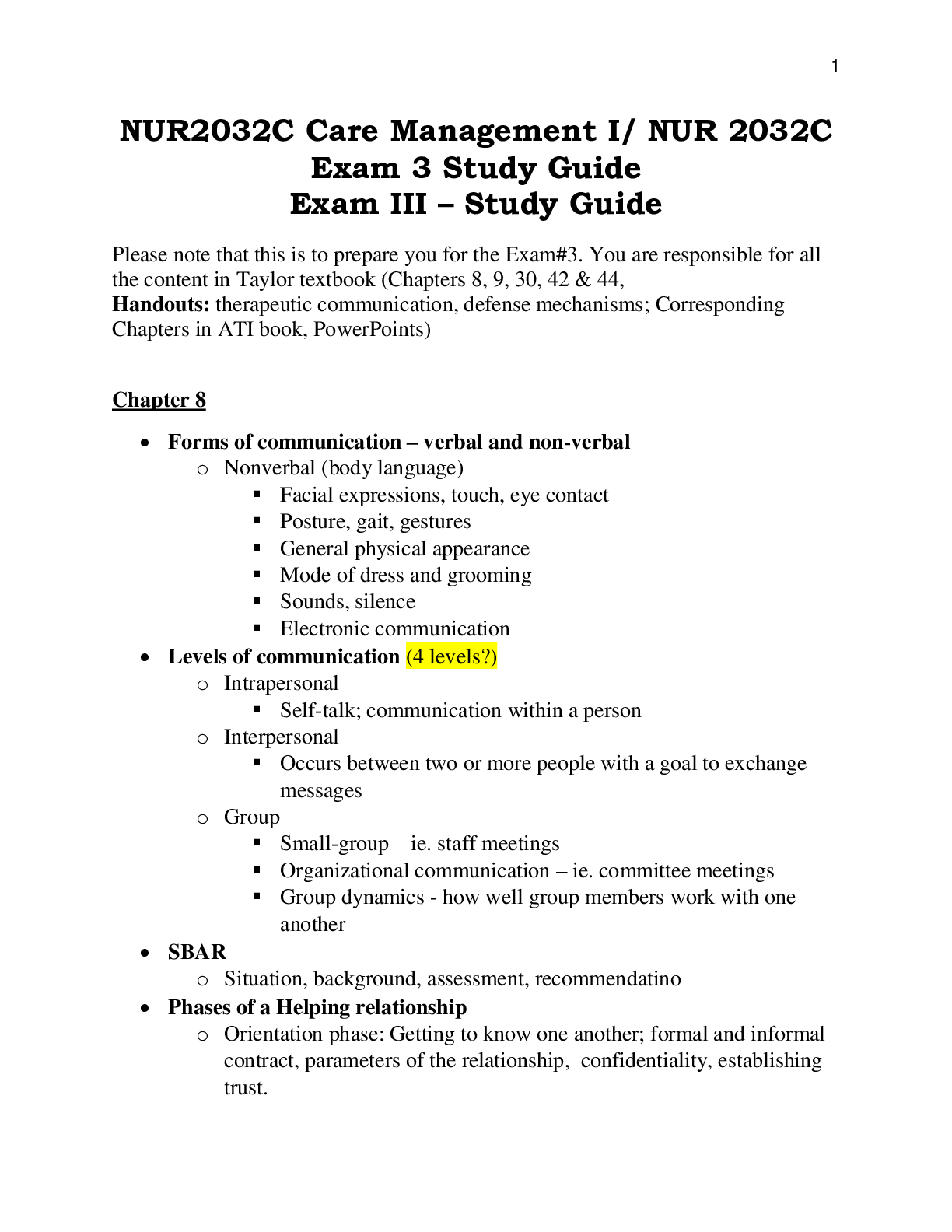
NUR2032C Care Management I/ NUR 2032C
Exam 3 Study Guide1
NUR2032C Care Management I/ NUR 2032C
Exam 3 Study Guide
Exam III – Study Guide
Please note that this is to prepare you for the Exam#3. You are responsible f
...
NUR2032C Care Management I/ NUR 2032C
Exam 3 Study Guide1
NUR2032C Care Management I/ NUR 2032C
Exam 3 Study Guide
Exam III – Study Guide
Please note that this is to prepare you for the Exam#3. You are responsible for all
the content in Taylor textbook (Chapters 8, 9, 30, 42 & 44,
Handouts: therapeutic communication, defense mechanisms; Corresponding
Chapters in ATI book, PowerPoints)
Chapter 8
Forms of communication – verbal and non-verbal
o Nonverbal (body language)
Facial expressions, touch, eye contact
Posture, gait, gestures
General physical appearance
Mode of dress and grooming
Sounds, silence
Electronic communication
Levels of communication (4 levels?)
o Intrapersonal
Self-talk; communication within a person
o Interpersonal
Occurs between two or more people with a goal to exchange
messages
o Group
Small-group – ie. staff meetings
Organizational communication – ie. committee meetings
Group dynamics - how well group members work with one
another
SBAR
o Situation, background, assessment, recommendatino
Phases of a Helping relationship
o Orientation phase: Getting to know one another; formal and informal
contract, parameters of the relationship, confidentiality, establishing
trust.2
o Working phase: implementing nursing interventions to achieve
outcomes; promoting problem-solving skills and self-esteem. For
example:. client shows awareness of his/her difficulties.
o Termination phase: End of relationship; client achievement of
independence; client stability; resolution
o See page 460 Box 20-3
Therapeutic vs. nontherapeutic communication (do’s and don’ts)
Interviewing techniques (nursing considerations)
o Open-ended questions or comments
o Closed questions or comments
o Validating questions or comments
o Clarifying questions or comments “are you saying …”
o Reflective questions or comments
o Sequencing questions or comments
o Directing questions or comments
Strategies to include to foster therapeutic communication with clients
Communicating with hearing impairment
Communicating with clients with language barrier
Open and closed communication questions
Chapter 9
Learning Domains and examples of each
o Cognitive: storing and recalling of new knowledge in the brain
(mental skills (knowledge)
such as learning food portions to maintain a calorie count
o Psychomotor: learning a physical skill. (manual or physical skills
(skills.).
Demonstrating how to change a wound dressing or care for an
umbilical cord
o Affective: changing attitudes, values, and feelings (growth in feelings
or emotional areas (attitude or self)
Expressing renewed confidence following a teaching session
Chapter 303
Informed Consent for surgery
o Dr – explain risk, benefits, alternative and procedure
o Nurse – advocate and witness
o Description of procedure and alternative therapies
o Name and qualifications of person performing procedure
o Explanation of risks and how often they occur
o Explanation that the client has the right to refuse treatment or
withdraw consent
o Explanation of expected outcome, recovery, rehabilitation plan, and
course of treatment
Perioperative phases and what happen at each phase
o Caring for the client during the three phases of surgical intervention:
Preoperative: Teaching (splinting), answering questions,
complete checklist, ; begins with decision to have surgery, lasts
until client is transferred to operating room or procedural bed
Intraoperative: begins when the client is transferred to the OR
bed until transfer to the post anesthesia care unit (PACU)
Postoperative: lasts from admission to recovery room (PACU)
to complete recovery from surgery and last follow-up physician
visit
o Types of procedures
Nurses role during each of the perioperative phases
o Perioperative:
Manager/director
Clinical practitioner
Educator
Researcher
Expanded and advanced practice roles e.g., CNOR, RNFA;
CNS/ARNP; CRNA
o Pre:
Ensure that a complete H & P has been performed and recorded
Ensure that tests and operative procedures are explained to the
client by the surgeon.
Ensure that appropriate lab specimens are collected.
Ensure that results/findings are recorded in client records.
Ensure that abnormal results are reported to surgeon/anesthesia.4
Ensure that preoperative medications have been administered as
per order
Preoperative Teaching has been performed
Classification of surgical procedures and purpose of each class
o Classifications of surgical procedures are based on three factors:
Elective
Urgent
Emergency
o Additional considerations include:
Risk Factors: related to current client’s condition
Purpose of the procedure: diagnostic, curative, preventive,
ablative, palliative, reconstructive, transplantation or
constructive
Support systems following surgery
Postoperative complications of anesthesia
o General Anesthesia
Malignant Hyperthermia
CV and/or Respiratory Problems
o Regional Anesthesia
Loss of movement/sensation after surgery
Allergic Reaction
o Prevent pneumonia – incentive sper
o Collapsed lung
o Blood clot – two types throm – stationary em is moving
Preventing respiratory and cardiovascular complications post-surgery
o Monitoring vital signs (q 2 – q 4Hrs as ordered, including
temperature)
o Checking incisional sites for bleeding; monitoring amount, color &
consistency
o Implementing deep breathing exercises as ordered
o Coughing (as needed)
o Utilizing Incentive spirometry (Teaching)
o Changing positions q2hours
o Ambulating prn as ordered
o Maintaining hydration
o Monitoring responses to analgesics
When and what to teach clients in preparation of surgery5
o Description of procedure and alternative therapies (in lay terminology
and in native language)
o Name and qualifications of person performing procedure
o Explanation of risks and how often they occur
o Explanation that the client has the right to refuse treatment or
withdraw consent
o Explanation of expected outcome, recovery, rehabilitation plan, and
course of treatment
Postoperative exercise and purpose of each
Preventing aspiration for postoperative clients following general
anesthesia
Priority interventions on care of postoperative clients
o Check every 10 to 15 minutes:
Respiratory status (ABC; + pulse oximetry)
Cardiovascular status (ABC, blood pressure)
Temperature
Central nervous system status (level of alertness, movement,
shivering, pain)
Fluid status
Wound status
Gastrointestinal status (nausea and vomiting)
General condition
Postoperative assessment of clients
o Same as above
Binder use for postoperative clients with an abdominal incision
o
Prevention of venous stasis and thrombus formation in postoperative
clients
o Move/raise legs and feet frequently
Signs and symptoms of postoperative hemorrhage
o Blood that soaks through the bandage covering your incision
o Anxiety or confusion
o Faster heart rate than normal for you
o Faster breathing than normal for you, or shortness of breath
o Urinating less than usual, or not at all
Surgery and aspirin use by clients
Teaching about pain management6
Monitoring urine output after surgery
Positioning postoperative semiconscious clients
Nursing considerations when a post-op patient resumes solid food
following general anesthesia
Chapter 42 STRESS AND ADAPTATION
Physiological effects on the body after relaxation activity
General Adaptation Syndrome (GAS) phases (Manifestations at each
phase)
o GAS: describes stress reaction
o Alarm stage
Fight or flight response
Also called the shock phase
Increased energy, oxygen intake, cardiac output, blood pressure
and mental alertness
o Stage of resistance
Body attempts to adapt to the stessor
Vital signs, hormone levels, and energy production return to
normal
o Stage of exhaustion
Adaptive mechanisms can no longer provide defense
Identifying Maladaptive coping (Negative consequences)
o self-harm, binge eating and substance abuse
Effects of the Sympathetic and Parasympathetic Nervous System on the
body during stress
o
Difference between Adaptation vs coping mechanisms
o Coping: how a person deals with problems/issues
Short-term response
o Adaptation: the change that take places as a result of the responses to
a stressor
Long-term response
Commonly occurring defense mechanisms (Taylor: Table 41-2) and
handout (eg Denial)
o Compensation
o Denial
o Displacement7
o Introjection
o Projection
o Rationalization
o Reaction formation
o Regression – acting like a child, tantrum
o Repression – unconscious (suppression is conscious)
o Sublimation
o Undoing
Stages of Anxiety. Manifestations at each stage
o Mild
Present in day-to-day living
Use for problem solving
Increased questioning and restlessness
o Moderate
Narrows a person’s perceptual field
Focus is on immediate concerns
Tremors, muscle tension, “butterflies” in the stomach, slight
increase in vitals, quavering voice
o Severe
Extreme fear
Impaired learning ability – cannot teach this person
Easily distracted
Tachycardia, hyperventilation, headache
Maladaptive behavior (Examples: self-harm, binge
eating and substance abuse)
o Panic
Loss of control
Experience of dread and terror
Distorted perception
Irrational thoughts
Difficulty communicating verbally; agitation; sensory changes;
dyspnea; palpitation, chest pain/pressure
o This level can lead to death
Nurses interventions caring for patients under stress
Nursing diagnoses for patients undergoing stress
o Caregiver role strain
Defense mechanisms
Chapter 448
Types of Aphasia and nursing interventions
o Expressive (motor type). The inability to name common objects or
express simple ideas in words or writing. For example, a patient
understands a question but is unable to express an answer.
o Sensory or receptive: The inability to understand written or spoken
language. A patient is able to express words but is unable to
understand questions or comments of others.
o Global: The inability to understand language or communicate orally.
Discharge instructions to a patient with visual alterations
o Make sure they don’t have rugs, good lighting, and a cane to feel
around clear walkway
Disturbed sensory perceptions:
o sensory deprivation, sensory overload, sensory deficits, sensory
poverty – isolation room
o Sensory overload
Effect from environmental elements (eg. crowding, noise,
mass media, technology) (minimize stimuli eg private room,
seclusion room, can use ear plugs) ensure there isn’t too
many smells
o Sensory deprivation
Deliberate restricted environmental stimulation. Sound,
light, and smell minimized (eg. Isolation rooms (be there for
patient) i.e isolation room
o Sensory deficit
o a defect in the function of one or more of the senses.
o Sensory poverty
o technology replacing exposure/experiences. e.g. cell phone
(patients who are at risk for each and nursing interventions for each)
Teaching tips to stimulate senses
Meeting the needs of patients with reduced hearing
Assisting clients with temporary loss of vision
Caring for a client with artificial eye9
Ensure that during your study you include:
TERMINOLOGY
[Show More]



.png)



![Preview of NR667 Complete Question Bank with Correct Answers: Final Exam Study Guide [2026 Updated]](https://browseimages.nyc3.digitaloceanspaces.com/paper-images/2026/02/25/AULA53fD2026-02-25-02-58699ee3d811bc7.png)