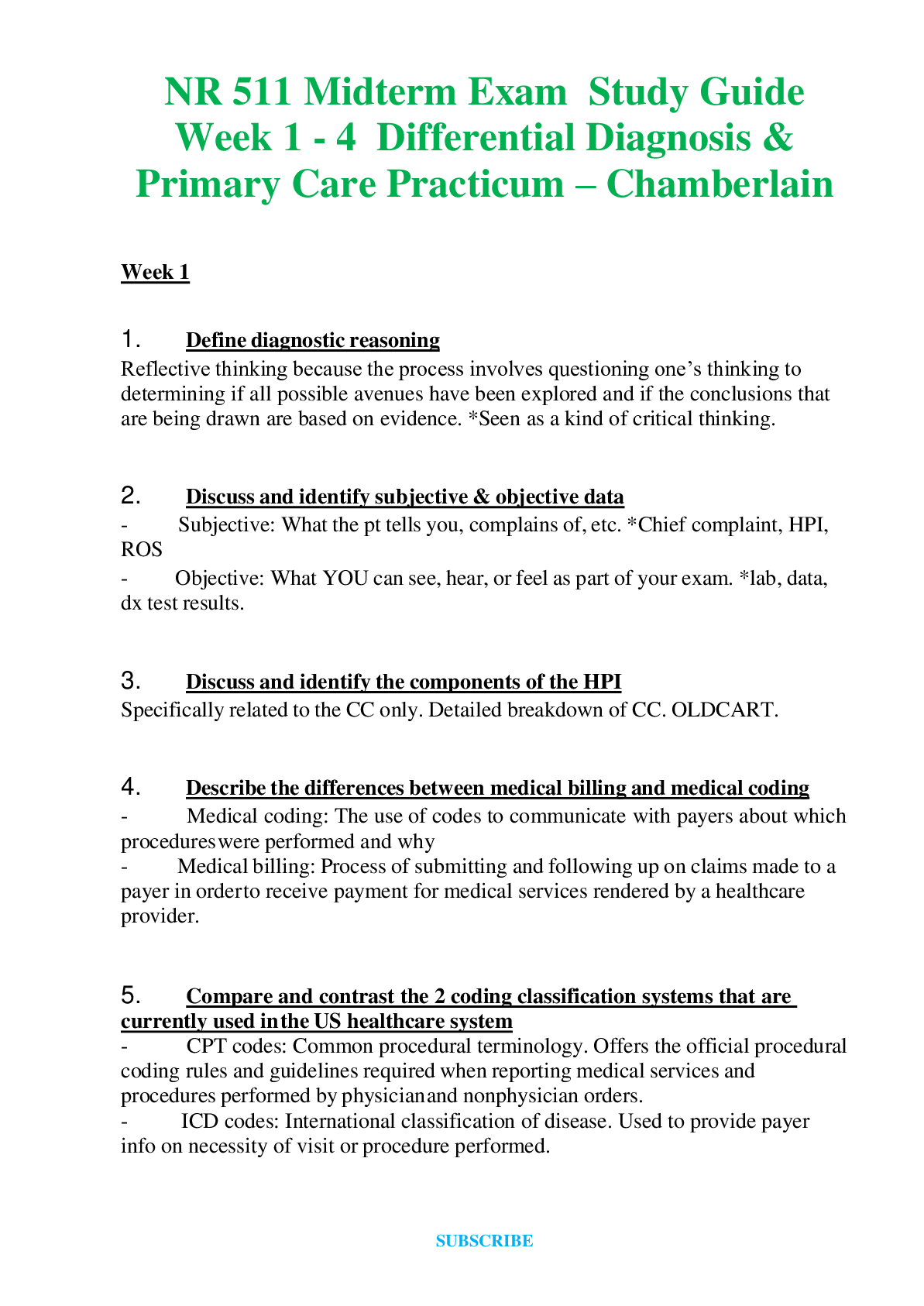
NR 511 Week 1 Study Guide/
NR 511 Week 1 Exam Study Guide
Week 1
1. Define d
ysician providers
Recognized universally and also provide a logical means to be able to track
healthcare data, trends, and outcomes. Ea
...
NR 511 Week 1 Study Guide/
NR 511 Week 1 Exam Study Guide
Week 1
1. Define d
ysician providers
Recognized universally and also provide a logical means to be able to track
healthcare data, trends, and outcomes. Each service or procedure is represented
by a five-digit code that is presented in six sections, including
1. Evaluation & Management
2. Anesthesiology
3. Surgery
4. Radiology5. Pathology
6. Medicine
International Classification of Diseases (ICD) system: we are in the tenth revision
of the system, and, therefore, the classification system is known as ICD-10
ICD-10 codes are shorthand for the patient’s diagnoses, which are used to
provide the payer information on the necessity of the visit or procedure
performed. This means that every CPT code must have a diagnosis code that
corresponds.
6. Discuss how specificity, sensitivity & predictive value contribute to the usefulness
of the diagnostic data
When we describe the specificity of a test, we are referring to the ability of the test
to correctly detect a specific condition. If the patient has the condition but testing is
negative, we describe this as a false negative. If the patient does not have the
condition but the test result is positive, this is considered to be a false positive test.
When a test is very sensitive, we mean it has few false negatives. The higher the
sensitivity, the lesser the likelihood of a false negative. A sensitivity of 99% means
that it is very unlikely for a false negative result.
Predictive value is the likelihood that the patient actually has the condition and is, in
part, dependent upon the prevalence of the condition in the population. If a condition
is highly likely, a positive test result is more likely to be accurate. If a condition is very
unlikely, a positive test needs to be questioned and perhaps additional testing would
need to be done.
5 things to consider before ordering a test: cost, convenience, sensitivity,
specificity, risk of missing a condition (predictive value)
7. Discuss the elements that need to be considered when developing a plan
Evidence based care: providing care and making treatment and screening choices
based on current research findings. Generally, EBP refers to using research findings
from multiple studies that are convincing enough that a consensus is formed
recommending the findings be used for clinical decision-making or practice
guidelines.
EBP also involves inclusion of patient and provider preferences, patient values, and
cultural considerations in the clinical decision-making process. Guidelines should be
followed in the majority of cases unless there is a clear rationale for deviating from
them to serve the particular needs of the patient.
Elements include clinical state and circumstances, patient’s preferences and
actions, research evidence, and clinical expertise
8. Discuss a minimum of three purposes of the written history and physical in
relation to the importance of documentation
It is an important reference document that gives concise information about a patient's
history and exam findings.
It outlines a plan for addressing the issues that prompted the visit. This information
should be presented in a logical fashion that prominently features all data
immediately relevant to the patient's condition.
It is a means of communicating information to all providers who are involved in the
care of a particular patient.
It is an important medical-legal document. It is essential in order to accurately code and bill for services.
9. Accurately document why every procedure code must have a corresponding
diagnosis code
Every procedure code needs a diagnosis to explain the necessity whether the code
represents an actual procedure performed or a nonprocedural encounter like an
office visit.
Understanding and accurately recording procedure and diagnosis codes are
necessities in order for you or your practice to get reimbursed.
10. Correctly identify a patient as new or established given the historical information
A new patient is one who has not received professional service from a provider from
the same group practice within the past 3 years. Conversely, an established patient
has received professional service from a provider of your office within the last 3
years.
11. Identify the 3 components required in determining an outpatient, office visit E&M
code
Self-directed learning: investigate more about the topics you are unsure about.
[Show More]




![Preview of NR667 Complete Question Bank with Correct Answers: Final Exam Study Guide [2026 Updated]](https://browseimages.nyc3.digitaloceanspaces.com/paper-images/2026/02/25/AULA53fD2026-02-25-02-58699ee3d811bc7.png)