NR 326 ATI MENTAL HEALTH
PRACTICE FINAL STUDY GUIDE
A nurse is caring for a client whose child has a terminal illness. The client requests
information about how to deal with the upcoming loss. Which of the following
...
NR 326 ATI MENTAL HEALTH
PRACTICE FINAL STUDY GUIDE
A nurse is caring for a client whose child has a terminal illness. The client requests
information about how to deal with the upcoming loss. Which of the following
statements should the nurse make?
"It is not uncommon to feel angry toward yourself or others."
A nurse is teaching a client who has bipolar disorder and a prescription for lithium.
Which of the following instructions should the nurse include in the teaching
"Take this medication with food
R: Lithium can cause GI distress
A nurse is planning care for four clients in a mental health facility. Which of the
following clients is at the greatest risk for injury when performing ADLs
A client who has severe Alzheimer's disease
R: these pt are typically confused, have memory difficulties, tend to wander, and
will need assistance
A nurse is updating the plan of care for a client who has bulimia nervosa and is 5%
above his ideal body weight. Which of the following interventions should the nurse
include in the plan
Identify the client's trigger foods
R: to help pt understand the thoughts and behaviors that relate to the food
A nurse who works with newborns is assessing the potential for abuse or neglect.
Which of the following family groups should the nurse identify as the highest
potential for future child abuse
A family where one or both parents witnessed intimate partner violence in the
home as children
R: They are more likely to become abused themselves.A nurse is performing an admission assessment on a client and notices that the
client appears withdrawn and fearful. To establish a trusting nurse-client
relationship, which of the following actions should the nurse take first
Inform the client that her admission is confidential
A nurse is talking with a client who is beginning chemotherapy. The client tells the
nurse that she is mourning the loss of her hair. Which of the following actions
should the nurse take first
Discuss the importance of hair with the client
R: 1st action for a nurse is to assess the pt, the experience of anticipatory grieving
begins w the importance of the expected loss
A nurse is caring for a client who is undergoing electroconvulsive therapy (ECT)
and will receive succinylcholine. The client asks the nurse about this medication.
What is an appropriate response by the nurse
"Succinylcholine is given to reduce muscle movements during therapy
R: succinylocholine is a muscle paralyzing agent that will decrease muscle
movement during the procedure so that injury is less likely to occur
A nurse is caring for a client who has a history of substance use disorder and was
involuntarily admitted to a mental health facility. When the nurse attempts to
administer oral lorazepam, the client refuses to take the medication and becomes
physically aggressive. Which of the following actions should the nurse take
Do not administer the lorazepam
R: pt who is involuntarily admitted have the right to refuse tx
A nurse is caring for four clients in an inpatient mental health facility. Which of
the following clients can give informed consent
A 35-year-old client who has major depressive disorder
R: pt w majar depressive d/o can make decisions unless legally incompetent
A nurse is admitting a client who has schizophrenia to an acute care setting. When
the nurse questions the client regarding his admission, the client states, "I'm red, in
the head, and I'm going to bed!" The nurse should document the client's speech
pattern as which of the followingClang association
R: clang often rhymes or contains a string of words tha can have the same
beginning sounds
During a client's initial interview in a mental health inpatient setting, the nurse
identifies that the client is maintaining eye contact and leaning forward. Which of
the following assumptions should the nurse make based on the client's nonverbal
behaviors
The client is interested in what the nurse is saying
A nurse is educating the parent of a child who has a new diagnosis of autism
spectrum disorder. Which of the following manifestations of this disorder should
the nurse include in the teaching
Language delay
R: typical manifestation
A nurse in a mental health unit is admitting a client who is anxious because he
often hears voices telling him what to do. Which of the following actions should
the nurse take?
Ask the client what the voices are saying
R: to determine if the pt or others are at risk for injury
A nurse is caring for an older adult client who begins to cry and states, "I knew
God would punish me and I deserve this horrible sickness!" Which of the
following responses should the nurse make
"Let's talk about what is upsetting you."
R: nurse is acknowledging the ot concerns and is showing desire to understand
what the pt is thinking and feeling
A nurse is providing care for a client who has bipolar disorder and is experiencing
acute mania. The client's morning lithium level is 1.5 mEq/L. Which of the
following laboratory findings should the nurse report to the provider? (Click on the
"Exhibit" button below for additional client information. There are three tabs that
contain separate categories of data
Sodium level 125 mEq/lR: In the presence of low Na+ levels, renal excretion of Li is reduced and the pt is
at risk for Li toxicity
A school nurse is assessing a school-age child who experienced the traumatic loss
of a parent 8 months ago. Which of the following findings should the nurse
identify as an indication that the child is experiencing post traumatic stress disorder
(PTSD)
Lack of interest in an upcoming holiday
R: pt w PTSD will have - moods, child can also have loss or lack of interest and
participation in significant activities.
A nurse in the emergency department is caring for a client who has alcohol toxicity
and is unresponsive. Which of the following interventions should the nurse take
Gather supplies for endotracheal intubation
R: the expected finding is resp depression
A nurse in an acute mental health facility is receiving change-of-shift report for
four clients. Which of the following clients should the nurse assess first
A client who is experiencing delusions of persecution
R: greatest risk due to the pt belief that a person in power is out to harm him.
A nurse is planning care for a client who constantly threatens others on the unit.
Although the client does not want to leave the unit, the nurse requests the provider
to transfer the client to a unit that is equipped to manage violent behavior. Which
of the following ethical principles should the nurse apply in this situation
Nonmaleficence
R: it is the responsibility of the nurse to not harm the pt.
A nurse is reviewing the medication administration record for a client who is
experiencing the adverse effects of chlorpromazine. The nurse should administer
benztropine to relieve which of the following adverse effects
Acute dystoniaA nurse in a mental health facility is planning discharge for a client who has a long
history of alcohol use disorder. Which of the following post discharge activities
should the nurse plan to include
Attending a relapse prevention group several times each week
R: most effective relapse prevention is a 12 step program such as AA
A nurse is communicating with a client in an inpatient mental health facility.
Which of the following actions by the nurse demonstrates the use of active
listening
Attention to body language
R: active listening involves identifying verbal and nonverbal communication
A nurse is preparing to participate in an interdisciplinary conference for a client
who has bipolar disorder. Which of the following behaviors is the priority for the
nurse to report to the treatment team
Giving away possession
R: giving away possessions indicates that the pt is a greater risk for suicide.
A nurse in a community health center is counseling a family of two parents and
two children. Which of the following statements by a family member indicates
manipulative behavior
"If you do my homework for me, I won't bother you for the rest of the day
R: this is an ex of manipulative behavior
A nurse is caring for a client who is receiving hospice care for an inoperable brain
tumor. When completing a spiritual assessment as part of end-of-life care, which of
the following interventions should the nurse implement
Discuss spiritual issues in a conversational manner
A nurse is planning care for a newly admitted client who has bipolar disorder.
Which of the following is the priority action by the nurse
Provide frequent high-calorie snacks
R: Maslow's requirement is for adequate nutritionA nurse is planning discharge teaching with a family member of a client who has a
new diagnosis of depression. Which of the following information about relapse
should the nurse include
Early identification of changes, such as decreased social involvement, is important
R: decreased social involvement in a manifestation of depression, and early
identification of findings can lead to early intervention
A nurse is admitting a female client who has anorexia nervosa. Which of the
following manifestations should the nurse expect during the admission assessment
Orthostatic hypotension
R: low wt, electrolyte imbalance, starvation, and dehydration can cause this
A nurse is teaching the partner of a client who has bipolar disorder how to identify
manifestations of acute mania. Which of the following findings should the client's
partner report to the provider
Inability to sleep
R: pt is extremely active and doesn't sleep, which can lead to relapse.
A charge nurse is developing an educational program about schizophrenia. Which
of the following manifestations should the nurse include as a negative symptom of
schizophrenia
Thought blocking
R: thought block is a - symptom of schizo. It is a sudden interruption in pt thought
processes usually due to internal stimuli
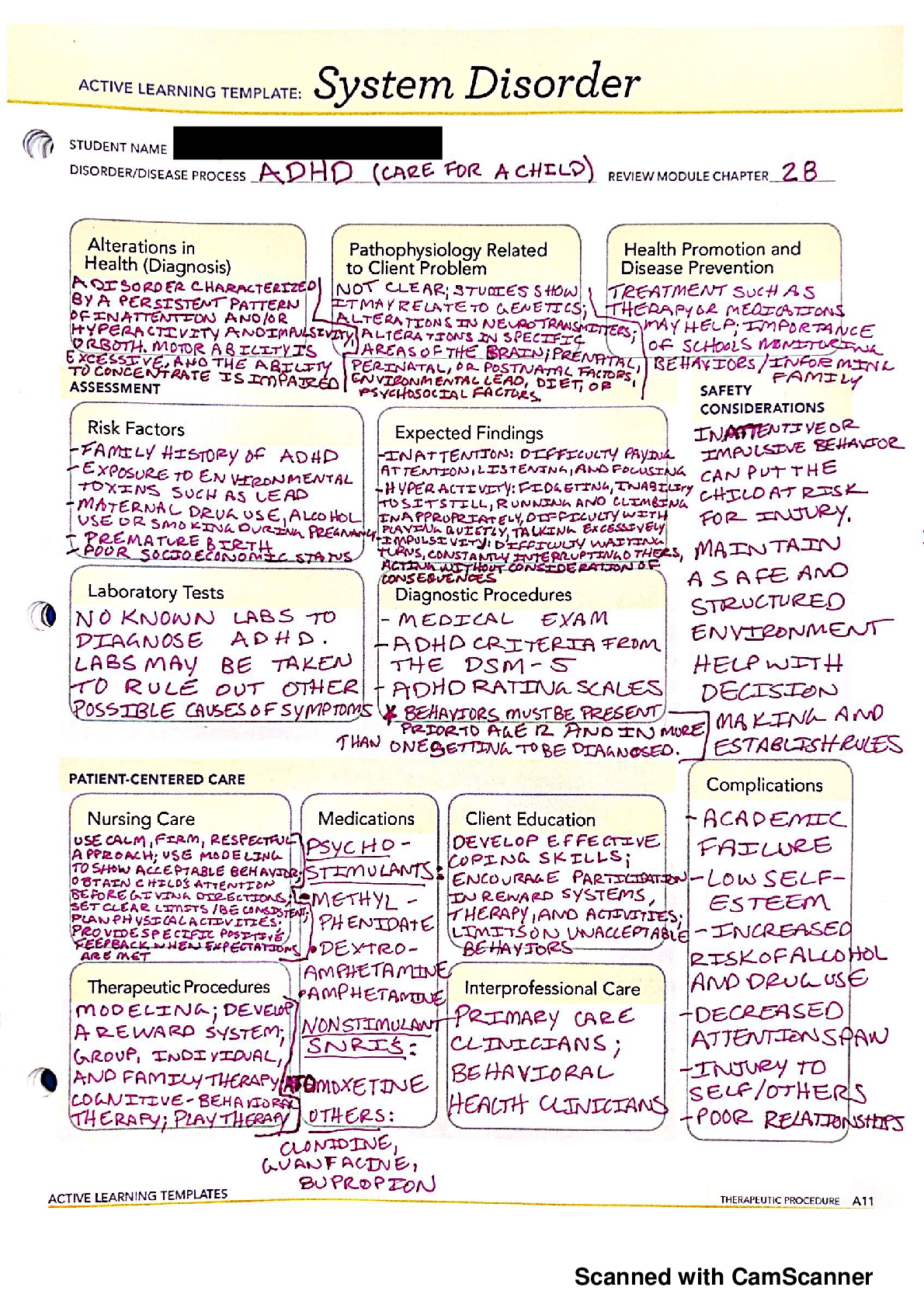
A nurse is teaching the parent of a 10-year-old child who has ADHD and a new
prescription for dextroamphetamine. Which of the following instructions should
the nurse include in the teaching
"Administer the last dose of medication to your child 6 hours before bedtime
R: A/E of dextro. is insomnia
A client who has paranoid schizophrenia is attending a treatment planning
conference with a family member. During the discussion of the medication
adherence portion of the plan, the nurse notices that the family member seems
distracted. Which of the following actions should the nurse takeAsk the family member if she has any thoughts or questions about the treatment
plan
A nurse is admitting a client who has alcohol use disorder. Which of the following
statements by the client indicates that the client is using denial as a defense
mechanism
"I am able to go to work every day, so I don't have a problem
A client who has a diagnosis of depression is attending group therapy. During the
group meeting, the nurse asks each member to identify one goal for the day. When
it's the client's turn, she doesn't respond. Which of the following actions should the
nurse take before repeating the request to the client?
A) Allow the client time to collect her thoughts
B) Prompts the client to give a response
C) Move on to the next client
D) Offer the client a suggestion for a goal
A) Allow the client time to collect her thoughts
A nurse on a mental health unit is caring for a group of clients. Which of the
following actions by the nurse is an example of the ethical principle of justice?
A) Allowing a client to choose which unit activities to attend
B) Attempting alternative therapies instead of restraints for a client who is
combative
C) Providing a client with accurate information about his prognosis
D) Spending adequate time with a client who is verbally abusive
D) Spending adequate time with a client who is verbally abusive
While observing group therapy, a nurse recognizes that a client is behaving in a
way suggestive of dependent personality disorder. Which of the following
behaviors is consistent with this condition?
A) The client needs excessive external input to make everyday decisions
B) The client demonstrates a dedication to his job that excludes time for leisure
activities
C) The client adheres to rigid set of rules
D) The client has difficulty starting new relationships unless he feels accepted
A) The client needs excessive external input to make everyday decisionsA nurse is creating a plan of care for a client who has been placed in seclusion after
threatening to harm others on the unit. Which of the following interventions should
the nurse include in the plan?
A) Document the client's behavior every 8hr
B) Limit the client's fluid intake to 50mL/hr
C) Renew the prescription for the client q4hr
D) Toilet the client q4hr
C) Renew the prescription for the client q4hr
A nurse is reviewing routine lab values for several clients who are taking Lithium
carbonate. Which of the following clients should the nurse assess further for
findings indicating Lithium toxicity?
A) A client who has a fasting blood glucose of 80mg/dL
B) A client who has a sodium level of 128 mEq/L
C) A client who has a BUN of 18mg/dL
D) A client who has a potassium level of 3.6 mEq/L
B) A client who has a sodium level of 128 mEq/L
A nurse is reviewing the chart of a client who has dissociative amnesia. Which of
the following findings should the nurse expect?
A) The client was seriously injured while under the influence of alcohol
B) The client has a history of panic attacks
C) The client chose to drop out of college a few months ago
D) The client works a stressful job at an international bank
A) The client was seriously injured while under the influence of alcohol
A nurse is assessing a client for risk factors for the development of depression. The
nurse should identify that which of the following factors places the client at an
increased risk for depression?
A) The client is married
B) The client recently received a promotion at work
C) The client has COPD
D) The client is a male
C) The client has COPDA nurse is admitting a client who has anorexia nervosa and is at 60% of ideal body
weight. Which of the following interventions should the nurse include in the plan
of care?
A) Encourage the client to drink 125mL of fluid each hr while awake
B) Allow the client to eat independently in his room
C) Weigh the client twice weekly
D) Measure the client's VS once each day
A) Encourage the client to drink 125mL of fluid each hr while awake
A client who has a recent diagnosis of bipolar disorder is placed in a room with a
client who has severe depression. The client who has depression reports to the
nurse, "That man in my room never sleeps and he keeps me up, too." Which of the
following is an appropriate action for the nurse to take?
A) Move the client who has bipolar disorder to a private room
B) Administer sleep medication to the client who has bipolar disorder
C) Move the client who has severe depression to a private room
D) Administer sleep medication to the client who has sever depression
A) Move the client who has bipolar disorder to a private room
A nurse is caring for a client who is experiencing a panic attack. Which of the
following actions should the nurse take?
A) Orient the client to person, place, and time
B) Assist the client with deep-breathing exercises
C) Calm the client by using therapeutic touch
D) Have the client sit alone in a quiet room
B) Assist the client with deep-breathing exercises
A nurse is planning care for a client who has bipolar disorder and is experiencing
mania. Which of the following interventions should the nurse include in the plan of
care?
A) Encourage the client to participate in group therapy
B) Instruct the client to avoid napping during the day
C) Offer the client high-calorie finger foods frequently
D) Decrease the client's daily fiber intake
C) Offer the client high-calorie finger foods frequentlyA charge nurse enters a client's room and observes and assistive personnel (AP)
slapping an older adult client. After moving the client to safety, which of the
following actions is the charge nurse's priority?
A) Complete an incident report
B) Determine if the client has been physically harmed
C) Provide emotional support to the client
D) Discipline the AP
B) Determine if the client has been physically harmed
A nurse in a provider's office is collecting a health history from the parent of a
school-age child who has been taking atomoxetine. Which of the following adverse
effects reported by the parent is the priority for the nurse to report to the provider
Dark urine
R: greatest risk for a child is liver damage from atomoxetine, which can progress to
failure and death.
A nurse is caring for a client who has moderate Alzheimer's disease. Which of the
following nursing interventions assists in orienting the client to reality
Talk with the client about scheduled daily activities
R: this can orient the pt to time and reality throughout the day
A nurse is assessing a client who is experiencing opioid withdrawal. Which of the
following manifestations should the nurse expect
Rhinorrhea
R: rhinorrhea and flu like manifestions such as yawning, sneezing, and abd pain
A nurse is caring for a client who is in an abusive relationship and is assisting in
the development of a safety plan. Which of the following actions is the first
component of a safety plan
Identify signs of escalation of violence
A nurse who is working on a mental health unit should recognize that which of the
following are indications for the use of electroconvulsive therapy (ECT)? (Select
all that apply- Pt who is suicidal and need rapid tx
R: ECT is a rapid, definitive response for suicidal pt
-pt w bipolar d/o w rapid cycling
R: works best for these pt
-pt w mania and not responding to med therapy
A nurse is caring for a client who has borderline personality disorder. Which of the
following goals is the priority when planning care for this client
The client will refrain from self-mutilation
R: greatest risk is injury to self or others
A nurse is teaching coping strategies to a client who is experiencing depression
related to intimate partner abuse. Which of the following statements by the client
indicates an understanding of the teaching
"I will talk about my feelings with a close friend."
R: discussion feelings w a support person is effective coping
A nurse in a clinic is assessing a client whose partner died 4 months ago. Which of
the following statements indicates that the client is at risk for complicated grief
"I feel so empty without my wife that it's hard to get up every morning."
R: difficulty carrying on w normal activities indicates a risk for complicated grief
A nurse is caring for an older adult client who is experiencing delirium. Which of
the following interventions should the nurse include in the client's plan of care
Permit the client to perform daily rituals to decrease anxiety
R: allowing them to do so will decrease frustration and anxiety
A nurse is assisting a client who has a terminal illness adjust to progressive loss of
independence. Which of the following statements by the client indicates
acceptance of her illness
"I am going to order a wheelchair for when I'm unable to walk."
R: pt is recognizing the reality of continued loss of independence and is
anticipating the need for assistive devices, indicative of acceptance.A nurse in the emergency department is admitting a client who reports a headache
along with heart palpitations after having a glass of wine with dinner a few hours
ago. The client has a history of depression and has a blood pressure of 210/105 mm
Hg. Which of the following questions should the nurse ask first
"What medications are you currently taking?"
R: If the pt is taking MAOI to tx depression, they are at a greater risk for
hypertensive crisis, it can also be precipitated by tyramine containing food
A nurse is providing teaching to the partner of a client who is in a rehabilitation
program for alcohol use disorder. The nurse should identify that which of the
following statements by the client's partner indicates an understanding of the
teaching
"I will not take charge of my partner's work responsibilities
A nurse is caring for a client who is experiencing a situational crisis. Which of the
following findings should the nurse expect
The client recently lost a grandparent in a motor vehicle crash
R: unexpected events
A community health nurse is planning an education program about depressive
disorders. Which of the following factors should the nurse include as increasing the
risk for depression
Substance use disorder
A nurse is establishing a therapeutic relationship with a client who has antisocial
personality disorder. Which of the following strategies should the nurse use when
communicating with this client
Set realistic limits on the client's behavior
R: these pt can seem to be in control of their behavior, but are manipulative and
impulsive and can suddenly become aggressive and assaultive.
A nurse is caring for an older adult client who has dementia and has wandered into
the day room looking for her deceased partner. Which of the following actions
should the nurse takeTalk with the client about activities she enjoyed with her partner
R: talking about + experiences can help distract her from disorientation
A nurse is assessing a client who recently used cocaine. Which of the following
findings should the nurse expect
Hypertension
R: it is a stimulant that increase BP, HR, body temp, energy levels, and metabolism
A charge nurse is planning a teaching session regarding the code of ethics for
registered nurses. Which of the following information should the nurse include in
the teaching
The right to treatment ensures individualized care
R: The Hospitalization of the Mentally Ill Act of 1964 requires that pt admitted to
an inpatient mental health facility have a right to individualized tx
A nurse is teaching the parents of a client about their daughter's diagnosis of
bulimia nervosa. Which of the following statements made by the parents indicates
an understanding of their daughter's illness
"It is important for our daughter to have regular dental checkups
R: repeated vomiting erodes tooth enamel and predisposes the teeth to caries.
A nurse is caring for a client who was admitted following an overdose of
amitriptyline. The nurse should monitor the client for which of the following
adverse effects associated with this medication
Urinary retention
R: OD can result in anticholinergic effects and the pt is more likely to experience
constipation rather than loose stools
A nurse is caring for a client who has alcoholic cardiomyopathy. Which of the
following laboratory findings should the nurse expect
Increased creatine phosphokinase (CPK)
R: it is an enzyme released when muscle tissue is damagedA nurse is teaching a client who has a depressive disorder about fluoxetine. Which
of the following information should the nurse include in the teaching
"You may experience difficulties with sexual functioning while taking this
medication
R: SSRI can cause sexual dysfunction
A nurse in the emergency department is caring for four clients. Which of the
following clients is the nurse required to report as a potential victim of abuse
An older adult client who is bedbound and has a stage IV pressure ulcer
R: Stage 4 pressure ulcer in a pt who is bedbound can indicate physical neglect and
warrants reporting
A nurse is assessing a school-age child who has conduct disorder. Which of the
following characteristics should the nurse expect the child to demonstrate
Aggression toward animal
A nurse is caring for a client who is taking clozapine. For which of the following
findings should the nurse withhold the medication
The client reports a sore throat
R: clozapine can lead to a fatal blood d/o, agranulocytosis. this is a severe drop in
WBC which leaves them at risk for infection. Nurse should w/hold
A nurse is preparing to administer diazepam 7.5 mg IV bolus to a client for alcohol
withdrawal. Available is diazepam injection 5 mg/mL. How many mL should the
nurse administer? (Round the answer to the nearest tenth. Use a leading zero if it
applies. Do not use a trailing zero
1.5
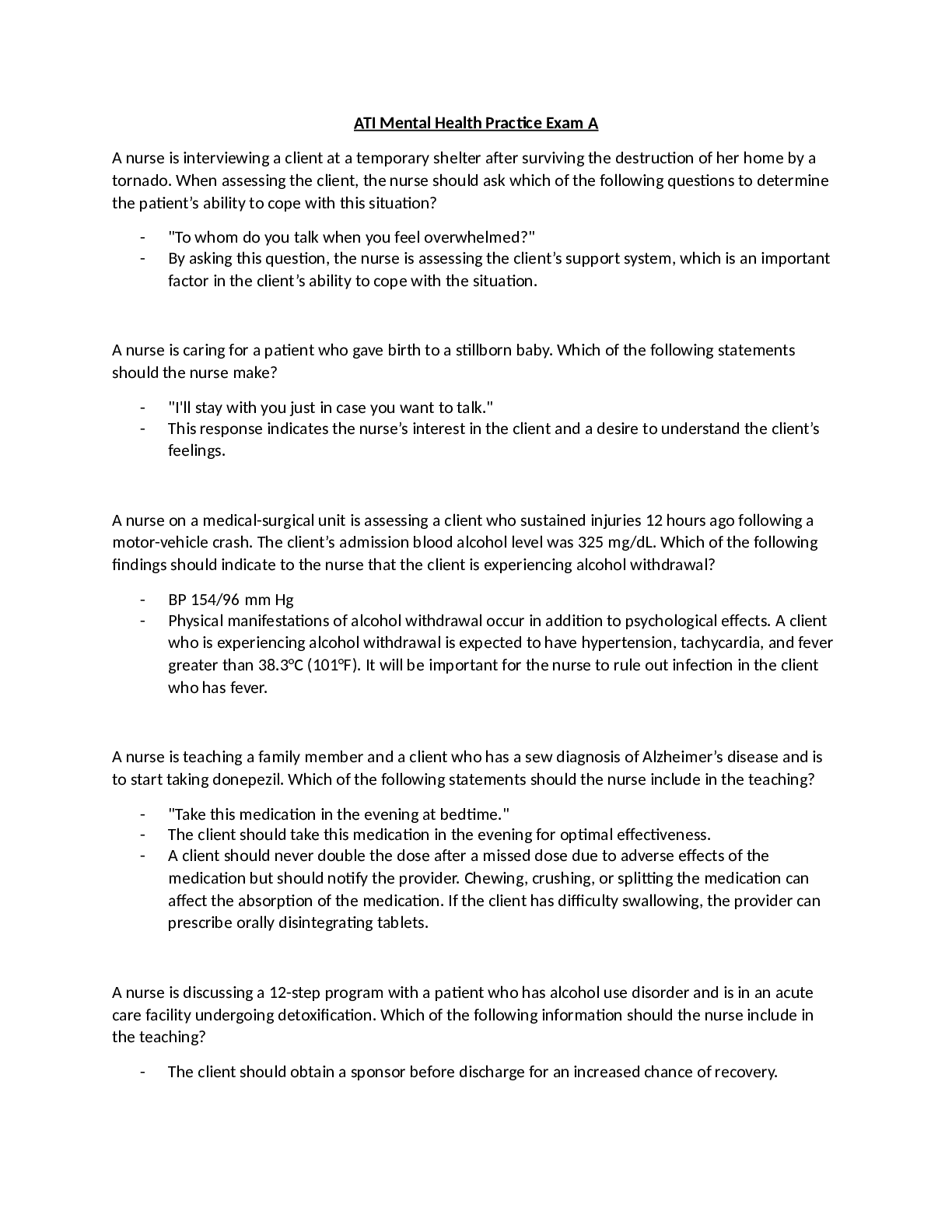
A nurse is interviewing a client at a temporary shelter after surviving the
destruction of her home by a tornado. When assessing the client, the nurse should
ask which of the following questions to determine the client's ability to cope with
this situation?
A) "Don't you think you'll get through this in time?"
B) "To whom do you talk when you feel overwhelmed?"
C) "Have you thought about rebuilding your home on the same site?"D) "Would you like me to find a therapist for you to speak with?"
B) "To whom do you talk when you feel overwhelmed?"
A nurse is caring for a client who gave birth to a stillborn baby. Which of the
following statements should the nurse make?
A) "You probably want to hold your baby"
B) "I'll stay with you in case you want to talk"
C) "I know how you must be feeling"
D) "It hurts now, but things will be better soon"
B) "I'll stay with you in case you want to talk"
A nurse on a medical-surgical unit is assessing a client who sustained injuries 12hr
ago following a motor-vehicle crash. The client's admission blood alcohol level
was 325mg/dL. Which of the following findings should indicate to the nurse that
the client is experiencing alcohol withdrawal?
A) Somnolence
B) BP 154/96
C) Pinpoint pupils
D) Blood glucose 210
B) BP 154/96
Rationale: Withdrawal can include hypertension, tachycardia, and fever
A nurse is teaching a family member and a client who has a new diagnosis of
Alzheimer's disease and is to start taking Donepezil. Which of the following
statements should the nurse include in the teaching?
A) "Take this medication in the evening at bedtime"
B) "Expect this medication to reverse the effects of Alzheimer's disease"
C) "If you miss a dose, double the next dose"
D) "You can crush this medication in applesauce"
A) "Take this medication in the evening at bedtime"
A nurse is discussing a 12-step program with a client who has alcohol use disorder
and is in an acute care facility undergoing detoxification. Which of the following
information should the nurse include in the teaching?
A) The program will help the client accept responsibility for his disorderB) The client should obtain a sponsor before discharge for an increased chance of
recovery
C) The client will need to identify individuals who have contributed to his disorder
D) The program will need a prescription from the client's provider prior to
attendance
B) The client should obtain a sponsor before discharge for an increased chance of
recovery
During morning rounds, a nurse finds a client who has schizophrenia trembling and
tearful in her bed. The client reports that a bomb was placed in her room by a
family member during visiting hours. Which of the following actions should the
nurse take?
A) Ask the client to identify the bomb in the room
B) Initiate disaster protocols per facility policies and procedures
C) Assess the client for evidence of a perceptual disturbance
D) Convince the client that there is no bomb in her room
C) Assess the client for evidence of a perceptual disturbance
A nurse is admitting a client who has major depressive disorder and a new
prescription for Tranylcypromine. Which of the following over-the-counter
medications that the client reports taking should alert the nurse to a potential
adverse reaction?
A) Lansoprazole
B) Naproxen
C) Magnesium hydroxide
D) Phenylephrine
D) Phenylephrine
Rationale: Tranylcypromine is an MAOI antidepressant and should not be taken
with over-the-counter medications such as sinus congestion, cold, or allergy meds
A nurse is assessing a client who has schizophrenia. Which of the following
findings should the nurse document as a negative symptom of this disorder?
A) Delusions
B) Neologisms
C) Anhedonia
D) EchopraxiaC) Anhedonia
Rationale: Means the inability to enjoy otherwise pleasurable activities
A nurse in an ED is caring for a female adolescent who has a diagnosis of bulimia
nervosa and has a fainting episode during a ballet performance. Which of the
following statements by the mother acknowledges her daughter's diagnosis?
A) "She works so hard at ballet. Will she still be able to perform?"
B) "She won't let me take the trash from her room. I'm concerned about what she
has in there"
C) "She told me she was tired, so I did her shores for her today"
D) "She is happier with her appearance now that she's lost some weight"
B) "She won't let me take the trash from her room. I'm concerned about what she
has in there"
A nurse is assessing a client who has major depressive disorder and has been
receiving Amitriptyline for 1wk. Which of the following outcomes should the
nurse expect?
A) Rapid improvement in affect within 30-60min after taking the medication
B) Greater risk of attempting suicide as affect and energy improve
C) Onset of frequent loose stools
D) Development of physiologic dependence on the medication
B) Greater risk of attempting suicide as affect and energy improve
A nurse in a community health center is teaching families of clients who have
PTSD about expected clinical manifestations. Which of the following
manifestations should the nurse include?
A) Repeatedly talks about the traumatic incident
B) Sleeps excessively
C) Experience feelings of isolation
D) Uses repetitive speech
C) Experience feelings of isolation
A nurse is caring for a client who has anorexia nervosa. Which of the following
criteria requires hospitalization?
A) Weight loss 10% of total body weight in 3mo
B) Potassium 3.8C) Temp. 96.1 F
D) HR 54bpm
C) Temp. 96.1 F
Rationale: Severe hypothermia, due to loss of subcutaneous tissue or dehydration
A nurse is caring for a client who is experiencing alcohol withdrawal. Which of the
following medications should the nurse administer first?
A) Diazepam 5mg IV bolus
B) Clonidine 0.1mg transdermal patch
C) Naltrexone 380mg IM
D) Bupropion 150mg PO
A) Diazepam 5mg IV bolus
Rationale: Acts rapidly to prevent seizures, stabilize VS, and decrease the intensity
of withdrawal symptoms
A nurse in a mental health unit observes a client who has acute mania hit another
client. Which of the following actions should the nurse take first?
A) Call the provider to obtain an immediate prescription for restraints
B) Prepare to administer Benzodiazepine IM
C) Call for a team of staff members to help with the situation
D) Check the client who was hit for injuries
C) Call for a team of staff members to help with the situation
A nurse is providing teaching to a client who is to begin undergoing light therapy
at home to treat seasonal affective disorder. Which of the following should the
nurse include in the teaching?
A) Have a family member present during treatment
B) Increase fluid intake
C) Change position slowly
D) Wear sunglasses when outdoors
D) Wear sunglasses when outdoors
A client who has bipolar disorder is to be discharged home with a prescription for
Lithium. Which of the following statements indicates that client teaching regarding
the medication has been effective?
A) "I should eat a regular diet with normal amounts of salt and fluids"B) "I should discontinue the Lithium when I begin to feel better"
C) "I need to be careful to avoid becoming addicted to the Lithium
D) "I can skip a dose of medication if my stomach is upset"
A) "I should eat a regular diet with normal amounts of salt and fluids"
A nurse is working with a group of parents who recently lost a child. Which of the
following actions should the nurse take?
A) Encourage the parents to avoid discussing the death with their other children in
order to protect their feelings
B) Recommend each parent grieve in private to avoid hindering each other's
healing
C) Suggest forming a weekly support group for parents who have experienced the
loss of a child
D) Advise the parents to begin counseling if they are still grieving in a few months
C) Suggest forming a weekly support group for parents who have experienced the
loss of a child
A nurse in a mental health clinic is planning care for a client who has a new
prescription for Olanzapine. Which of the following interventions should the nurse
identify as the priority?
A) Advise the client to take frequent sips of water
B) Instruct the client to avoid driving during initial therapy
C) Consult a dietitian for a calorie-controlled diet plan
D) Recommend that the client exercise regularly
B) Instruct the client to avoid driving during initial therapy
Rationale: Side effect includes drowsiness and dizziness
A nurse is preparing to discharge an older adult client who attempted suicide to his
home where he lives alone and has difficulty performing ADLs. Which of the
following referrals should the nurse initiate? (Select all that apply)
A) Occupational therapy
B) Meal delivery services
C) Speech therapy
D) Physical therapy
E) Home health servicesA) Occupational therapy
B) Meal delivery services
D) Physical therapy
E) Home health services
A nurse is reviewing lab results for a client who has schizophrenia and is taking
Clozapine. Which of the following values should the nurse identify as a
contraindication for receiving Clozapine?
A) WBC 2500
B) Hgb 11.5
C) Platelets 150,000
D) RBC 3.5 million
A) WBC 2500
Rationale: Shouldn't be given if WBC count is below 3,000
A nurse in an outpatient mental health setting is collecting a health history from a
client who is taking Paroxetine for depression. The client reports to the nurse that
he also takes herbal supplements. The nurse should advise the client that which of
the following supplements interacts adversely with Paroxetine?
A) St. John's wort
B) Saw palmetto
C) Echinacea
D) Ginkgo
A) St. John's wort
Rationale: It decreases the reuptake of serotonin
A nurse is teaching a newly licensed nurse about nursing care plans for clients who
have depressive disorders. Which of the following statements by the newly
licensed nurse indicates an understanding of the teaching?
A) "I will use the same plan of care and interventions for each client who has
depression"
B) "Each individual nurse will develop a separate plan of care when managing
clients who have depression"
C) "I will update the plan of care as a client's manifestations of depression change"
D) "An assistive personnel can use the plan of care for client teaching"
C) "I will update the plan of care as a client's manifestations of depression change"A nurse is caring for a child who is taking Methylphenidate. The nurse should
monitor the child for which of the following findings as an adverse effect of
Methylphenidate?
A) Weight gain
B) Tinnitus
C) Tachycardia
D) Increased salivation
C) Tachycardia
A nurse is caring for a client who has antisocial personality disorder and is
receiving behavioral therapy through operant conditioning. Which of the following
client behaviors indicates effectiveness of the therapy?
A) Controls anger outbursts to avoid being placed in seclusion
B) No longer exhibits a fear of social or public situations
C) Refrains from manipulating others o earn dining-room privileges
D) Imitates the therapist's use of relaxation techniques
C) Refrains from manipulating others o earn dining-room privileges
A nurse is planning care for a client who has generalized anxiety disorder. At
which of the following levels of anxiety should the nurse plan to teach the client
relaxation techniques?
A) Panic
B) Moderate
C) Severe
D) Mild
D) Mild
A nurse is caring for a client in a mental health facility. The nurse overhears
another staff member make derogatory comments to the client. Which of the
following actions should the nurse take?
A) Confront the staff member
B) Encourage the client to report the incident
C) Document the incident in the client's health record
D) Report the occurrence to the charge nurse
D) Report the occurrence to the charge nurseA nurse is caring for a client who has attempted suicide and has alcohol use
disorder. Which of the following statements indicates tat the client is using a
positive coping mechanism?
A) "I will limit my drinking to the weekends"
B) "I will stay in my room and avoid others when I'm feeling down"
C) "I will be dependent on others for the time being"
D) "I will attend daily group therapy sessions to practice relaxation techniques"
D) "I will attend daily group therapy sessions to practice relaxation techniques"
A nurse is planning care for a client who has depression and has made frequent
suicide attempts. Which of the following statements indicates the client has a
decreased risk for suicide?
A) "I'm relieved now that my financial affairs are in order"
B) "It's easier to talk about my feelings now"
C) "Suddenly I have enough energy to do anything I want"
D) "Thank you for always taking such good care of me"
B) "It's easier to talk about my feelings now"
A nurse is assessing a client who has bulimia nervosa. The nurse should expect
which of the following findings?
A) Amenorrhea
B) Lanugo
C) Cold extremities
D) Tooth erosion
D) Tooth erosion
A nurse is planning care for a preschool-age child who has ADHD. Which of the
following interventions should the nurse identify as the priority?
A) Decrease distractions during meal times
B) Provide positive feedback when the child completes a task
C) Clearly identify consequences for unacceptable behavior
D) Remove unnecessary equipment from the child's surroundings
D) Remove unnecessary equipment from the child's surroundingsA nurse is caring for a client who has a recent diagnosis of Alzheimer's disease.
The client's partner asks the nurse about expected manifestations. The nurse should
teach the partner to expect which of the following manifestations to occur first?
A) Inability to recognize family members
B) Choose clothing that is inappropriate for the weather
C) Exhibits a change in personality
D) Frequently misplaces objects
D) Frequently misplaces objects
A nurse is caring for a child who has conduct disorder and is behaving in a
destructive manner, throwing objects and kicking others. Which of the following
therapeutic nursing interventions is the priority?
A) Encourage expression of feelings
B) Promote attendance at an assertiveness training group
C) Assist the client to perform relaxation breathing
D) Reduce environmental stimuli
D) Reduce environmental stimuli
A nurse is planning care for a client who is to undergo electroconvulsive therapy.
Which of the following actions should the nurse include in the plan?
A) Administer Phenytoin 30min prior to the procedure
B) Instruct the client to expect a headache following the procedure
C) Place the client in four point restraints prior to the procedure
D) Monitor the client's cardiac rhythm during the procedure
D) Monitor the client's cardiac rhythm during the procedure
A nurse is obtaining a mental health history from an older adult client. Which of
the following actions should the nurse plan to take?
A) Raise the pitch of the voice when speaking to the client
B) Begin the interview by explaining the plan of care
C) Interview the client in a private setting
D) Ask the client to complete a detailed questionnaire
C) Interview the client in a private setting
A nurse is counseling an adolescent who has anorexia nervosa and reports
excessive laxative use and a fear of gaining weight. The client states, "I'm so fat Ican't even stand to look at myself." Which of the following therapeutic responses
demonstrates the nurse's use of summarizing?
A) "You've discussed several concerns about your weight. Let's go back and talk
about your belief that you are fat"
B) "You're saying that you think you are fat and are using laxatives because you
are afraid of gaining weight"
C) "You don't want to look at yourself because you think you are fat"
D) "You and I can work together to overcome your fears of gaining weight"
B) "You're saying that you think you are fat and are using laxatives because you
are afraid of gaining weight"
nurse is planning prevention strategies for intimate partner abuse in the
community. Which of the following strategies should the nurse include as a
method of secondary prevention?
A) Provide teaching about the use of positive coping mechanisms
B) Establish screening programs to identify at-risk clients
C) Refer survivors of intimate partner abuse to a legal advocacy program
D) Organize rehab therapy for clients who have experienced intimate partner abuse
B) Establish screening programs to identify at-risk clients
A nurse in a mental health clinic is caring for a client who has bipolar disorder and
reports that she stopped taking Lithium 2wks ago. The nurse should recognize
which of the following as an expected adverse effect that might have caused the
client to stop taking the medication?
A) Sore throat
B) Photophobia
C) Hand tremors
D) Constipation
C) Hand tremors
A nurse is planning care for an adolescent who is being admitted to an acute care
unit following a suicide attempt. Which of the following interventions should the
nurse identify as the priority?
A) Arrange one-to-one observation of the client
B) Encourage interaction with the client's peers
C) Administer medication for depressive disorder
D) Encourage the client to attend a support groupA) Arrange one-to-one observation of the client
A nurse in a mental health facility is caring for a client who has schizophrenia.
Which of the following places the client at the greatest risk for self-directed injury
or injuring others?
A) Inability to communicate with others
B) Feelings of absence of self-worth
C) Lack of motivation to perform daily tasks
D) Command hallucinations
D) Command hallucinations
A nurse is facilitating a community meeting for acute care clients. One client is
constantly talking and using the majority of the group's time. Which of the
following interventions should the nurse implement?
A) Tell the client that he must talk less or he will be removed from the meeting
B) Ask group members to discuss their feelings about this client's monopolizing
behavior
C) End the group meeting and take the client aside to discuss his behavior
D) Focus on other group members and ignore the client who is doing all the talking
B) Ask group members to discuss their feelings about this client's monopolizing
behavior
A home health nurse is assessing an older adult client whose sibling is the primary
caregiver. Which of the following should the nurse identify as a possible indicator
of neglect?
A) Increased confusion
B) Sleep disturbances
C) Cluttered environment
D) Inappropriate dress
D) Inappropriate dress
A nurse is assessing a client who has borderline personality disorder. Which of the
following findings should the nurse expect?
A) Emotional lability
B) Self-sacrificing
C) Suspicious of othersD) Grandiosity
A) Emotional lability
A nurse is performing a cognitive assessment to distinguish delirium from
dementia in a client whose family reports episodes of confusion. Which of the
following assessment findings supports the nurse's suspicion of delirium?
A) Slow onset
B) Aphasia
C) Confabulation
D) Easily distracted
D) Easily distracted
A nurse is caring for a client who has schizophrenia and was prescribed a
conventional antipsychotic medication yesterday. Which of the following findings
indicates the nurse should administer Benztropine 2mg IM?
A) Shuffling gait
B) Hypotension
C) Decreased WBC count
D) Blurred vision
A) Shuffling gait
A nurse is caring for a client who has an anxiety disorder. Which of the following
statements by the client indicates successful use of guided imagery?
A) "I consciously decrease my breathing rate when I feel anxious"
B) "I am riding my bike around the neighborhood every day"
C) "I find at least one positive thing in situations that upset me"
D) "I imagine myself lying on a quiet beach when I start to feel anxious"
D) "I imagine myself lying on a quiet beach when I start to feel anxious"
A nurse is assessing a family's dynamics during a counseling session. The nurse
should recognize which of the following findings as an indication of a boundary
issue?
A) An adolescent family member who questions parental authority
B) A family with three generations in the same household
C) Older children who are responsible for their younger siblings
D) Two adults and their children from prior relationships in the same householdC) Older children who are responsible for their younger siblings
A nurse observes a client on a mental health unit pushing on the locked unit door.
Which of the following statements should the nurse make?
A) "It appears as though you would like to open the door"
B) "You will feel more comfortable after you've been here for a while"
C) "It's okay to not want to be here"
D) "You really shouldn't be pushing on the door"
A) "It appears as though you would like to open the door"
A nurse is caring for a client who is postoperative following vein ligation and
stripping for varicose veins. Which of the following actions should the nurse take?
Position the client supine with his legs elevated when in bed.
-elevate above heart to promote venous return by gravity
-during d/c reinforce importance of periodic positioning of legs above heart
-encourage ambulation for 5-10 min every hr while awake to prevent venous stasis
-discourage pt from sitting/ standing for any duration to prevent venous stasis
-pt should wear graduated compression stockings for up to 1 wk post-surgery to
promote venous return
A nurse is caring for a client who has an abdominal aortic aneurysm and is
scheduled for surgery. The client's vital signs are blood pressure 160/98 mm Hg,
heart rate 102/min, respirations 22/min, and SpO2 95%. Which of the following
actions should the nurse take?
A. Administer antihypertensive medication for blood pressure.
B. Monitor that urinary output is 20 mL/hr.
C. Withhold pain medication to prepare for surgery.
D. Take vital signs every 2 hr.
A. Administer antihypertensive medication for blood pressure.
The nurse should administer antihypertensive medication for the elevated blood
pressure because hypertension can cause a sudden rupture of the aneurysm due to
pressure on the arterial wall.A nurse is caring for a client who has hemophilia. The client reports pain and
swelling in a joint following an injury. Which of the following actions should the
nurse take?
A. Obtain blood samples to test platelet function.
B. Prepare for replacement of the missing clotting factor.
C. Administer aspirin for the client's pain.
D. Place the bleeding joint in the dependent position
B. Prepare for replacement of the missing clotting factor.
Hemophilia is a hereditary bleeding disorder in which blood clots slowly and
abnormal bleeding occurs. It is caused by a deficiency in the most common
clotting factor, factor VIII (hemophilia A). Aggressive factor replacement is
initiated to prevent hemarthrosis that can result in long-term loss of range of
motion in repeatedly affected joints.
A nurse is assessing a client for manifestations of aplastic anemia. Which of the
following findings should the nurse expect?
A. Plethoric appearance of facial skin
B. Glossitis and weight loss
C. Jaundice with an enlarged liver
D. Petechiae and ecchymosis
D. Petechiae and ecchymosis
The client who has aplastic anemia will have manifestations of petechiae and
ecchymosis. Dyspnea on exertion also can be present. In aplastic anemia, all three
major blood components (red blood cells, white blood cells, and platelets) are
reduced or absent, which is known as pancytopenia. Manifestations usually
develop gradually.
A nurse is assessing a client who has right-sided heart failure. Which of the
following findings should the nurse expect?
A. Decreased capillary refill
B. Dyspnea
C. Orthopnea
D. Dependent edemaD. Dependent edema
Blood return from the venous system to the right atrium is impaired by a weakened
right heart. The subsequent systemic venous backup leads to development of
dependent edema.
A nurse is caring for a client who has a demand pacemaker inserted with the rate
set at 72/min. Which of the following findings should the nurse expect?
A-Telemetry monitoring shows QRS complexes occurring at a rate of 74/min with
no pacing spikes.
B-The client is experiencing premature ventricular complexes at 12/min.
C-Telemetry monitoring shows pacing spikes with no QRS complexes
D-The client is experiencing hiccups
A-Telemetry monitoring shows QRS complexes occurring at a rate of 74/min with
no pacing spikes.
The nurse should not expect pacer spikes when the client's pulse is greater than the
set rate of 72/min, because the client's intrinsic rate overrides the set rate of the
pacemaker.
A nurse is transfusing a unit of O-negative fresh frozen plasma to a client whose
blood type is B positive. Which of the following actions should the nurse take?
A. Continue to monitor for manifestations of a transfusion reaction.
B. Remove the unit of plasma immediately and start an IV infusion of normal
saline solution.
C. Continue the transfusion and repeat the type and crossmatch.
D. Prepare to administer a dose of diphenhydramine IV
B. Remove the unit of plasma immediately and start an IV infusion of normal
saline solution.
A client who receives FFP that is not compatible can experience a hemolytic
transfusion reaction. The nurse should stop the transfusion and infuse 0.9% sodium
chloride solution with new tubing.
A nurse is planning care for a client who is having a percutaneous transluminal
coronary angioplasty (PTCA) with stent placement. Which of the following actions
should the nurse anticipate in the postprocedure plan of care?A. Instruct the client on a long-term cardiac conditioning program.
B. Administer scheduled doses of acetaminophen.
C. Check for peak laboratory markers of myocardial damage.
D. Monitor for bleeding.
D. Monitor for bleeding.
Bleeding is a post-procedure complication of PTCA because of the administration
of heparin during the procedure and the removal of the femoral (or brachial)
sheath. Manual pressure or a closure device is used to obtain hemostasis to the site.
The client remains on bed rest until hemostasis is assured.
A nurse is assessing a client who has an abdominal aortic aneurysm. Which of the
following manifestations should the nurse expect?
A. Midsternal chest pain
B. Thrill
C. Pitting edema in lower extremities
D. Lower back discomfort
D. Lower back discomfort
Abdominal aortic aneurysm involves a widening, stretching, or ballooning of the
aorta. Back and abdominal pain indicate that the aneurysm is extending downward
and pressing on lumbar spinal nerve roots, causing pain.
A nurse is providing teaching about lifestyle changes to a client who had a
myocardial infarction and has a new prescription for a beta blocker. Which of the
following client statements indicates an understanding of the teaching?
A. "I should eat foods high in saturated fat."
B. "Before taking my medication, I will count my radial pulse rate."
C. "I will exercise once per week for an hour at the health club."
D. "I will stop taking my medication when my blood pressure is within a normal
range."
B. "Before taking my medication, I will count my radial pulse rate."
A beta blocker will induce bradycardia. The client should take her pulse rate for 1
min before self-administration.A nurse is monitoring a client who has heart failure related to mitral stenosis. The
client reports shortness of breath on exertion. Which of the following conditions
should the nurse expect?
A. Increased cardiac output
B. Increased pulmonary congestion
C. Decreased left atria pressure
D. Decreased pulmonary artery pressure
B. Increased pulmonary congestion
Pulmonary congestion occurs due to right-sided heart failure. Because of the defect
in the mitral valve, the left atrial pressure rises, the left atrium dilates, there is an
increase in pulmonary artery pressure, and hypertrophy of the right ventricle
occurs. In this case, dyspnea is an indication of pulmonary congestion and rightsided heart failure.
A nurse is caring for a client who has heart failure and whose telemetry reading
displays a flattening of the T wave. Which of the following laboratory results
should the nurse anticipate as the cause of this ECG change?
A. Potassium 2.8 mEq/L
B. Digoxin level 0.7 ng/mL
C. Hemoglobin 9.8 g/dL
D. Calcium 8.0 mg
A. Potassium 2.8 mEq/L
A flattened T wave or the development of U waves is indicative of a low potassium
level.
A nurse is assessing a client who has pericarditis. Which of the following
manifestations should the nurse expect?
A. Bradycardia with S-T segment depression
B. Relief of chest pain with deep inspiration
C. Dyspnea with hiccups
D. Chest pain that increases when sitting upright
C. Dyspnea with hiccupsThe client who has pericarditis will experience dyspnea, hiccups, and a
nonproductive cough. These manifestations can indicate heart failure from
pericardial compression due to constrictive pericarditis or cardiac tamponade.
A nurse is reviewing laboratory values for an adult client who has sickle cell
anemia and a history of receiving blood transfusions. For which of the following
complications should the nurse monitor?
A. Hypokalemia
B. Lead poisoning
C. Hypercalcemia
D. Iron toxicity
D. Iron toxicity
The client who has received several blood transfusions is at risk for development
of hemosiderosis, which is excess storage of iron in the body. The excessive iron
can come from overuse of supplements or from receiving frequent blood
transfusions, as in sickle cell anemia.
A nurse is providing teaching to a client who has anemia and a new prescription
for epoetin alfa. Which of the following information should the nurse include in
the teaching?
A. Hospitalization is required when administering each treatment.
B. The maximum effect of the medication will occur in 6 months.
C. Hypertension is a common adverse effect of this medication.
D. Blood transfusions are needed with each treatment.
C. Hypertension is a common adverse effect of this medication.
The nurse should teach that a common adverse effect of epoetin alfa is
hypertension because of the rise in the production of erythrocytes and other blood
cell types. Epoetin alfa is a synthetic version of human erythropoietin. Epoetin alfa
is used to treat anemia associated with kidney disease or medication therapy. It
increases and maintains the red blood cell level.
A nurse in a clinic is assessing the lower extremities and ankles of a client who has
a history of peripheral arterial disease. Which of the following findings should the
nurse expect?A. Pitting edema
B. Areas of reddish-brown pigmentation
C. Dry, pale skin with minimal body hair
D. Sunburned appearance with desquamation
C. Dry, pale skin with minimal body hair
A client who has peripheral arterial disease can display dry, scaly, pale, or mottled
skin with minimal body hair because of narrowing of the arteries in the legs and
feet. This causes a decrease in blood flow to the distal extremities, which can lead
to tissue damage. Common manifestations are intermittent claudication (leg pain
with exercise), cold or numb feet at rest, loss of hair on the lower legs, and
weakened pulses.
A nurse is reviewing a client's repeat laboratory results 4 hr after administering
fresh frozen plasma (FFP). Which of the following laboratory results should the
nurse review?
A. Prothrombin time
B. WBC count
C. Platelet count
D. Hematocrit
A. Prothrombin time
The nurse should review the client's prothrombin time after the administration of
FFP, which is plasma rich in clotting factors. FFP is administered to treat acute
clotting disorders. The desired effect is a decrease in the prothrombin time.
A nurse is preparing to transfuse a unit of packed red blood cells (RBCs) to a client
who has anemia. Which of the following actions should the nurse take first?
A. Hang an IV infusion of 0.9% sodium chloride with the blood.
B. Check the client's identification number with the number on the blood
C. Witness the informed consent.
D. Obtain pretransfusion vital signs.
C. Witness the informed consent.The nurse should apply the least invasive priority-setting framework. This
framework assigns priority to nursing interventions that are least invasive to the
client, as long as those interventions do not jeopardize client safety. The nurse
should take interventions that are not invasive to the client before interventions that
are invasive; therefore, as witnessing the informed consent is the least invasive, it
is the action that should be performed first. Unless it is an emergency, informed
consent should be obtained prior to initiating a blood transfusion to a client.
nurse is assessing a client who has fluid volume overload from a cardiovascular
disorder. Which of the following manifestations should the nurse expect? (Select
all that apply.)
A. Jugular vein distension
B. Moist crackles
C. Postural hypotension
D. Increased heart rate
E. Fever
Jugular vein distension is correct. The increase in venous pressure due to excessive
circulating blood volume results in neck vein distension.
Moist crackles is correct. This is an indicator of pulmonary edema that can quickly
lead to death.
Postural hypotension is incorrect. Fluid volume excess, or hypervolemia, is an
expansion of fluid volume in the extracellular fluid compartment. This results in
hypertension and tachycardia.
Increased heart rate is correct. Fluid volume excess, or hypervolemia, is an
expansion of fluid volume in the extracellular fluid compartment. This results in
increased heart rate and bounding pulses.
Fever is incorrect. Fever is common in clients who are experiencing dehydration,
not fluid volume excess.
A nurse is completing a medication history for a client who reports using fish oil as
a dietary supplement. Which of the following substances in fish oil should the
nurse recognize as a health benefit to the client?
A. Omega-3 fatty acids
B. Antioxidants
C. Vitamins A, D, and C
D. Beta-carotene
A. Omega-3 fatty acidsFish oil contains omega-3 fatty acids, which can help lower the risk of
cardiovascular disease and stroke by decreasing triglyceride levels.
A nurse is monitoring a client who had a myocardial infarction. For which of the
following complications should the nurse monitor in the first 24 hr?
A. Infective endocarditis
B. Pericarditis
C. Ventricular dysrhythmias
D. Pulmonary emboli
C. Ventricular dysrhythmias
After a myocardial infarction, the electrical conduction system of the heart can be
irritable and prone to dysrhythmias. Ischemic tissue caused by the infarction can
also interfere with the normal conduction patterns of the heart's electrical system.
A nurse is planning care for a client who has pernicious anemia. Which of the
following interventions should the nurse include in the plan?
A. Administer ferrous sulfate supplementation.
B. Increase dietary intake of folic acid.
C. Initiate weekly injections of vitamin B12.
D. Initiate a blood transfusion.
C. Initiate weekly injections of vitamin B12.
The nurse should initiate weekly injections of vitamin B12 for a client who has
pernicious anemia, and then decrease to monthly. Pernicious anemia is caused by a
lack of intrinsic factor needed to absorb vitamin B12 from the gastrointestinal tract.
A nurse is administering a unit of packed red blood cells (RBCs) to a client who is
postoperative. The client reports itching and has hives 30 min after the infusion
begins. Which of the following actions should the nurse take first?
A. Maintain the IV access with 0.9% sodium chloride.
B. Stop the infusion of blood.
C. Send the blood container and tubing to the blood bank.
D. Obtain a urine sample.
B. Stop the infusion of blood.The nurse should apply the urgent vs. nonurgent priority-setting framework. Using
this framework, the nurse should consider urgent needs the priority because they
pose more of a threat to the client. The nurse might also need to use Maslow's
hierarchy of needs, the ABC priority-setting framework, or nursing knowledge to
identify which finding is the most urgent. The nurse should stop the infusion of
blood because the client has manifestations of an allergic reaction.
A nurse is assessing a client who has late-stage heart failure and is experiencing
fluid volume overload. Which of the following findings should the nurse expect?
A. Weight gain 1 kg (2.2 lb) in 1 day
B. Pitting edema +1
C. Client report of nocturnal cough
D. B-Type Natriuretic Peptide (BNP) level of 100 pg/mL
A. Weight gain 1 kg (2.2 lb) in 1 day
A weight gain of 1 kg (2.2 lb) in 1 day alerts the nurse that the client is retaining
fluid and is at risk of fluid volume overload. This is an indication that the client's
heart failure is worsening.
A nurse is completing an assessment for a client who has a history of unstable
angina. Which of the following findings should the nurse expect?
A. Chest pain is relieved soon after resting.
B. Nitroglycerin relieves chest pain.
C. Physical exertion does not precipitate chest pain.
D. Chest pain lasts longer than 15 min.
D. Chest pain lasts longer than 15 min.
This is due to the reduced blood flow in a coronary artery due to atherosclerotic
plaque and thrombus formation causing partial arterial obstruction, or from an
artery spasm.
A nurse is caring for a client who had a myocardial infarction 5 days ago. The
client has a sudden onset of shortness of breath and begins coughing frothy, pink
sputum. The nurse auscultates loud, bubbly sounds on inspiration. Which of the
following adventitious breath sounds should the nurse document?
A. Coarse crackles
B. WheezesC. Rhonchi
D. Friction rub
A. Coarse crackles
A client who had a recent myocardial infarction is at risk for left-sided heart
failure. Crackles are breath sounds caused by movement of air through airways
partially or intermittently occluded with fluid and are associated with heart failure
and frothy sputum. Crackling sounds are heard at the end of inspiration and are not
cleared by coughing.
A nurse on a telemetry unit is caring for a client who has an irregular radial pulse.
Which of the following ECG abnormalities should the nurse recognize as atrial
flutter?
A. -P waves occurring at 0.16 seconds before each QRS complex
B. -Atrial rate of 300/min with QRS complex of 80/min
C. -Ventricular rate of 82/min with an atrial rate of 80/min
D. -An irregular ventricular rate of 125/min with a wide QRS pattern
B. -Atrial rate of 300/min with QRS complex of 80/min
The nurse should interpret this finding as atrial flutter, which indicates a lack of
conduction between the atria and ventricles. The additional atrial beats are not
conducting.
A nurse is assessing for cardiac tamponade on a client who had coronary artery
bypass grafts. Which of the following actions should the nurse take?
A. Check for hypertension.
B. Auscultate for loud, bounding heart sounds.
C. Auscultate blood pressure for pulsus paradoxus.
D. Check for a pulse deficit.
C. Auscultate blood pressure for pulsus paradoxus.
The client who has cardiac tamponade will have pulsus paradoxus when the
systolic blood pressure is at least 10 mm Hg higher on expiration than on
inspiration. This occurs because of the sudden decrease in cardiac output from the
fluid compressing the atria and ventricles.A nurse is caring for a client who is in hypovolemic shock. While waiting for a
unit of blood, the nurse should administer which of the following IV solutions?
A. 0.45% sodium chloride
B. Dextrose 5% in 0.9% sodium chloride
C. Dextrose 10% in water
D. 0.9% sodium chloride
D. 0.9% sodium chloride
Solutions of 0.9% sodium chloride, as well as Lactated Ringer's solution, are used
for fluid volume replacement. Sodium chloride, a crystalloid, is a physiologic
isotonic solution that replaces lost volume in the blood stream and is the only
solution to use when infusing blood products.
A nurse is preparing to transfuse 250 mL of packed RBCs to a patient over four
hours. Available is a blood administration set that delivers 10 GTT/mL. The nurse
should set the manual blood transfusion to deliver how many GTT/min? )Round
the answer to the nearest whole number. Use a leading zero if it applies. Do not use
a trailing zero)
10 gtt/min
10 gtt / 1 mL x 250 mL / 4 hrs x 1 hr / 60 min =
2,500 gtt / 240 min =
10.4166667 --> 10 gtt/min
[Show More]






.png)