ATI NURSING vati pediatric remediation T
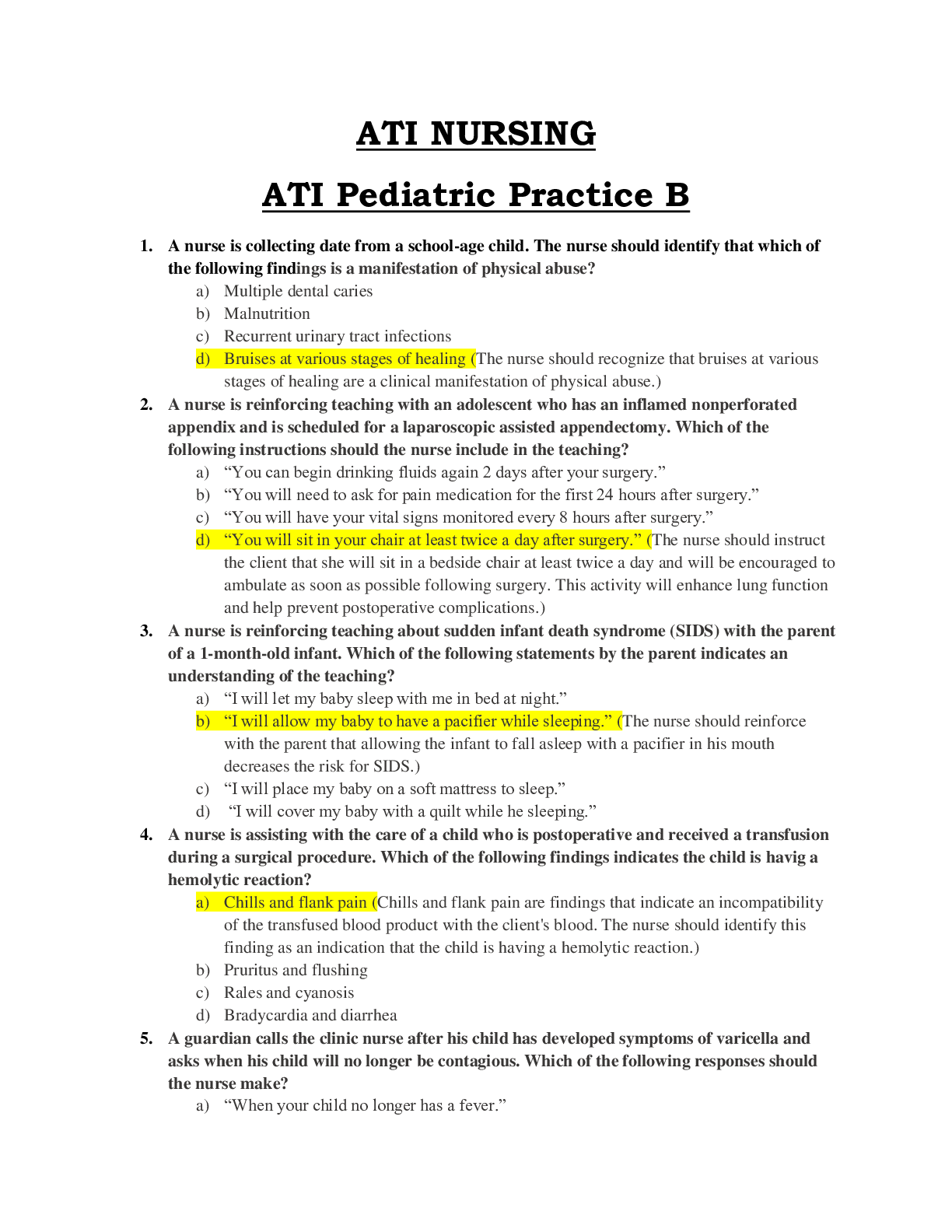
1. Complete an ATI Focused Review® and send a detailed summary (2-3 sentences each) of 4
concepts that you learned from the focused review to me in the messaging system.
Expect
...
ATI NURSING vati pediatric remediation T
1. Complete an ATI Focused Review® and send a detailed summary (2-3 sentences each) of 4
concepts that you learned from the focused review to me in the messaging system.
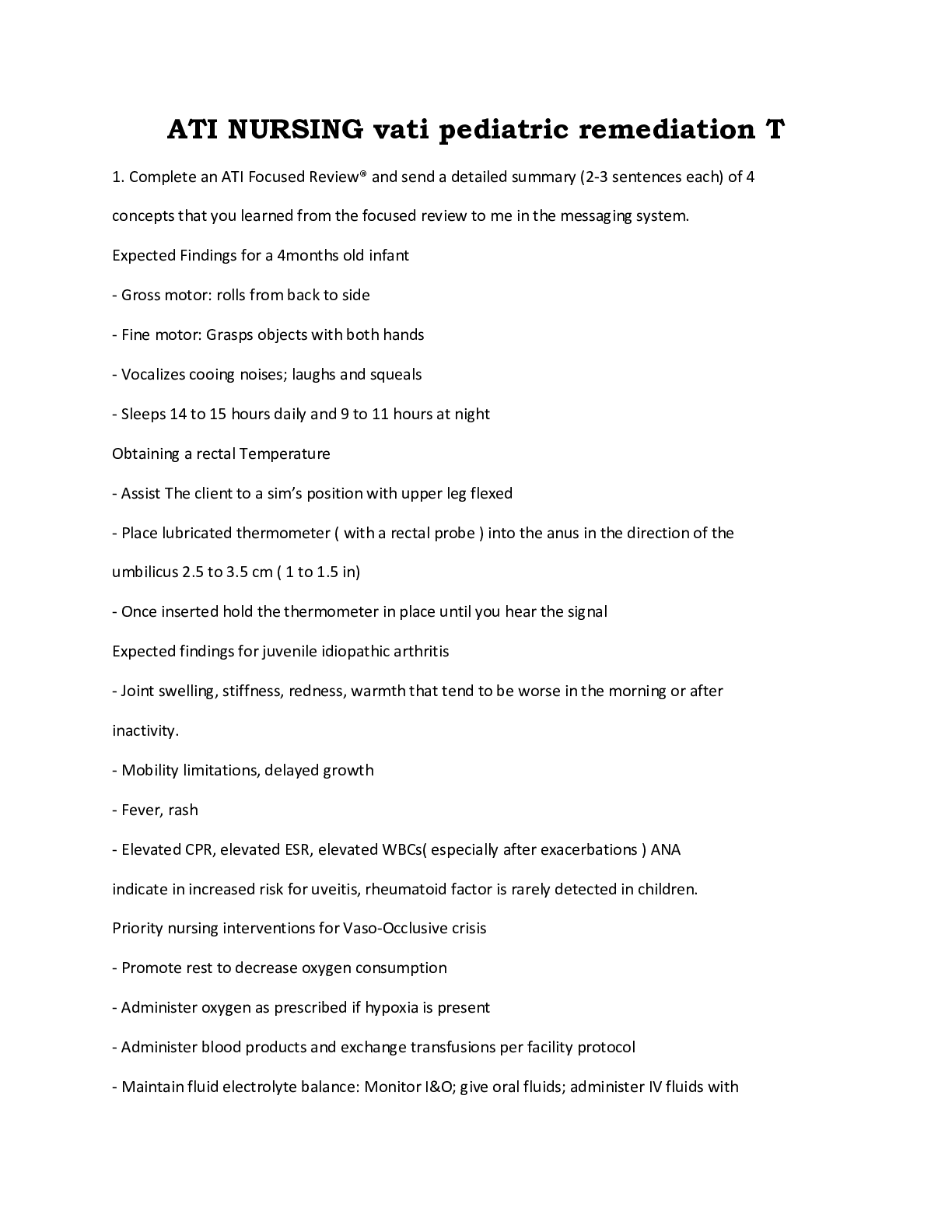
Expected Findings for a 4months old infant
- Gross motor: rolls from back to side
- Fine motor: Grasps objects with both hands
- Vocalizes cooing noises; laughs and squeals
- Sleeps 14 to 15 hours daily and 9 to 11 hours at night
Obtaining a rectal Temperature
- Assist The client to a sim’s position with upper leg flexed
- Place lubricated thermometer ( with a rectal probe ) into the anus in the direction of the
umbilicus 2.5 to 3.5 cm ( 1 to 1.5 in)
- Once inserted hold the thermometer in place until you hear the signal
Expected findings for juvenile idiopathic arthritis
- Joint swelling, stiffness, redness, warmth that tend to be worse in the morning or after
inactivity.
- Mobility limitations, delayed growth
- Fever, rash
- Elevated CPR, elevated ESR, elevated WBCs( especially after exacerbations ) ANA
indicate in increased risk for uveitis, rheumatoid factor is rarely detected in children.
Priority nursing interventions for Vaso-Occlusive crisis
- Promote rest to decrease oxygen consumption
- Administer oxygen as prescribed if hypoxia is present
- Administer blood products and exchange transfusions per facility protocol
- Maintain fluid electrolyte balance: Monitor I&O; give oral fluids; administer IV fluids withelectrolyte replacement
- Treat mild to moderate pain with acetaminophen or ibuprofen; treat severe pain with
opioid analgesics
- Apply warm packs to painful joints
2. Answer the following questions and review the suggested learning activities. Send me your
answers here.
In reinforcing safety education to the parents of 2-year-old, what strategies should the nurse
include to assist in the prevention of falls?
- Doors and windows should be kept locked
- Transition from a crib to bed when the toddler reaches a height of 89 cm (35 in)
- Safety gates should be used across the top and bottom of stairs
A nurse is reinforcing teaching to a new mother about the colic hold. What would the nurse
instruct the client to do?
- Newborn faced down along holder’s forearm firmly between newborn’s legs,newborn’s
cheek should be by the holder’s elbow
A nurse is caring for a preschooler who has amblyopia. What techniques can be used to
encourage the child to keep the patch on their eye?
- You have to explain the importance of keeping the patch on.
- Also offer some form of rewards to a child so she can keep the patch on.
A nurse is going to perform percussion on a school aged client. What techniques for percussion
would the nurse include in her data collection? (Review the Fundamentals Review Module)
- Direct percussion, which involve striking the body to elicit shoulda
- Indirect percussion, which involves placing your hand flatly on the body, as the striking
surface, for sound production
- Fist percussion, which helps to identify tenderness over kidneys, liver, and gallbladder.The nurse is taking a blood pressure on a child. What are some nursing considerations when
doing the procedure?
- Most common sites for blood pressure measurements in children are the upper arm and
lower leg
- Frequently the blood pressure is taken in the lower leg in newborn and infants
- Use the same extremity as baseline in order to determine trends
- The width of the cuff should occupy ¾ of the upper arm segment or length sufficient to
completely encircle arm/leg without overlap.
Suggested Nursing Care of Children Learning Activity: Vital Signs in the Pediatric Population
A nurse is caring for an infant who is 6 months of age. Which of the following findings should
the nurse expect?
- A 6 months old infant should be able to roll from back to front
- Holds a feeding bottle
- Starts to have stranger anxiety
Posterior fontanel closedAnterior fontanel closedTriple birth weightSits unsupported
Suggested Nursing Care of Children Learning Activity: Developmental Stages and Transitions
A nurse is reinforcing education to parents of a child who stutters. What interventions should be
included?
Suggested Nursing Care of Children Learning Activity: Developmental Stages and Transitions
- Avoid finishing sentences for your child
- Speak slowly and calmly to your child
- Maintain a calm, quiet atmosphere at home
A nurse is caring for a child who is 10-years-old. What are some findings that may suggest that
the child is experiencing delays in development?
Suggested Nursing Care of Children Learning Activity: Developmental Stages and TransitionsDelays at least in one of the following
- Social interaction
- Social communication
- Imaginary play prior to 3 years
- Distress when routines are changed
- Unusual attachment to objects
- Inability to start or continue with a conversation
When reinforcing education regarding immunizations, the nurse should include information on
contraindications/precautions. Identify three (3) complications/contraindications that can be
noted after administration of an immunization.
Suggested Nursing Care of Children Learning Activity: Immunizations
- A severe allergic reaction, such as anaphylactic, can occur in response to any vaccine
and is a contraindication for receiving further doses of that vaccine or other vaccines
containing that substance.
- Swelling, redness and tenderness at the site
- Hoarseness,fever,headache,cough and aches.
The nurse is caring for a client who had a cleft lip repair. The nurse will reinforce what feeding
techniques to the parents after this procedure?
- Feeding the infant can be frustrating and slow process
- Burn the infant frequently
- Feeding routinely take longer than forty minutes
- Place nipple against the side of the infant's cheek toward the back of the tongue
- Teach mom to pump as well
Suggested Nursing Care of Children Learning Activity: Cleft Lip and Palate
A nurse is reinforcing education to the parents of a 4-month-old infant regarding introduction ofsolid food. What guidelines should be followed?
- Indicators for readiness include interest in solid food, voluntary control of the head and
trunk, and disappearance of the extrusion reflex
- Iron- fortified cereal is typically introduced first due to its high in iron content
- New foods should be introduced one at a time, over a 5 to 7 day period, to observe for
indications of allergy or intolerance, which can include fussiness, rash, vomiting,diarrhea,
and constipation.
The nurse is caring for a client who is diagnosed with Nephrotic Syndrome. What four (4)
nursing interventions would the nurse do when providing nursing care to this client?
- Administer medication, such as diuretic,antibiotic, and corticosteroids as ordered
- Ask dietitian to plan a low- sodium diet with moderate amounts of protein
- Provide meticulous skin care to combat the edema that usually occurs with nephrotic
syndrome
- Frequently check the patient’s urine for protein, indicated by frothy appearance
The nurse is evaluating the effectiveness of sleep teaching to a group of parents. Identify two
things that the parents have done at home to promote effective sleep patterns in their
preschooler.
- Parents should keep a consistent bedtime routine
- Use a nightlight in the room
- Provide child with a favorite toy
- Leave a drink of water by the bed.
A nurse is caring for a client with asthma who is prescribed Albuterol, a beta2-adrenergic
agonist. Identify two (2) adverse effects of this medication therapy.
- Headache
- Muscles crampsSuggested Nursing Care of Children Learning Activity: Asthma
A nurse is preparing to administer Ampicillin 25 mg/kg PO divided in equal doses every 12
hours to an adolescent who weighs 99 lbs. The amount available is Ampicillin suspension 50
mg/5 ml. How many mL should the nurse administer per dose? (Round to the nearest whole
number). (Review the Fundamentals Review Module)
- 56 mL
3. Complete the pre-test, tutorial and post-test for the Physical Assessment -- Child Skills
Module
4. Complete the following Practice assessments and Focused Review and send a detailed
summary (2-3 sentences each) of 4 concepts that you learned from the focused review to me in
the messaging system.
Risk Factors of Scoliosis
- Genetic tendency
- Sex: more common in females
- Age: highest incidence from 8 to 15 years
Expected findings
- Asymmetry in scapula, ribs,flanks, shoulders and hips
- Improperly fitting clothing ( one leg shorter than the other)
Diagnostic procedures
- Screening during preadolescence
- Observe the child, who should be wearing only underwear, from the back
- Have the child bend over at the waist with arms hanging down and observe for
asymmetry of ribs and flank.
- An advance practice nurse or provider uses a scoliometer to measure truncal rotation.
Radiography is used to determine the degree of the curvature and skeletal maturityNursing care
- Treatment depends on the degree, location, and type of curvature.
Nursing Action
- Assist with fitting the child with a brace
- Inspect skin
- Promote the child’s positive self-image
- Reinforce teaching with the child on how to correctly apply the brace.
[Show More]







.png)
.png)