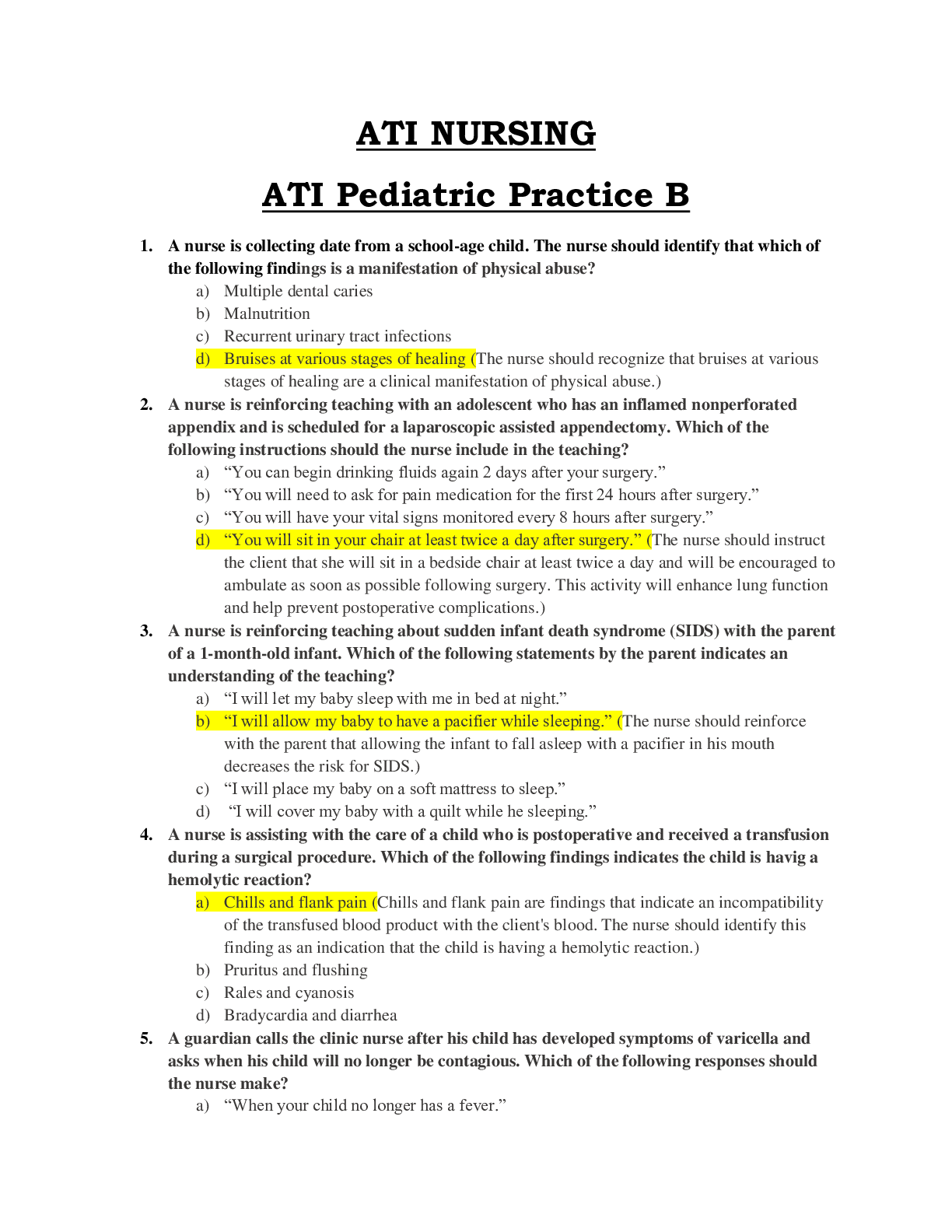
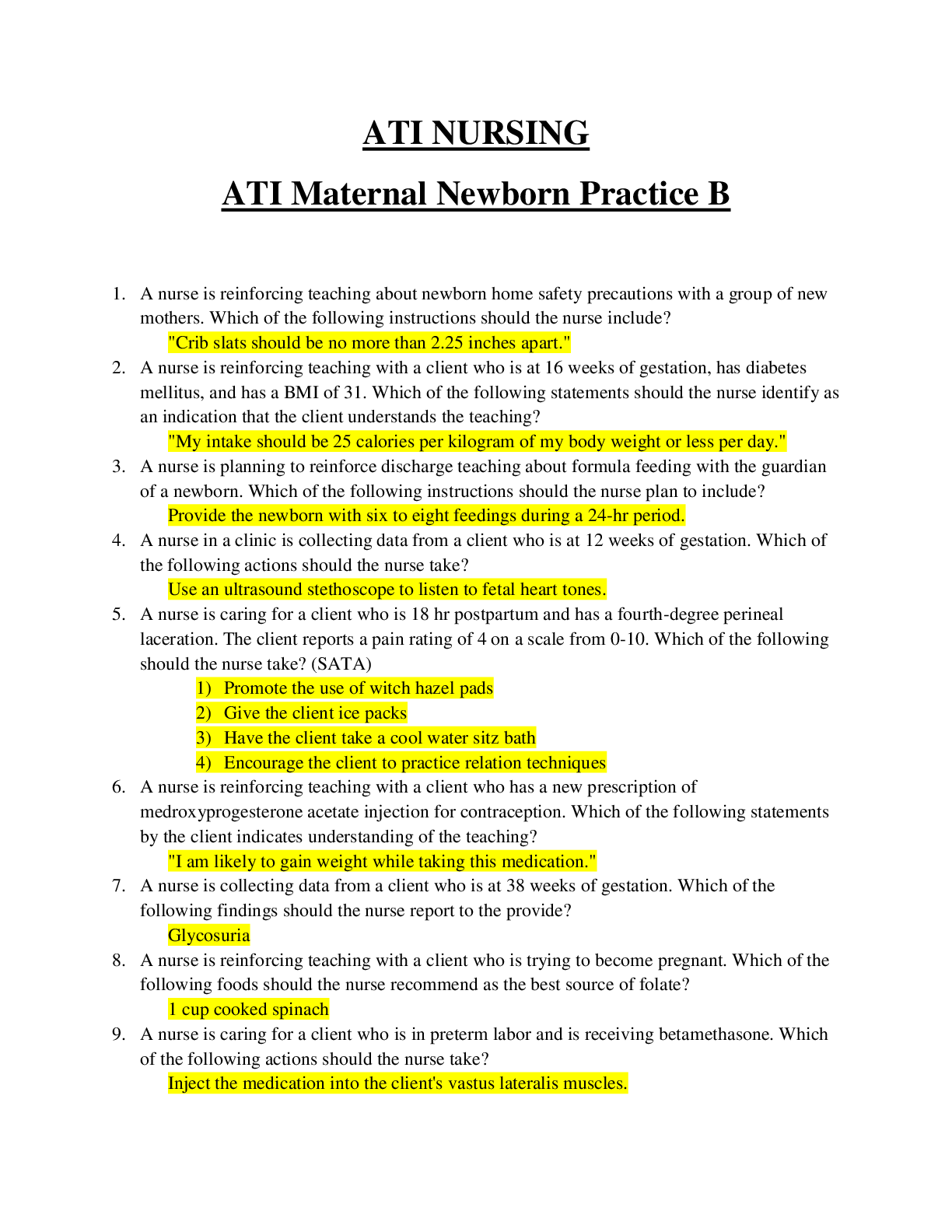
ATI NURSING
9-ATI Pediatric Proctored Exam
A nurse is planning care for a toddler who has a serum lead level of 4 mcg/dL. which of
the following actions should the nurse plan to take?
A- Instruct the parents to decre
...
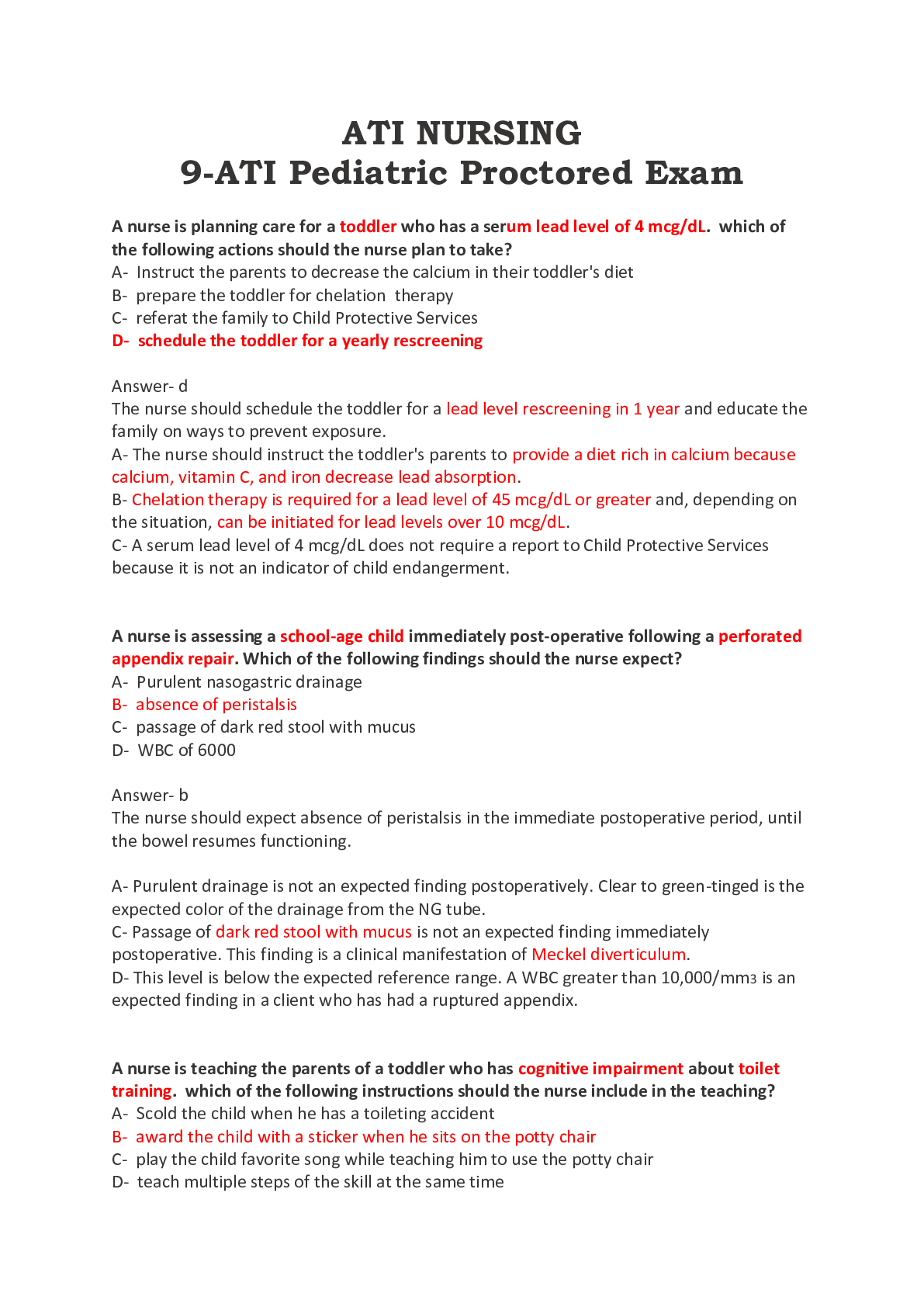
ATI NURSING
9-ATI Pediatric Proctored Exam
A nurse is planning care for a toddler who has a serum lead level of 4 mcg/dL. which of
the following actions should the nurse plan to take?
A- Instruct the parents to decrease the calcium in their toddler's diet
B- prepare the toddler for chelation therapy
C- referat the family to Child Protective Services
D- schedule the toddler for a yearly rescreening
Answer- d
The nurse should schedule the toddler for a lead level rescreening in 1 year and educate the
family on ways to prevent exposure.
A- The nurse should instruct the toddler's parents to provide a diet rich in calcium because
calcium, vitamin C, and iron decrease lead absorption.
B- Chelation therapy is required for a lead level of 45 mcg/dL or greater and, depending on
the situation, can be initiated for lead levels over 10 mcg/dL.
C- A serum lead level of 4 mcg/dL does not require a report to Child Protective Services
because it is not an indicator of child endangerment.
A nurse is assessing a school-age child immediately post-operative following a perforated
appendix repair. Which of the following findings should the nurse expect?
A- Purulent nasogastric drainage
B- absence of peristalsis
C- passage of dark red stool with mucus
D- WBC of 6000
Answer- b
The nurse should expect absence of peristalsis in the immediate postoperative period, until
the bowel resumes functioning.
A- Purulent drainage is not an expected finding postoperatively. Clear to green-tinged is the
expected color of the drainage from the NG tube.
C- Passage of dark red stool with mucus is not an expected finding immediately
postoperative. This finding is a clinical manifestation of Meckel diverticulum.
D- This level is below the expected reference range. A WBC greater than 10,000/mm3 is an
expected finding in a client who has had a ruptured appendix.
A nurse is teaching the parents of a toddler who has cognitive impairment about toilet
training. which of the following instructions should the nurse include in the teaching?
A- Scold the child when he has a toileting accident
B- award the child with a sticker when he sits on the potty chair
C- play the child favorite song while teaching him to use the potty chair
D- teach multiple steps of the skill at the same timeAnswer- b
The child with a cognitive impairment learns through shaping behaviors. The parents should
reward the child for sitting on the potty chair as a reinforcement of the desired behavior of
continence. As the child repeats this action, the parents can gradually decrease this reward
and then give rewards for the next step in the task, such as voiding while sitting on the potty
chair.
A- The parents should use positive reinforcement when teaching their child a new task.
Reinforcing positive behaviors, such as remaining dry through the night, will have a greater
impact on the child than the negative reinforcement of scolding.
C- A child who has a cognitive impairment has difficulty discriminating between two or more
cues or stimuli. The nurse should instruct the parents to eliminate all other stimuli when
teaching the child the task of toilet training.
D- The nurse should instruct the parents to teach one step at a time to the child. Children
who have a cognitive impairment are less able to remember multiple steps. The child should
master each step before the parents introduce the next step.
A nurse in a provider's office is caring for a school-age child who has varicella. The parent
ask the nurse when her child will no longer be contagious. Which of the following
responses should the nurse make?
A- When your child no longer has an increased temperature
B- three days after you first noticed the rash appear on your child
C- when your child lesions are crusted, 6 days after they appear
D- 2 - 3 weeks, when your child's lesions completely disappear
Answer- c
The nurse should inform the parent that the child is contagious 1 day prior to lesion
eruption and until the vesicles have crusted over, which usually takes about 6 days.
A- The nurse should inform the parent that an absence of a fever does not indicate the child
is no longer contagious.
B- The nurse should inform the parents that the child will remain contagious longer than
three days after the lesions appear.
D- The incubation period of varicella is two to three weeks. However, this is not related to
the appearance and disappearance of the lesions.
A nurse is caring for a school-age child who has primary nephrotic syndrome and is taking
prednisone. Following one week of treatment, which of the following clinical
manifestations indicate to the nurse that the medication is effective?
A- Decrease edema
B- increased abdominal girth
C- decreased appetite
D- increased protein in the urine
Answer- aA child who has nephrotic syndrome can experience edema due to the increased glomerular
permeability, which increases protein loss. Prednisone decreases glomerular permeability,
which causes fluid to shift from the extracellular spaces, decreasing edema.
B- The nurse should expect decreased abdominal girth with prednisone therapy.
C- Increased, rather than decreased, appetite is an expected manifestation of corticosteroid
therapy.
D- The nurse should expect decreased protein in the urine with prednisone therapy.
A nurse is caring for a toddler who has spastic (pyramidal) cerebral palsy. Which of the
following clinical manifestations should the nurse expect? Select all that apply.
A- Negative Babinski reflex
B- Ankle clonus
C- exaggerated stretch reflexes
D- uncontrollable movements of the face
E- contractures
Answer- BCE
Negative Babinski reflex is incorrect. A child who has spastic cerebral palsy will exhibit a
positive Babinski reflex.
Ankle clonus is correct. A child who has spastic cerebral palsy will exhibit ankle clonus which
is a rhythmic reflex tremor when the foot is dorsiflexed.
Exaggerated stretch reflexes is correct. A child who has spastic cerebral palsy will exhibit
spasticity or exaggerated stretch reflexes.
Uncontrollable movements of the face is incorrect. Uncontrollable movements of the face
and extremities are manifestations of nonspastic (dyskinetic) cerebral palsy, rather than
spastic (pyramidal) cerebral palsy.
Contractures is correct. A child who has spastic cerebral palsy will exhibit contractures due
to the tightening of the muscles.
A nurse is assessing the vital signs of a 10 year old child following a burn injury. Which of
the following clinical manifestations indicate early septic shock?
A- Blood pressure 130/ 90
B- heart rate 60/ Minute
C- temperature 39.1 degrees Celsius or 102.4 degrees Fahrenheit
D- urinary output 100 mL/hr
Answer- c
The nurse should expect a child who has early septic shock to have a fever and chills.
A- A blood pressure of 130/90 mm Hg is above the expected reference range for a 10-yearold child. The nurse should expect a child who has early septic shock to have a blood
pressure within the expected reference range.
B- A heart rate of 60/min is below the expected reference range for a 10-year-old child. The
nurse should expect a child who has early septic shock to have a heart rate within the
expected reference range.D- Urinary output of 100 mL/hr is above the expected reference range for a 10-year-old
child. The nurse should expect a child who has early septic shock to have urinary output
within the expected reference range.
A nurse is creating a plan of care for a preschooler who has Wilms tumor and is scheduled
for surgery. Which of the following interventions should the nurse include?
A- Avoid palpating the abdomen when bathing the child before surgery
B- refrain from auscultating the child bowel sounds during the post-operative assessment
C- encourage the child to play with other children on the unit prior to surgery
D- explain it to the child that his pain will be managed after the surgery
Answer- a
The nurse should avoid palpating the abdomen when bathing the child before surgery
because movement of the tumor can cause cancer cells to disseminate to other sites,
adjacent and distant to the tumor site.
B- Auscultation of the child's bowel sounds to monitor for an obstruction is an important
part of the postoperative assessment. Therefore, the nurse should auscultate bowel sounds
following the surgery.
C- The child's risk for injury increases with physical activity. Therefore, the nurse should not
encourage the child to play with other children on the unit.
D- Telling the child about pain prior to surgery will likely increase his fear and anxiety level.
Therefore, the nurse should not explain to the child that pain will be managed after surgery.
A charge nurse in an emergency department is preparing an in-service for a group of
newly licensed nurses on the clinical manifestations of child maltreatment. Which of the
following clinical manifestations should the charge nurse include as suggestive of
potential physical abuse?
A- Recurrent urinary tract infections
B- symmetric Burns of the lower extremities
C- growth failure
D- lack of subcutaneous fat
Answer- b
The nurse should include in the teaching that symmetric burns of the lower extremities are
a suggestive clinical manifestation of physical abuse. The patterns are usually characteristic
of the method or object used, such as cigar or cigarette burns, or burns in the shape of an
iron.
A- Recurrent urinary tract infections are a suggestive clinical manifestation of sexual abuse.
C- Growth failure is a suggestive clinical manifestation of physical neglect due to
malnutrition.
D- Lack of subcutaneous fat is a suggestive clinical manifestation of physical neglect. This
manifestation is likely a result of poor healthcare, infections that were untreated, and/or a
lack of or delayed childhood immunizations.The nurse is caring for a 15 year old client following a head injury. Which of the following
findings should the nurse identify as an indication that the child is developing syndrome of
inappropriate antidiuretic hormone secretion SIADH?
A- sodium 148
B- urine specific gravity of 1.020
C- mental confusion
D- weak peripheral pulses
Answer- c
ATI Mental Health Proctored Exam, Latest 16 Versions,
More than 900 Question and Answers.Cover All possible
Answers,, Extremely High reviewed Documents
https://www.stuvia.com/doc/792204/ati-mental-health-proctored-exam-latest-16-versions-morethan-900-question-and-answers.cover-all-possible-answers-extremely-high-reviewed-documents
ATI Maternal Newborn Proctored exam , Latest 11
Versions, More than 900 Question and Answers.
Extremely High reviewed Documents
https://www.stuvia.com/doc/792209/ati-maternal-newborn-proctored-exam-latest-11-versionsmore-than-900-question-and-answers.-extremely-high-reviewed-documents
ATI Community Health Proctored Exam -Latest 23
Versions, More than 2000 Question and Answers.
Extremely High reviewed Documents
https://www.stuvia.com/doc/792213/ati-community-health-proctored-exam-latest-23-versionsmore-than-2000-question-and-answers.-extremely-high-reviewed-documents
ATI Leadership Proctored Exam, (13 Latest Versions),
Extremely High reviewed Documents, Cover All possible
Answers, Updated Correct Answers|Extremely Helpful
during Examhttps://www.stuvia.com/doc/792216/ati-leadership-proctored-exam-13-latest-versions-extremelyhigh-reviewed-documents-cover-all-possible-answers-updated-correct-answersextremely-helpfulduring-exam
ATI Leadership Management Proctored Exam, (2
Versions), Verified Correct Solution. Cover All Possible
Questions
https://www.stuvia.com/doc/792218/ati-leadership-management-proctored-exam-2-versionsverified-correct-solution.-cover-all-possible-questions
ATI Med-Surg Proctored Exam, (Latest 14 Versions),
Cover All possible Answers, Updated Correct
Answers|Extremely Helpful during Exam
https://www.stuvia.com/doc/792224/ati-med-surg-proctored-exam-latest-14-versions-cover-allpossible-answers-updated-correct-answersextremely-helpful-during-exam
ATI Proctored Pharmacology Exam, Latest 15 Versions,
100% verified correct answers, Cover All possible
Answers, Updated Correct Answers|Extremely Helpful
during Exam
https://www.stuvia.com/doc/792235/ati-proctored-pharmacology-exam-latest-15-versions-100-
verified-correct-answers-cover-all-possible-answers-updated-correct-answersextremely-helpfulduring-exam
ATI Comprehensive Predictor Exam, Latest 14 Versions,
Best for Exam Preparation, 100% verified correct
answers
https://www.stuvia.com/doc/792240/ati-comprehensive-predictor-exam-latest-14-versions-bestfor-exam-preparation-100-verified-correct-answers
ATI Comprehensive Predictor Exam, Latest 14 Versions,
More than 2000 Question and Answers. Extremely High
reviewed Documents
https://www.stuvia.com/doc/792246/ati-comprehensive-predictor-exam-latest-14-versions-morethan-2000-question-and-answers.-extremely-high-reviewed-documentsTI Pediatric Proctored Exam Exam, Latest 7 Versions,,
Best for Exam Preparation, Cover All possible Answers,,
100% verified correct answers
https://www.stuvia.com/doc/792249/ati-pediatric-proctored-exam-exam-latest-7-versions-best-forexam-preparation-cover-all-possible-answers-100-verified-correct-answers
ATI Comprehensive EXIT Exam, Latest 14 Versions,
Best for Exam Preparation, Cover All possible Answers,,
100% verified correct answers
https://www.stuvia.com/doc/792254/ati-comprehensive-exit-exam-latest-14-versions-best-forexam-preparation-cover-all-possible-answers-100-verified-correct-answers
ATI Fundamentals Exam/ ATI Fundamentals Proctored
Exam, Latest 7 Versions, Cover All possible Answers,,
Best for Exam Preparation, 100% verified correct
answers
https://www.stuvia.com/doc/792258/ati-fundamentals-exam-ati-fundamentals-proctored-examlatest-7-versions-cover-all-possible-answers-best-for-exam-preparation-100-verified-correctanswers
[Show More]







.png)
.png)