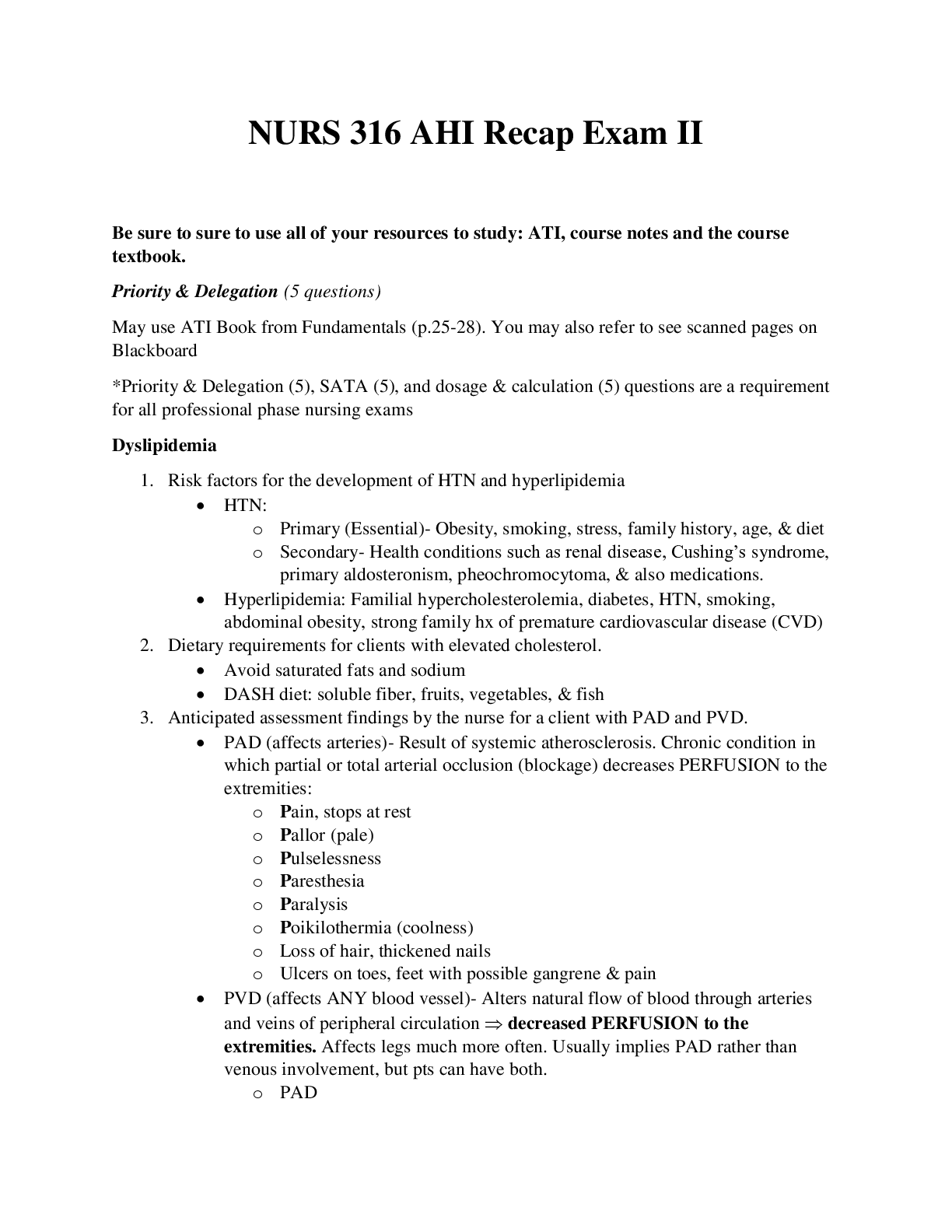
NURS 316 AHI Recap Exam II
Be sure to sure to use all of your resources to study: ATI, course notes and the course
textbook.
Priority & Delegation (5 questions)
May use ATI Book from Fundamentals (p.25-28). You may a
...
NURS 316 AHI Recap Exam II
Be sure to sure to use all of your resources to study: ATI, course notes and the course
textbook.
Priority & Delegation (5 questions)
May use ATI Book from Fundamentals (p.25-28). You may also refer to see scanned pages on
Blackboard
*Priority & Delegation (5), SATA (5), and dosage & calculation (5) questions are a requirement
for all professional phase nursing exams
Dyslipidemia
1. Risk factors for the development of HTN and hyperlipidemia
HTN:
o Primary (Essential)- Obesity, smoking, stress, family history, age, & diet
o Secondary- Health conditions such as renal disease, Cushing‟s syndrome,
primary aldosteronism, pheochromocytoma, & also medications.
Hyperlipidemia: Familial hypercholesterolemia, diabetes, HTN, smoking,
abdominal obesity, strong family hx of premature cardiovascular disease (CVD)
2. Dietary requirements for clients with elevated cholesterol.
Avoid saturated fats and sodium
DASH diet: soluble fiber, fruits, vegetables, & fish
3. Anticipated assessment findings by the nurse for a client with PAD and PVD.
PAD (affects arteries)- Result of systemic atherosclerosis. Chronic condition in
which partial or total arterial occlusion (blockage) decreases PERFUSION to the
extremities:
o Pain, stops at rest
o Pallor (pale)
o Pulselessness
o Paresthesia
o Paralysis
o Poikilothermia (coolness)
o Loss of hair, thickened nails
o Ulcers on toes, feet with possible gangrene & pain
PVD (affects ANY blood vessel)- Alters natural flow of blood through arteries
and veins of peripheral circulation decreased PERFUSION to the
extremities. Affects legs much more often. Usually implies PAD rather than
venous involvement, but pts can have both.
o PADo Venous insufficiency
Ache on dependency
Pulses WNL
Normal or cyanotic color
Normal or slightly cool temp
Edema present
Brown pigmentation at ankles, skin thickened
Ulcers on ankles with no gangrene or severe pain
4. Cholesterol: less than 200 mg/dL
Triglycerides: less than 150 mg/dL
HDL cholesterol: 60 mg/dL (low is bad)
LDL cholesterol: 60-130 mg/dL (high is bad)
HTN
5. Which medications discussed in Unit I: Fluids and Electrolytes are related to the
treatment of patients diagnosed with HTN? What medication instructions are important to
include?
diuretics
-get BP checked by HCP often (every 2 weeks)
-encourage K+ rich diet (citrus fruits, potatoes)
-check K+ labs (if K+ labs have not been drawn, suggest it to provider)
-WATCH FOR IRREGULAR HEART RATE
6. How is HTN identified and diagnosed? What are presenting clinical manifestations?
Pregnancy, Cushing‟s syndrome, chronic renal failure, diabetes,
hypo/hyperthyroidism, & high BP x3 with same HCP.
-usually none until it causes organ damage, sometimes an occipital headache may
present but this is rare
7. What are modifiable and non-modifiable risk factors for HTN as referenced in the
textbook?
smoking, stress (reduce stress response), & diet: avoid foods high in Na+ &
cholesterol (red meat and visible fat); use EVOO and DASH diet
race/genetics, family history, & age
8. List blood pressure ranges for normotension (normal blood pressure), pre-HTN, Stage 1
and Stage 2 HTN as referenced in the textbook?
Normotension: less than
Pre-HTN:
Stage 1:
Stage 2:
9. Identify treatment interventions for patients with normotension, pre-HTN, Stage 1 and
Stage 2 HTN. What cardiovascular assessment parameters should the nurse follow when
administering these medications? * Review HTN handout on Blackboard.
-normotension: keep up good work-preHTN: life-style changes
-stage 1 HTN: diuretics (combination)
-stage 2 HTN: Anti HTN drugs and diuretics
Assess vital signs: HR & BP.
10. List common causes for primary HTN and secondary HTN discussed in class.
Essential- not caused by an existing health problem. Lifestyle & genetics.
Secondary- Caused by an existing health problem.
11. List complications of HTN discussed in class, and key interventions to avoid each
complication.
HF, renal disease, arterial insufficiency, & venous insufficiency
Na restriction, weight maintenance, diet, & complementary & alternative therapy.
12. Explain the procedure for taking a two-step blood pressure measurement. How are the
systolic blood pressure and a palpable blood pressure related?
If only patient's carotid pulse is palpable, the systolic BP is 60-70 mm Hg. if
carotid and femoral pulses are palpable, the systolic BP is 70-80 mm Hg. If the
radial pulse is also palpable, the systolic BP is more than 80 mm Hg
13. How do meds ending in „pril‟ and „olol‟ correspond to classifications of anti-HTN meds
discussed in class? Which CV assessment parameters should the nurse follow when
administering these meds?
-pril (lisinopril): ACE inhibitors -> Check K+ blood levels b4 administering.
*Low K+ diet.
-olol (Atenolol): Beta blockers-> HR should be monitored bc cardio-selective
14. Which dietary instructions should be included for clients taking anti-HTN medications?
Dietary Approaches to Stop HTN (DASH)
15. List key nursing interventions for HTN patients receiving ACE inhibitors.
-assess for cough
-avoid K+ substitutes (ACE inhibitors cause body to retain K+)
-compliance (NEVER suddenly stop taking med to avoid rebound HTN)
-take this med 1 hour BEFORE meals
16. More common name for lipid-lowering meds aka HMG-CoA reductase inhibitors? 3
generic med exs of statin meds, 5 common side effects, and 5 nursing interventions?
Statins
3 Generic Medications
o Atorvastatin (Lipitor)
o Simvastatin (Zocor)
o Lovastatin (Mevacor)
5 Common side effects: Abdominal cramps, constipation, diarrhea, heartburn, &
rashes.
5 Nursing interventions: Evaluate serum cholesterol and triglyceride levels b4
initiating & periodically. Monitor liver function tests b4 initiating. If pt develops
muscle tenderness during therapy, monitor CK (creatinine kinase) levels; if
greatly elevated, discontinue med. Administer lovastatin w/ food at dinner. Avoid
large amounts of grapefruit juice.
17. HTN management (ABCD): Angiotensin-converting enzyme inhibitors/Angiotensin II receptor blockers (Can
cause HYPERKALEMIA)- lisinoPRIL (ACE), ValsarTAN (ARB)
Beta blockers- atenoLOL (BB- Not for use in HF or bronchial asthma)
Calcium channel blockers- AmlodiPINE (CCB- ^ DIGOXIN levels)
Diuretics- HydrochloroTHIAZIDE (diuretic) *electrolyte disturbances
18. Secondary HTN causes: (ABCDE)
Aldosterone/Apnea
Bad kidney/Bruits
Catecholamines/Cushing syndrome
Drugs/Diet
Endocrine
19. HTN nursing interventions (DIURETIC)
Daily weight
Intake and output
Urine output
Response of blood pressure
Electrolytes
Take pulses
Ischemic episodes (transient ischemic attack)
Complications (four Cs)
o Coronary artery disease (CAD)
o Coronary rheumatic fever
o Congestive heart failure (CHF)
o Cardiovascular accident (CVA)
20. Review Laboratory Profile (Chart 33-2) p.656
Immune/Hypersensitivity Reactions
21. Discuss the nursing care for procedures and tests that diagnose hypersensitivity reactions.
skin patch- done to determine which specific allergens, if any, cause an allergic
reaction; they can also test for irritation
o place patch on arm or back for 48 hours and avoid activities that cause
excessive sweating
skin injection (intradermal test)- small amount of allergen is injected into skin
o the site should be examined for a reaction (the 5 ORs) after 15 mins
-weal may form (looks like mosquito bite): glucocorticoids can be used to
treat this
-anaphylaxis may develop so the nurse should have the pt remain nearby for
20-30 min to be sure they will not go into shock
blood tests (RAST test and WBC): can test for x reactions at once. Blood test that
evaluates the severity of an allergy by measuring how much IgE reacts with the
allergen. On a scale of 0 to 5 (higher the # the + likely for a reaction to allergen)
22. Discuss the anatomic locations and functions of immunoglobulins synthesized in
response to allergens: IgA, IgD, IgE, IgG, IgM. IgA (Active, have disease)- located in secretions such as mucous membranes and
intestinal mucosa
o prevents infection in upper and lower respiratory tract, GI, and GU tract
IgD- found mostly on surface of B-lymphocytes
o plays a role in B cell activation and works w/ IgM so they are both present in
low blood concentrations
IgE (Everywhere)- acts as a mediator of many allergic responses by inactivating
the allergen
o least concentrated immunoglobulin.
o defends against parasitic invasions
IgG (Gone, don‟t have disease)- most abundant of IGs (makes up 75%)
o levels increase on 2nd and subsequent exposure to allergen to provide LONG
TERM IMMUNITY
o enhances neutrophils and macrophage actions
IgM (immediate, not sure if have disease)- initial antibody produced after an
infection)
o makes up 10-15% of all immunoglobulins and is the largest
o performs agglutination and precipitation
o activates complement pathway
23. Describe with examples types of immunity: natural, artificial (acquired), active, passive
Natural- exposure to disease or microorganism, producing antibodies.
Natural active- exposure to a live pathogen, develops the disease, and
becomes immune ex: chicken pox
Natural passive- something else or someone else makes antibodies
o Ex: babies can get antibodies from mom through placenta or breast milk
Artificial/acquired- Purposely inject antigen so immune system can respond and
make antibodies
Artificial/acquired active- vaccine
Artificial/acquired passive- injecting antibodies
Active- antibodies develop after exposure to an antigen thru disease or vaccine.
Passive- antibodies produced artificially are being injected
24. List strategies that promote antibody-mediated immunity.
Children
o ***FOLLOW IMMUNIZATION SCHEDULE
-get Heb B shot at birth (within 24 hours of life), again at 2 months, and
again at 1 year
-also at 2 months: get TDAP, Hib, IPV, PCV, RV
Adults- **FOLLOW IMMUNIZATION SCHEDULE
-age 60 and older: get herpes zoster (shingles) vaccine
-age 65 and older: get pneumococcal vaccine (get it when younger if smoker)
-get flu shot every 6 months
25. Discuss nursing interventions for the client admitted to the nursing unit with a latex
allergy.
Mild- contact dermatitis: rash, urticaria, itching, and/or redness
Severe- anaphylaxis; usually occurs due to an inhalation reaction Nursing interventions:
o -educate pt about S&S of latex reaction and products that contain latex
-pt should have ID band stating they have a latex allergy
-latex free room (aka avoidance therapy)
-sign should be posted above room door and above bed stating allergy
-manage allergic reaction (proper meds, EpiPen, & all members of
healthcare team should be notified)
26. Describe clinical manifestations and immune system components/cells involved in Type
I, Type II, Type III, and Type IV hypersensitivity reactions.
Type I (Rapid hypersensitivity reactions/Atopic allergy)- immediate (occurs
within minutes) or IgE-mediated. IgE antibodies attached themselves to mast cell
receptors which causes the mast cell to release histamine and other inflammatory
mediators that is toxic to both the allergen and host cells. Typically causes
anaphylactic shock. *Mast cells
o Latex allergy
o Clinical manifestations:
-Most common- rhinitis -clear rhinorrhea
-sneezing and sinus pressure -itchy, watery eyes
-headache and itching
Type II (Cytotoxic reactions)- antibody-dependent process in which specific
antibodies bind to antigens, resulting in tissue damage or destruction.
o Hemolytic anemias
o Immune thrombocytopenic purpura – (ITP)
o Hemolytic transfusion reactions
o Goodpasture’s syndrome (glomerulonephritis)
Type III (immune complex reactions- rheumatoid arthritis or systemic lupus
erythematosus)- Excess antigens cause immune complexes to form in blood.
Circulating complexes lodge in small blood vessels. Clinical manifestations:
Kidneys, skin, joints -> inflammation and tissue damage.
Type IV (delayed/ t-cell mediated)- T-lymphocytes cause a reaction. Clinical
manifestation: edema, redness, fever, and tissue damage.
o 3 common examples
-contact dermatitis (Latex “allergy”- inflammation of skin d/t chemicals
NOT latex)
-Purified Protein Derivative (PPD): wheals may form
-Local response to insect stings.
-tissue transplant rejections
Pain Management
27. What is the purpose of a symptom analysis for pain assessment?
to gather subjective data (most reliable indicator of pain. most comprehensive
way of assessing pain
OPQRSTUAAA
28. How should the nurse validate the client's c/o severe pain? using objective data as well as a pain scale
29. Define acute pain; define chronic pain. How are they similar? How are they different?
Acute- pain that last for 3 months or less and has a sudden onset. usually linked to
specific tissue injury
Chronic- pain that is present for longer than 3-6 months
Similar: Can be both a nursing dx and medical dx, nursing interventions for both
are similar
Different: Pt behavior may be different depending on whether or not pain is acute
or chronic, vital signs different, timing different
30. What is the purpose of acute pain? of chronic pain?
warning sign that something is wrong
none
31. Describe 2 categories of nociceptive pain; give a postoperative example of each.
Midline incision from surgery, goes from xiphiod process to top of umbilicus
Debridement: done after burns to remove eschar (hardened slough that looks like
leather; it is hard; traps bacteria. can be grey, green, yellow, and black)
32. Describe 3 causes of postoperative neuropathic pain.
-phantom limb pain (after amputation)
-infection (can cause neuritis)
-diabetic neuropathy
33. Define 4 types of pain with respect to location.
-nerve pain
-somatic pain (skin, muscle, skeletal)
-radiating pain (starts in one area and spreads until a larger area hurts)
-referred pain (ex- pain from the pancreas, which is felt in the back.)
34. Describe non-pharmacologic methods of pain relief.
-prayer and meditation -repositioning -exercise/ physical therapy
-music -TV (contraindicated in pt's with Meinere's disease)
-cold (decreases swelling and functions as an anesthetic) and warm compresses
(RICE) -deep breathing
35. Discuss medication teaching instructions for the client who has been prescribed opioid
analgesics for postoperative pain relief.
can cause constipation: prevent Colace from working which is a laxative that
makes you have a BM; PRUNE JUICE IS HIGH IN FIBER
-FFA (fluids, fiber, ambulate) -respiratory assessment -assess pain
-encourage pt to monitor who has access to his or her meds
36. What are the most severe side effects of opioid analgesics? of NSAIDs?
Opioid analgesics- respiratory depression
NSAIDs- Renal failure, bleeding
37. Discuss medication teaching instructions for the client who has been prescribed fentanyl
patches for pain relief.
-wash area w/ mild soap and water after removing old patch
-DO NOT use alcohol to remove patch -dispose old patch in sharps
38. Discuss best-practice procedures for the client receiving round-the-clock pain medication.
Call HCP if pain gets worse or if it does not get better in about 3 days39. Discuss the nurse's role in assessing the client with a high pain tolerance, with a low pain
tolerance.
High- tell them they are doing well; appeal to culture or behaviors to get them
more comfortable with you
Low- get OBJECTIVE signs, listen to whatever pt says about pain (you must
believe them)
-they usually have anxiety so sit down with pt and use therapeutic use of touch
and self and encourage deep breathing
40. Adjuvant analgesics are effective against which type of pain?
-antidepressants that are effective against neuropathic pain when prescribed with
another milder analgesic.
41. Discuss purpose and components of the WHO Analgesic Ladder.
to classify pain and organize treatment
-mild to moderate pain (1-3)
o **Non-opioids
-aspirin
-NSAIDs
-paracetamol
moderate to severe pain (4-7)
o -mild opioids (ex- codeine) with or without non-opioids
severe pain (8-10)
o -Strong opioids (ex- morphine) with or without non-opioids
42. Pain types
Nociceptive pain- Normal pain as result of actual/potential tissue damage or
inflammation.
o Somatic- arises from skin & musculoskeletal structures
o Visceral- arises from organs
Neuropathic pain- Abnormal pain as a result of damage/dysfunction of PNS &/or
CNS.
“burning”, “shooting”, “tingling”, “feeling pins and needles”
[Show More]




x.png)

![Preview of NUR2488 / NUR 2488 Exam 2 Study Guide [In Class Review] : Mental Health Nursing - Rasmuss](https://scholarfriends.com/storage/Mental Health Exam 2 Study Guide [In class review] MY21.png)





![Preview of NURS 6541 Week 7 Quiz [Completed A]](https://scholarfriends.com/storage/NURS 6541 Week 7 Quiz.png)