Biochemistry Readiness Check
The 2nd OA Readiness Check is designed to give you additional practice with
new assessment-style questions to help prepare for success on the OA. Thus,
please try to mimic exam-like condit
...
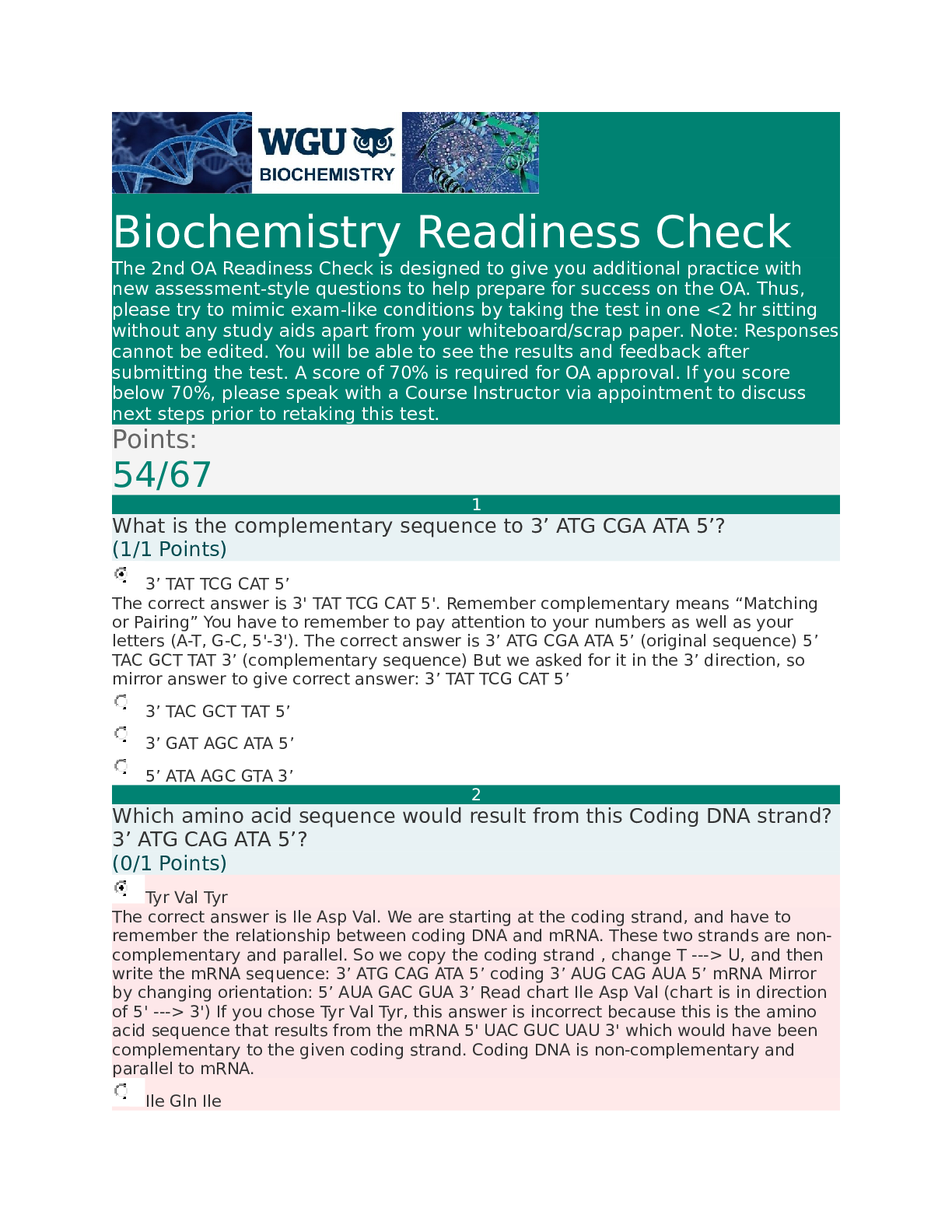
Biochemistry Readiness Check
The 2nd OA Readiness Check is designed to give you additional practice with
new assessment-style questions to help prepare for success on the OA. Thus,
please try to mimic exam-like conditions by taking the test in one <2 hr sitting
without any study aids apart from your whiteboard/scrap paper. Note: Responses
cannot be edited. You will be able to see the results and feedback after
submitting the test. A score of 70% is required for OA approval. If you score
below 70%, please speak with a Course Instructor via appointment to discuss
next steps prior to retaking this test.
Points:
54/67
1
What is the complementary sequence to 3’ ATG CGA ATA 5’?
(1/1 Points)
3’ TAT TCG CAT 5’
The correct answer is 3' TAT TCG CAT 5'. Remember complementary means “Matching
or Pairing” You have to remember to pay attention to your numbers as well as your
letters (A-T, G-C, 5'-3'). The correct answer is 3’ ATG CGA ATA 5’ (original sequence) 5’
TAC GCT TAT 3’ (complementary sequence) But we asked for it in the 3’ direction, so
mirror answer to give correct answer: 3’ TAT TCG CAT 5’
3’ TAC GCT TAT 5’
3’ GAT AGC ATA 5’
5’ ATA AGC GTA 3’
2
Which amino acid sequence would result from this Coding DNA strand?
3’ ATG CAG ATA 5’?
(0/1 Points)
Tyr Val Tyr
The correct answer is Ile Asp Val. We are starting at the coding strand, and have to
remember the relationship between coding DNA and mRNA. These two strands are noncomplementary and parallel. So we copy the coding strand , change T ---> U, and then
write the mRNA sequence: 3’ ATG CAG ATA 5’ coding 3’ AUG CAG AUA 5’ mRNA Mirror
by changing orientation: 5’ AUA GAC GUA 3’ Read chart Ile Asp Val (chart is in direction
of 5' ---> 3') If you chose Tyr Val Tyr, this answer is incorrect because this is the amino
acid sequence that results from the mRNA 5' UAC GUC UAU 3' which would have been
complementary to the given coding strand. Coding DNA is non-complementary and
parallel to mRNA.
Ile Gln IleIle Asp Val
Leu His Lys
3
Which amino acid sequence would be made from this template DNA
strand? 5’ TAT TAC CGA 3’?
(1/1 Points)
Tyr Tyr Arg
Ile Met Ala
Ser Val Ile
The correct answer is Ser Val Ile because 5’ TAT TAC CGA 3’ template is complementary
and antiparallel so 3’ AUA AUG GCU 5’ but it is in the wrong orientation, so mirror 5’
UCG GUA AUA 3’ and read the chart Ser Val Ile
Ser His Gln
4
Which of the following are the correct components for a PCR reaction?
(1/1 Points)
dNTPs, Primer, RNA Polymerase, template RNA
dNTPs, Primer, DNA Polymerase, template DNA
The correct answer is dNTPs, Primer, DNA Polymerase, template DNA. Notice that all
components are about DNA. The Primer is even a DNA Primer.
ATP, Primer, mRNA polymerase; template mRNA
Acetyl CoA, RNA primer, DNA Ligase, Template phosphate
5
Assuming 100% reaction efciency, how many DNA copies will be
produced after 5 PCR cycles, if we begin with 1 DNA template?
(1/1 Points)
16
32
The correct answer is 32. 2x2x2x2x2=32
64
10
6
Which of the following would represent a silent mutation if this is the
original sequence: 5’ AUC GUA ACA 3’?
(1/1 Points)
5’ AUC GGA ACA 3’
5' AUA GUA ACA 3'
The correct answer is 5' AUC GUA ACA 3' Ile Val Thr5’ AUG GUA ACA 3’
5’ AUC GCA ACA 3’
7
If the original coding sequence is 5’ CGA TAC TTC AGA 3’ and it is
mutated to 5' CGA TAT TTC AGA 3', what type of mutation would have
taken place?
(0/1 Points)
Silent
Missense
The correct answer is silent mutation. The nucleotide sequence changes, but it codes for
the same amino acid. The coding sequence 5' TAC 3' corresponds to the mRNA
sequence 5' UAC 3' (Tyr), and the coding sequence 5' TAT 3' corresponds to the mRNA
sequence 5' UAU 3' (Tyr). Since the C changed to at T, this is a point mutation. If the
point mutation results in the same amino acid in the new sequence as in the original
sequence, the point mutation is a silent mutation.
Nonsense
Insertion
8
This learning objective is now tested in a different WGU course than
Biochemistry. Please select True.
True
The correct answer is Option 1 because an autosomal dominant disorder would be
inherited on numbered chromosomes, not sex chromosomes X or Y. Also, at least one
dominant allele (yellow box) needs to be present for the individual to have the dominant
disease.
False
9
This learning objective is now tested in a different WGU course than
Biochemistry. Please select True.
True
The correct answer is X- linked recessive because parents (carriers) do not have it (II-5-
6) but a child does (III-5). You will get the same result if you consider parents (carriers)
(I-1-2), who do not have the trait, but a child does (II-3). A third option that gives the
same result (X-linked recessive) is by considering parents (carriers) who do not have the
trait (III-1-2), and their child does (IV-1). The pattern is recessive because the selected
parents are carriers, and it is X-linked because only males have the trait.
False
10
This learning objective is now tested in a different WGU course than
Biochemistry. Please select True.
TrueThe correct answer is 50%. Homozygous recessive: aa Heterozygous: Aa When you see
"percentage" or "probability," think Punnett square. 50% of the children would be
expected to be Aa, and 50% of the children would be expected to be aa.
False
11
Which of the following describes an epigenetic change?
(0/1 Points)
Denaturation of template DNA to facilitate primer annealing.
Increased methylation of the promoter region of a tumor suppressor gene in a
developing fetus.
Thymine dimer formation resulting from UV radiation.
The correct answer is "Increased methylation of the promoter region of a tumor
suppressor gene in a developing fetus."
Mismatch mutation caused by mistakes made by DNA Polymerase during
replication.
12
Rett syndrome is a brain disorder that occurs almost exclusively in
females, causing severe defcits in language, learning, coordination
and other brain functions. Decreased expression of the MECP2 gene
causes Rett syndrome. Which of the following scenarios correctly
describes how Rett syndrome could be developed?
(0/1 Points)
A DNA-binding protein blocks RNA Polymerase from binding to the promoter
sequence, facilitating the transcription of the MECP2 gene.
The answer is "Transcription factors are unable to bind to the transcription start site of
the MECP2 gene because nucleosomes are tightly packed together." Think "increased
space gives increased access and increased expression." Gene expression is increased
when nucleosomes are widely spaced and transcription factors and RNA Polymerase are
able to bind to the transcription start site of the gene. In this question, decreased
expression is resulting from decreased space between the nucleosomes, so the RNA
Polymerase and transcription factors have decreased access to the transcription start
site of the gene. If you answered, "A DNA-binding protein blocks RNA Polymerase from
binding to the promoter sequence, facilitating the transcription of the MECP2 gene," this
answer is incorrect. Transcription factors are proteins that bind to the promoter region
on the 5' side of the gene to be expressed. The RNA Polymerase then binds to the
transcription start site.
Transcription factors are unable to bind to the transcription start site of the MECP2
gene because nucleosomes are tightly packed together.
Transcription activators cause nucleosomes to separate, exposing the MECP2 gene.
RNA Polymerase binds to the MECP2 gene and begins translation.
13
What happens when the incorrect base is added during the synthesis
of a DNA strand in DNA replication?
(1/1 Points)The homologous chromosome is used to replace the incorrectly added base with the
correct one.
DNA Polymerase removes the incorrect base and adds in the correct base.
The correct answer is "DNA Polymerase removes the incorrect base and adds in the
correct base." DNA Polymerase repairs mismatch errors that occur during DNA
replication.
Thymine dimers occur.
Distortion of the double helix occurs and is repaired by RNA Polymerase.
14
What is the correct defnition of nucleotide excision repair?
(1/1 Points)
Removal of a single damaged nucleotide
Damage to a few or several nucleotides are identifed, then many nucleotides are
removed and all are replaced to repair the DNA segment
The correct answer is "Damage to a few or several nucleotides are identifed, then many
nucleotides are removed and all are replaced to repair the DNA segment." In nucleotide
excision repair, several nucleotides are removed whereas, in BER (base excision repair),
a single nucleotide is removed.
Required when there are breaks in the double stranded DNA strand which causes
discontinuity in both strands
Insertion of a thymine dimer
15
If arginine is mutated to leucine within a protein, how would the
structure of the protein be affected?
(1/1 Points)
Ionic bonds will continue to form, allowing the protein to fold as normal.
Hydrophobic interactions will continue to occur resulting in normal folding.
Ionic bonds will no longer form, potentially causing the protein to misfold.
The correct answer is "Ionic bonds will no longer form, potentially causing the protein to
misfold." Since arginine is a positively-charged amino acid, it would have formed an
ionic bond with a negatively-charged amino acid in the protein. Leucine is not charged
and is hydrophobic, so it will not form this same ionic bond, and could lead to protein
misfolding.
Hydrophobic interactions will be broken, potentially causing aggregation.
16
Which pair of amino acids below could bond together to stabilize the
tertiary structure of a protein?
(0/1 Points)
Option 1
Option 2The correct answer is "phenylalanine" and "methionine." Phenylalanine and methionine
are both nonpolar (hydrophobic) amino acids, and they interact in the core of the
protein through hydrophobic forces.
Option 3
Option 4
17
On a summer's day, I was cleaning my garage. My cat Sophie was out
with me, and got into a bottle containing a strong reducing agent. Of
course I took her straight to the vet. What type of amino acid bonds
would be disrupted by exposure to the strong reducing agent?
(1/1 Points)
Hydrophobic interactions
Hydrogen bonds
Disulfde bonds
The correct answer is covalent (disulfde) bonds. Hydrophobic interactions are disrupted
by heat. Hydrogen bonds and ionic bonds are both disrupted by pH and by salt.
Ionic bonds
18
What type of bond can the amino acids below form to stabilize the
tertiary structure of a protein?
(0/1 Points)
Ionic bond
The correct answer is "hydrogen bond." Each of the amino acids shown is a polar amino
acid, and polar amino acids interact through hydrogen bonds. The NH combined with
the C=O in glutamine places this amino acid side chain into the polar category. The OH
bond in serine places this amino acid side chain into the polar category.
Hydrophobic interaction
Hydrogen bond
Disulfde bond
19
What type of reaction forms the primary structure of a protein?
(1/1 Points)
Activation energy
Enzymes
Dehydration
The correct answer is a dehydration reaction. When two amino acids join together, they
lose water. One loses an O from a carboxyl group, and the other loses two Hs from its
amino group, to give a loss of water. See Study Guide Step 7 for review.
Hydrolysis
20Myoglobin is an oxygen storage protein and exhibits a hyperbolic curve
in an oxygen saturation graph. What is the highest level of protein
structure exhibited by myoglobin?
(1/1 Points)
Primary
Secondary
Tertiary
The correct answer is "tertiary." Myoglobin is made from one polypeptide chain, or is a
"single subunit" protein. Myoglobin's tertiary structure gives it its functional 3D shape. A
hyperbolic curve indicates a "single subunit" protein. A sigmoidal curve indicates a
quaternary (multi-subunit) protein.
Quaternary
21
What level of protein structure involves alpha helices and beta pleated
sheets?
(1/1 Points)
Primary
Secondary
The secondary level has alpha helices and beta pleated sheets. Primary structure is
formed by joining together amino acids through peptide bonds. Secondary structure is
formed by hydrogen bonds between backbone amino acids. Tertiary structure is formed
form interactions between amino acid side chains. Quaternary structure is formed from
interactions between amino acid side chains. Proteins with quaternary structure have
two or more subunits.
Tertiary
Quaternary
22
Glutamine is located at position 13, of a protein, and forms a hydrogen
bond with the amino acid at position 89. What would happen if the
amino acid at position 89 was mutated to alanine?
(1/1 Points)
Nothing, they will bind normally
The hydrogen bond will no longer be formed, and the protein will be misfolded
The correct answer is "The hydrogen bond will no longer be formed, and the protein will
be misfolded. Glutamine is a polar amino acid (NH and also C=O), and alanine is a
nonpolar (hydrophobic) amino acid (CH3), and so alanine will not interact with the polar
amino acid glutamine.
Nothing, they will form a hydrophobic interaction
They will form a disulfde bond
23An elderly patient is diagnosed with Alzheimer’s Disease. Which of the
following is most likely the cause of this neurological disorder?
(1/1 Points)
Disulfde bond formation by cysteine amino acids
Iron defciency
Aggregation of hydrophobic amino acids
The correct answer is "Aggregation of hydrophobic amino acids." Alzheimer's disease
results from abnormal protein aggregation in the brain.
Ionic bonds formed by hydrogen bonding of amino acids
24
What type of interactions would be affected in a patient with diabetic
ketoacidosis? (select all that apply)
(0/1 Points)
Hydrogen bonds
Hydrogen bonds and ionic bonds are affected by a change in pH. Hydrogen bonds and
ionic bonds are also affected by a change in salt concentration.
Ionic bonds
Hydrophobic interactions
Disulfde bonds
25
Hydrogen bonds between backbone groups stabilize what level of
protein structure?
(1/1 Points)
Primary
Secondary
The correct answer is "secondary." Primary structure is formed by joining together
amino acids through peptide bonds. Secondary structure is formed by hydrogen bonds
between backbone amino acids. Tertiary structure is formed form interactions between
amino acid side chains. Quaternary structure is formed from interactions between
amino acid side chains. Proteins with quaternary structure have two or more subunits.
Tertiary
Quaternary
26
What type of bond is found in the primary structure of a protein?
(1/1 Points)
Ionic
Disulfde
Charged
PeptideThe correct answer is "peptide bonds." The primary structure is built by hooking
together amino acids to make the amino acid backbone of the protein. The amino acids
are joined together by peptide bonds.
27
Which of the following is true about protein structure and function?
(0/1 Points)
A protein has optimal function in its primary structure.
All proteins carry out cellular functions when they have obtained their fnal
quaternary structure.
Ionic bonds between the backbone groups of amino acids stabilize a protein's
tertiary structure.
If you chose "All proteins carry out cellular functions when they have obtained their fnal
quaternary structure, this answer is incorrect. If the word "all" is changed to "some,"
then the statement would be a true statement. All proteins have tertiary structure
(made from one polypeptide chain), and only some proteins are built from the two or
more subunits that give quaternary structure. If you chose "ionic bonds between the
backbone groups of amino acids stabilize a protein's tertiary structure," this answer is
incorrect. Ionic bonds form between amino acid side chains, not between backbone
groups. In addition, although the ionic bonds can give some stability to the protein
structure, the hydrophobic effect drives the formation of the core of a protein, which is
the predominant contributing factor to the protein's tertiary structure.
The hydrophobic effect primarily contributes to a single subunit protein's tertiary
structure.
28
Frying an egg in a pan changes the egg white color, due to the protein
ovalbumin, from translucent to white. Which bond or interaction is
most likely to be disrupted within the Ovalbumin?
(1/1 Points)
Ionic bonds
Hydrophobic interactions
The correct answer is "Hydrophobic interactions." Heat will disrupt hydrophobic
interactions. Ionic bonds are disrupted by changes in pH and by salt, and disulfde
bonds are disrupted by reducing agents.
Disulfde bonds
None of the above
29
Which of the following statements correctly describes the difference
between hemoglobin and myoglobin?
(1/1 Points)
Hemoglobin binds oxygen in a cooperative manner, while Myoglobin binds oxygen
with a relatively higher afnity and stores oxygen.
The correct answer is, "Hemoglobin binds oxygen in a cooperative manner, while
Myoglobin binds oxygen with a relatively higher afnity and stores oxygen." Hemoglobin
has 4 subunits and binds oxygen in a cooperative manner. Cooperativity means that asone molecule of oxygen binds to hemoglobin, the shape of hemoglobin changes to
make it easier to bind subsequent molecules of oxygen. Myoglobin’s job is to store
oxygen, so it binds to oxygen with a high afnity and stores it.
Hemoglobin has tertiary structure, while Myoglobin has quaternary structure and
binds oxygen in a cooperative manner.
Hemoglobin stores oxygen and Myoglobin delivers oxygen to oxygen-deprived
muscle tissue.
Myoglobin is bound by 2,3-BPG and changes into the T-state to deliver oxygen
30
Which of the following molecules binds directly to the iron in
hemoglobin?
(1/1 Points)
CO2
Mg
2,3-BPG
CO
CO does bind directly to the iron in hemoglobin, taking the place of oxygen in subunit
bound CO
31
Susie is 18 weeks pregnant with twins and was recently diagnosed with
gestational diabetes. Susie’s twins are developing according to
schedule and Susie hopes to carry the twins as close to full term as
possible. Which statement below describes how a sufcient amount of
oxygen is made available to Susie’s developing fetuses?
(1/1 Points)
Bicarbonate binds to Susie’s hemoglobin and stabilizes the T-state conformation,
which favors the delivery of oxygen to the developing fetuses.
2,3-BPG binds to Susie’s hemoglobin and stabilizes the T-state conformation, which
favors the delivery of oxygen to the developing fetuses.
The correct answer is, "2,3-BPG binds to Susie’s hemoglobin and stabilizes the T-state
conformation, which favors the delivery of oxygen to the developing fetuses." 2,3-BPG
binds to hemoglobin and stabilizes the T-state which favors oxygen delivery.
Carbon monoxide binds to Susie’s hemoglobin and stabilizes the R-state
conformation, which increases the delivery of oxygen to the developing fetuses.
Bicarbonate induces Susie’s hemoglobin to adopt a non-planar conformation and
bind oxygen so that the developing fetuses are sufciently oxygenated.
32
Alex is preparing to run in his frst 5K. As he stretches, his muscles are
producing ATP through aerobic metabolic pathways. A byproduct of a
functioning citric acid cycle is carbon dioxide. How is this carbon
dioxide removed from the body?
(1/1 Points)Carbon dioxide is converted to bicarbonate and binds to hemoglobin, which shuttles
the carbon dioxide to the lungs so that it can be exhaled out of the body.
Carbon dioxide flows through the bloodstream to the lungs so that it can be exhaled
out of the body.
Carbonic anhydrase helps carbon dioxide stick to hemoglobin, which shuttles the
carbon dioxide to the lungs. In the lungs, Carbonic Anhydrase converts carbon dioxide
to a gas so that it can be exhaled out of the body.
Carbonic anhydrase converts carbon dioxide to bicarbonate, which can flow through
the bloodstream to the lungs. In the lungs, Carbonic Anhydrase converts bicarbonate
back to carbon dioxide so that it can be exhaled out of the body.
The correct answer is, "Carbonic anhydrase converts carbon dioxide to bicarbonate,
which can flow through the bloodstream to the lungs." In the lungs, carbonic anhydrase
converts bicarbonate back to carbon dioxide so that it can be exhaled out of the
body.) CO2 is a waste product produced in the tissues from aerobic respiration. The CO2
is converted to bicarbonate (HCO3-) in the tissues as a way to shuttle CO2 to the lungs
so that it can be exhaled out of the lungs. In the lungs, HCO3- is converted back to CO2,
and CO2 is exhaled out of the body.
33
What occurs as the amount of hemoglobin saturated with oxygen
increases?
(1/1 Points)
Hemoglobin adopts the T-state conformation and the heme groups become planar.
Hemoglobin adopts the R-state conformation and the heme groups become planar.
The correct answer is, "Hemoglobin adopts the R-state conformation and the heme
group becomes planar." When hemoglobin binds oxygen (in the lungs) in changes into
the R-state and the heme groups take on a planar shape. Think of hemoglobin as
becoming relaxed as it binds more oxygen, just like you might if you stop and take a
deep breath. Think CHART in the tissues, the opposite in the lungs: C for high CO2, H for
high H+, A for acidity, R for release of oxygen, and T for T state, or benT heme.
Hemoglobin adopts the T-state conformation and the heme groups become bent.
Hemoglobin adopts the R-state conformation and the heme groups become bent.
34
During a morning run on the treadmill, the blood around muscle tissue
becomes increasingly acidic. What happens to hemoglobin when it
encounters this acidic muscle tissue?
(1/1 Points)
Hemoglobin will switch into the R-state and deliver oxygen
Hemoglobin will bind and store oxygen
Hemoglobin will switch into the T-state and deliver oxygen
The correct answer is "Hemoglobin will switch into the T-state and deliver oxygen,"
because Hemoglobin switches into the T-state and delivers oxygen in the acidic (low pH)
environment of exercising muscle tissue. Think CHART: C for high CO2, H for high H+, A
for acidity, R for release of oxygen, and T for T state.Hemoglobin will switch into the R-state and bind oxygen
35
Based on the graph below, which of the following statements is true?
(1/1 Points)
The hemoglobin curve will shift to the right when there is a high concentration of
H+ (protons) and the concentration of CO2 is high.
The correct answer is, "The hemoglobin curve will shift to the right when there is a high
concentration of H+ (protons) and the concentration of CO2 is high." A right shift in the
hemoglobin curve correlates with a decrease in pH. At low pH, H+/proton concentration
is high (this occurs in muscle tissue and tells hemoglobin to release oxygen). In the
muscle tissue, at low pH, CO2 concentration is high because it is being produced by the
muscles. Think CHART in the tissues, the opposite in the lungs: C for high CO2, H for
high H+, A for acidity, R for release of oxygen, and T for T state, or benT heme.
The hemoglobin curve will shift to the left when there is a high concentration of H+
(protons) and the concentration of CO2 is low.
The hemoglobin curve will shift to the right when there is a low concentration of H+
(protons) and the concentration of CO2 is low.
The hemoglobin curve will shift to the left when there is a high concentration of H+
(protons) and the concentration of CO2 is high.
36
If Enzyme 4, in the pathway below, were inhibited, which of the
following would be true?
(0/1 Points)
The amount of A would decrease
The amount of D would increase
The correct answer is, "The amount of E would increase." If enzyme 4 is inhibited, then
D will no longer be made, so C will be converted to E. Thus, E would increase.
The amount of C would decrease
The amount of E would increase
37
Describe what would happen if Enzyme 2 in the pathway below were
inhibited.
(1/1 Points)
The amount of compound C would build up
The amount of compound B would build up
The correct answer is, "The amount of compound B would build up." When an enzyme is
inhibited within a pathway, the enzyme’s substrate builds up and its subsequent
products will decrease.
The amount of compound D would increase
The amount of compound A would decrease
38Which enzyme adds a phosphate group from ATP to a molecule?
(1/1 Points)
Kinase
The correct answer is, "Kinase." A kinase ‘kindly’ adds a phosphate to a molecule and
that phosphate can be removed by a phosphatase. Another way to remember this is
that a kinase is "kind and giving" of a phosphate (from ATP).
Phosphatase
Acetyltransferase
Dehydrogenase
39
Different compounds are needed to carry out essential cellular
functions which maintain a physiological homeostatic balance.
Enzymes catalyze reactions that produce these compounds and, in
doing so, play a pivotal role in our bodies. Which statement below
accurately describes how enzymes catalyze reactions within our cells.
(1/1 Points)
Enzymes increase the activation energy of a reaction.
Enzymes decrease the reaction rate.
Enzymes don’t change the reaction rate.
Enzymes decrease the activation energy of a reaction.
The correct answer is,. "Enzymes decrease the activation energy of a reaction." The
activation energy is the amount of energy required to start the reaction. The lower the
activation energy, the faster the reaction.
40
Asparagine endopeptidase has optimal activity at an acidic pH of 5.5
and a temperature of 98 degrees F. Under which of the following
conditions would the catalytic activity of asparagine endopeptidase be
highest?
(1/1 Points)
In brain tissue at pH 5 following traumatic brain injury
The correct answer is, "In brain tissue at pH 5 following traumatic brain injury." Enzymes
function optimally at their optimal temperature and pH. When the temperature, or pH, is
substantially higher or lower than the optimal conditions for the enzyme, its catalytic
activity decreases.
Exposure to a temperature of 150 degrees F
In renal tissue at pH 10 during alkalosis
Exposure to a temperature of 20 degrees F
41An experimental compound, termed Drug X, can inhibit an enzyme by
binding at a site that is distinct from the enzyme's active site. What
type of inhibitor is Drug X?
(1/1 Points)
Competitive
Non-competitive
The correct answer is, "Non-competitive." An inhibitor that binds to a site other than the
enzyme's active site (allosteric site) is a non-competitive inhibitor.
Sequential
Congruent
42
Alcohol dehydrogenase converts ethanol to acetoacetate. Which one of
the compounds below could act as a competitive inhibitor of alcohol
dehydrogenase?
(1/1 Points)
Option 1
Option 2
Option 3
The correct answer is Option 3, methanol. Alcohol dehydrogenase converts ethanol to
acetoacetate, which means that ethanol is the substrate of the enzyme. A competitive
inhibitor should have a similar structure as the substrate of the enzyme, since they both
compete to bind to the active site of the enzyme. The structure of methanol is very
similar to the structure of ethanol.
Option 4
43
Zylezol is a fctitious drug that attenuates enzymatic activity. Over
time, however, increased concentration of the enzyme’s substrate
renders Zylezol ineffective. What kind of inhibition is used by Zylezol?
(1/1 Points)
Communicative
Non-competitive
Competitive
The correct answer is, "Competitive." Competitive inhibitors compete with substrate to
bind to the active site of an enzyme and can be out-competed by high concentrations of
substrate.
Saturated
44
Melatonin is a molecule, produced primarily in the pineal gland, which
regulates the circadian rhythm. The following pathway depicts how theSerotonin is converted to Melatonin. Which of the molecules listed
below is most likely to act as a feedback inhibitor of the pathway?
(0/1 Points)
Serotonin
AcCoA
The correct answer is, "Melatonin." Since melatonin is the product of the pathway, it can
act as a feedback inhibitor by giving a message (feedback) to one of the frst enzymes
in the pathway, and shut down the pathway. AcCoA is a coenzyme for the enzyme
AANAT. AcCoA must be present in sufcient amounts for AANAT to function. It does not
inhibit enzyme AANAT.
N-acetyl-serotonin
Melatonin
45
In the enzymatic cycle fgure below, identify the step that best
demonstrates where the ‘induced ft model’ would occur.
(1/1 Points)
1 2
The correct answer is Step 2. The induced ft model describes how substrate binds to
the enzyme and forms an enzyme-substrate complex, in which the enzyme wraps itself
around the substrate to convert the substrate into product. Step 2 represents the
formation of the enzyme-substrate complex.
3 4
46
Which molecule would build up if Enzyme 2 were inhibited?
(1/1 Points)
A B
The correct answer is B, because B is the substrate of enzyme 2. When an enzyme is
inhibited within a pathway, the enzyme’s substrate builds up and its subsequent
products will decrease.
C E
47
How many ATP would we expect to produce from glucose after one full
round of aerobic metabolism?
(1/1 Points)
2 46
30
The correct answer is 30. Two ATPs are made from Glycolysis, four is the net loss in the
Cori Cycle, 6 is how many ATP are used in the Cori cycle, and 30 is the correct answer.
From glycolysis through the ETC, we will produce about 30 ATP.
48
What most accurately describes this reaction?
(1/1 Points)
Catabolic
Anabolic
The correct answer is "anabolic," because ATP is being built by adding a phosphate to
ADP to make ATP. Ants like to build (anabolic). In a catastrophe, everything falls apart
(catabolic).
Dehydration
Hydrolysis
49
___________________ molecule enters the citric acid cycle and creates
coenzymes such as ________ and _________that eventually enter the
electron transport chain to produce ATP.
(1/1 Points)
Acetyl CoA; GTP, ATP
Pyruvate; ATP, NADH
Acetyl CoA; NADH, FADH2
The answer is " Acetyl CoA; NADH, FADH2". Acetyl CoA is the common molecule
produced from Fatty acids, Glucose and some proteins that enter the citric acid cycle.
The citric acid cycle in addition to some other molecules such as GTP, Carbon dioxide,
produces NADH and FADH2 that move on to the electron transport chain to help
produce ATP.
Glucose; NADH, FADH2
50
Concomitant with electron transfer, complexes I, III and IV of the
electron transport chain pump protons from the __________ to the
_____________.
(1/1 Points)
Mitochondrial Matrix, Cytoplasm
Cytoplasm, Mitochondrial Matrix
Mitochondrial Matrix, Intermembrane Space
The correct answer is "Mitochondrial matrix. Intermembrane Space," because the
transmembrane complexes I, III and IV pump protons from the mitochondrial matrix into
the intermembrane space to form the proton gradient.Intermembrane Space, Mitochondrial Matrix
51
If Metformin targets the efcacy of the Cori Cycle, what would be the
possible changes to body pH?
(1/1 Points)
No change
Blood will go acidotic
The correct answer is, "Blood will go acidotic." Lactic acid can build up in the blood
stream if the Cori cycle is not properly functioning, therefore dropping the blood pH and
making it Acidotic. This occurs because the Cori cycle consists of glycolysis,
fermentation, and gluconeogenesis. The fermentation step produces lactic acid from
pyruvate, and the lactic acid then goes through the bloodstream to the liver. If
gluconeogenesis is not working well, which is the step inhibited by metformin, the lactic
acid can build up in the bloodstream, because it will not be used to make more glucose.
Blood will go alkaline
Temperature will increase
52
Fermentation allows the cell, under ____________ conditions, to continue
the _____________ (name of cycle) and make __________________ amounts
of ATP.
(1/1 Points)
Aerobic, citric acid cycle, large
Anaerobic, citric acid cycle, large
Aerobic, glycolysis, small
Anaerobic, glycolysis, small
The correct answer is, "Anaerobic, glycolysis, small." Fermentation allows the cell, under
anaerobic conditions, to continue glycolysis and make small amounts of ATP. The ATPs
are made in glycolysis, not in fermentation.
53
How many rounds of beta oxidation are required to break down the
following fatty acid?
(1/1 Points)
10
9
The correct answer is 9 rounds of beta oxidation. 20 carbons/2= 10. 10 -1 for the
number of rounds = 9 rounds.
19
20
54
The following outputs are a part of which metabolic cycle? NADH,
FADH2, AcCoA(0/1 Points)
Fermentation
Citric acid cycle
In Beta-Oxidation, fatty acids are broken down to produce AcCoA and in each round of
Beta-Oxidation, NADH and FADH2 are produced. In the citric acid cycle, pyruvate is not
involved, as it would already have been converted into acetyl CoA. The citric acid cycle
(per one acetyl CoA) gives one GTP, which later becomes ATP, 3 NADH, and 1 FADH2.
Glycolysis
Beta-Oxidation
55
Which statement best describes the role of NADH in aerobic
metabolism?
(1/1 Points)
NADH is an electron shuttle that carries electrons to the electron transport chain.
The correct answer is, "NADH is an electron shuttle that carries electrons to the electron
transport chain." NADH and FADH2 are produced by the Citric Acid Cycle and carry
electrons to the Electron Transport Chain.
NADH is a proton shuttle that carries protons to the electron transport chain.
NADH is a high energy molecule that directly fuels all cellular work.
NADH is an electron shuttle that carries electron to the Krebs cycle.
56
Why must red blood cells perform anaerobic metabolism?
(1/1 Points)
They are small and can only use glucose as an energy source
They do not have mitochondria, so they have to function by anaerobic metabolism
The correct answer is, "They can only perform anaerobic metabolism because they lack
mitochondria, the organelle where aerobic metabolism occurs."
They have a specialized citric acid cycle that allows them to undergo anaerobic
metabolism
57
Following glycolysis, what decides the fate of pyruvate?
(1/1 Points)
When oxygen is present, pyruvate is converted lactate during fermentation
When oxygen is not present, pyruvate enters the mitochondrial matrix and is
converted to lactate
When oxygen is present, pyruvate is converted to acetyl-CoA in the mitochondrial
matrix
The correct answer is, "When oxygen is present, pyruvate is converted to acetyl-CoA in
the mitochondrial matrix." If it has oxygen, it undergoes aerobic metabolism. If it does
not, it is converted into lactic acid in the cytosol in fermentation.When oxygen is present, pyruvate produces glucose to reverse the cycle
58
A coworker shared that he is dieting and has been avoiding fatty foods.
He mentions that he craves starchy foods and has been eating more of
them. After two months on the diet, his body fat composition has
increased slightly. What could account for this?
(0/1 Points)
The starchy foods lead to an increase in acetyl-CoA, which is necessary for fatty acid
synthesis.
Carbohydrates and fatty acids have similar molecular structures. This allows for
carbohydrates to be directly stored as fat.
The diet has caused a buildup of glycogen in the adipose and muscle cells.
The correct answer is, "The starchy foods lead to an increase in acetyl-CoA, which is
necessary for fatty acid synthesis." Glucose and fatty acids do not share similar
structures, so glucose cannot be stored as fatty acids. Glucose is stored as glycogen,
and most of our energy is stored as triglycerides. Glucose does result in glycosylation,
although most of the material is used in fatty acid synthesis. Glucose is processed to
acetyl-CoA through glycolysis, and then pyruvate is converted, in the mitochondrion, to
acetyl-CoA. If there are high levels of acetyl-CoA present, acetyl-CoA is used to produce
fatty acids.
An increase in carbohydrates leads to protein glycosylation that results in decreased
triglyceride synthesis in the kidneys.
59
Maria takes a snack break while she is at work. Which one of the
processes below would be stimulated after Maria eats a Snickers bar?
(1/1 Points)
Gluconeogenesis
Glycogenolysis
Glucagon
Glycogenesis
The correct answer is, "Glycogenesis." After eating a candy bar, Maria will have a lot of
glucose in her bloodstream, so insulin will be secreted to lower blood glucose levels.
Insulin stimulates the production of glycogen, through glycogenesis, to store excess
glucose. Glucagon is not a process. Glucagon is the hormone that is secreted by the
alpha cells of the pancreas when the blood sugar is low. Insulin is the hormone that is
secreted by the beta cells of the pancreas when the blood sugar is high.
60
What is the role of insulin, when is it released, and how does it affect
the overall blood glucose?
(1/1 Points)
Insulin lowers blood glucose levels by allowing glucose to enter into cells through
Glut4 transporters when blood sugar is highThe correct answer is, "Insulin lowers blood glucose levels by allowing glucose to enter
into cells through GluT4 transporters when blood sugar is high." Once the glucose
enters the cells, it will stimulate the cells to break down the glucose through glycolysis,
and to store the extra as glycogen.
Insulin raises blood glucose levels by allowing glucose to leave cells through the use
of Glut4.
Insulin has no effect on blood glucose
Insulin has no relationship with Glut4, it just signals the blood
61
What is the name of this molecule?
(1/1 Points)
Phospholipid
Triglyceride
The correct answer is, "Triglyceride." A triglyceride consists of three fatty acids that are
linked to one glycerol molecule. Triglycerides are the primary means of fat storage in
the adipose tissue.
Trans fatty acid
Saturated fatty acid
62
Which of the following is an essential fatty acid?
(1/1 Points)
Option 1
Option 2
Option 3
Option 4
The correct answer is Option 4. Option 4 has the structure of a long-chain fatty acid that
has omega-3 and an omega-6 (and also an omega-9) bonds, which are the
characteristics of an essential fatty acid.
63
What type of bond is highlighted in purple below:
(1/1 Points)
Cis
The correct answer is a cis bond. The hydrogens are on the same side of the double
bond.
Trans
Essential
Omega-9
64
What is the purpose of the molecule shown below?
(1/1 Points)This molecule is the primary component of the lipid bilayer.
The correct answer is "This molecule is the primary component of the lipid bilayer." The
molecule shown is a phospholipid, which contains a polar phosphate head group and
two fatty acid tails.
This molecule is the major energy storage molecule found in adipose tissue.
This molecule is the precursor to a variety of eicosanoids, including prostaglandins.
This molecule is a polysaccharide that stores glucose in the liver and muscle.
65
Jessie decides that she wants to lose weight before the high school
prom. She reads a magazine that suggests a diet that cuts out all fat
for 30 days. Jessie decides to try this diet so that she can ft into her
prom dress. When Jessie decides to try this no-fat diet, which of the
following defciencies may she experience?
(1/1 Points)
Iron
Glucose
Vitamin A
The correct answer is, "Vitamin A." Vitamin A is a fat-soluble vitamin that needs fat in
order to be absorbed.
Insulin
66
Eicosanoids are derived from essential fatty acids and can act as
hormones. Which of the following structures could represent the
precursor to an eicosanoid?
(1/1 Points)
Option 1
The correct answer is Option 1, arachidonic acid, which is made from essential fatty
acids. Arachidonic acid is best recognized by its characteristic "hairpin" and
polyunsaturated structure. Eicosanoids have twenty carbon atoms.
Option 2
Option 3
Option 4
67
How would you describe this fatty acid: CH3(CH2)7CH=CH(CH2)5COOH
(1/1 Points)
Long-chain unsaturated
The correct answer is, "Long chain unsaturated." This fatty acid has a single double
bond, and it has more than 12 carbons.
Long-chain saturatedMedium-chain unsaturated
Medium-chain saturated
Short-chain unsaturated
Short-chain saturated
68
What would be the physical state of this fatty acid at room
temperature? CH3(CH2)15COOH
(1/1 Points)
Liquid
Solid
The correct answer is, "Solid." It is a long-chain saturated fatty acid. Long-chain fatty
acids have more than 12 carbon atoms, and they have no double bonds. Since the chain
is so long, it is a solid at room temperature and stacks well.
Bilayer
Phospholipid
69
Individuals with long-chain 3-hydroxyacyl-CoA dehydrogenase (LCHAD)
defciency are unable to break down long-chain fatty acids. Which of
the following is true for these patients?
(0/1 Points)
During fasting, these individuals will produce excessive amounts of ketone bodies.
They should avoid intake of carbohydrates and instead focus on a high-fat diet.
The correct answer is, "They should ensure that they eat frequently so that their body
has adequate supplies of glucose." Individuals that are not able to breakdown lipids
should limit their intake of lipids and consume more protein and carbohydrates instead.
They should ensure that they eat frequently so that their body has adequate
supplies of glucose.
They will break down CH3(CH2)8CH=CH(CH2)10COOH without a problem.
70
Newborns are tested for a variety of metabolic disorders including
Familial Lipoprotein Lipase Defciency, which is a disease in which the
gene that codes for Lipase is defcient. Lipase is the enzyme that
breaks down triglycerides. Which of the following would be true for an
individual with Familial Lipoprotein Lipase Defciency?
(1/1 Points)
Triglycerides could not be broken down to release fatty acids for beta-oxidation.
The correct answer is, "Triglycerides could not be broken down to release fatty acids for
beta-oxidation." Lipase is an enzyme that breaks down triglycerides to release the three
fatty acids from glycerol. The fatty acids are then used to produce energy when they are
broken down through beta oxidation.Triglycerides could not be broken down to release glucose in response to glucagon
signaling.
Gluconeogenesis could not occur and glucose would have to be taken in from the
individual's diet.
Amino acids could not be broken down to acetyl-CoA which decrease ATP formed by
the electron transport chain.
71
Name
72
WGU email address
73
Have you already booked an appointment with Biochemistry Course
Instructors to discuss your Readiness Check score? You can contact
mentors by booking an appointment here:
https://tinyurl.com/BiochemContact-Appts
74
I understand that I need to click to view the feedback results RIGHT
AFTER submitting because I will NOT have another opportunity to view
the feedback results.
True
False
Go back to thank you page
This content is created by the owner of the form. The data you submit will be sent to the form owner.
Powered by Microsoft Forms
|
Privacy and cookies
| Terms of use
Kevin Matth
Rnkev1@y
kevin matth
[Show More]











![Preview of NURS 6541 Week 7 Quiz [Completed A]](https://scholarfriends.com/storage/NURS 6541 Week 7 Quiz.png)