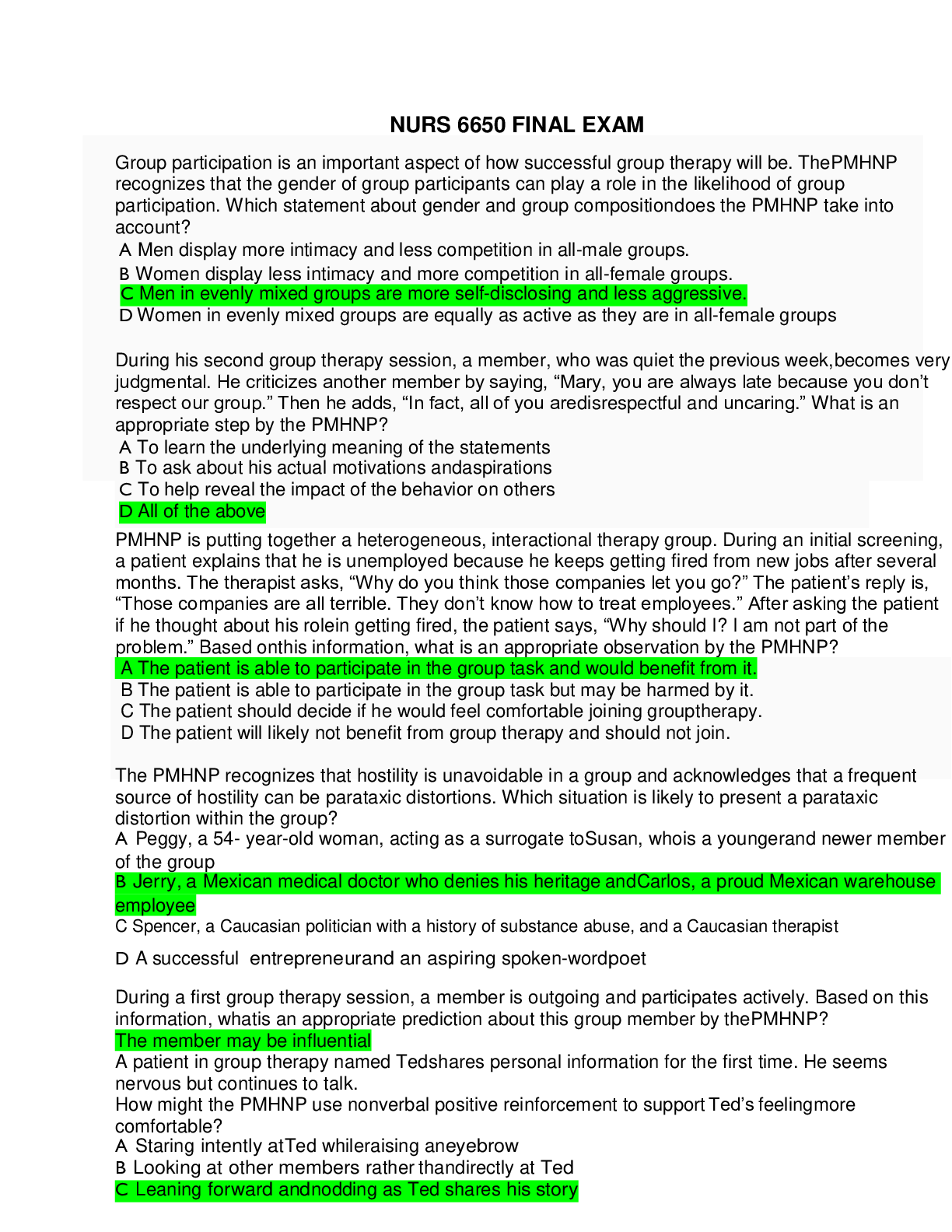
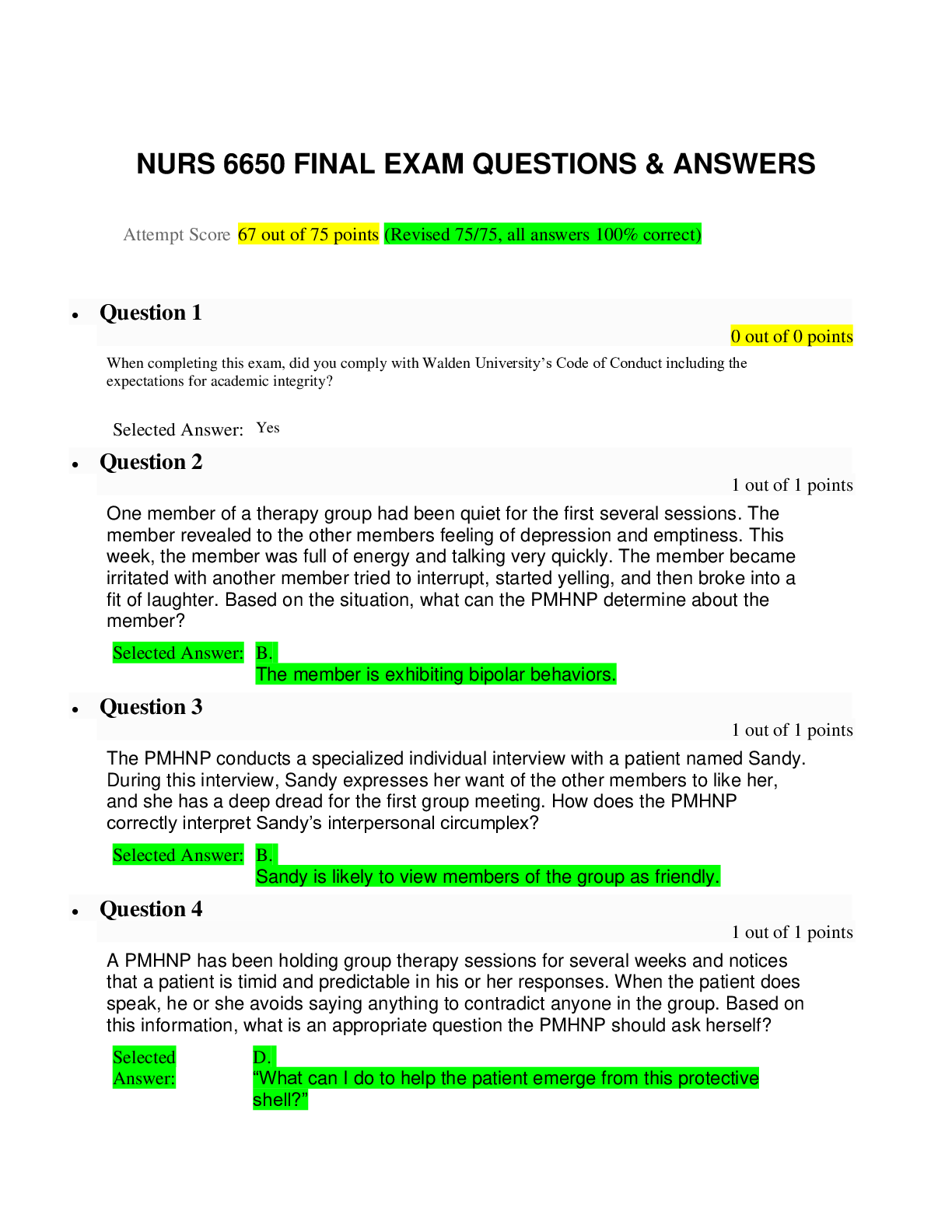
NURS 6650 FINAL EXAM
Group participation is an important aspect of how successful group therapy will be. The PMHNP recognizes that the gender of group participants can play a role in the likelihood of group participatio
...
NURS 6650 FINAL EXAM
Group participation is an important aspect of how successful group therapy will be. The PMHNP recognizes that the gender of group participants can play a role in the likelihood of group participation. Which statement about gender and group composition does the PMHNP take into account?
During his second group therapy session, a member, who was quiet the previous week, becomes very judgmental. He criticizes another member by saying, “Mary, you are always late because you don’t respect our group.” Then he adds, “In fact, all of you are disrespectful and uncaring.” What is an appropriate step by the PMHNP?
PMHNP is putting together a heterogeneous, interactional therapy group. During an initial screening, a patient explains that he is unemployed because he keeps getting fired from new jobs after several months. The therapist asks, “Why do you think those companies let you go?” The patient’s reply is, “Those companies are all terrible. They don’t know how to treat employees.” After asking the patient if he thought about his role in getting fired, the patient says, “Why should I? I am not part of the problem.” Based on this information, what is an appropriate observation by the PMHNP?
A The patient is able to participate in the group task and would benefit from it.
B The patient is able to participate in the group task but may be harmed by it.
C The patient should decide if he would feel comfortable joining group therapy.
D The patient will likely not benefit from group therapy and should not join.
The PMHNP recognizes that hostility is unavoidable in a group and acknowledges that a frequent source of hostility can be parataxic distortions. Which situation is likely to present a parataxic distortion within the group?
A Peggy, a 54- year-old woman, acting as a surrogate to Susan, who is a younger and newer member of the group
B Jerry, a Mexican medical doctor who denies his heritage and Carlos, a proud Mexican warehouse employee
C Spencer, a Caucasian politician with a history of substance abuse, and a Caucasian therapist
D A successful entrepreneur and an aspiring spoken-word poet
During a first group therapy session, a member is outgoing and participates actively. Based on this information, what is an appropriate prediction about this group member by the PMHNP?
The member may be influential
A patient in group therapy named Ted shares personal information for the first time. He seems nervous but continues to talk.
How might the PMHNP use nonverbal positive reinforcement to support Ted’s feeling more comfortable?
A Staring intently at Ted while raising an eyebrow
B Looking at other members rather than directly at Ted
C Leaning forward and nodding as Ted shares his story
D Ignoring any members who are not listening to Ted
A PMHNP is treating a 7-year-old child exhibiting signs of aggression and attention problems. Before suggesting an intervention using a common elements approach, what may the PMHNP consider?
During an initial screening session, the PMHNP is considering a patient for group
therapy. The patient is recently divorced and says he is lonely and depressed. What is the best referral by the PMHNP?
A client is observed discussing many problems and complaints during group therapy. However, when other group members attempt to offer advice, the client does not accept it. Based on this observation, what can the PMHNP determine about the client?
In a group therapy session for patients with anxiety problems, a patient named Eve was
afraid to disclose to the other members that she was a victim of sexual abuse. She kept the secret for months, although she hinted at it to other members. During a meeting, another member tried to pressure Eve to disclose her secret, but she was flustered and not ready to share. What is an appropriate response by the PMHNP?
During an initial meeting, a patient who has been discussing suicide says to the
PMHNP, “I’m so depressed that I don’t want to leave my house. All I want to do is stay in bed.” What type of therapy would the PMHNP most likely recommend to this patient?
. Following the PMHNP’s cancellation of a group session, he or she notices a decrease in compliance and attendance within the group. What does the PMHNP identify as the group’s reason for noncompliance?
The PMHNP understands that conflicts within the psychotherapy group can be
troublesome for clients and have the potential to reduce the effectiveness of the group process. As it pertains to group meetings, the PMHNP understands which statement to be true about conflict?
Conflict exists when there is a lack of mutual respect.
To eliminate conflict, it must be recognized and addressed immediately.
Conflict within the group indicates a lack of growth amongst the group members.
Conflict exists in every group and is expected to reoccur throughout the group meetings.
A patient in group therapy discloses her concern about feeling suicidal again in the future. Using the principle of universality, what is an appropriate step by the PMHNP?
A Encourage other members who have similar concerns to share their feelings
B Tell the patient to believe that she will continue to make progress in the future
C Explain to the patient the mental health benefits of group therapy
D Have the patient work to correctively relive early familial conflicts
According to Dr. Carlson, since Adler talked about how the social setting in which we live influences our lives, the best way parents can change their children’s behavior is to change:
A What is happening in the home environment.
B The discipline techniques used at home.
C The expectations for the child at home and school.
D How extended family members behave toward the children.
In the parent consultation session, the parent discusses her son “Blake” who has
changed since his 13th birthday. Dr. Carlson discusses the power conflict that the parent appears to be getting into with her son. When they discuss approaches they can use to help Blake experience increased responsibility, Dr. Carlson explains that the parent must make a commitment with her son by agreeing to:
The anticipation of the first meeting among psychotherapy group attendees may cause
feelings of dread and uneasiness among clients. How does the PMHNP demonstrate awareness and promote the success of this first psychotherapy meeting?
The PMHNP is meeting with a married couple. The husband is 81 years old, and the
wife is 78 years old. They tell the PMHNP that many of their friends have passed away over the last couple of years, and it’s making them feel sentimental about their lives and the fact that they are getting older. Hearing this, the PMHNP uses a life review approach with the couple. What action will the PMHNP employ?
Peter, a successful businessman, is introduced to the group during the twelfth week.
Following Peter’s introduction, Joseph, a long-term member in the group, begins to lead the group and discuss all of the things that he has personally accomplished. In what way does the PMHNP correctly interpret Joseph’s behavior?
Question 24
A “How would you
A How would you compare today’s meeting with last week’s?”
B “Can you see that today’s meeting was not that productive?”
C “I wonder why everyone was so reluctant to work hard today.”
D “Next week, we will try to have a more intensive interaction.”
Question 25
A Direct advice
B Imitative behavior
C Installation of hope
D Altruism
A “We are trying to reduce some of the symptoms your father experiences.”
B “We are trying to teach your father about skills for daily living.”
C “We are trying to cure your father so that he does not have depression.”
D None of the above.
.
Question 27
A Silent members can progress as much as others in the group if they are able to process vicariously through other members in the group.
B Silent members are silent because they have attended group therapy before and most likely have lost trust in self-disclosure to others.
C Silent members have learned to observe the behaviors of others; this allows them to make effective contributions and promote growth within the group.
D Silent members usually will hinder the group while hindering their own growth within the group.
Question 28
A “We will come up with a treatment plan that takes into account your goals and preferences.”
B “I have a treatment plan that has worked successfully for children going through divorce.”
C “Because Malik is depressed, I think we might want to try to see if medication works.”
D “Tell me your treatment ideas, and that will be the plan we use to reach your goals.”
Question 29
A Cognitive behavioral therapy
B Complementary and alternative therapies
C Reminiscence and life review therapy
D Interpersonal psychotherapy
.
Question 30
A Extragroup therapy should be addressed before it occurs, to prevent it.
B Extragroup behavior that is discussed in group therapy can encourage group resistance.
C Extragroup behavior discussed in group therapy can be therapeutic.
D Extragroup behavior can occur in all levels of group therapy.
Question 31
A To help individuals see how unique they are and how they “personalize” themselves through unique variations of their name.
B To help groups members stay connected to one another while remaining their own unique people.
C To help members see how connected they are to their parents by understanding how their names came about.
D To provide at least one explanation for one of the things members would like to achieve in group.
Question 32
A The client is using the ego defense mechanism of “projection,” which must be addressed to get to the root of the problem.
B The client may benefit from individual therapy, because he or she is shy and this could hinder group therapy.
C The client is aware of his or her current issue and will do very well in group therapy.
D The client suffers from boredom, which is a serious condition that must be addressed and treated.
Question 33
A 14-year-old girl named Laura and her parents are meeting with a PMHNP. The parents explain why they are there by saying, “Laura has been unhappy since she moved to a new school. She has been moody and often talks back to us.” Laura sits quietly and looks uncomfortable. Which is the best response by the PMHNP?
A “Can you elaborate on why Laura is unhappy at her new school?”
B “Please step out for a moment, Laura, so I can talk to your parents.”
C “Laura, can you explain from your perspective why you are here?”
D “If Laura is uncomfortable being here, it’s OK if she doesn’t join in today
Question 34
A Gregory is not yet in a stage where he is able to cope with disappointment, so the PMHNP had to retract her statement and will revisit the situation at a later time.
B The PMHNP wants Gregory to think about why he fears the thought of silence, and she encourages him to talk more to the people who have prompted that fear.
C Though Gregory talks a lot, his conversation is rarely meaningful. The PMHNP encourages Gregory to talk for more than the purpose of entertainment and/or attention.
D Though Gregory talks a lot, his conversation is rarely meaningful. The PMHNP encourages Gregory to talk for more than the purpose of entertainment and/or attention.
Question 36
B “You are doing a great job at explaining how you feel.”
C “I will do my best to help you so you feel better.”
D All of the above
.
Question 37
A “Don’t forget about the progress you made last week by joining a yoga class.”
B “We just heard from another member about his improvement from being in the group.”
C “Remember the power of positive expectations to help you deal with your goals.”
D All of the above
.
Question 38
A Wait for a new member to join before holding the next session
B Suggest the remaining members switch to individual therapy
C Allow group cohesiveness to naturally evolve on its own
D Explore the problems the group is having with cohesion
.
Question 39
A “I am sorry to hear you feel overwhelmed, and I have several suggestions that you might find helpful.”
B “Let’s ask the group what they think. Does anyone have feedback about this situation?”
C “Before I give recommendations, please explain why turning down the project might make you seem incompetent.”
D All of the above
Question 40
During a group therapy session, a member comments that another member named Ted had no compassion. Ted replies, “Why does it matter if I care one way or another. I can’t solve their problems.” The other member starts crying and blames Ted for this. He shrugs and answers, “I don’t understand why you are crying.” Based on this information, what is the most likely determination the PMHNP can make about Ted?
A He is a help-rejecting complainer.
B He suffers from depression.
C He is protecting himself from group behaviors/emotions.
D He has borderline personality disorder.
Question 41
A “How can I help the other members tolerate this patient?”
B “Are other group members also bored by this patient?”
C “How can I inspire this patient to become lively and spontaneous?”
D “What can I do to help the patient emerge from this protective shell?”
Question 42
A The PMHNP has a 5-year-old daughter, and the client is a convicted pedophile.
B The PMHNP has been employed in this field for less than a year.
C The PMHNP had to cancel a meeting two months ago.
D The PMHNP monitors what is disclosed to ensure that too much is not disclosed.
Question 43
Jane has been
A Jane is depressed and could benefit from individual therapy.
B Jane is being rebellious, because she no longer needs help from the group.
C Jane is showing signs of independence, because she will no longer be attending group soon.
D Jane is showing signs of regression due to the termination phase.
Question 44
A Recommend the patient join the PMHNP’s therapy group for anxiety disorders
B Suggest the patient see the PMHNP for individual therapy before group therapy
C Refer the patient to another therapist who has a suitable therapy group
D Ask another therapist for impartial advice regarding treating the patient
Question 45
A Helping the patient and children understand the skills for daily living
B Educating the patient and children about how to maintain a meaningful
relationship
C Teaching the patient and children concrete suggestions for managing anxiety related to dementia
D A and B
Question 46
A Assign homework to have the patient work on improving interpersonal
communication
B Translate depression into interpersonal issues, and then treat the underlying
issues
C Focus and treat the patient’s depression before examining interpersonal
relationships
D All of the above
. A patient has had a problem with substance use and has been receiving treatment for addiction. Which additional step might the PMHMP suggest to help the patient maintain abstinence from drugs during and after treatment?
Question 48
Members of a therapy group have been meeting for several months. During group therapy, a patient is bossy and controlling. During this week’s session, she is confronted by another group member about her behavior and replies, “This is not how I normally act. You are not my family and friends. I don’t act the same way around them.” What can the PMHNP deduce from her behavior?
A She is only bossy and controlling with the group.
B She is displaying her true interpersonal behavior.
C Her mother or father is bossy and controlling.
D She is actually shy and meek outside of the group.
Question 49
A narcissistic patient was unhappy that other members did not seem concerned about his or her dating problems, which the patient spent half the session talking about. The patient confronted the group by saying, “All of you are rude and uncaring!” When group members ignored this comment, the patient said, “And no one said anything nice about my new haircut either!” What is an appropriate response by the PMHNP?
A Assuring the patient that the group is concerned and complimenting the haircut
B Encouraging other group members to tell the patient how this behavior makes them feel
C Asking members to spend the rest of the session helping the patient with his or her problems
D Allowing group members to continue to ignore the patient’s rant, because it is inappropriate
Question 50
A Use group pressure by not beginning the meeting until the client arrives
B Explain to the client that he or she has been referred to individual therapy
C Allow members to express how the client’s interruptions interfere with group progress
D Encourage the client to take a break from group therapy to get his or her affairs inorder
[Show More]














.png)