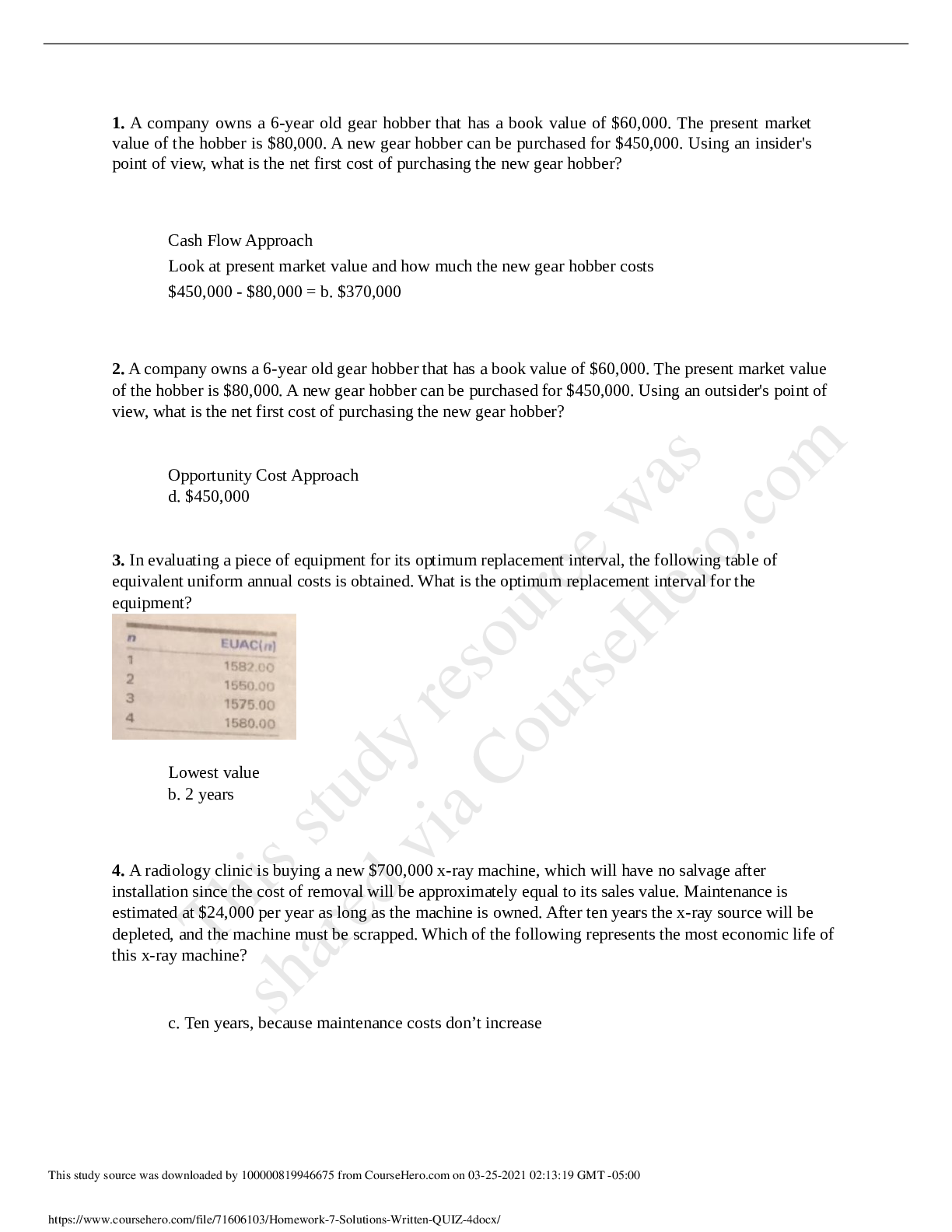
1. A company owns a 6-year old gear hobber that has a book value of $60,000. The present market
value of the hobber is $80,000. A new gear hobber can be purchased for $450,000. Using an insider's
point of view, what is
...
1. A company owns a 6-year old gear hobber that has a book value of $60,000. The present market
value of the hobber is $80,000. A new gear hobber can be purchased for $450,000. Using an insider's
point of view, what is the net first cost of purchasing the new gear hobber?
2. A company owns a 6-year old gear hobber that has a book value of $60,000. The present market value
of the hobber is $80,000. A new gear hobber can be purchased for $450,000. Using an outsider's point of
view, what is the net first cost of purchasing the new gear hobber?
3. In evaluating a piece of equipment for its optimum replacement interval, the following table of
equivalent uniform annual costs is obtained. What is the optimum replacement interval for the
equipment?
4. A radiology clinic is buying a new $700,000 x-ray machine, which will have no salvage after
installation since the cost of removal will be approximately equal to its sales value. Maintenance is
estimated at $24,000 per year as long as the machine is owned. After ten years the x-ray source will be
depleted, and the machine must be scrapped. Which of the following represents the most economic life of
this x-ray machine?
5. Which of the following is not an approach to replacement analysis?
7. A company owns a 5-year old turret lathe that has a book value of $20,000. The present market value of
the lathe is $16,000. A new turret lathe can be purchased for $45,000. Using a before tax analysis and an
outsider's point of view, what is the first cost of keeping the old lathe?
8. A company owns a 5-year old turret lathe that has a book value of $20,000. The present market value
of the lathe is $16,000. A new turret lathe can be purchased for $45,000. Using a before tax analysis and
an insider's point of view, what is the first cost of the new lathe?
9. What two cost categories form the trade off that leads to an optimum replacement interval?
9. Allen Construction purchased a crane 6 years ago for $130,000. They need a crane of this capacity for
the next five years. Normal operation costs $35,000 per year. The current crane will have no salvage value
at the end of 5 more years. Allen can trade in the current crane for its market value of $40,000 toward the
purchase of a new one that costs $150,000. The new crane will cost only $8,000 per year under normal
operating conditions and will have a salvage value of $55,000 after 5 years. If MARR is 20%, determine
which option is preferred.
Make a Table
a. Use the cash flow approach (insider’s viewpoint approach)
b. Use the opportunity cost approach (outsider’s viewpoint approach)
Keep:
11. Five years ago, a multi-axis NC machine was purchased for the express purpose of machining large,
complex parts used in commercial and military aircraft worldwide. It cost $350,000, had an estimated life
of 15 years, O&M costs of $50,000 per year. It was originally thought to have a salvage value of $20,000
at the end of 15 years, but is now believed to have a remaining life of 5 years with no salvage value at that
time. With business booming, the existing machine is no longer sufficient to meet production needs. It can
be kept and supplemented by purchasing a new smaller Machine S for $210,000 that will cost $37,000 per
year for O&M, have a life of 10 years, and a salvage value of $210,000(0.8^t) after t years. As an
alternative, a larger, faster, and more capable Machine L can be used alone to replace the current machine.
It has a cash price without trade-in of $450,000, O&M costs of $74,000 per year, a salvage value of
$450,000(0.8^t) after t years, and a 15 year life. The present machine can be sold on the open market for a
maximum of $70,000. MARR is 20% and the planning horizon is 5 years.
Only pay attention to t = 5 years okay especially on salvage value equations
a. Clearly show the cash flow profile for each alternative using a cash flow approach
b. Using an EUAC and a cash flow approach, decide which is the more favorable alternative.
Machine S:
c. Clearly show the cash flow profile for each alternative using an opportunity cost approach
d. Using an EUAC comparison and an opportunity cost approach, decide which is the more favorable
alternative.
[Show More]