By definition eukaryotic cells are required to have membrane enclosed compartments and thus are not just
enclosed by a membrane within the plasma membrane and also use their organelles to confine the
chemical reactions
...
By definition eukaryotic cells are required to have membrane enclosed compartments and thus are not just
enclosed by a membrane within the plasma membrane and also use their organelles to confine the
chemical reactions that it must undergo into separate compartments.
By enclosing the biochemical reactions necessary to survive and grow within compartments and
organelles the cell protects the biochemical products from essentially being produced in close
proximity to where they would also be broken apart saving
energy for the cell.
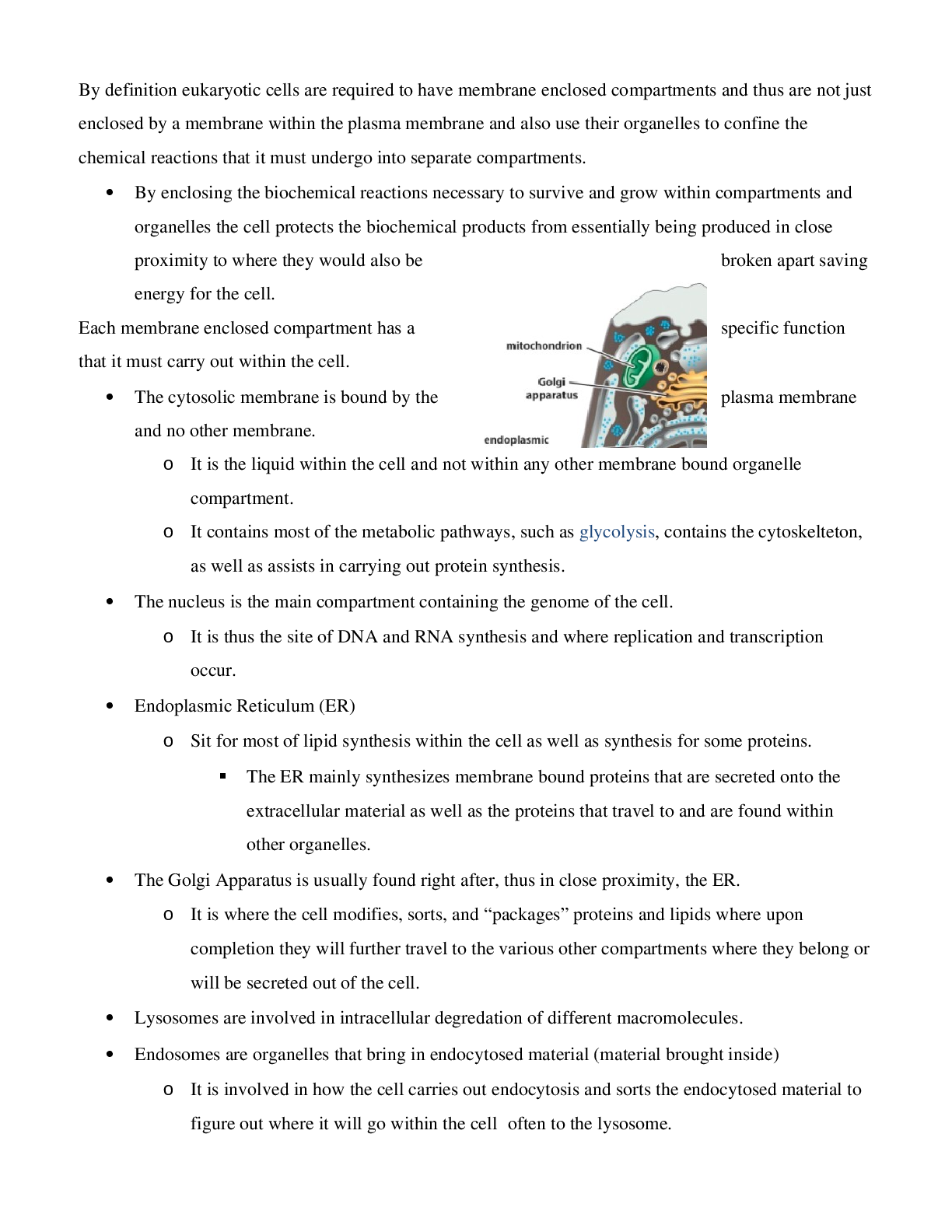
Each membrane enclosed compartment has a specific function
that it must carry out within the cell.
The cytosolic membrane is bound by the plasma membrane
and no other membrane.
o It is the liquid within the cell and not within any other membrane bound organelle
compartment.
o It contains most of the metabolic pathways, such as glycolysis, contains the cytoskelteton,
as well as assists in carrying out protein synthesis.
The nucleus is the main compartment containing the genome of the cell.
o It is thus the site of DNA and RNA synthesis and where replication and transcription
occur.
Endoplasmic Reticulum (ER)
o Sit for most of lipid synthesis within the cell as well as synthesis for some proteins.
The ER mainly synthesizes membrane bound proteins that are secreted onto the
extracellular material as well as the proteins that travel to and are found within
other organelles.
The Golgi Apparatus is usually found right after, thus in close proximity, the ER.
o It is where the cell modifies, sorts, and “packages” proteins and lipids where upon
completion they will further travel to the various other compartments where they belong or
will be secreted out of the cell.
[Show More]