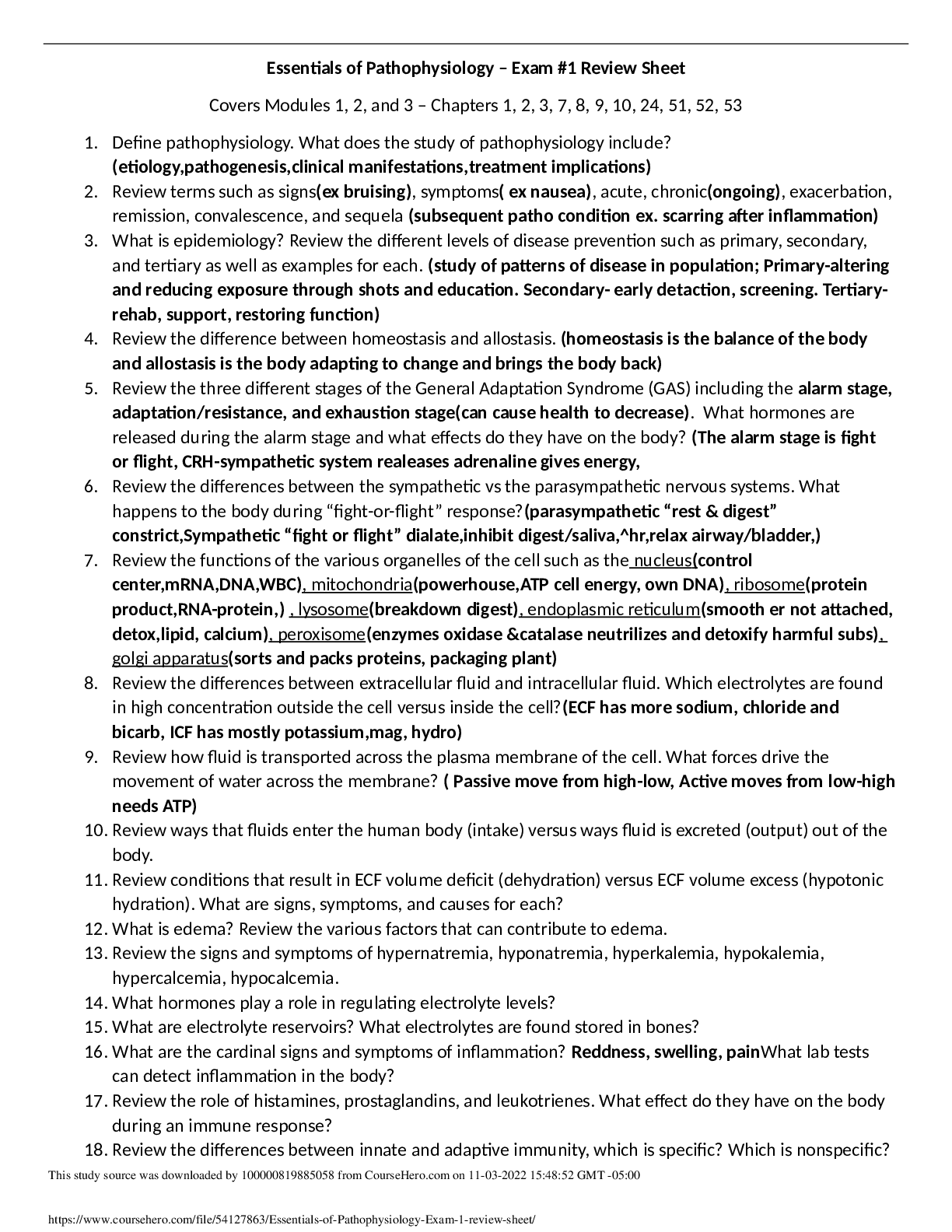
Essentials of Pathophysiology – Exam #1 Review Sheet
Covers Modules 1, 2, and 3 – Chapters 1, 2, 3, 7, 8, 9, 10, 24, 51, 52, 53
1. Define pathophysiology. What does the study of pathophysiology include?
PATHOPHYSIOL
...
Essentials of Pathophysiology – Exam #1 Review Sheet
Covers Modules 1, 2, and 3 – Chapters 1, 2, 3, 7, 8, 9, 10, 24, 51, 52, 53
1. Define pathophysiology. What does the study of pathophysiology include?
PATHOPHYSIOLOGY: The study of all the abnormalities in physiologic
function of living beings.
o Derives from 2 disciplines:
Patho meaning Dx of diseases through exam of organs, tissues, and cells.
Physiology meaning Mechanical, physical, and biochemical functions.
o There are FOUR parts of pathophysiology:
1- Etiology: causes/reasons of disease. This ID’s causal factors for Dz
2- Pathogenesis: Evolution of Dz from the initial stimulus to ultimate
manifestations of the Dz. (GENESIS = CREATE)
2. Review terms such as signs, symptoms, acute, chronic, exacerbation,
remission, convalescence, and sequela
Signs: objective/observed manifestations
o Ex: rash, change in temperature
Symptoms: Subjective
o Ex: pain, nausea
Acute: short-lived.
Chronic: lasts for months/years
Exacerbation: increase in severity
Remission: decrease in severity
Convalescence: Stage of recovery
Sequela: subsequent pathological condition resulting from an illness
o Ex: renal failure 2/2 HTN
o
3. What is epidemiology? Review the different levels of disease prevention
such as primary, secondary, and tertiary as well as examples for each.
Epidemiology is the study of study and analysis of the distribution, patterns
and determinants of health and conditions in defined populations.
o Primary level: altering susceptibility
a. Ex: Immunizations
o Secondary level” early detections/screenings
a. Ex: Pap smears, breast exams, cancer screenings
o Tertiary level: Rehabilitation (reduce disabilities)
a. Ex: PT/OT after a stroke
Florence Nightingale was the first practicing epidemiologist.
4. Review the difference between homeostasis and allostasis.
Homeostasis: The process by which a state of internal, physiological
equilibrium is maintained.
o Ex: pH, concentration of ions in ECF, glucose levels, osmolality of ECF
Allostasis: Steps the body takes to re-establish homeostasis. Adaptation to
a changing internal and external environment
o Ex: HR, body core temperature, BP
5. Review the three different stages of the General Adaptation Syndrome
(GAS) including the alarm stage, adaptation/resistance, and exhaustion
stage. What hormones are released during the alarm stage and what
effects do they have on the body?
Three stages of GAS:
1: Alarm Stage: Fight/Flight response.
2: Resistance/Adaptation: Activity of nervous/endocrine systems to return
to homeostasis
3: Exhaustion: If stressor is not removed the body cannot return to
homeostasis. The body will go into allostatic overload and organs tissues
give out.
o Ex: renal failure 2/2 HTN
6. Review the differences between the sympathetic vs the parasympathetic
nervous systems. What happens to the body during “fight-or-flight”
response?
Stressor Excites receptors
Hypothalamus relases
CRH + ACH
This activates the SNS
Providing a surge of energy
Adrenal Medulla releases
catecholamines
(epinepherine and
Norepinepherine)
Increased cardiac output, increased
respirations, enhanced blood coag.
increased BP, dialated pupils,
increadd BG (energy), GI/GU
supressed.
Adrenal Medulla releases
cortisol due to ACTH. Corticosteroids stabilize vascular
reactivitiy, inhibit glucose uptake,
suppress protein sysnthesis
*inhibit release of CRH+ACH fron
the hypothalamus
7. Review the functions of the various organelles of the cell such as the
nucleus, mitochondria, ribosome, lysosome, endoplasmic reticulum,
peroxisome, golgi apparatus
Nucleus
Control center or “brain” of the cell
DNA and genes stored here
Production of messenger RNA
Contains the instructions needed to build nearly all the body’s proteins
Most cells contain only one nucleus
Some cells like liver and skeletal muscle cells contain more
Red blood cells contain no nucleus
Mitochondria - “Power house” of the cell
Provide energy to the cell in the form of ATP
More metabolically active cells have more mitochondria
Mitochondria are enclosed by two membranes
Outer membrane
Inner membrane has folds called cristae
Mitochondria are a unique organelle because they contain their own set of
DNA
Ribosomes
Site of protein production - RNA produced in nucleus sent to ribosomes
RNA Protein = Translation
Found either floating in the cytoplasm (free) or attached to the endoplasmic
reticulum (bound)
Endoplasmic Reticulum (ER)
Series of folded membranes that move proteins around the cell
Continuous with nuclear membrane of nucleus
Rough ER – ribosomes attached to ER
Site of protein synthesis
Production of integral proteins and phospholipids found in cellular
membranes
Smooth ER – ribosomes not attached to smooth ER
Functions include:
Detoxification
Lipid metabolism
Synthesis of hormones
Calcium storage
Golgi Bodies (Golgi Apparatus)
Organelle made up of stacked, flattened membranes
Sorts and packages proteins produced in ER
Protein “packaging plant” – cell post office
Move materials within cell and out of the cell
Lysosomes
Lysosomes are spherical membranous organelles containing digestive
enzymes
Lysis = breakdown
Digests particles taken in by endocytosis
Including bacteria, viruses, and toxins
Degrades worn-out or nonfunctional organelles and tissues
Peroxisomes
membranous sacs containing a variety of powerful enzymes such as oxidase
and catalase
Oxidases use molecular oxygen (O2) to detoxify harmful substances such as
alcohol and f formaldehyde
Neutralize dangerous free radicals into hydrogen peroxide (H2O2)
Free radicals - highly reactive chemicals with unpaired electrons that
can damage biological molecules
Catalase breaks down hydrogen peroxide (H2O2) into H2O and O2
Numerous peroxisomes found in liver and kidney cells
[Show More]